Archive for September, 2007

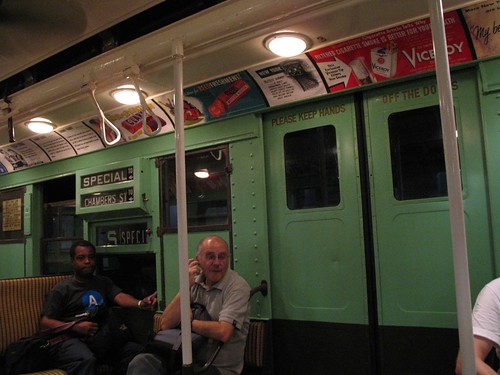
Fade in on a nearly-empty subway station. It’s 2:30 a.m., and you’re stuck at the 2nd Ave. subway stop waiting for an F train that never shows up. Mostly drunk and dead tired, you just want to sit there quietly until the train rolls up to shuttle you back to Brooklyn.

But the air is pierced by an all-too-familiar sound. It’s that blasted Nokia ringtone you’ve come to know and despise. As the loud, obnoxious cell phone user proceeds to shout the amazing details of how a friend just puked all over the bathroom at d.b.a, you can’t help but think about how you wish the MTA had simply kept the subways cell-phone free.

Now, I know what you, reading this on Sept. 20, 2007, are thinking: What a far-fetched scene. The MTA hasn’t been able to get its act together in well over two years of talking about subway cell service. What makes me think they can do it now?
Read More→

Comments (22)

Subway buffs enjoy a ride on a Nostalgia Train. The Comptroller hates these. (Courtesy of flickr user bifteck)

With Second Ave. Sagas firmly entrenched — or is that floating underwater? — during old subway car day, let’s venture over to the economics of maintaining the rolling stock of yore. Old train rides, according to the New York State Comptroller, aren’t economically-efficient. Oh, the horrors.

The tireless Sewell Chan at The Times’ Cityroom blog reported last week on a New York State audit’s findings that the NYCT nostalgia train rides are a losing proposition for the MTA (Audit in PDF form here). But it’s not nearly as cut-and-dry as it sounds. Take it away, Sewell:

A new audit by the office of State Comptroller Thomas P. DiNapoli has found that the M.T.A. did not adequately keep track of the money raised from the Nostalgia Train trips. Furthermore, the audit found that New York City Transit, the largest arm of the M.T.A., had to pay to restore and maintain the vintage train cars, but did not, in turn, benefit from the money raised from the train excursions. In other words, subway riders and taxpayers have been subsidizing the history-evoking train rides…

The Nostalgia Train program earned revenue of $23,035 in 2004 and $12,110 in 2005, according to the audit, but the cost of the crews to run those trains was $31,566 in 2004 and $20,576 in 2005 — so the program operated at a net loss.

Now, I know the MTA is rather strapped for cash right now. But as one comment on Cityroom aptly noted, how much do you think the audit costs?

As much as I prode the MTA over its financial mishaps (student Metrocards anyone?), I will staunchly defend these nostalgia-laden train rides. And for its part, the MTA does an apt job defending itself. Chan notes:

The M.T.A. responded to the audit with several points. It argued that the maintenance and repair costs associated with the Nostalgia Train excursions are “immaterial” when compared with the overall cost of maintaining the entire subway car fleet. It also noted that the Transit Museum is run for historical and educational purposes and is not expected to turn a profit.

In reality, we’re talking about a deficit of $8,000. Considering that the MTA’s financial problems could run into the hundres of millions, arguing over less than $10,000 of money put toward an educational and historical purpose seems petty. The Comptroller’s office should stick to big picture items such as the looming fare hike.

To be fair, the MTA should work on its accounting practices. What it implements at the micro level with the Transit Museum could serve as a model for the finances of the Authority and NYCT on the whole. But let’s not unnecessarily rain on the parades of those who enjoy these train rides. As Tom on Cityroom said, “Of the billions that the MTA spends, this was the biggest budgetary scandal you could find? Twenty grand is a rounding error in an agency this size. If it was used to renovate the director’s bathroom that would be a different story, but these trips clearly have value as a service to the many people interested in the city’s history.”

Comments (2)

They don’t go heaven where the angels fly. (Photo courtesy of NYCSubway.org)

Welcome to Old Subway Car Day at Second Ave. Sagas. I’ve got two stories lined up today about our old subway cars and where the rolling stock ends up after its reached the figurative end of the line.

Let’s start down the coast a little bit in New Jersey. Or more accurately, let’s start off the coast of New Jersey, in the world’s largest artificial reef. That’s right; the waters off the coast of the Garden State feature the world’s largest artificial, and it’s made of old subway cars. For more on that fascinating story, check out this National Geographic missive from 2006, featuring some excellent photos.

For a while, New Jersey had stopped accepting old subway cars for its artificial reef over asbestos concerns. But, as The Press of Atlantic City reports, the state’s top environmental official has given the go-ahead to add 600 new old subway cars to the reef. The article — aptly and hilariously headlined “NYC subway cars may sleep with the fishes” — talks about the approval process and more:

They won’t hurt the marine environment, but they will attract black sea bass, tautog, cunner and other fish for anglers to catch. That’s why New Jersey’s top environmental official has given enthusiastic approval to taking 600 subway cars from New York City for the state’s artificial reef program.

“Both New Jersey’s fishing and sport-diving communities would directly benefit from the addition of the stainless steel subway cars on the artificial reef network,” concluded Commissioner Lisa P. Jackson of the state Department of Environmental Protection.

Jackson recently completed a scientific review of whether asbestos in the subway cars would pose any risk to marine life. She determined exposure to marine life from the asbestos fibers would be minimal.

The story goes more in depth into the structural state of subway cars buried under water for the last 14 years. These cars are 67 percent in tact and have not substantially shifted. They are, in other words, perfectly suited to serve as artificial reefs, and the stainless steel cars heading New Jersey’s way are expected to last longer than the ones currently under water.

Meanwhile, New Jersey will have to amend itss reef management plan and the federal Army Corps permit to make provisions for subway cars under the artificial reef guidelines. Oh, the joys of bureaucracy.

So these subway cars will live on under the water. For decades they shuttle people, packed like sardines in a can, around New York City. Now, the sardines, or at least their acquatic counsins, will get to enjoy the subway cars as an artificial reef environment. How apt.

For some excellent pictures of the Redbird reef currently resting deep under the Atlantic Ocean, check out this photo set on NYCSubway.org. And come back at 1:30 p.m. for the second Old Subway Car story. It’s all about the economics of old subway cars.

Categories : MTA Absurdity
Comments (5)

For the last few months, we’ve heard a litany of calls from politicians urging the MTA to hold off, or outright reject, the upcoming fare hike. The folks who hold the purse strings — the New York State Comptroller and the New York City Comptroller — got in on the act as well. Now, a supergroup of advocates has called on the MTA to hold off on implementing the hike until the middle of 2008.

These advocates, led of course by the ever-present Gene Russianoff, have released a letter written to MTA CEO Elliot “Lee” Sander, urging him to wait until at least March 31, 2008, to proceed with the fare hike. The letter, available here as a PDF, lays out a compelling case for the delay. Take a look:

As civic groups concerned with decent transit, we write to urge that if the MTA does adopt a fare increase for 2008, no final action be taken before March 31, 2008, at the earliest …

Right now, the MTA plan calls for a decision on fares in December 2007, to go into effect in “early 2008.” But we urge that no final action on the fare should happen before March 31, 2008. That’s because two other key actions take effect on that date.

First, this is the date by which the state legislature and New York City Council have to decide on the recommendations of the traffic congestion mitigation commission recently created by the state legislature. The commission will be considering Mayor Bloomberg’s congestion pricing proposal, which would include new transit funding.

Second, on that same day, the MTA is required to submit its five-year, multi-billion dollar capital rebuilding plan, giving the public its detailed program for what repairs will be slated between 2008 and 2013. Our groups feel strongly that the whole range of transit funding — from operations to capital needs — should be considered as a whole, rather than piecemeal.

This is a rock-solid rebuttal to what is beginning to look more and more like an unnecessary-for-now fare hike. Of course, the MTA is pushing back. In an article in today’s Daily News, Jeremy Soffin, MTA spokesman, spoke on the need for financial relief sooner rather than later. “Our financial plan puts the MTA back on sound financial footing while actually increasing service for our ridership,” he said. “Delaying its implementation will only lead to larger fare increases and unacceptable service cuts.”

But if the city and state come through on the congestion pricing issue, won’t the MTA stand to benefit more by delaying the fare hike until every piece of the financial puzzle can be completed? I think so; Gene Russianoff thinks so; now we just have to hope the MTA thinks so too.

Comments (2)

The Coney Island/Stillwell Ave. terminal uses solar panels on the roof as an alternative source of energy. (Photo courtesy of Wikipedia.)

Earlier this week, the MTA joined the growing chorus of environmentally minded political and corporate entities when it launched its very own sustainability initiative. By now, the details of the initiative and the members of the Sustainability Commission have proliferated throughout the regular news sources: Cityroom, Gothamist, New York 1.

On its surface, a green MTA represents a very smart political move in an era when our society is finally focusing on the environmental dangers we will be facing in the very near future. But there’s more to this announcement than meets the eye. More on that in a minute.

First, what’s the MTA doing? Take it away, press release:

The Sustainability Commission will develop a master set of recommendations that will help reduce the ecological footprint of MTA operations and capital programs and minimize the impact of the MTA on ecosystems in the MTA region and Northeast Corridor. The commission will cast a wide net, looking at everything from energy use and waste management to transit-oriented development and green, high-performance buildings.

Part of the commission’s mission will be to identify sustainability initiatives that have both environmental benefits and financial benefits. These financial benefits can take a number of forms, including cost savings from the use of new technologies or revenue from an agency’s green venture.

Among your typical “How can we reduce our carbon footprint?” questions, the MTA will tackle is this interesting one: What role can the MTA play in promoting smart-growth strategies and transit-oriented development? Of course, MTA CEO Elliot “Lee” Sander extolled the virtue of this very worthwhile program. “This is a unique moment both globally and here in New York, with more and more people focused on sustainability and living greener lives,” Sander said. “As we advocate for a sustainable future based on increased transit usage, the MTA is doing its part to make sure our transportation network operates as sustainably as possible.”

But while cleaner-fuel buses, energy-efficient stations like the Coney Island terminal pictured above, and the use of wind power in some facilities are all well and great, the MTA is already doing more than we realize for the environment in New York City. The MTA, by virtue of its public transportation mission, is already a very green organization.

New York City Transit shuttles around millions of people every day. These millions could just as well clog up the air with exhaust for their cars if they chose to forgo commuter rail, buses or subways in exchange for the singularly American experience of driving in 38 hours of traffic per year. Without the myriad buses and subways, New York City would be a cesspool of pollution, and the best example of a dystopian New York City can be found in the smog of Los Angeles.

I certainly will applaud the MTA for taking a green initiative. Clean-air buses, like those in, for example, San Francisco, more subway service, green bus rooftops: These would all serve to make our city environmentally more healthy, and I look forward to reading the Commission’s recommendations come Earth Day 2008. But we shouldn’t lose sight of the fact that the MTA is already green. So keep riding those subways. The city’s air and your lungs will thank you later on.

Categories : MTA Politics
Comments (8)

I always thought everyone supported the F Express Plan. Who wouldn’t want more train service and express train options for underserved and overcrowded parts of Brooklyn? It seemed like a no-brainer to me. Boy, was I naïve in this thinking.
Last week, Gersh Kuntzman’s Brooklyn weekly The Brooklyn Paper ran a scathing (and, in my opinion, very short-sighted) editorial entitled “Who needs an F express?” As you may have guessed from the non-too-subtle title, Kuntzman, supposedly a champion of Brooklyn, isn’t in favor of this added train service on tracks that have existed since these subway lines opened in the 1930s.

In response to this outrageous editorial, I wrote a letter to the editor. The letter, co-signed by the other two major proponents of the F Express Plan, Gary Reilly, the driving force behind the F Express and author of Brooklyn Streets, Carroll Gardens, and Jen from Kensington (Brooklyn), disputes every contention made by The Brooklyn Paper in its editorial. While we hope the letter will appear in an upcoming issue of the paper, here it is in its entirety:

We were dismayed, surprised and saddened by your Sept. 15 editorial entitled “Who needs an F express?” Chock-full of misconceptions, gross oversimplifications and simply wrong information, the editorial provides a disservice to residents of not just Carroll Gardens and Cobble Hill but to all Brooklynites who stand to benefit from express service along the F line and an overall increase of service along the Culver Line.

First among your charges is that due to a supposed bottleneck at York St., “there may not be enough capacity to add trains.” This is an unfounded claim. Elsewhere in the system – the 7 line comes to mind – where express and local tracks feed into one, express service and increased train capacity have led to a lessening of crowded trains. If our greatest concern is one focusing on a scheduling issue past Jay St./Borough Hall, the real location of the bottleneck, then we have nearly won the battle for express service.

Next up is your claim of “simple populism” levied against our local politicians. These politicians are signing on to the research we have conducted that shows our proposal is more than just “simple populism.” As we have stressed over and over again, we don’t need to build new subway tracks to increase service along the Culver Line. The express tracks – the only unused express tracks in the City – were built with the subway line in the 1920s. We don’t need the hard work, vision or money to build new subways; we just need an MTA willing to utilizing underused tracks.

With our plan encompassing V service into Brooklyn past its current Second Ave. terminus and F express service into Kensington and beyond, we fail to see how Brownstone Brooklynites won’t enjoy any benefits. The V will, in our plan, service the current F stops, and the F will service the express stations. Both trains will run frequently, and both will be less crowded.

Overall, it is true that Brooklyn – much like New York City on the whole – needs a bold vision to bring about the next generation of transit enhancements. But we can’t afford to ignore or dismiss the solution right under our noses. Brooklyn needs a restored F express and extended V local, and everyone will benefit from that service.

We like to hope that there’s no such thing as bad publicity. Even if Kuntzman is against the F Express Plan for reasons unknown — or at least, just plain wrong — to us, he’s keeping the issue on the forefront of public discourse in the fair borough of Brooklyn. But I can’t stress enough the F Express Plan as we propose it — with added V service past Second Ave. and the utilization of existing, unused express tracks — would be a boon for an undertaxed neighborhood. The MTA is willing to make it happen when they can; the rest of Brooklyn should cheer this news.

Categories : F Express Plan
Comments (11)

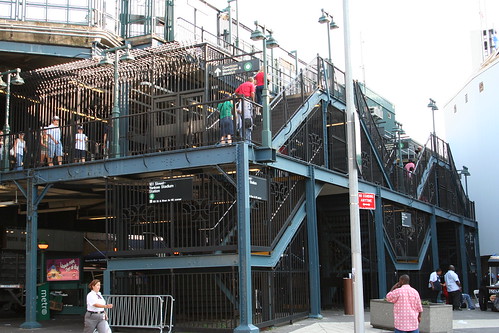
Barriers, bottom left, are used to stop fare jumpers and emergency exiters alike. (Photo courtesy of flickr user The Sean)

Remember when Andy Van Slyke got busted for fare-jumping at Yankee Stadium two weeks ago? Well, the New York City Transit Police’s efforts at catching Yankee Stadium fare jumpers just landed them in some hot water.

The ever-vigilant New York Post noticed that the police barriers in place at Yankee Stadium to stop fare jumpers on the 4 platform were blocking three of the five emergency exits. Rupert Murdoch’s rag would have none of that. Transit Reporter Jeremy Olshan has the story:

At the busy Yankee Stadium No. 4 subway stop, three out of the five emergency exits have been routinely blocked with metal barricades.

Station agents and police assigned to the 161st Street-River Avenue stop said the barriers were put in to deter passengers from using the gates for non-emergency purposes or to beat the fare…Two of the three exits on the mezzanine were barricaded, and one downstairs at the B and D entrance also had a handwritten sign that read: “Please use other exit.”

The MTA employers were as helpful as they usually are. “People are people, they’re going to try to beat the fare,” a station agent said to Olshan. “I don’t know who put up the barricades, but it’s not my job to move them.”

Bronx Borough President Adolfo Carrion expressed the necessary outrage as this bit of MTA absurdity, and supposedly, the barriers have since been moved. While I’ll be able to confirm that tonight, I have to think that the Post may be making a mountain out of a mole hill here. For a few minutes while the cops monitor the turnstiles — always replete with fare-jumpers after baseball games — some of the emergency exits can be blocked.

As long as they’re unblocked in a timely fashion, I’ll take the increased fare monitoring. The ramped-up police presence should secure the rest of us in case of an emergency anyway.

Categories : MTA Absurdity
Comments (4)

img_3665.jpg

A view into the Second Ave. Subway construction staging ground at 2nd Ave. between 92nd and 91st Sts. (Courtesy of the fantastic photoblog The Launch box)

It’s payback time for New York’s senior senator, and the Second Ave. Subway stands to benefit from Chuck Schumer’s handling of the DSCC in 2006.

Once upon a time, on the very first day of Second Ave. Sagas, I wrote about how Schumer’s success during the mid-term elections would lead to subway pork for New York City. Now, the money’s coming home.

On Friday, the United States Senate passed their appropriations bills for the upcoming fiscal year 2008. In that bill coming our way is $125 million earmarked for the Second Ave. Subway. Before we can start counting our money, the bill still has to go through the conference committee session. It’s really just a formality at this point.

Also in the Transportation Appropriations Bill is $200 million for the East Side Access Project. It sure is good to have politicians who can deliver the pork.

The two Senators — Schumer and one Hillary Clinton — issued their typical responses praising the projects. Schumer spoke about the necessity of the projects. Clinton extolled federal investment in these projects. “Now that the ground has been broken and the commitment is real for the Second Ave. subway, this kind of federal investment is critical to helping the city and state keep the project on track,” she said.

While this federal infusion still leaves the MTA a few hundred million dollars short, the federal funds should cover the gap should congestion pricing become a reality. Phase 1 of that Second Ave. Subway is getting closer and closer to reality. Who woulda thunk it?

Comments (1)

No witty comments or pithy observations from me today. Just the Weekend Service Advisory, ma’am.

1

From 12:01 a.m. Saturday, September 15 to 5 a.m. Monday, September 17, there are no 1 trains between 14th Street and South Ferry. Customers may take the 2 or 3 between 14th Street and Chambers Street. There are free shuttle buses operating between Chambers Street and South Ferry. This is due to Port Authority underpinning work at the WTC site for the new PATH station.

2

From 12:01 a.m. Saturday, September 15 to 5 a.m. Monday, September 17, 2 and 3 trains run local between 96th Street and Chambers Street due to Port Authority underpinning work at the WTC site for the new PATH station.

From 6 a.m. Saturday, September 15 to 9 p.m. Sunday, September 16, Manhattan-bound 2 trains run express from East 180th Street to 3rd Avenue due to rail installation south of East 180th Street station.

3

From 6 a.m. to 7:30 a.m., Sunday, September 16, 3 train service is replaced by M7, M102 and shuttle buses between 135th Street and 148th Street due to switch renewal south of 148th Street-Lenox Avenue.

4

At all times through mid-November, Manhattan-bound 4 trains skip Mosholu Parkway due to station rehabilitation.

From 12:01 a.m. Saturday, September 15 to Monday, September 17, no 4 train service at Mosholu Parkway due to station rehabilitation. Free shuttle buses operate between Woodlawn and Bedford Park Blvd.

From 12:01 a.m. Saturday, September 15 to Monday, September 17, Bronx-bound 4 trains run express from 125th Street to Burnside Avenue due to track chip-out north of 149th Street-Grand Concourse.

6

From 4 a.m. Saturday, September 15 to 10 p.m. Sunday, September 16, Bronx-bound 6 trains run express from Hunts Point Avenue to Parkchester due to track panel installation at Whitlock Avenue. (The last stop for some Bronx-bound 6 trains will be 3rd Avenue.)

A

From 12:01 a.m. Saturday, September 15 to Monday, September 17, free shuttle buses and shuttle train service replace the A between Howard Beach-JFK Airport and the Rockaways due to track panel installation south of Howard Beach-JFK Airport station.

E

From 12:30 a.m. Saturday, September 15 to 4:30 a.m. Monday, September 17, Manhattan-bound E trains run express from Roosevelt Avenue to Queens Plaza due to track chip-out south of Queens Plaza station.

From 12:01 a.m. Saturday, September 15 to 5 a.m. Monday, September 17, Manhattan-bound E trains run express from Van Wyck to Roosevelt Avenue due to track conduit work south of Kew Gardens-Union Turnpike station.

F

From 12:01 a.m. Saturday, September 15 to 5 a.m. Monday, September 17, Manhattan-bound F trains run express from Parsons Blvd. to Forest Hills-71st Avenue due to track conduit work south of Kew Gardens-Union Turnpike station.

G

From 8:30 p.m. Friday, September 14 to 5 a.m. Monday, September 17, (and until further notice), there is no G train service between Forest Hills-71st Avenue and Court Square due to track chip-out south of Queens Plaza. Customers should take the E or R.

NR

From 12:01 a.m. Saturday, September 15 to 5 a.m. Monday, September 17, Manhattan-bound NR trains are rerouted over the Manhattan Bridge from DeKalb Avenue to Canal Street due to tunnel rehabilitation south of Prince Street station.

N

From 12:01 a.m. Saturday, September 15 to 5 a.m. Monday, September 17, Manhattan-bound N trains run on the D line from Coney Island-Stillwell Avenue to 36th Street (Brooklyn) due to track panel installation between 86th Street and 59th Street stations.

Q

From 12:30 a.m. Saturday, September 15 to 4:30 a.m. Monday, September 17, there are no Q trains between 57th Street and 42nd Street due to a track chip-out south of Queens Plaza station. Customers may take the N or R instead.

R

From 5 a.m. to midnight Saturday, September 15 and Sunday, September 16, R trains skip 5th Avenue, Lexington Avenue, and Queens Plaza in both directions due to roadbed replacement/chip-out work south of Queens Plaza. For 5th Avenue and Lexington Avenue, customers should transfer to the N at 57th-7th Avenue. For Queens Plaza, customers should take the E.

From 5 a.m. to midnight Saturday, September 15 and Sunday, September 16, Manhattan-bound R trains run express from Forest Hill-71st Avenue to Roosevelt Avenue due to track conduit work south of Kew Gardens-Union Turnpike station.

RW

The Cortlandt Street Station is closed until further notice while the Port Authority of New York and New Jersey continues to build on the WTC site.

Categories : Service Advisories
Comments (1)

transportationgraph.jpg

An excerpt from the New York Metropolitan Transportation Council’s report.

The subways are crowded. This much we know from riding the trains everyday and also from past stories about the MTA’s tooting its own popularity horn.

Today, from a report issued by the New York Metropolitan Transportation Council, we learn that, yup, those subways are indeed still crowded. You don’t say?

According to this grand survey of New York City transportation sources (PDF file here), New York City Transit ridership averaged 4,928,222 people a day during the first quarter of 2007. That figure represents a 3 percent increase over the same quarter in 2006.

More impressive is the March total: 5,096,905. For the first time since the 1950s, as I’ve noted before, ridership has exceeded that 5-million-a-day mark. That means that well over half the population of the city swipes through the subway’s turnstiles each day. While I know that five million New Yorkers are not making one trip each on the subway every day, the numbers are comparable. And not matter how you slice or dice it, that’s a whole lotta people. So if the subways seem crowded, it’s because they are.

To slam home this point with a sledgehammer, the NYMTC reports that 51 percent of New Yorkers using public transportation turn to those lines run by New York City Transit. In other words, the majority of the area’s public transportation trips now take place in the subways.

With these crowded subways, of course, comes a familiar drum beat to those of you who are regular readers around here. The MTA has to find a way to meet the demands of a growing readership. They need to make sure they have enough working train cars to keep up with heavy transit loads. They have to make sure that areas of the city with growing populations are adequately serviced by mass transit.

Now more than ever, this city depends upon the subways to run. Without a functioning and fully funded subway system, this city would see a very real economic downturn. Hopefully, this doomsday scenario won’t come to pass. For now, we should — outside of rush hour, at least — basque in the glow of our popular and efficient subway system.

Click here for a nifty pie chart showing the breakdown of Average Weekday Passengers on NYC’s public transportation options.

Categories : MTA Economics
Comments (7)
  • Extended Stay

    Featuring a wide range of sophisticated furnished apartments throughout the city and surrounding areas, ExecuStay can help you enjoy a New York extended stay that's both productive and relaxing.

  • Corporate Apartments

    As a resident of ExecuStay New York corporate apartments, you'll find that getting around is a snap, thanks to the many MTA subway lines, buses and yellow cabs.