Archive for April, 2010

When Jay Walder arrived at the MTA from England last fall, he was supposed to take the reins of an organization that had finally secured some semblance of financial stability. Although New York State had eschewed smarter congestion fee or bridge toll plans, Albany had delivered a comprehensive package of fees and taxes that, while not perfect, should have provided the MTA with enough money to cover its operating deficit.

As with all things these days out of Albany, however, the gold turned to dust. First, Albany took over $140 million from the MTA’s coffers; then, the state taxation calculations were off by over $300 million; and then a still-weak economy cost the MTA millions in missed real estate tax revenue. It was the perfect storm of fiscal problems, and it has led to a deficit of nearly $800 million for the authority this year.

With Walder at the helm, the MTA has tried to make every dollar count, as he is so fond of saying. Since December, when the scope of the deficit has become clear, the authority has instituted on sweeping package of service cuts that will eliminate buses and trains, reduce the in-station employee headcount and lead to longer and more crowded off-peak commutes. Still, that package resulted in savings of just under $400 million with another $350 million gap looming.

To close that gap, the MTA has searched high and low for inefficiencies. The authority has eliminated nearly $50 million in managerial staffing positions, cut 141 capital improvement projects for a savings of $40 million and renegotiated $17 million in contractor savings. Still, the gap is significant, and before pursuing a politically risky fare hike, the MTA is looking for more internal savings.

Today, Jay Walder makes his case for union sacrificies in the pages of The Post. He writes:

As you can see, I won’t shy away from the tough decisions that are needed to drive down costs at the MTA. We are doing our part, but $800 million is a massive shortfall. If we are to succeed, our labor unions must contribute to the solution.

Before I arrived at the MTA, an arbitrator awarded our largest union 11 percent raises over three years. Our employees work extremely hard and deserve to be well compensated – but that compensation comes with the responsibility to maximize productivity and eliminate waste. The reality is that our labor force costs taxpayers far too much. With families and businesses struggling across the state, it’s time for labor to address outdated work rules, limited employee availability and rising pension and medical costs.

Deficit reduction wasn’t what I had in mind when I accepted this job. But I believe we have a once-in-a-generation opportunity to make long-overdue changes at the MTA. By creating a leaner, more efficient organization, we can restore the MTA’s credibility and position ourselves to make great improvements to our system when the economy recovers.

Walder ends his piece on an upbeat note, but it it was encased in an appeal to politics as well. “Here in New York, where transit is more fundamental to our lives than anywhere else,” he says, “it’s something everyone should be rooting for.”

The MTA CEO and Chairman is, of course, striking the right note, but the unions won’t give in without a fight. In a sense, they’re the last holdouts. The riders are losing service from an organization that is a service providers; employees have been laid off; projects delayed; contracts renegotiated. It’s time for the unions to explore how they can help the MTA save money before we all lose our healthy and vital transit network.

Comments (20)

A glimpse of the long-shuttered pedestrian tunnel underneath 6th Ave. (Photo courtesy of flickr user newpennstation)

Everyday, thousands of New Yorkers destined for Midtown exit the 34th St./Herald Square station and walk north along Sixth Avenue. Most do not realize it, but they are tracking the path of an underground complex that ranges north from 35th to 40th Sts. and connects the Herald Square subway station to the 42nd St./Bryant Park stop. That passageway, closed for nearly 20 years, is just one of the many secrets the subway system hides right before our eyes.

This passageway dates from the construction of the IND, and it originally opened, as the Municipal Arts Society recounted, in 1940. A piece from the May 4 New Yorker that year introduced the city to the tunnel as a work in progress:

It’s a passageway running from Thirty-fifth Street to Fortieth, connecting with both the Thirty-fourth and Forty-second Street stations. The idea is that it will relieve congestion at these points by distributing passengers over a greater area. If you add the length of the station platforms to the length of the underpass, you have something impressive – a stretch of more than nine blocks, from Thirty-third Street to north of Forty-second. There will be a catch to using this as a summer promenade, however. There will be turnstiles at the ends of both station platforms, so it will cost ten cents to make the entire distance. The arrangement should nevertheless be a boon to adventurous strollers in the summer of 1941…At the south end, once you’re through the turnstile, you will be able to wander on indefinitely underground: through territory of the BMT, the Hudson & Manhattan terminal, Saks-Thirty-fourth Street, Gimbel’s, the Pennsylvania Station – a whole world in itself.

For years, the passageway served as a short cut away from the crowds on 6th Ave., but as the subway system fell into ruin, so too did these less-than-secure areas underground. Eventually by the 1980s and early 1990s, homeless people outnumbered commuters, and long, dark passageways were hallmarks of the unsafe subways. Junkies and pushers sprung up in area that bred graffiti and saw nary a cop – or station agent – patrolling the grounds.

Resembling what we might see in a movie today, these tunnels were ominous, and in 1991, after years of police complaints, disaster struck in the form of a horrific rape. A 22-year-old woman from New Jersey was sexually assaulted in that 6th Ave. tunnel on a weekday afternoon in March, and her attacker used construction equipment to shield the crime. The MTA’s reaction was swift. They barricaded that long tunnel and offered a mea culpa. The authority had kept open the passageway despite police requests because they feared a public outcry from homeless advocates. The crime though tipped the balance.

A now-shuttered passageway between 7th and 8th Aves. at 14th St. (Photo via NYCSubway.org)

That now-forgotten tunnel under 6th Ave. wasn’t the only casualty of an unsafe and unpatrolled system. Throughout the system, the MTA shuttered various isolated crossovers and passageways that many deemed to be unsafe. “Although it may be inconvenient for some people to walk the long way around,” Beverly Dolinsky, then of the Permanent Citizens Advisory Council, said, “I think most riders won’t mind because of the increased feeling of safety.”

Included in those closings were a walkway outside of fare control that connected the IRT stop at 14th St. and 7th Ave. with the IND station at 14th and 8th; free connections between the uptown and downtown platforms at 28th St. along the 6 and 23rd St. on the R; various staircases at the C/E station at 50th St.; and assorted understaffed areas in Brooklyn, Queens and Manhattan. Few of these passageways and staircases have reopened in the intervening twenty years, and most have been lost to the vagaries of time and subway history. That Gimbel’s tunnel is but a memory from another era.

Today, the subways are safer than they’ve ever been in part because the more dangerous high-crime areas have been off limits for two decades, and yet, that fear always lurks in the minds of New Yorkers. With station agents set to be eliminated, many wonder if we’re in for a repeat of the shiftiness of the the 1970s and 1980s. Yet, new technology and innovation – cameras, more efficient police beats – make the subways safer, and maybe one day, the MTA, with the right investment project, can reactivate these old passageways and restore lost transfer points.

In fact, Vornado is proposing to do just that. In a sweeping plan that would overhaul the Herald Square-Penn Station area, the real estate company has called for the reopening of the Gimbel’s tunnel. Their ambitious transit renovations would reconnect the 34th St./Herald Square complex with the 7th Ave./Penn Station stop, and instead of a dual fare at either end of the tunnel, the connection would be free. This underground dream that would see 34th St. resemble the Rockefeller Center are a long way from reality, and for now, these various passageways shuttered throughout the city remain the ghosts in the subway machine.

Categories : Subway History
Comments (44)
Apr
14

Saving millions just by asking

Posted by: | Comments (2)

Toward the end of last week, the MTA announced $40 million in savings through cuts to back-end projects, and in doing so, authority officials said they would next begin to renegotiate vendor contracts. Today, the MTA has announced $18 million dollars in 2010 savings through just that route. By renegotiating contracts with 43 vendors and suppliers, the MTA will rack up the savings in 2010 and reduce costs by $70 million over the life of the contracts.

According to MTA officials, the savings will come via renegotiated paratransit and IT vendor savings, and the MTA says that riders will not notice the difference. “Companies in financial distress often go back to vendors and ask them to renegotiate contracts and that’s exactly what we’re doing here,” MTA Chief Operating Officer Charles Monheim said. “We took a new approach asking our suppliers if they could do better and in many cases, the answer was yes.”

Interestingly, as per The Times, those vendors who refused to negotiate will be penalized in the future with fewer MTA business opportunities. “Let me put it this way,” Monheim said to Michael Grynbaum. “They will be given all the rights any contractor would receive. But we may be less inclined, where we have discretion, to be favorably disposed to them.” Meanwhile, the MTA still has to find at least another $300 million in savings to close their 2010 budget gap, and without more massive cuts or a premature fare hike, they will be hard-pressed to do so.

Categories : Asides, MTA Economics
Comments (2)

When Michael Bloomberg upending term limits and ran for a third four-year stint as Mayor of New York City, he did so on a platform of reforming mass transit in New York City. Less than six months after Election Day, voters are already indicted Bloomberg for his public transportation failures.

Bloomberg’s plan was a fairly straight-forward one. It included 33 points that ranged from subway expansion plans pushed by transit advocates – F express, for instance – to controversial calls to make all bus rides free to the amorphous “overhauling the MTA” and “trimming the fat” that have become transit buzzwords in New York City over the past 10-15 years. Generally, as I noted in August, because Bloomberg controls just 4 of the 14 votes on the MTA’s board, his plan was a populist appeal for votes from disgruntled New York City subway riders and not something he could actually implement.

Yet, despite this political reality, Bloomberg pushed the plan in TV spots and Internet ads. He railed against the state of transit, and despite a less-than-stellar transit record during his first two terms, he made his campaign about improving transit in the city. After earning his reelection, he quickly cooled talk on his transit promises, and since then, we’ve heard little from Bloomberg on his late-summer promises to help the cash-starved MTA.

Yesterday, a Marist revealed that New Yorkers aren’t keen with the Mayor’s transit record but that they also don’t care too much about it. The poll – available in full here – gave Bloomberg a 56 percent approval rating, and 38 percent of respondents called Bloomie the best mayor in New York City in three decades.

While voters say overall quality of life has improved, New Yorkers’ views of transportation have not. The poll asked voters if, in the past eight years since Bloomberg became better, public transit had gotten better, worse or stayed the same. While in 2006 voters thought transit had improved under Bloomberg’s watch, this time around 46 percent believed the subways and buses have gotten worse. Of the remaining 54 percent, 18 percent said the options are better, and 36 percent said transit has stayed the same.

In response, the Straphangers Campaign tried to spin as though New Yorkers are making a connection. “Not surprisingly,” Gene Russianoff said, “voters hold the Mayor accountable for the bad news about transit.”

The problem, however, is that voters do not hold the Mayor accountable for the bad news about transit. Voters don’t hold the mayor accountable; they don’t hold their State Senators accountable; they don’t hold the Assembly accountable; they don’t hold anyone accountable. New Yorkers prefer to complain about the MTA – offering similar services for a higher nominal-dollar but not inflation-adjusted dollar price today than they did eight years ago – than actually do something or vote someone into office who will do something about it.

Over the last six months, Mayor Bloomberg has been an abject failure on transit. In fact, since his congestion pricing plan failed to garner approval in Albany, Bloomberg has been a non-entity when it comes to helping the MTA. He hasn’t expressed support for a permanent funding plan based on bridge tolls or a renewed congestion pricing push. He hasn’t vowed to fund student transit as the municipality that schools children should. He hasn’t made noises in Albany to help rescue the MTA, and he hasn’t done much of anything in New York. Still, New Yorkers view him favorable, and they clearly do not hold him accountable for bad news about transit.

As the MTA falters, political apathy on the part of voters is just another force with which those who want transit investment must contend. New Yorkers recognize the importance of public transportation to New York City, and they recognize that it isn’t as good as it should be or once was. Yet, the fingers are pointed not at our elected officials but at an MTA too poor to do much about it. These poll results reflect badly on Bloomberg, but no one would hold him accountable.

Categories : MTA Politics
Comments (20)

At the end of last week, I profiled the tunnel boring machine that the MTA said would soon be lowered into the launch box below Second Ave. Yesterday, we learned that the big date is sooner than we think.

The SAS TBM – whose 22-foot cutterhead is shown above – is heading for Second Ave. Over the next three weeks, according to a notice posted on the CB8 website, the TBM will be lowered into the launch box and reassembled. It will then start drilling out the Second Ave. Subway tunnels. The notice reads:

Tunnel Boring Machine delivery notice

Over the next three weeks, between April 12 – 30, 2010, we plan to deliver to the work site and start assembly of the 22-foot diameter Tunnel Boring Machine (TBM), all its associated back-up equipment, as well as the excavation material haulage system and removal equipment.

The TBM and associated back-up equipment are over 300 feet long, and consists of the TBM itself and eighteen double-deck rail cars on which the actual back-up equipment is carried. In addition, locomotives to haul material into the tunnel and rail cars for removal of excavated material will also be delivered. The total weight of the TBM itself is of the order of 485 tons, and will therefore be delivered in smaller pieces and assembled on site. Some of the individual heavier components of the TBM weigh between 60 to 125 tons. Similarly, the rail cars and back-up equipment will be delivered as individual components and installed/assembled in the Launch Box. All lowering of the TBM and back-up components will take place at the deck opening between 92nd and 91st Streets. A large crane will be located south of this deck opening to perform the lowering operations.

Due to the size of the machinery and DOT oversize load restrictions, the delivery of this equipment will need to occur at night between the hours of 11:00 pm and 6:00 am, on weekdays only. Lifting the equipment off the trucks and lowering into the launch Box will require up to three lanes of Second Avenue to be closed to traffic for two weeks (April 12 through April 23) and one lane for one week (April 26 through April 30) between the hours of 11:00 pm and 6:00 am. In addition, all lanes will be shut down during the actual pick of the equipment for safety reasons. Second Avenue will remain open to traffic during other times. Staging of the delivery trucks will be alongside the Launch Box and possibly at discrete locations north of 95th Street.

Please be advised that a safe work plan for this operation is in place. Due to the nature of this extended operation and safety precautions to be taken, the area will be lighted and some noise during its performance is unavoidable. MTACC will make every effort to minimize any impact to the community during these night-time hours.

As I mentioned on Friday, this TBM was made 30 years and was reconditioned to be “like new.” It has been put to use on four other projects, including the 63rd St. subway tunnel, and it was tested just a few weeks ago in Newark, NJ. Watch below a video of the testing, and for more on this TBM, check out coverage on The Launch Box and Upper Green Side.

Image above courtesy of MTA Capital Construction. Click it to enlarge.

Comments (8)

In this April 1, 2010 photo, NYPD transit officer Robert McMillan watches the subway tunnel on video monitors from the Omega booth at the Borough Hall station in the borough of Brooklyn, in New York. (AP Photo/Mary Altaffer)

As details have emerged about the planned attack on the New York City subway led by Najibullah Zazi, I haven’t focused too closely on the story. For one, few people like to be reminded of the dangers we face everyday as we ride a very porous subway system. For another, although the FBI stopped this potential terrorist attack four days before it was set to be put in motion, law enforcement had the situation under control for months. We can’t let fear rule our lives when governmental agencies are doing their jobs properly.

The story, generally, is this: Zazi, a legal permanent resident of the United States, had trained with al-Qaeda for a while in Pakistan. While there, he had met a few other United States natives, and he and his followers had put in motion a plan to attack the New York City subways. This week, details of the plans emerged in the Daily News, and they are chilling:

Zazi and his two Queens friends allegedly planned to strap explosives to their bodies and split up, heading for the Grand Central and Times Square stations – the two busiest subway stations in New York City.

They would board trains on the 1, 2, 3 and 6 lines at rush hour and planned to position themselves in the middle of the packed trains to ensure the maximum carnage when they blew themselves up, sources said.

During Zazi’s brief visit to Queens from his home in Denver last September, he rode the subway multiple times to the Grand Central and Wall St. stations, scouting where to best spread death and mayhem, the sources said.

Terrorist experts estimated that these attacks would have been more deadly than any of the previous train bombings, and it’s hard to guess how damage along the IRT lines would have impacted the oldest tunnels in the city. Yet, despite these fears, Scotland Yard had received word of a planned attack well ahead of time, and the FBI arrested Zazi on September 10, 4-6 days before the planned attacks.

When it comes to anti-terrorist efforts underground, we hear frequently of initiatives that aren’t working. the MTA’s dispute with Lockheed Martin over the installation of security cameras has garnered headlines lately, and although I question the limitations of underground surveillance cameras, the public perception is one of risk. We hope today isn’t the day someone detonates a bomb in the subways.

In a more comforting look at security underground, though, the AP explored how the NYPD is pursuing a counterterrorism strategy when it comes to the subways. The AP notes that the NYPD uses “bomb-sniffing dogs, high-tech explosive detection devices and security cameras” as well as good old fashioned manpower in booths that sit in stations next to the various tunnels that cross from Manhattan to the outer boroughs.

Still, the Zazi story makes me believe that maybe the NYPD isn’t doing as much it could. According to a few sources, Zazi and his co-conspirators would have taken their explosives in backpacks. Perhaps, the NYPD back checks should be reconsidered. Perhaps it’s just impossible to stop someone determined enough to attack a vast and open subway system.

In a way, much of our subway security is based upon hope. We hope a terrorist slips up. We hope the FBI or Homeland Security is paying attention to the right warning signs. We hope no one is asleep at the proverbial wheel. It might be the most comforting thought, but at times, it’s all we have.

Categories : Subway Security
Comments (15)

For the better part of two years, new LCD displays have set wrapped and unused at Brooklyn stations along the IRT lines. At Bergen St. and at Grand Army Plaza, at Eastern Parkway and at Kingston Ave., these countdown clocks have been idle, a reminder of promises of MTA technology to come.

Today, Transit announced that four stations along the 2 and 3 line in Brooklyn are now enjoying the countdown clocks. The PA/CIS system has been activated at Bergen St. (above), Eastern Parkway-Brooklyn Museum, Nostrand Ave. and Kingston Ave. with more stations to enjoy countdown clocks in Kings County over the next few months.

The Public Address Customer Information Screens are a part of a project nearly ten years in the making. It was originally funded under the 2000-2004 capital plan, and the A Division rollout won’t be completed until the spring of 2011. In addition to arrival information, the screens can also allow Transit to provide important audio and visual messages to customers in the event of an emergency. All information originates from Transit’s Rail Control Center.

Since the MTA announced a 2011 completion date for the project in October, we’ve seen the clocks debut along the 6 as the rollout has continued incrementally. Soon, Brooklyn and Manhattan’s IRT stops will enjoy the necessity of late-20th Century technology as well. One day, peering into the tunnel to look for a train will be the wave of the transportation past.

Photo via Twitpic and courtesy of New York City Transit.

Categories : MTA Technology
Comments (14)

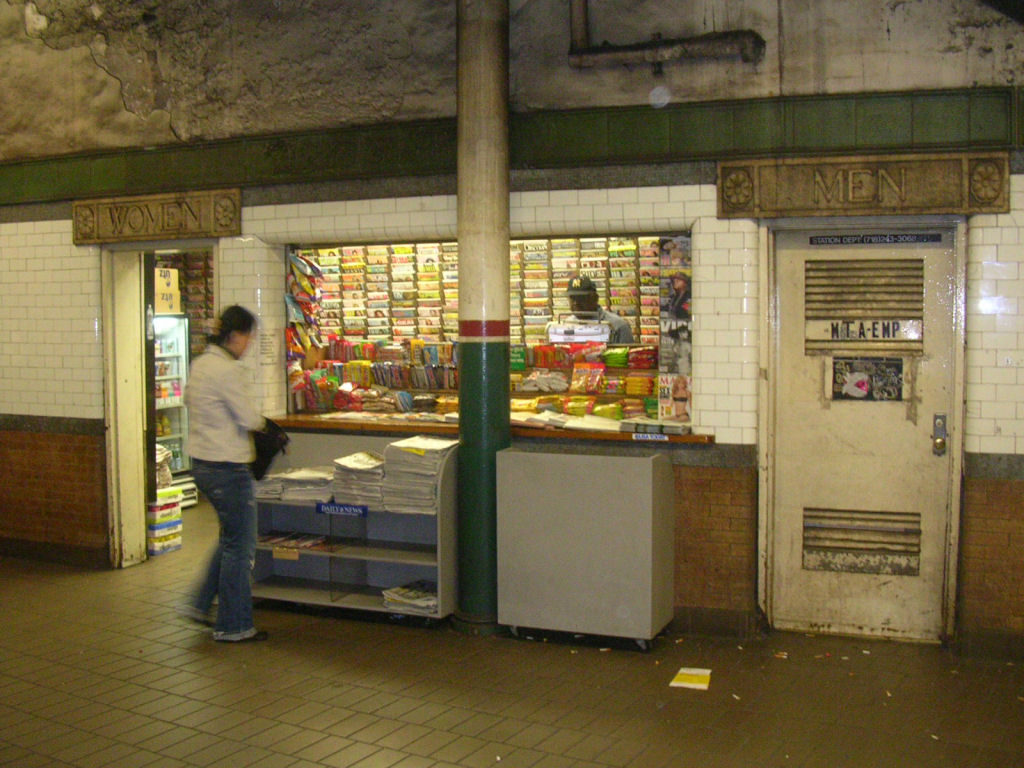
Once a bathroom; now a newsstand. (Photo by flickr user theratrace)

A few weeks ago, I was heading back to Park Slope from Manhattan and found myself on a D train. To get home, I had to switch at Atlantic/Pacific to a train that makes local stops, and I thought I’d use the time I had to duck into the bathroom. It was during the middle of the afternoon rush, and I assumed that bathrooms on the mezzanine between the Fourth Ave. stop at Pacific St. and the IRT platforms at Altantic Ave. would be open. Luckily for my olfactory sense, the bathroom was locked even though the sign said it would be closed only from midnight to 5 a.m., and I simply waited until I arrived home a few minutes later.

Around the subway system, the MTA’s bathrooms pop up like hidden gems – or trash heaps – amidst an unfriendly system. New York isn’t known for its public restrooms, and the subways are no exception. The johns at Times Square near the 8th Ave. line are useable; the ones at W. 4th St. are generally locked; and I don’t know anyone who dares enter the restrooms on the F platform at Delancey St. You never know what you’re going to find.

For a few years, I’ve toyed on and off with a subway bathroom feature. I’d take my camera and document the toilets underground. Somehow, though, I haven’t been able to stomach the idea. Do we really want to see what’s inside the subway’s myriad unloved bathrooms? Today, Heather Haddon did just that sans a camera. She explored all 129 restrooms in 77 subway stations and found what you would expect. Most are dirty; most reek of human waste; and nearly half of them were closed when they should have been open. “They’re pretty disgusting. People are always cleaning themselves in there and doing other stuff,” Kelvin Pau said at 168th St.

Haddon continues:

Of the open bathrooms, a third were frightening caverns of garbage, urine, standing water or unseemly smells. Odors from the Astoria-Ditmars Blvd. station on the N nearly caused an amNewYork reporter to feel faint during a recent visit…

Don’t expect to find toilet paper or soap, as few of the bathrooms had either. And while graffiti has largely been eliminated from subway stations, it lives on in the bathrooms, as many of the walls and stalls were covered in tags.

Keeping the bathrooms tidy and open is a challenge because they are constantly being vandalized or attract “criminal activity,” Seaton said. “They may be locked at any given time due to vandalism and ongoing repairs,” he said.

Haddon and her co-reporter Nicholas Klopsis close with a list of the best and worst bathrooms in the system. Stay away from Hunts Point where the men’s room stalls have no walls or 57th St. and Broadway with its “potpourri of not-so-pleasing smells.” And if you really have to go, just head above ground and find the nearest coffee house. It can’t be worse than the restrooms that mar the subways.

Comments (23)

Even as Phase 1 of the Second Ave. Subway moves forward, the Holy Grail of New York City subway expansion plans is still inspiring those who dream of a better mass transit system for the city. Over at his excellent site vanshnookenraggen, Andrew Lynch recently unveiled his incredibly fascinating and thorough examination of the Second Ave. Subway future. I’m working with Andrew to bring parts of his series to Second Ave. Sagas, but in the meantime, his post has me taking a trip back through New York City subway planning history.

The date in 1969, two years after the Chrystie St. Cut opened, and New York City is eying another round of subway expansion. The Board of Estimate and the New York City Transit Authority are working, often at odds with each other, to develop plans for the Second Ave. Subway, forty years after the initial IND Second System fell victim to the Great Depression. The debate over the route would expose the demands of a Board trying to respond to constituent demands and a Transit Authority attempting to make the most out of its service offerings.

The newly-formed MTA’s plan for Second Ave. was a simply one. As the current plans propose, the new subway line would have headed straight down Second Ave. and south of Houston St., would have followed, in the words of Emanuel Perlmutter, “Chrystie Street, the Bowery, St. James Place, Pearl and Water Streets to a Broad Street terminus.” This route would have maximized connections with out lines as well because plans called for transfers between the SAS and the F at 2nd Ave. and the D at Grand St. The MTA alleged that 25,000 riders from the Bronx and 30,000 from Brooklyn would have taken advantage of these transfers, and from a planning perspective, the MTA would have achieved its goal of offering comprehensive service.

The politicians though did not like it one bit. Manhattan Borough President Percy Sutton called it a “snobway thruway.” This train, he alleged, skirted the city’s poorer neighborhoods – called slums by reporters and politicians – and it did not provide ready transit access to those who lived in Alphabet City. Instead, in the days before the MetroCard, thousands of less well-off New Yorkers would have to continue paying double fares to take the bus from the far reaches of the East Village to the subway on Second Ave.

And so throwing money to the wind, the Board of Estimate pushed what they thought to be a better solution. Will Lisner of The Times described the change as thus: “The amended route would leave Second Avenue at 17th Street and bend east to Stuyvesant Square (near Stuyvesant Town), under 15th, 14th and 13th Streets to Avenue A, south to Essex Street along East Broadway and across Chatham Square.” This Ave. A would cost an additional $57 million, and although the Board of Estimate believed it would service 20,000 additional passengers, the MTA claimed just 3000 more riders would enter at Ave. A than if the subway were to stay on Second Ave. Furthermore, the IND transfers would be lost as well.

Eventually, after much political wrangling, the Board of Estimate and the MTA agreed to a proposal so expansive it could never see the light of the day. At a cost of $55 million more, the Second Ave. Subway would have the best of both worlds: The train would head south via Second Ave. and also include a loop to Ave. C between 14th and Houston Sts. As some transit planners called the loop a “gimmick” to save “a few blocks walk,” others hailed it as a compromise that would placate both the Board and the MTA.

Yet, by the 1974, it was not to be. Spiraling costs shelved the Second Ave. Subway to at least 1986, and today, as I wrote in September, that tea-cup shaped Alphabet City loop, while the darling of subway dreamers, just isn’t meant to be.

Comments (22)

It’s Friday evening once again, and you know what that means: Service advisories!

This week, I have announcement of a change that will last three months along the 6. There will, says New York City Transit, be “limited Pelham Bay Park-bound 6 service to and from Parkchester station beginning on Saturday, April 10 through early July, 2010 because of ongoing station rehabilitation.” The station, which opened in 1920, will enjoy new canopies, a refurbished mezzanine, new lighting and a public address system. The platform edges will receive the tactile strips in place throughout the system.

Due to this work, various platforms will be closed over the next few months:

  • At all times, all northbound 6 local trains will skip Parkchester, while express trains will stop at Parkchester between 3 p.m. and 9 p.m. on weekdays, but on the Manhattan-bound platform.

  • From 6:30 a.m. to 10:30 a.m., the last stop for some 6 trains is St. Lawrence Avenue; to continue northbound, transfer to a Pelham Bay Park-bound 6 train at St. Lawrence Avenue.
  • From 3 p.m. to 9 p.m. on weekdays, the last stop for all 6 local trains is St. Lawrence Avenue; to continue northbound, transfer to a Pelham Bay Park-bound ^ express train at Hunts Point Avenue.
  • From 10:30 a.m. to 3 p.m., the last stop for some Bronx-bound 6 trains is 3rd Avenue-138th Street; to continue northbound, transfer to a Pelham Bay Park-bound 6 train.

And that’s that. Meanwhile, below are the rest of this weekend’s service changes. As always, these come to me via New York City Transit and are subject to change without notice. Listen to on-board announcements and pay attention to signs in your local station. For a map of these changes, check out Subway Weekender.


From 11:30 p.m. Friday, April 9 to 5 a.m. Monday, April 12, there are no 1 trains between 14th Street and South Ferry. The 23 trains provide alternate service, running local between 14th Street and Chambers Street. Free shuttle buses replace 1 trains between Chambers Street and South Ferry. Please note that during the day 1 trains skip 18th, 23rd, and 28th Streets in both directions. During the overnight hours, 1 trains skip 18th, 23rd, and 28th Streets only in the uptown direction. These service changes are due to Port Authority work at the World Trade Center site and concrete pours at 50th and 79th Streets.


From 11 p.m. Friday, April 9 to 5 a.m. Monday, April 12, 2/3 trains run local between 96th Street and Chambers Street due to concrete pours at 50th Street and 79th Street. Note: Overnight, 3 trains run local between 96th Street and 34th Street.


From 1 a.m. to 1 p.m. Sunday, April 11, downtown 4 trains run local from 125th Street to Grand Central-42nd Street due to track cable work.


From 6:30 a.m. to 1 p.m., Sunday, April 11, downtown 5 trains run local from 125th Street to Grand Central-42nd Street due to track cable work.


At all times until September 2010, the Whitlock Avenue and Morrison-Sound View Avs. stations are closed for rehabilitation. Customers should use the Elder Avenue 6 station or the Simpson Street 25 station instead. The Bx4 bus provides alternate connecting service between stations.


Beginning 12:01 a.m. Saturday, April 10, through 5 a.m. Monday, July 5, the Pelham Bay Park-bound 6 platform at Parkchester is closed for rehabilitation.


From 12:01 a.m. Saturday, April 10 to 5 a.m. Monday, April 12, downtown A trains run local from 168th Street to West 4th Street, then are rerouted on the F to Jay Street; trains resume local service on the A to Euclid Avenue, then continue on the regular A route to Lefferts Blvd or the Rockaways due to a concrete pour at West 4th Street.


From 12:01 a.m. Saturday, April 10 to 5 a.m. Monday, April 12, uptown A trains run local from Euclid Avenue to 168th Street due to a concrete pour at West 4th Street.


At all times until June 2010, the Far Rockaway-bound A platforms at Beach 60th Street and Beach 36th Street are closed for rehabilitations.


From 12:01 a.m. Saturday, April 10 to 5 a.m. Monday, April 12, there are no C trains running due to a concrete pour at West 4th Street. Customers should take the A instead. Please note: A trains run local with exceptions.


From 12:01 a.m. Saturday, April 10 to 5 a.m. Monday, April 12, Bronx-bound D trains run on the N line from Coney Island-Stillwell Avenue to 36th Street (Brooklyn) due to switch renewal north of 9th Avenue. Please note: During the day, Bronx-bound trains skip 53rd Street and 45th Street R stations.


From 11:30 p.m. Friday, April 9 to 5 a.m. Monday, April 12, free shuttle buses replace E trains between Jamaica Center and Union Turnpike due to switch renewal and asbestos abatement north of Sutphin Blvd. Please note: E trains are rerouted on the F line between Forest Hills-71st Avenue and 179th Street.


From 12:01 a.m. Saturday, April 10 to 12 noon Sunday, April 11, Manhattan-bound E trains run express from Forest Hills-71st Avenue to Roosevelt Avenue due to track cable work.


From 12:01 a.m. Saturday, April 10 to 5 a.m. Monday, April 12, Queens-bound F trains run on the A line from Jay Street to West 4th Street due to the Broadway-Lafayette to Bleecker Street Transfer construction.


From 12:01 a.m. to 12 noon Sunday, April 11, after leaving Roosevelt Avenue, Queens-bound F trains are rerouted to the E from Queens Plaza to 5th Avenue-53rd Street; trains resume service on the F at 47th-50th Sts. due to cable work at Roosevelt Island station.


From 8:30 a.m. Friday, April 9 to 5 a.m. Monday, April 12, there is no G train service between Forest Hills-71st Avenue and Court Square due to fan plant work near Queens Plaza. Customers should take the E or R instead. Note: Brooklyn-bound R trains run express from Forest Hills-71st Avenue to Roosevelt Avenue.


From 12:01 a.m. Saturday, April 10 to 5 a.m. Monday, April 12, Queens-bound N trains are rerouted to the R line from DeKalb Avenue to Canal Street due to track maintenance.


From 11 p.m. Friday, April 9 to 7 a.m. Saturday, April 10, from 11 p.m. Saturday, April 10 to 8 a.m. Sunday, April 11 and from 11 p.m. Sunday, April 11 to 5 a.m. Monday, April 12, uptown Q trains run local from Times Square-42nd Street to 57th Street-7th Avenue due to a track dig out north of Times Square.


From 12:01 a.m. Saturday, April 10 to 5 a.m. Monday, April 12, Manhattan-bound Q trains run on the R line from DeKalb Avenue to Canal Street due to track maintenance.


From 6:30 a.m. to midnight Saturday, April 10 and from 6:30 a.m. to 12 noon Sunday, April 11, Brooklyn-bound R trains run express from Forest Hills-71st Avenue to Roosevelt Avenue due to track cable work.


From 10:30 p.m. Friday, April 9 to 5 a.m. Monday, April 12, free shuttle buses replace Rockaway Park Shuttle S trains between Rockaway Park and Beach 67th Street due to station rehabilitation at Beach 98th Street.

Categories : Service Advisories
Comments (2)
  • Extended Stay

    Featuring a wide range of sophisticated furnished apartments throughout the city and surrounding areas, ExecuStay can help you enjoy a New York extended stay that's both productive and relaxing.

  • Corporate Apartments

    As a resident of ExecuStay New York corporate apartments, you'll find that getting around is a snap, thanks to the many MTA subway lines, buses and yellow cabs.