Archive for September, 2011
From the TWU, a petition against rats and irony
Posted by: | Comments
The TWU's petition drive will persuade this rat to leave the subway. (Photo by flickr user Ludovic Burtron)
No one likes seeing rats in the subway. It’s one of those universal things about New York City because rats are disgusting, unpleasant to look at and dirty creatures with which we co-exist uneasily. If it were possible to get rid of them all, the MTA would in a heartbeat.
Lately, though, rats have become more prevalent underground. Transit has cut its cleaning budget, and garbage collection runs have become less frequently. As trash sits, rats take over. Now, though, the TWU wants the MTA to take action.
Yesterday, the Transport Workers Union Local 100 unveiled a new petition effort. They are asking riders to sign a letter that urges the MTA to “adopt a System-Wide Rat Eradication Initiative immediately.” The petition is available online, and TWU operatives were out and about on Wednesday. “We have a huge rat problem,” Kevin Harrington of the TWU said at Parsons/Archer in Queens yesterday.
As union members called for more cleaners, the MTA said they were working on, well, something. “We are working with the city in an effort to find more effective ways of addressing the rodent problem,” the authority said.
It’s hard not to applaud the TWU for this initiative, but there’s no small sense of irony here either. Because of restrictive work rules, the MTA can’t use existing station personnel — many of whom have little to do — to help clean the system. They have employees who sit in their booths but can’t sweep the platforms or help with trash collection. Instead, we have a regimented system of jobs, and with the MTA eying the dismissal of over 200 cleaners in the looming years, the stations will just get dirtier and thus more rat-infested.
Subway Rider, a commenter on Streetsblog, put it best:
They think that attacking, undermining and directing populist and politician anger toward the MTA is a great strategy for them. Yet, all this strategy has done over the last 15 years is undermine the public’s confidence in the MTA and make it easier for Albany politicians to steal funding and resources from TWU employees! The result of TWU strategy is that TWU workers get laid off, their salaries are frozen and cut, their work conditions deteriorate.
But even more significant: The TWU doesn’t seem to get that making the public hate the MTA is bad for TWU workers. As far as the public is concerned, TWU employees are the face of the MTA. It’s the TWU workers who are sitting there napping in bullet-proof glass boxes while garbage collects in piles around them. The public doesn’t get angry at Jay Walder and the MTA board for that. The public looks at that TWU worker sitting in his box doing nothing and thinks: Hmm? Really? Is that a good use of MTA resources? Why is that man sitting in a glass box while machines dispense MetroCards and no one picks up the rubbish or puts up proper signage in this station?
When the group advocating for a solution is part of the problem, it’s hard not to grow cynical.
On debt, a comptroller’s report reveals the obvious
Posted by: | Comments
The latest Comptroller's report echoes findings issued last month by the RPA. Image via RPA/ESTA.
When the MTA unveiled its latest three-year budget projections, transit advocates and transportation experts raised the debt alarm. As I detailed in early August, the MTA’s three-year projections relied on numerous assumptions and a larger debt burden. A few weeks ago, a recent report by the Regional Plan Association and the Empire State Transportation reinforced that idea. Debt service could account for nearly a quarter of the MTA’s operations budget by 2014.
It is, then, no surprise that yet another report issued by Thomas DiNapoli, New York State Comptroller, reaches the same conclusions. What is surprising, though, is the amount of time it took DiNapoli’s office to release this report and the ways in which it does little to help the MTA’s economic position. In an eight-page report (available here as a PDF) with lots of graphs published at a size far too small, DiNapoli explores the MTA’s basic assumptions and raises the same debt alarm.
“The MTA is in a very difficult position as it struggles to hold together a strained operating budget while proposing the largest borrowing program in its history to fund capital projects,” DiNapoli said. “There is no debating that the capital program is critically important, but my analysis shows that the magnitude of this borrowing plan will have serious implications for the operating budget in the coming years. Before taking on nearly $15 billion in new debt, the MTA must present the public with the facts about the potential long-term implications of this new borrowing on services, fares and budget gaps.”
The MTA hasn’t yet been forthcoming with the real impact the debt will have on services, fares and budget gaps, but the RPA/ESTA analysis did. DiNapoli’s work basically rehashes those findings. Here are his key conclusions in bullet-point form:
- Debt service as a percent of total revenue could rise from 16.4 percent in 2011 to 22.7 percent in 2018 without new fare and toll increases. (The burden could reach 20.5 percent in 2018 even with biennial fare and toll increases of 7.5 percent).
- In total, the proposed financing program would cost the authority’s operating budget $33 billion over the term of the loans, or nearly $13 billion more than the approved financing program.
- The July financial plan assumes that any wage increases during the first three years of a new labor agreement will be offset by savings from union concessions. Wage increases at the projected inflation rate, for example, without offsetting savings would increase costs by $62 million in 2011 and as much as $327 million by 2015.
- Spending continues to rise at a rate more than twice that of inflation. Despite an assumed three-year wage freeze, the MTA projects annual spending increases of 5.1 percent through 2015 based on rising costs for health insurance, pensions, debt service and services for disabled commuters.
- The pace of the economic recovery is a matter of grave concern. Roughly one-third of the MTA’s revenues come from economically sensitive taxes, and the use of mass transit is closely tied to employment levels in the region.
Now, over the years, I’ve been fairly critical of DiNapoli’s reports. They don’t really shed light on any new problems with the MTA. In fact, we’ve known about the debt bomb for years; the recent three-year plan just accelerates the high percentage of the operating revenue that will have to be spent on debt service rather than on transit service. How many taxpayer dollars are going to DiNapoli’s office to duplicate research that’s already been published?
Yet, this report shows glimpses of, well, something. DiNapoli notes that spending has increased at twice the rate of inflation, and he pinpoints a variety of causes — labor costs, debt service and services for disabled commuters — as the primary culprits. The next steps then involve addressing these problems. How can the MTA lower its health care and pension obligations? What must be done to streamline debt service? How can we reduce Access-A-Ride costs? Those question don’t even address the concerns astutely raised by Andrew Smith in this extensive comment he left yesterday.
At some point, New York politicians who are in these positions of power are going to have to get serious about identifying cost savings plans. This report by DiNapoli is a small step toward that goal, but to save the MTA will require more than just small steps.
A PA toll increase and the law of intended consequences
Posted by: | CommentsWhen the Port Authority raised its fares this month, it levied a disproportionate increase on tolls for drivers who still insist on paying cash while giving those who use E-ZPass something of a break. The thinking behind this move is simple: The Port Authority does not need to spend as much money collecting tolls if they can eliminate cash lanes. This is, not coincidentally, why the MTA wants to eliminate MetroCards as well. It’s possible to spend money up front on improvements that will realize multi-million-dollar savings down the line.
Lo and behold, the move has paid off. With cash fares so high, more drivers are turning to E-ZPass, and SI Live is ON IT.”We have had higher than usual volumes at the Staten Island E-ZPass customer service center today,” a Port Authority spokesman said. Drivers can save $2.50 per fare with an E-ZPass while bus operators can realize savings of $10 per trip. So the transportation agency can save costs on fare collection while passing those benefits onto its customers thanks to the power of a relatively simple technology.
A rant on using PA/CIS as a communications tool
Posted by: | Comments
Suspicious activity is about the only creative announcement the PA CIS system is capable of broadcasting. (Photo by Benjamin Kabak)
For the past few years, I have been an unabashed supporter of the MTA’s new countdown clocks. The system, available in most A Division stations, is based on a signalling system that can assess where along the signal blocks and also how far away the next train is. Ostensibly, the system is flexible as well as the CIS part of PA/CIS allows the MTA to provide customer information to certain stations from a centralized location. Unfortunately, it doesn’t seem to work like that.
Last night, I had one of those moments that I often have at Nevins St. when something goes wrong with the subway system that could have easily been avoided. It’s happened often and usually it involves headways that are improperly spaced or an announcement that should have been made. Last night, it was the latter.
This story begins as my tales from Nevins St. often do: on a 4 train on the way back from Yankee Stadium. It was around 11:30 when we pulled into Nevins, and the PA/CIS clocks said the next local train was eight minutes away. Usually, I would just walk home from Atlantic in the face of an eight-minute wait, but I was tired and had a good book with me. So I waited.
As I waited out those eight minutes for the 3 train (with a 2 train just two minutes behind), another 4 came and went at Nevins St., and no signs of a problem emerged. The 3 arrived on time and inched its way to Atlantic Ave. I noticed something was wrong when it hit the switch and wound up on the express tracks. Only then did the conductor announce that all trains were running express from Atlantic Ave. to Franklin Ave. due to track work.
Now, this was not an unplanned service change. Had I read the service alerts before leaving or had I walked to the other end of the Nevins St. platform to inspect the one sign hanging there, I would have seen it. But I didn’t. Instead, I waited. I waited as the automated PA/CIS announcements alerted me to approaching trains. I waited in sight of a countdown clock that not once warned passengers of a service change. I waited near a column that had no hanging signs. In fact, only until I walked past Bergen Street — a station closed because of the service change — did I see a sign warning of the 11 p.m. start time.
Over the years, I’ve written about the MTA’s need to focus on its customer. The authority has taken great strides in the realm of technology, but it hasn’t yet bridged the gap between active and passive information. The conductor on my original 4 train should have warned riders that there would be no local service between Atlantic and Franklin Aves. The conductor on the next 4 train should have said the same thing, and the MTA, which has the ability to do so, should have programmed the PA/CIS monitor to announce the change. For nearly ten minutes, I waited in Nevins St. with no visible or audible sign of an impending service change.
Ultimately, last night, I learned a lesson I should have learned a long time ago. Even if there are no individual signs, it’s best to check the service advisories at any time of day. Still, the MTA should learn a lesson too from the numerous irate customers who found out about the change after standing around Nevins St. for ten minutes: Information is key. With new technologies, Transit can better alert its riders to service changes, and they can take an active role in doing so. That is, after all, why the new devices are called Public Address/Customer Information Signs. It’s in the name.
From LI Bus, a case study in the purpose of transit
Posted by: | CommentsHere’s an interesting question for you: Should public transit systems and the public authorities that run them be trying to turn a profit? In other words, at what point should authority heads such as Jay Walder cease running a transportation network as a public good and start running it as a business?
The answer to this question isn’t an easy one in an age of austerity. By and large, public transportation networks are inherently not operated as a business as the service level. In New York, for instance, the MTA runs mostly empty trains at 3 a.m. and allows buses to run routes with a cost-per-passenger high enough to make any private CFO cry. That’s how New York City exists as a huge economic hub and tourist destination today, and that’s how mass transit is operated as a public good.
On the other hand, though, are a few competing demands. First, the MTA must operate these services efficiently through a streamlined bureaucracy and a procurement process that isn’t beset with red tape. Second, it cannot become an organization beholden to pension costs and lifetime benefits. Third, it will require public subsidies from a government whose constituents depend on public transit for their daily lives, and politicians will have to recognize that the MTA or a similarly situated organization may not operate as efficiently as a corporation that answers to stock-holders. The demands are different, and the expected benefits are different.
Recently, a few good minds in the transit realm have been debating the way transit authorities operate. David Levinson has called for financially sustainable mass transit systems while Jarrett Walker has called upon those funding transit systems to better outline their goals. The competing demands of ridership vs. coverage are at odds with financially self-sustaining transit systems. I’ve simplified their arguments, and it’s worth reading their pieces at length because we’re seeing this debate play itself out in real life on Long Island.
The Long Island Bus saga has been a debacle. In its original agreement with Nassau County, the MTA agreed to operate the service as long as the county paid for it. Over the years, the county’s contributions had decreased while the MTA’s had increased, and the authority threatened to pull out of Nassau if County Executive Edward Mangano didn’t agree to upping the county’s contributions from $9 million to $26 million. Mangano called the MTA’s bluff and decided he could run the bus system for less by farming it out to a private company. He claimed no service cuts or fare hikes would follow.
From the start, the privatization process has been a mess. The county used a non-transparent process to pick Veolia, a company with close ties to Mangano’s campaign, and they failed to meet a July deadline for an agreement. The MTA will operate the buses until December 31, and at that point, Nassau County will reduce its contributions to just $2.5 million — $6 million less than the cost of fuel alone. Veolia will then be expected to cover the difference. Without subsidies, no one, including the company’s CEO, knows how.
Earlier this week, Michael Setzer spoke about how the company would save the millions it stands to lose from the MTA and state when it takes over the LI Bus network. “You can’t save $35 million by turning off the lights,” Setzer said. In other words, there’s virtually no way Veolia can operate the bus system with its current route structure and fare system while breaking even or turning a profit.
On their website, if you read closely enough, Veolia has said as much. They are threatening “adjustments” of bus timetables that will reduce frequency, and while they say there is no plan in place to raise fares next year, they also say that “it’s possible that modest service redesigns and fare increases will be recommended.” You can’t just save $35 million by turning off the lights.
Veolia is a private company long used to operate bus systems with large public subsidies. If they can’t turn a profit in Nassau County with a meager subsidy and the current route plan or fare structure, something will have to go. Relatively empty buses that provide a transit lifeline for people who can’t afford anything else will be cut, and fares will go up. A public good won’t be so public any longer.
As this grand experiment rushes toward a launch, we’ll watch Nassau County closely. It could be a model for how transit agencies can operate, but it sounds as though it’s going to be an example in government failure and the decline of a once-proud bus system. Perhaps Nassau County will come to its senses and recognize the purpose of its bus system before it’s too late, but I’m not counting on it.
A digression on parking rates and spaces
Posted by: | CommentsOver the years here, as I’ve tried to develop a semi-coherent argument for public transit investment at the expense of automobiles, I’ve occasionally returned to the idea of the parking space. Two years ago, I said the city could fund transit by raising on-street parking rates, and I’ve argued in favor of residential parking permits as a way to raise revenue for anything from street repair and maintenance to public transit investments.
My biggest complaints about parking spaces concern the way we use space and the way we charge for it. In New York, everything costs a lot. Housing prices are high; office rates are high; parkland is at a premium; even sidewalk space has whittled down over the years. Yet, cars get away with parking for free. In essence, you have around two tons of inert metal taking up precious urban space and paying nothing for in exchange for the privilege.
In his City Room column today, Clyde Haberman plays off of the deactivation of the last Manhattan parking meter to wax poetic on parking spaces. Much like the death of the token brought about thought-provoking reflections on mass transit, so too has the death of the parking meter. Muni-meters, after all, free up space. No longer are cars bound by parking meters, and that can be both good and bad for on-street parking.
Haberman’s point, though, is a different one. “Why,” he asks, “is public space, a most precious commodity in this city, allowed to be used as a private storage area?” He continues:
Years ago, I asked in a column if it would be all right for a New Yorker in a crowded apartment to put a chest of drawers on wheels and leave it at curbside — observing all parking rules and taking a chance on theft. The very idea was, of course, absurd; you can’t store personal property on the street.
Why, then, is it O.K. to do that when the wheeled property is called a car?
If public space is to be used for this private purpose, perhaps what the city needs to do is greatly expand the areas where people must pay for the privilege.
Not that this could be done without fierce resistance from some on the City Council and in the State Legislature. Generally speaking, when it comes to the proper place of the automobile in this crowded city, what we have, as Cool Hand Luke found out in his own way, is a failure to communicate.
I don’t believe cars are inherently evil. My family has lived in New York City for my entire life, and we’ve always owned a car. I’m enrolled with the AAA and and card-carrying member of ZipCar. I’m also sympathetic to those who say that fees and taxes in New York are getting out of hand. Parking, though, is a market-based solution. If the market is willing to support significantly higher parking rates, why does New York continue to squander a money-making resource while it gives premium space away for free?
‘On The Go’ pilot brings travel info underground
Posted by: | Comments
Paul Fleuranges offers up a demonstration of the MTA's new On The Go video board. Photo courtesy of New York City Transit.
Over the past few years, the MTA has moved its technological offerings into the 21st century. The authority took a staid website with little interactivity, and bit by bit, they have added more real-time information about subway and rail services, introduced a better TripPlanner and unveiled a map that will change as the weekend service does. With bus trackers and countdown clocks going live, customers should be better informed than ever before.
Still, though, the MTA has to get its information through a physical barrier. As a large portion of the subway system is underground, cell signals do not penetrate to the stations below, and at the times when customers most need that real-time information, they have no way of accessing it. Enter the new “On The Go” program.
The new travel stations, unveiled yesterday at Bowling Green by MTA officials, is part of a pilot program that will include five subway stations and commuter rail hubs. Interactive touch screens will be set up Bowling Green, Grand Central, Atlantic Ave./Pacific St., Jackson Heights/Roosevelt Avenue and Penn Station. The interactive data offerings include maps, TripPlanner capabilities, real-time status updates, escalator and elevator outages and local neighborhood maps. The MTA will also partner with third-party app developers to provide additional local information and, for example, dining guides from Zagats. Similar to those in taxicabs, the screens will also show a news crawl and the latest weather.
“With On the Go, we are adding yet another layer of state-of-the-art customer communications into our subway system, but it goes far beyond the already helpful information provided by our countdown clocks and the displays in our new technology subway cars,” Transit President Thomas F. Prendergast said. “On the Go will provide riders with instant information that makes using the transit system more efficient.”
The technology behind these terminals comes from Cisco’s Interactive Services Solution. A general manager from the company spoke about the way the screens can both improve passenger experience while creating new revenue sources for the MTA. “We have worked with cities all over the world, as a part of our Smart+Connected Communities initiative, in using the network as the platform to transform physical communities to connected communities. This pilot demonstration shows the potential for technology to connect, enhance and improve the quality of life for communities,” Syed Hoda said.
Following the unveiling yesterday, a few commentators wondered about the durability of such devices, but Transit says they are built to withstand the beating to which New Yorkers will subject them. Antenna Design New York Inc., the same firm behind the Help Point pilot program, has constructed a stainless steel enclosure with components that are durable and easy to clean and maintain. Of course, based on the MTA’s touchy relationship with technology, that’s one area in which the authority will have to prove itself through actions rather than words.
Ultimately, if customers are accepted of the new technology, the MTA anticipates installing these devices throughout the system. Officials believe the screens can also generate revenue through advertising which would “help to defray the costs of installation.”
A plan for a park underneath Delancey Street
Posted by: | Comments
Renderings of the Delancey Underground pay homage to the Underbelly Project. Photo via Inhabitat.
Over the past year, since the Underbelly Project exposed New York City to the abandoned South 4th Street subway station, interest in the various unused parts of the subway infrastructure has been on the rise. It’s part of a cycle really. Over the years, various groups have called upon the MTA to reopen the City Hall stop, provide tours for shuttered stations and flat-out admit that some stations exist. After all, many at the MTA won’t admit that the South 4th Street shell exists, let alone that a street art project used it as a canvas.
Since Underbelly, though, the MTA’s relationship with its unused infrastructure has grown more strained. Transit sometime last fall sealed up one of the South 4th Street access points with a new false wall in an effort to keep vandals and urban explorers out. By doing so, though, they also allow a part of subway history when the city dared to dream big to fade away behind new walls. Not everything has been ignored though.
Across the tracks from the BMT’s Essex St. subway station rests the unused trolley terminal that, until 1948, brought riders across the Williamsburg Bridge. These days, the old station sits unused and in disarray, a visible relic of another error, but some architects and social innovators want to turn into an underground park. Eying the success of the High Line, they want to turn the trolley terminal into the Low Line. By channeling sunlight into the subterranean cavern via fiber optics network, they could print light and plant life to what is now a dank, dark space.
On Monday, James Ramsey, an architect and engineer from RAAD Studio, along with Dan Barasch of PopTech and R. Boykin Curry IV of a New York investment firm, unveiled the Delancey Underground website as part of a publicity push for their idea. They were featured in New York magazine and spoke at length with The Low Down NY about their idea.
Ramsey, who went on a tour with some MTA officials last year, talked about the concepts behind the Low Line. “We were thinking about this amazing space lurking underneath Delancey Street, totally in the darkness, dripping, just sitting there, not activated,” he said. “We started thinking, how can we activate this space, how can we make something appealing here? A very natural way to do that is to introduce natural sunlight. What happens if you (do that) is that you can actually grow some plants down there. It’s a totally bizarre fun idea but I think it makes a lot of natural sense.”

The trolley terminal at Delancey Street has sat unused since the late 1940s. Photo via Inhabitat.
A brief bit published by Inhabitat discusses some of the technology behind it as well:
Even though the park design will be set below the street, the goal is to create a space that is far from a dark, dank and depressing destination. The ground-breaking design team is banking on a high-tech fiber optic lighting system to enable a green space that is bright, sunny and welcoming. The park will be equipped with extensive lighting units utilizing fiber optics to channel natural daylight to the depths below. Dozens of lamppost-like solar collectors will be placed on the Delancey Street to complete this task. And as a bonus, the system the designers envision will also filter out harmful ultraviolet and infrared light, but keeping the wavelengths used in photosynthesis to foster and nourish plant growth.
The idea itself seems like a neat one on the surface. It rivals one out of Boston in terms of creativity and outside-the-box thinking, but the practical considerations make it a long shot. In conversations with transportation officials with knowledge of the situation, I understand that the team has a in with the current MTA leadership, but that leadership is on the way out in a few weeks. Hence, the recent effort to drum up public support. They’ve presented to city officials and will soon be meeting with Community Board 3 who would have to approve numerous aspects of this plan.
As far as the space is considered, the politics are a little more delicate. The MTA currently controls the unused trolley terminal, and they’re not going to simply hand it over to the Parks Department without adequate compensation or safety assurances. Furthermore, the authority rightly won’t contribute a dollar to this program, and anyone who replaces Jay Walder likely won’t view this project as a priority. Finally, it’s likely that the MTA or similarly situated government entity would have to open up this space to an RFP process and bidding before it could move ahead.
It took the High Line supporters ten years to realize their goals of a park atop that rail line. Patience, it seems, is a virtue for proponents of creative uses for public space. Maybe the Low Line — bad name and all — isn’t a perfect idea; maybe it won’t see the light of day. But it will make people think, and if the city can turn an abandoned trolley terminal into something useful, the early ideas will have been well worth it.

The Low Line park would bring light underground. Image via Inhabitat.
CPW water main break impacting IND service
Posted by: | Comments
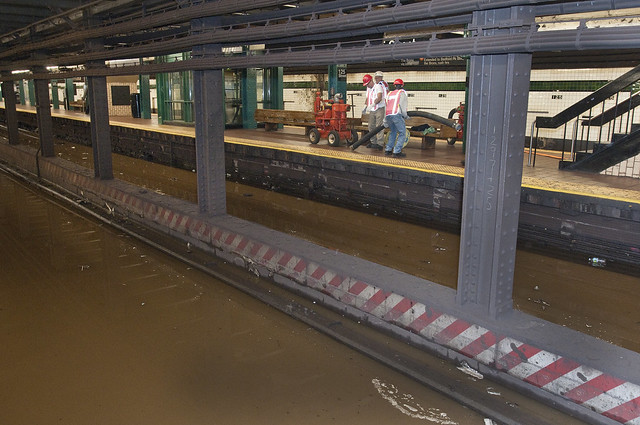
A glimpse at water levels at 125th Street earlier this afternoon (Photo via Metropolitan Transportation Authority, Patrick Cashin)
Due to a water main break near 110th Street and Central Park West, New York City Transit is anticipating severe service disruptions for the A, B, C and D trains this evening. As of around 3:50 p.m., B and C trains are suspended from end to end, and A train service is suspended between West 145th Street and 59th Street-Columbus Circle. The D is not operating between 161st Street-Yankee Stadium and 34th Street-Herald Square.
Transit says it will be providing shuttle train service on the Concourse (D) Line between 205th Street and Yankee Stadium in order to allow customers to transfer to the 4. A similar shuttle train will from 207th Street to 168th Street to allow for a connection with the 1, and subway-bound straphangers leaving Yankee Stadium have been told to take the 4 train. Metro-North will cross-honor tickets from Yankee Stadium to Harlem-125th Street and Grand Central.
According to a report from DNA Info, the main that broke is a 30-inch tube that’s approximately 100 years old. MTA crews are currently pumping out water that’s covering tracks at stations from 103rd to 125th Streets along Central Park West and St. Nicholas Ave. Although four pumps are working to remove 6000 gallons of water per minute, Transit does not yet know when regular service along these IND routes will be restored. Get ready for a fun commute home tonight.

Water from a ruptured main near Central Park West and 110th Streets floods the avenue. (Photo via DNA Info)
Photo of the Day: Bike hooks for the M-8s
Posted by: | Comments
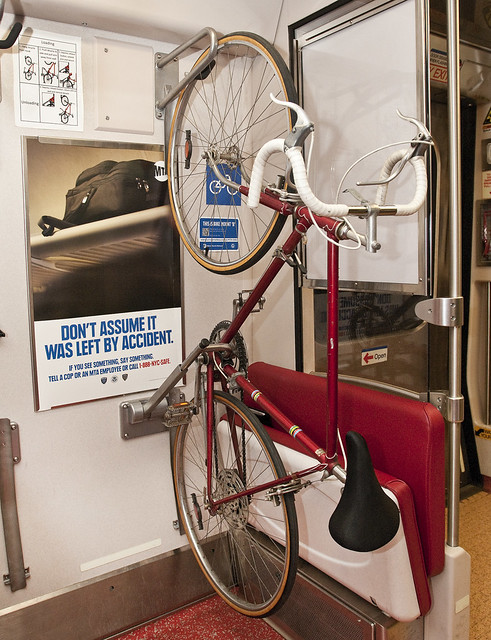
Cyclists at Grand Central Terminal on Friday tested prototype bicycle hooks being piloted on Metro-North's M-8 cars by the Connecticut Department of Transportation. Photo by Metropolitan Transportation Authority, Patrick Cashin.
For a long time, bicyclists and Metro-North trains have co-existed rather uneasily. The MTA charges a $5 permit for those who wish to bring their bikes on board, but the limitations are extensive. Bikes are, of course, not allowed at all in peak directions during peak hours, and the railroad limits the total number of bicycles per train to four during the week and just eight during the weekend. For cyclists who want to take advantage of the numerous trails around the New York area, these rules make riding the rails onerous and sometimes impractical.
On and off, we’ve heard of efforts by the MTA to improve the way bikes are stored on Metro-North trains. The authority originally announced a prototype test on the M-7s back in 2009 but had to cancel amidst cost concerns last year. Now, the prototype is back on track.
Last Friday, Metro-North held a demonstration of a potential bike solution for the M-8 trains. They tested two types of hooks as cyclists experimented with the hanging bike hooks. I’ve heard that test trains will run on the New Haven line between now and November 13, and NYCC has published the prototype schedule. Bikes can be just as intrusive as those travelers with giant luggage who often use Metro-North, and adding hooks as an accommodation should help make it easier for those on two wheels to get around.