Archive for Abandoned Stations

The Shadow Machine from Jason Eppink on Vimeo.

When news leaked of the Underbelly Project gallery at an abandoned subway station somewhere in New York, I assumed that the MTA would quickly identify the site and shut down porous access. It took of us intrigued by and obsessed with abandoned stations just a quick glance to identify the gallery site as the South 4th Street station, and today, I was able to confirm that the art is indeed in this IND Second System shell station. The MTA figured it out too and pledged better security.

I asked the authority about their official response to the so-called exhibition, and it was as you might expect. “NYC Transit is working with the NYPD in the investigation and follow-up on this matter,” MTA spokesman Aaron Donovan said. “Further inspections will be made to this and other similar locations throughout the system to better secure these areas. We remind the public that any such incursions into unauthorized areas of the transit system is considered trespassing and is punishable by law not to mention, dark and dangerous.”

Meanwhile, I learned this morning as well that an MTA work crew went into the old South 4th Street station to explore the site. They were spotted entering the shell at the northbound end of the Broadway stop on the G train, and Donovan told me that the authority’s crews are working to identify potential access points and to seal up these abandoned areas. “New York City Transit staff were on site today to assess the station’s security and make some adjustments to make it more secure,” Donovan said.

As the video above from Jason Eppink — the artist behind this summer’s Spoiler Alert signs and a 2008 subway chair installation — shows, it is indeed dark and dangerous, and it appears as though at least one site access point requires walking along or through subway tracks. More scenes from the makeshift gallery have reached the Internet as well. Wall Kandy offers up a blog post and a flickr photo gallery. These photos are from July 30-August 1, and I have to wonder what time and other graffiti artists have done to the project in the intervening three months.

We won’t, it seems, learn that answer from the MTA. Although an MTA crew got to explore a long lost part of a planned subway expansion, I doubt they took pictures. Still, eve as the MTA works to secure the site and prevent unwanted access to dangerous areas and dark corners, the authority is tantalizingly leaving the art in place. “We have,” Donovan told me, “no intention of painting over or removing the artwork.”

After a jump, one of my favorite pieces of the street art from the Underbelly Project. Read More→

Categories : Abandoned Stations
Comments (9)

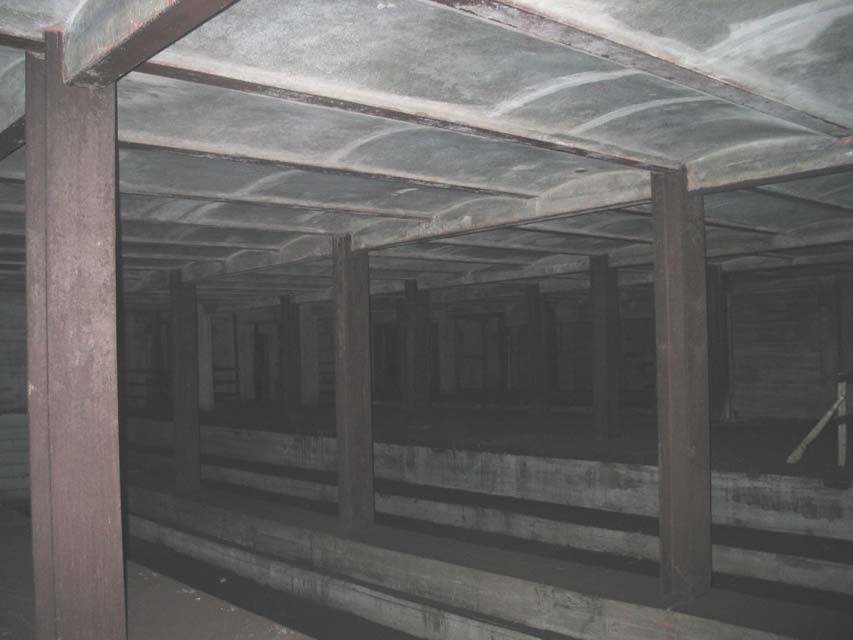
A six-track ghost station sits above the G train stop at Broadway in South Williamsburg. (Photo via Subway & Rail)

When news of the Underbelly Project’s subway station art show hit the Internet this weekend, subway lovers scrambled to adduce the site and quickly settled upon the South 4th Street subway shell. This is a six-track, IND station in South Williamsburg hidden from the public but identical to the station seen in the photos presented to the public by the Underbelly Project. To the uninitiated, this stop may sound like a phantom subway station. Isn’t the only 4th Street station at West 4th in Manhattan? What is this South 4th Street station? Where is it? And where do the trains that once serviced it go?

The answers — especially to the last question — are tricky. The South 4th Street subway station isn’t anything quite like the city’s other abandoned stations. It’s never seen revenue service before, and in fact, it doesn’t even have a rail track running through it. It exists in fragments — poured concrete, unfinished stairwells, no lightening, no through tunnels — and is a remnant of an era of larger plans. In a sense, it’s not an abandoned station because no trains ever served it nor could they. Rather, it is an abandoned dream.

The South 4th Street was to be a major transfer and connection point for the IND Second System. The shell was built into the ceiling of the Broadway stop on the IND Crosstown — a so-called provision statement — before the city even knew if funding for the remainder of the line would ever materialize. When World War II and the subsequent advent of the automobile age put a grinding halt to subway expansion, the South 4th Street shell remained just that. It is a testament to another era, behind false walls and closed-off staircases, and today, it apparently housings one of the largest street art exhibitions in New York City.

Today, a six-track station seems unimaginably wasteful. The MTA is building the Second Ave. Subway with only two tracks due to budgetary constraints, and the only other stations and tunnels with six tracks — Hoyt-Schermerhorn comes to mind — never make use of the full array of options. The two outer tracks at Hoyt-Schermerhorn lead into the Court St. stop which we know today as the Transit Museum. It too was part of the grandeur of the Second System and a planned Brooklyn extension for the 1930s edition of the Second Ave. Subway.

But back in 1929 and again in 1939 when the city was trying to build up its subway system, South 4th Street in South Williamsburg was to be a major intersection. The plans are aggressive: Both the Sixth Ave. and Eighth Ave. lines would have passed through this station, bound for multiple points east, south and north. The Second System, which I explored in depth in 2008, which have reimagined New York City, and the Second System’s Big Apple would be a more accessible one than ours is today.

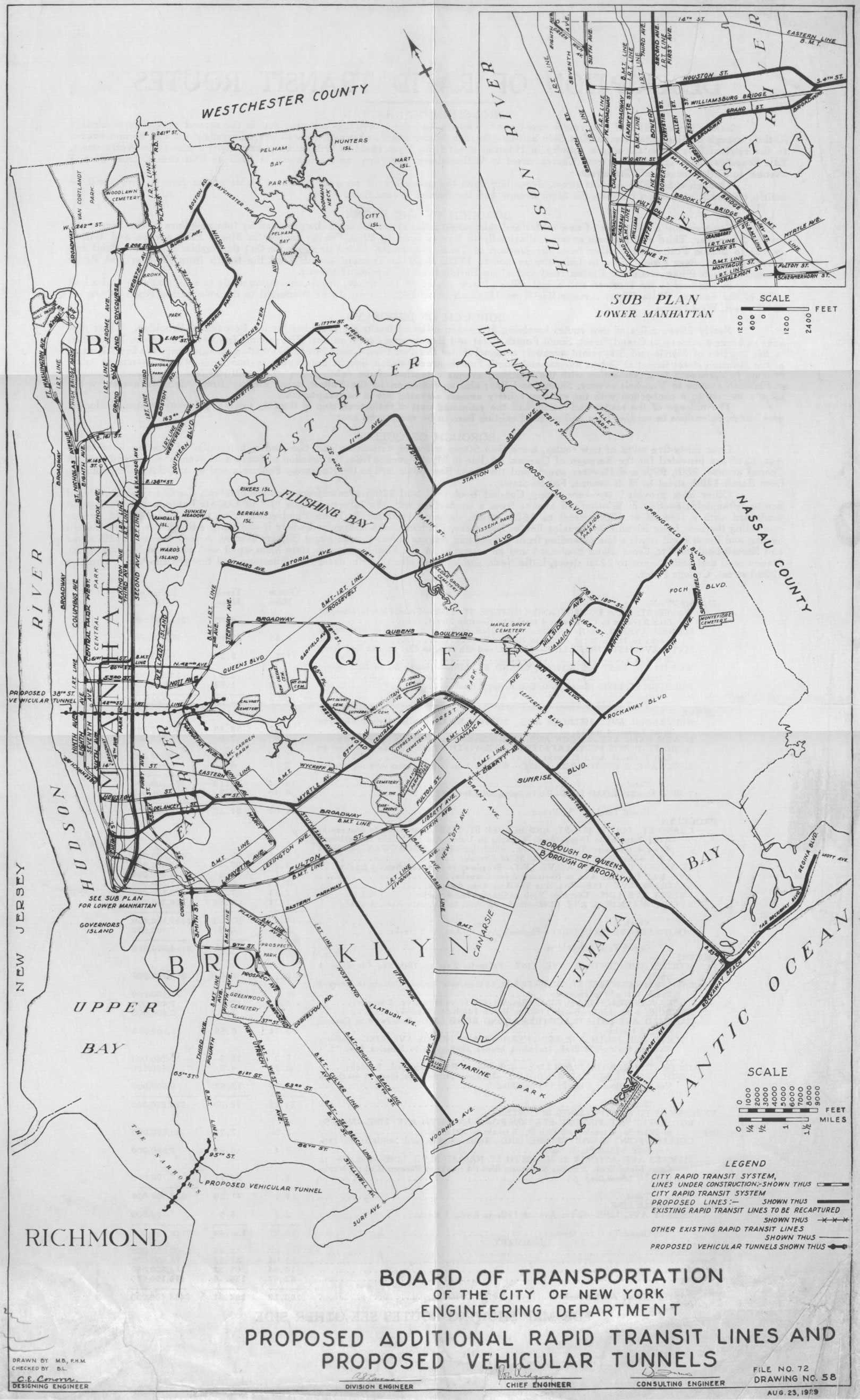
The 1929 expansion plans included three spurs from the six-track South 4th Street station. Click here for a full view.

According to proposals from the era, the city considered a variety of routes into Brooklyn and Queens, but the Manhattan connections were the same. The Sixth Ave. local would have run the route we know today, but from Second Ave., the trains would have continued east. In fact, the stub tunnels on the two middle tracks that extend eastward past the Second Ave. stop are a provision for the route that would have led through South 6th St. The other part would have swung the Eighth Ave. local up Worth St., past the current Essex St. East Broadway stop, across the East River and to South 4th Street.

Eastward out of South 4th Street, the possibilities were twofold. In the 1929 plan, one set of tracks would have led down Stuyvesant Ave., crossing the IND Fulton St. Line at Utica Ave. — where another shell station and some unused mezzanines live — and continuing down Utica Ave. and to Marine Park. The other spur would have led up Myrtle Ave. where the line would split again. This time, one route would have allowed the Queens Boulevard line to connect to the Rockaways via Fresh Pond Road, 65th Place and 78th St. while the other branch would head out to the Rockaways, a branch eventually realized by a more modest extension of the Fulton St. Line. We used to dream big.

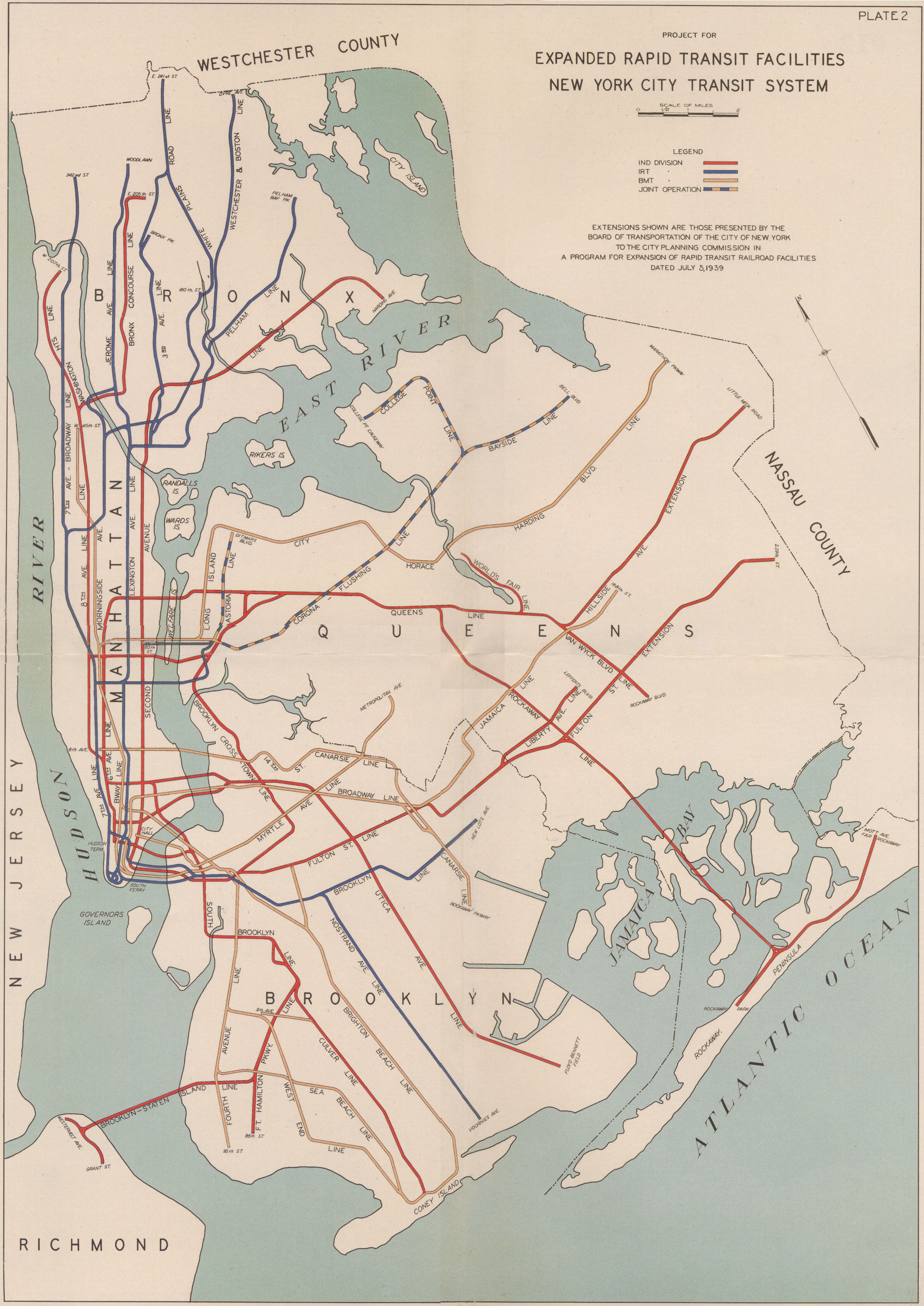
The subway expansion plans from 1939 show where the shell station at South 4th Street crosses over the G line. Click here for a full view.

When the Great Depression hit, the city had to shelve the 1929 expansion plan, and ten years later with a six-track shell provision built along South 4th St., the latest iteration of the Second System was far more modest. The Manhattan plans remained the same, but the line east from South 4th Street would continue on only to Marine Park via Utica Ave. Even before revenue service — or full tunnels were dug — the six-track station was a relic of another era. (Plans for a Utica Ave. subway in 1969 involved extending the IRT instead of the IND.)

Today, we think small and build small. Once upon a time, New York left stations unbuilt as shells for future expansion. It was cheaper and easier to build a shell at the South 4th Street transfer point than it was to build around a preexisting subway station. Now, we build just a two-track extension along Second Ave. and scoff at the notion of a Second System-like expansion in the 2010s. Imagine this part of Williamsburg as a major transfer point from the G to Manhattan, from Queens and Brooklyn into Manhattan. It’s what could have been and never was, and all that’s left is an abandoned shell of a subway station and some crazy photos of the remnants of an era when we tried to plan ahead.

Comments (40)

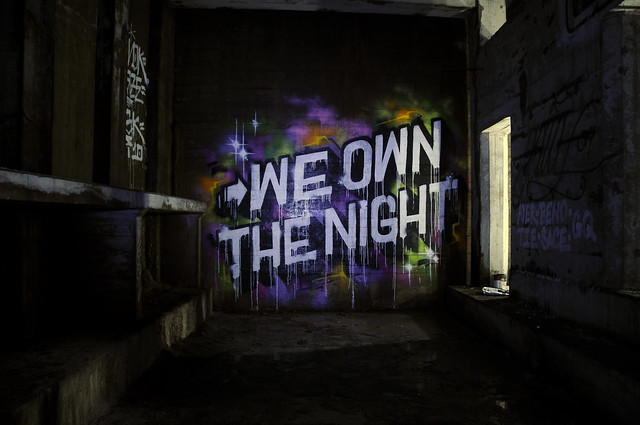
Works by Emile Souris and Jeff Soto are just two of the pieces that adorn an unused Brooklyn subway station. (Credit: Workhorse/New York Times)

Once upon a time, in the late 1970s, the subways were covered with graffiti that many considered art. This wasn’t the sloppy graffiti tags of today that involve a scrawled name or an uncreative expletive. These were full-car murals, sometimes with messages, that took time, skill and a certain willingness to spit in the face of authority. Today, even as we are commemorating early-1980s graffiti, we still debate whether these markings are art, vandalism or some mixture of the two.

Over the weekend, a story of subway graffiti and abandoned stations took the Internet by storm, and today’s Times Arts section has The Underbelly Project splashed across the front page. Per the project’s website, the concept is simple:

In early 2009, a project began four stories underneath the skin of New York. For nearly 100 years, a massive subway station sat unfinished, unused, and undiscovered. Over the course the last year, artists have been secretly escorted into this station to leave their creative mark. Unobstructed by the pressures of commercial sales, phone calls, or daily routines, each artist painted for one full night. The Underbelly Project is the result of the past year. At the close of the project, the entrance was removed and darkness reclaimed the space once again.

Jasper Rees’ piece in The Times goes more in depth. Workhorse and PAC, two street artists, came up with the idea a few years ago after seeing the abandoned subway stop, and the two took Rees on a secret tour recently. Rees can’t say where it is — more on that later — and he can’t say how they got into the station. The two artists, he says, are “seriously concerned about the threat of prosecution.” The two picked this station because, said PAC, they loved “the solitude of being underground.”

Rees talks more about the secret and hidden art show:

A vast new exhibition space opened in New York City this summer, with a show 18 months in the making. On view are works by 103 street artists from around the world, mostly big murals painted directly onto the gallery’s walls. It is one of the largest shows of such pieces ever mounted in one place, and many of the contributors are significant figures in both the street-art world and the commercial trade that now revolves around it. Its debut might have been expected to draw critics, art dealers and auction-house representatives, not to mention hordes of young fans. But none of them were invited.

In the weeks since, almost no one has seen the show. The gallery, whose existence has been a closely guarded secret, closed on the same night it opened. Known to its creators and participating artists as the Underbelly Project, the space, where all the show’s artworks remain, defies every norm of the gallery scene. Collectors can’t buy the art. The public can’t see it. And the only people with a chance of stumbling across it are the urban explorers who prowl the city’s hidden infrastructure or employees of the Metropolitan Transportation Authority.

That’s because the exhibition has been mounted, illegally, in a long-abandoned subway station. The dank, cavernous hall feels a lot farther than it actually is from the bright white rooms of Chelsea’s gallery district. Which is more or less the point: This is an art exhibition that goes to extremes to avoid being part of the art world, and even the world in general.

The piece goes on to talk about the artists who agreed to participate. Some came from as far as Europe while many were New Yorkers who jumped at the chance to explore this subway station. Rees also details, in broad strokes, how the artists accessed the spot, how they turned this dark and dank walls into a canvas and why Workhorse and PAC chose this site and had this image of it. Some time soon, the two curators will unleash on the world a list of the artists and pictures of the work. For now, we’re left with an extensive gallery on Luna Park’s blog and The Times’ own gallery. It’s quite a glimpse into a part of New York City few, if anyone, will ever seen, but it’s enough to tell those of us familiar with the subway system where it is.

One of the Underbelly Project's curators offered up this wide shot of the never-used shell station. (Credit: Workhorse/The New York Times)

Based on the visual evidence, it is in the never-used, once-built shell of a subway station at South 4th St. and Broadway in Brooklyn. I traced the unique origins of this long, lost part of the Second System two years ago, and Subway & Rail has a full gallery of this station online. Built in an age when the city built shell stations for cheap with an eye toward future expansion, this shell has set empty since the day the concrete was poured. Rumor has it that one can access the station via the G train stop at Broadway with the appropriate key.

The stories Rees tells bears out my guess:

The Metropolitan Transit Authority would occasionally shut down the nearby subway line. The artists, working through the night, would hear workers on the tracks and go silent, turning out any lights. The members of Faile were among several participants stuck that way for hours after their work (in their case, a woozy, zigzagging version of the Stars and Stripes) was done. “We were getting crazy,” Mr. McNeil recalled. “We were like, ‘We’ve got to get the hell out of this dusty blackness.’ You couldn’t see your hand in front of your face.”

Finally at 4 a.m., Mr. McNeil said, the coast seemed clear, and “we walked out there with our gear”; but the workers were still there. “We just walked by them and they’re like, ‘Where the hell did these guys come from?’ ”

The scariest moment came around 1:30 one morning, just after Workhorse had left the site with a Moscow-based Australian artist known as Strafe (who spoke on condition that her real name not be used). They heard workers nearby and sprinted back in the dark, but once back on their platform, Strafe said, “I swung round and stepped into thin air, and literally fell onto my back on the track bed.” Too stunned to move, she looked at Workhorse, who had jumped down to join her with a flashlight. She said she saw a look of horror that said, “ ‘What are we going to do if she’s seriously injured?’ ” Eventually she was able to sit up, but they still had to wait until after 5 a.m. to leave.

For its part, the MTA seems none too pleased with this revelation. Transit spokesman Charles Seaton said to The Times only that what the artists did constitutes trespassing, punishable by law. Anyone caught defacing M.T.A. property is subject to arrest and fine.”

The artists too understand both the insanity and inanity of what they’ve done. After taking Rees and a reporter from London’s Sunday Times on a tour, they destroyed the equipment they used to access the station. “We’re not under the illusion that no one will ever see it,” Workhorse said. “But what we are trying to do is to discourage it as much as possible… If you go in there and break your neck, nobody’s going to hear you scream. You’re just going to have to hope that someone is going to find you before you die.”

It is a dangerous thought about a morbid project that somehow captures both the recklessness of a bygone era, the foolhardiness of this undertaking and the mystery of an abandoned aspect of the New York City subway system. I don’t think Arts for Transit will approve.

Categories : Abandoned Stations
Comments (17)

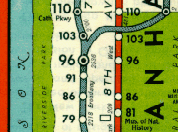
I grew up at 91st St. and Broadway in Manhattan, and I remember learning from an early age of the subway stop that, one day, years before I or my parents lived there, had been open at our corner. The station was a local stop on the IRT from 1904 until February of 1959 when modernization and platform expansion rendered it useless. Today, it is a graffiti-covered relic from another era.

These days, whenever the elimination of a service is mentioned or the partial shuttering of a subway station finds its way into the news, community groups react with a vehemence reserved only for the biggest of issues. Protests are planned; letters are written; politicians put pressure on the MTA to find a way to keep that station open. Even a station as lightly used as, say, Broad St. with its 7200 daily riders and its 589 weekend riders might garner some community support.

Once upon a time though, the Transit Authority engaged in a bit of system improvements that led to the shuttering of a good number of stations. A few were deemed redundant because they were simply too close to the next stop, and with longer trains and platforms that stretched an extra block or so, these stations were casualties various modernization programs. Surprisingly, the media reception to these closings were slight.

In 1959, when the TA closed 91st St., The Times mentioned it in the context of a 1000-word article about the $100 million West Side IRT upgrades that led to a clearing of the 96th St. bottleneck and a lengthening of that station to include a southern entrance between 93rd and 94th Sts.

Buried after the jump on page 18 of the paper was a solitary paragraph about 91st St. “One other change,” Stanley Levey wrote, “will be made on Feb. 6. The local station at Ninety-first Street will be closed. In its place an entrance to the new mezzanine of the Ninety-sixth Street station will be opened between Ninety-third and Ninety-fourth Streets.” It was rightly deemed pointless to double the length of the 91st St. stop with an express station just two blocks away.

A few of the other shuttered IRT stations received barely more coverage than that. When the city announced in 1948 that the 18th St. stop along the East Side IRT would be closed, The Times devoted three paragraphs and 123 words to the news. The reason given then wasn’t because Union Square’s northern entrances were three blocks away but because the 23rd St. station now had access points at 22nd St. “Trains will now run non-stop between Fourteenth and Twenty-third streets,” the unsigned article said.

The long-forgotten Worth St. stop, just a few hundred feet of the original Brooklyn Bridge station, received a scant send-off as well. It closed in 1962 as part of a $6 million overhaul of what we now call Brooklyn Bridge/City Hall on the East Side IRT. The TA had to lengthen and straighten the platforms to better accommodate 10-car trains, and when they did so, the Worth St. stop became pointless. Charles Grutzner of The Times was seemingly the only person to mark the occasion. “The rebuilt station, to be known as Brooklyn Bridge-Worth Street, will go into full service at 11 P.M. At the same time, the old Worth Street local station near by will shut down,” he wrote. “No ceremony will mark either event.”

And that is the way history had it. No ceremony marked the events as various stations faded into subway lore.

Comments (40)

In Boston, a team of architects won the SHIFTboston Ideas Competition by re-imagining an abandoned subway station as an underground theater space. (Click to enlarge)

The history of New York City’s subway system is littered with idiosyncratic sites. Amongst stop-and-start construction efforts, origins as three distinct companies and station expansion efforts, the tunnels underground feature their fair shares of hidden mysteries and abandoned stations. What to do with these shuttered stations has been a question long on the minds of urban planners.

For the most, New York’s long-forgotten stations — meticulously documented here by Joseph Brennan and here at NYCSubway.org — are slivers of the past. The station at 91st St. and Broadway whizzes by in the blink of an eye. It, like the ones at 18th St. and Park Ave. South and Worth St., was closed when trains were lengthened and stations were suddenly too close together. Others — such as the abandoned platforms at Canal St. along the BMT Nassau St. line — are remnants of a Manhattan Bridge connection long shuttered. Still others, such as the famous City Hall stop, were beautifully designed stations that were simply impractical for passenger service. Astute straphangers know where to look for glimpses of the past.

In New York City, the city’s approach to these stations has been to simply close them and allow urban decay to take over. Most are overrun with trash and graffiti and serve as shelters for those intrepid or foolish enough to brave a few hundreds yard in an empty subway tunnel. One in Brooklyn is the home of the Masstransiscope, an excellent Arts for Transit installation I profiled last year. Besides the 91st St. station that sits outside my parents’ apartment building, the Masstransiscope is a prime example of an excellent use for an abandoned station.

The Big Apple is not alone in dealing with its neglected stops. In Boston, the subway system also sports hidden secrets of abandoned spurs and empty stations, and recently, a pair of architects have proposed turning the station into a museum and arts complex. As Metropolis Mag’s Mason Currey notes, two designers won the SHIFTboston Ideas Competition with this proposal, and it’s not such a far-fetched one at that.

In fact, we need journey only 13 years in our own city’s history to unveil a similar proposal for the one-time Crown Jewel of the subway system. As Christopher Gray of The Times first reported in April 1997, the Transit Museum was going to open an annex in the City Hall stop. Using $2 million in Federal, city and state funds to renovate the station and prepare it for museum-goers, the Transit Museum had hoped to open the annex by 1998 and were anticipating more than 200,000 visitors per year to the unique space.

Unfortunately, Mayor Rudolph Giuliani had other ideas. Despite initially supporting the project when it was first announced in 1995, Giuliani quashed the plans in 1999, citing terrorism concerns over the station’s proximity to City Hall. “The decision was predicated on security considerations,” NYPD spokeswoman Marilyn Mode said at the time. “It’s right under the building.” With two other active subway stations in close proximity to City Hall, it sounded like a questionable excuse ten years ago and remains one today.

In the end, the Transit Museum spent $2 million to shore up the old station, and Museum members can now pay $25 for the unique privilege of attending tours of the old station. Still, as the 6 trains screech under the Guastavino Arches, the City Hall subway stop stands as an empty reminder of a plan that would better utilize an abandoned subway station. Maybe Boston can see fit to develop its unique empty underground spaces, and maybe New York could reconsider sprucing up the lost and forgotten bits of an extensive subway system.

Categories : Abandoned Stations
Comments (18)

Every now and then, I’ve written about some of the New York City subway’s abandoned stations. These relics of time past sit empty, some closed and some never used. Recently, Environmental Graffiti, a green-focused blog, went underground to explore five abandoned stations under the streets of Manhattan and Queens. The shot of the 18th St. station on the Lexington Ave. line is dramatic, and the tale of an unfinished upper level at Roosevelt Ave. makes me yearn for the never-built second system.

Comments (12)

Underneath the Waldorf-Astoria hotel, just a few steps from the busy Metro-North tracks at Grand Central Terminal, lies Track 61, a relic of another era. This track, now abandoned, had long been a mystery. Commuters can catch only glimpses of it, and it’s off-limits to all but the most senior MTA officials.

In 2007, Trainjotting offered up a few tidbits about Track 61, and yesterday, Matt Lauer on the Today Show went underground with a Metro-North spokesman to publicize of the track. The story is fascinating; it was built to accommodate FDR during his presidency when he tried to keep the extent of his disability brought about my polio under wraps. Watch the story, complete with a great look underground and word that maybe the platform isn’t as abandoned as we speak, right here.

Update: Loyal reader Francis Morrone points us to the Abandoned Stations entry on Track 61. It clears up the history and misconceptions surrounding the track’s origins. The track itself pre-dates FDR’s presidency.

Categories : Abandoned Stations
Comments (2)

Thousands of people walk past this subway entrance at 52nd and 8th, unaware of its history. (Photo by RJ Mickelson for amNew York)

We started the week with a tale about a doomed abandoned platform at 42nd and 8th Ave. Let’s end the week ten blocks north standing outside a gated subway entrance at 52nd St. and 8th Ave.

In what very well might be the best story to appear in the pages of amNew York — sorry, Chris — Matthew Sweeney explores the history of a subway entrance that has sat closed since 1991, and no one really knows what it was doing there in the first place. The article is part of a two-parter in Friday’s amNew York about some of the partnerships the MTA has formed with the buildings that climb high above their stations. The other piece focuses on the MTA’s tortured relationships with its escalators.

Sweeney gives us the history:

Paid for with private funds in 1986 — when the misbegotten K train still ran — the subway entrance at Eighth Avenue and 52nd Street has been gated and locked for nearly two decades.

It’s been shut for so long New York City Transit on Thursday could not remember when or why it ordered the gates locked. Transit officials also couldn’t say whether it will ever be open again. “It’s kind of ridiculous,” said real estate developer Adam Rose, who built the stairwell entrance to what is now the uptown C and E train platform. “The day after it opened, they closed it.”

Rose’s memory is not entirely accurate. For a brief period the entrance was open at off hours. But even then, it was not always open when it was supposed to be, said Andrew Albert, chairman of the NYC Transit Riders Council. According to Albert, the entrance was permanently closed after a woman was stabbed in the stairway in 1991.

The article doesn’t explain why the MTA has decided to close the entrance and why it was never fully staffed in the first place leading up to the Linda Belle stabbing. The building, according to Rose, was forced to construct the entrance by the MTA. Now, it sits empty, a late-1980s subway map hanging on the wall and trash collecting at the bottom of the stairwell.

Say what you will about MTA management in this instance, but stories like these are why I love the subways. While we see a lot of the system on the surface just by passing through, so many of the quirky stories behind its nooks and crannies are lost to time. You’ve got art in abandoned stations and artistic stations long since abandoned. We think of the subway map as static, but train lines head up different avenues and switch stops seemingly on a whim over the years.

The next time I walk past 52nd St. and 8th Ave., I’ll stop for a minute or two to take in an entrance I’ve seen and ignored countless times over the course of my life. One day, it may have a purpose; today, it’s just another one of New York’s great subway what if’s.

Categories : Abandoned Stations
Comments (8)

The old platform on the lower level at Times Square will soon be lost to the 7 Line Extension. (Photo by Tyler Hicks/The New York Times)

Astute subway buffs know where to look for the tell-tale signs of the mysterious lower level underneath the 8th Ave. IND platform at 42nd St. Stand on the northern edge of the uptown platform and look all the way across the tracks. If you look closely, you can see another level of subway tracks beginning a mysterious descent seemingly to nowhere.

Well, it’s not quite nowhere. Those tracks lead to the long-abandoned lower level platform that, for a few decades from 1959-1981, was home to the Aqueduct Express. The tunnel feeds into the lower level E platform at 50th St. and terminates with a merge, now out of service, in between 42nd St. and 34th St. on that IND line.

In Sunday’s Times City Section, Alex Mindlin writes about the waning days of that lower level platform. It is currently in the way of the 7 line extension and will soon to lost to the ages:

But the platform endures, gathering dust and grime. And it has seen more activity this year than in the previous few decades. Workers are preparing to demolish part of the platform so that the extended No. 7 line can cut across the space on its way westward. Other sections of the platform will be turned into electrical and hydraulic rooms; the rest will be walled off. The work should be complete in about four years…

Several films have been shot here; the track walls bear some “47-50” signs that, at this 42nd Street station, must have been intended for a movie. In the best-known scene shot at the location, from the 1990 film “Ghost,” Patrick Swayze stands on the empty platform and learns from another ghost how to move objects with his mind.

This great photo at NYCSubway.org shows how the station signage was cannibalized by Hollywood for those movies.

What Mindlin’s article misses is the amusing story behind the origins of the platform and its original purpose. After it was built during the construction of the IND lines in 1932, this lower level platform sat idle and unused until those Aqueduct trains started running 27 years later. Joseph Brennan’s abandoned station page for the platform speculates that the platform could have been used to hold Queens-bound trains at 42nd St. without impeding other trains along the 8th Ave. line.

But I prefer the theory set forth on the station’s NYCSubway.org page:

An oft-repeated story offers this as a reason the lower level was built: The Independent subway was being built by the city to compete directly with routes owned by the IRT and BMT companies. The #7 crosstown IRT line terminates at Times Square; it is said that the bumper blocks of the #7 are directly against or very close to the eastern wall of the lower level of the 42nd St. IND station. The construction of the lower level therefore blocked any potential extension of the #7 line to the west side of Manhattan. If this is true, it would have been done only in the spirit of crushing the competition, for the IND had no plans to construct a competing crosstown line.

This now-decaying station won’t impede westward progress any longer, and as the 7 line inches its way west, this platform will be lost to the annals of New York subway history. While the West Side 91st St. station and the famous City Hall stop exist through subway windows, this lower level platform will end up a legend of the subway, perhaps built to stop progress and now destroyed in the name of progress.

Comments (4)

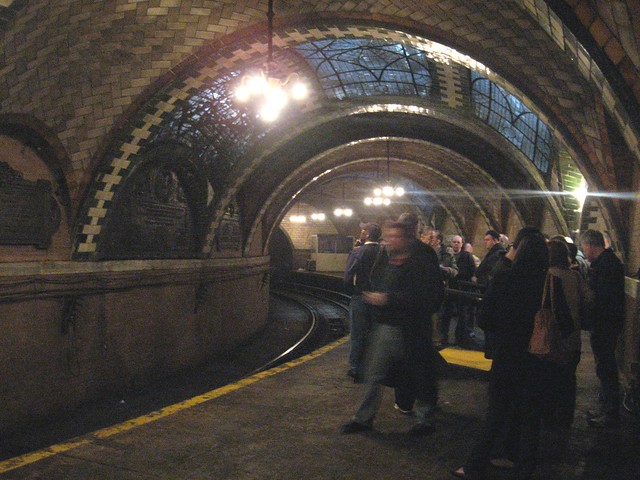
Three hundred feet south of the Brooklyn Bridge/City Hall stop on the East Side IRT lies an abandoned subway station. Called “the world’s most beautiful former subway station” by Forgotten NY, this station is the City Hall stop that served as in the inaugural launching point for the city’s subway system in 1904.

The station is ornate with chandeliers and Guastavino arches embellished with green tiling and decorative skylights. The station is also impractical. It’s a one-way local-only stop 300 feet away from a big transfer point that features both local and express IRT service. It’s built around a very sharp curve that makes the gaps at Union Square seem small. The City recognized these shortcomings and shut the station on December 31, 1945.

For fifty years, there it lay empty and unused. Trains on the 6 line would crawl through the darkened loop as they turned from downtown trains into uptown trains, but passengers were urged to dismount at Brooklyn Bridge. In the late 1990s, as the subway’s centennial neared, the MTA wanted to open the old station as an outpost of the Transit Museum. The museum started giving tours, but in 1998, the Giuiliani Administration declared the station a security risk due to its proximity to City Hall.

As the centennial came in 2004, the Transit Museum received permission to reopen the station to tours, and a few months ago, the MTA started allowing customers to ride past it on the 6 train. Every few months, Transit Museum members can take the tour of the Crown Jewel of the subway system. It’s an incredible glimpse back in time, and as the station is unique among all of the rest of the city’s 100-year stations, it’s really something to see up close.

This weekend, I finally took the tour and brought my camera along with me. While the conditions are tough for photography — it’s very poorly lit inside the station — I tried to get as many pictures as I could. You can view the entire set on flickr. But let’s take a closer look at a few shots.

Categories : Abandoned Stations
Comments (12)
  • Extended Stay

    Featuring a wide range of sophisticated furnished apartments throughout the city and surrounding areas, ExecuStay can help you enjoy a New York extended stay that's both productive and relaxing.

  • Corporate Apartments

    As a resident of ExecuStay New York corporate apartments, you'll find that getting around is a snap, thanks to the many MTA subway lines, buses and yellow cabs.