Archive for MTA Construction
Transit eying full line shutdowns to speed work
Posted by: | Comments
Transport for London often shuts down entire sections of Tube lines to finish up work quickly. The MTA may soon do the same. (Photo by flickr user Bluey Birdy)
Part of what makes New York the “city that never sleeps” are its subway lines. For 24 hours a day, seven days a week, 365 days a year, the subways always run. Some duplicative lines that offer extra peak-hour service shut down over night, but a straphanger can get on at any station and head to any other at any point in time. Now, according to reports, that could change.
For much of the past 18 months, MTA and Transit officials have struggled with keeping necessary maintenance on time and on budget while still offering as much subway service as possible. Yet, by starting work late at night during the week and wrapping up before the 5 a.m. rush the next day, the MTA has found progress slow and costly. In May of 2010, then-CEO and Chairman Jay Walder talked about full line shutdowns to improve work efficiency. “If you’re in London and you’re doing track work on the Jubilee Line, do you want me to tell you what the service announcement is on the Jubilee Line?” Walder said. “The service announcement is, ‘The Jubilee line is not running.’”
Even as late as last December, Transit President Thomas Prendergast expressed his desire to see such shutdowns implemented in New York. “Maybe for some of the more difficult tests, that take a long time to set up, pick one Saturday a month and do it at night, starting after five or six o’clock at night, look at things like that,” he said.
Now, according to a report in the Daily News based on MTA documents that will be presented to the authority board’s Transit Committee on Monday, the authority will shut down certain lines for “blitzes” that will look to speed up repairs. Pete Donohue has the details:
Every three months, a line segment — possibly stretching from midtown all the way to the southern tip of Manhattan or even downtown Brooklyn — would be closed for three or four consecutive weeknights, sources said. The new strategy likely will be tested first on the Lexington Ave. line between 42nd St. to the north and either Bowling Green in lower Manhattan or Atlantic Ave., Brooklyn, to the south, sources said.
Trains would stop running at about 10 p.m. each night and wouldn’t start up again until about 5 a.m. the next morning. That would allow the Metropolitan Transportation Authority to get many projects and tasks done at once rather than piecemeal throughout the year. It’s a worthwhile tradeoff, one transit source familiar with the plan said.
“For a few nights, you won’t have service on a segment of a line but contrast that with work being done over far more nights and weekends with all the service diversions and train slowdowns.”
In addition to the Manhattan pilot, Donohue reports, Transit may blitz some Queens work too. The Manhattan-bound F would not run from Forest Hills to Parsons Boulevard for nine days in an effort to avoid eight weekends of construction.
The details of this plan will be, as I mentioned, released on Monday, but from prior conversations with MTA officials and various statements, it’s clear that the authority has high hopes for this pilot. Track workers won’t have to contend with train traffic that, due to necessary safety precautions, delays the work schedule. Furthermore, by going all-in during the week, the MTA can scale back weekend work as well.
With weekend subway rides on the rise, the MTA is willing to take a chance by cutting off service during the week on routes that have, as Donohue terms it, “parallel subway lines.” With ridership very low during weeknight overnight periods, the MTA is seeking a way to inconvenience fewer people while improving efficiency. It might take some getting used to this plan, but as the subways never sleep, the work must go on one way or another.
Building a subway most expensive
Posted by: | CommentsA few weeks ago, when MTA Capital Construction President Michael Horodniceanu spoke at a New York Law School breakfast on the state of the MTA’s megaprojects, he let loose some interesting information on construction prices. During the Q-and-A session when I asked why construction in New York costs so much more than construction everywhere else, he said one thing: work rules. The MTA is required to overstaff projects so that the same TBM work, for instance, that can be done in Spain with 9 workers must be done in NYC with 25 workers. Thus, everything costs far too much.
Today, over at The Atlantic’s new-ish Cities blog, David Lepeska examines how $1 billion doesn’t go too far these days. Noting how projects in New York are orders of magnitude more expensive than similar efforts around the world, Lepeska wants to know why. To find out why, he spoke with Robert Paaswell of City College of New York, and the professor points to the age of our system and the general costs of regulation. The main culprits, he says, are “New York’s higher regulation costs, over-conservative labor laws and financing via bonds, which lead to longer-term debt plans.”
Paaswell also pondered on the length of time it takes to get work done. There, he blames neighborhood sensitivities. “There’s no urgency by governments or citizens here to get subways done, and when it finally happens the construction causes so much inconvenience that people don’t like it,” he said. “In Europe, they don’t care too much about it, they just blast right through and get it done.” It is a perfect storm of inefficient construction and a public that wants the results but fears the means.
The pipe dream of future expansion projects
Posted by: | Comments
It may be a while before funding materializes for future phases of the Second Avenue Subway.
Early this morning at the New York Law School, Dr. Michael Horodniceanu, president of the MTA’s Capital Construction division, spoke to a crowded room gobbling up their fruit slices and free croissants on the state of the MTA’s expansion efforts. For anyone whose been reading my site over the past few years, Horodniceanu’s presentation featured little new information. He spoke about the costs, complexities and challenges of the various big-ticket items and discussed how the MTA generates more construction jobs in the New York City area than anyone else.
Yet, despite the rather basic nature of the presentation, Horodniceanu let slip a few hints that this round of construction might be the last we see of transit expansion in and around the city, barring an unforeseen financial windfall anywhere. While speaking of the Second Ave. Subway, Horodniceanu discussed the impact Phase 1 will have and how the MTA is using the preexisting sections north of 99th St. as tail tracks. Of the future phases, he was less optimistic. “Sections two, three and four will be for our children or grandchildren,” he said with a sigh.
Later, during the Q-and-A when an audience member asked about the immediate future of the plans to extend the 7 line to Secaucus, Horodniceanu nearly dismissed it out of hand. He spoke of the engineering studies the city — not the MTA — is currently conducting but said point blank that the money isn’t there. It’s not there from the feds; it’s not there from the states of New York or New Jersey; it’s not there from the MTA. The only place I could imagine funding such a rail line would be the Port Authority, and they’re currently tapped out.
On the one hand, Horodniceanu is being politically practical here. The state hasn’t even figured out how to fund the current MTA capital plan, let alone any future ones. Why should we consider Phases 2 or 3 of the Second Ave. Subway if Phase 1 still won’t be completed for another five years? But on the other hand, Horodniceanu’s words are a bit discouraging. If transportation expansion and investment funds start to dry up by 2016, the city will likely faced stagnant growth and decaying infrastructure.
What also struck me about Horodniceanu’s words was how foolish it was to flat-out cancel the ARC Tunnel project. We’re reminded on a near-daily basis that the region is in desperate need of more trans-Hudson rail connections, and we were enjoying the perfect storm of funding, construction work and planning that would have produced ARC. Instead of reworking the project or trying to identify cost savings, Gov. Chris Christie flat-out canceled a 20-year planning effort, and it seems unlikely that a replacement will materialize within the next few years (or possibly even decades).
Enjoy the effort to expand our transit network while you can. As governments tighten their belts, increases in rail capacity will be few and far between. That’s some somber news for a Friday afternoon.
The MTA’s brain-drain problem at the top
Posted by: | CommentsA few weeks ago, word got out of a few new FTA reports concerning the MTA’s ongoing big-ticket capital items. Initially, we learned that the Federal Transit Administration believed the MTA’s current launch dates for the Second Ave. Subway and East Side Access project were premature. Instead of a 2016 revenue service date, the FTA expects SAS and ESA to open in 2018. That was not, apparently, the only key finding in the reports.
As The Post details, turnover at the top of the management structure for these projects has become a major issue for the MTA. Brain drain, it seems, isn’t just limited to the Chairman’s spot. Jennifer Fermino has more:
Top managers on mega-MTA projects — who haven’t had raises in four years — are bolting at an alarmingly high rate, leaving crucial positions vacant and prompting concern from federal regulators. The Federal Transit Administration is so disturbed by the high turnover that in two separate reports, they’ve cautioned the cash-strapped agency to quickly bring in experienced managers to fill current and future vacancies on such massive projects as the Second Avenue Subway, according to government reports obtained by The Post. But that likely will be easier said than done. Unlike unionized workers — whose contracts ensure they get annual cost-of-living increases — members of MTA management haven’t had a salary hike in four years.
“There are obviously issues with MTA employees and staffing levels and pay scales,” said MTA board member Mitch Pally, who is on the committee that monitors the agency’s big-ticket projects. “I can assure you that management doesn’t make enough money, especially for people who are experienced,” he said. “These are complicated jobs.”
…Federal regulators lamented the “substantial turnover” among contract and MTA staff managers over the past year in their monthly report on the Second Avenue Subway. The agency “remains concerned that the continued staff shortage may impair proper functioning of the project quality processes,” the FTA said in another report, which suggests they hire more managers. In one area of quality management on the Second Avenue Subway, two of the MTA’s three agency consultants are new. Another outside consulting position in the same division also is vacant, according to the report.
This is what we call a vicious cycle. As unionized workers — those who weren’t dismissed, that is — earned raises and will fight for more, the MTA’s management minds have gotten none, and they’re starting to leave. They can get higher paying jobs at organizations that enjoy greater political and fiscal support than the MTA. So then why shouldn’t they leave? If that story sounds similar, it’s because that’s basically what Jay Walder is doing at the end of October.
The solution, of course, is a politically dangerous one. The MTA must be allowed to raise salaries to remain competitive in a global market. The authority can’t afford to see its projects completed slowly, haphazardly or not at all because its salaries aren’t high enough to attract and retain the leaders they need. Ultimately, this isn’t some great insight into the state of things at the MTA, but it’s a lesson few people in Albany and elsewhere have learned. Now it’s starting to get too late.
Comptrollers’ audit blasts MTA service changes
Posted by: | Comments
To help weekend crowds combat route changes, the MTA redesigned its service advisory signs last fall.
The MTA is losing millions in poorly-planned weekend track work, and the agency is not doing an adequate enough job in providing alternate routes or information on service changes, a new report issued jointly by Thomas DiNapoli and John Liu says. The State and City Comptrollers’ report claims that the MTA wasted over $10 million over three years as trains were not placed back in service as work wrapped early. Furthermore, a sampling of projects found significant cost overruns as well.
“When the MTA fails to manage its service diversions properly, it’s more than an inconvenience; it’s a waste of taxpayer money and it derails local businesses,” DiNapoli, the state comptroller, said. “Our audit found that MTA’s service diversions are increasing in frequency and leaving taxpayers on the hook for millions of dollars in cost overruns. The subway system is showing its age, but the MTA has to do a better job managing all aspects of these diversions, from rider notification to budgeting.”
The report — the first one issued jointly by the two comptrollers’ offices in some years — landed yesterday, and it was but another salvo in the barrage aimed at the MTA’s track work. Earlier in July, weekend service changes drew headlines when The Times noted how growing weekend ridership at some stations and along some lines has led to disgruntled passengers. The MTA subsequently promised to study weekend service along the L, but this new report seems to show how one study won’t be enough.
The details of the report are fairly unsurprising. Basically, the MTA’s track work is a mishmash of GOs that often aren’t recorded properly, aren’t communicated to the public properly and cost to much. For instance, the report found that that Transit spent just $228,000 in 2010 informing its 2.3 billion riders of service diversions while the Long Island Rail Road spent over $740,000 on its 81.9 million riders. At randomly selected stations, auditors found 20 signs instead of Transit’s alleged 50 and did not find signs at street level, in subway cars or on platforms in many instances. Furthermore, while Transit has a policy that calls for newspaper advertisements, they ran just twice out of 50 sampled diversions.
On the efficiency front, the findings were even worse. Servuce diversions increased in number between 2008 and 2010, and those lasting for more than a month rose from seven to 57. More damning though were the allegations of poor time management that cost the MTA upwards of $10.5 million and its passengers countless aggravations. Says the report: “Transit often reroutes riders’ trains even when no work is taking place. When asked for the General Order Worksheets that track time spent on each diversion, Transit management could only provide auditors with 29 of the 50. Of those 29 diversions, work started late on 28 and stopped early on 21. Unproductive work time ate up anywhere from 10 to 27 percent of the time trains were diverted, though there was no cost mitigation.”
“Sadly this confirms the nagging suspicion of riders, residents and business owners alike, that subway service is taken down more than necessary,” Liu, the city’s comptroller, said. “The MTA must understand that the City never sleeps and weekend service is neither ancillary nor expendable. We expect the MTA to maintain and repair the tracks, while keeping disruptions to a minimum.”
The two final areas studied showed similarly poor findings. In a study of 15 diversions and 12 contracts, the comptrollers found that four of these contracts were over budget by $26.6 million. Furthermore, shuttle buses are seemingly employed without regard for the ridership numbers. Transit officials generally could not explain how estimates were used to determine shuttle bus demand, and the only estimate they could provide was six years old.
For its part, the MTA issued its usual statement on weekend work. “Due to the 24-hour, seven-day-a-week operation of the subway system, planned service diversions are necessary in order to perform maintenance and capital work,” the authority said. “We make every effort to minimize customer inconvenience by coordinating work — performing multiple jobs in the same area so that we do not have to go back again. However, some projects are extremely involved, requiring several shutdowns.”
Still, in a response to the comptrollers’ report, Transit acknowledged its shortcomings. DiNapoli and Liu issued five recommendations. They include better outreach on service changes; closer monitoring of expenditures; a push to restore subway service as soon as possible; and a renewed attempt to better assess shuttle bus demand. Simple changes could go a long way toward making off-hour and weekend travel much, much less inconvenient for millions.
Photo of the Day: The ‘why’ of weekend work
Posted by: | Comments
Trackbed removal along the G train often requires weekend service shutdowns. (Photo by Metropolitan Transportation Authority, Leonard Wiggins)
When my dad, who is currently on vacation in Prague, received his Second Ave. Sagas email this morning and read my take on the MTA’s increased weekend ridership, he had a question for me. “When are they supposed to do maintenance and improvements if not on weekends?” he asked.
It’s a good question, and one apparently lost on our public officials. In fact, John Liu himself, the city comptroller who has been mentioned as a potential 2013 mayoral candidate, didn’t seem to comprehend that point. “The MTA can no longer have the luxury to think that weekends are expendable; weekends are commuting days now,” he said to The Times. “People who commute Monday to Friday say nice things about the subways. But the complaints about weekend service resound all throughout the city.”
Apparently, the MTA had the same thought. Without referencing The Times article, the authority issued a pointed press release this afternoon intended to highlight the work crews do over the weekend. “At least three of this past weekend’s work projects involved jobs that required the removal of track,” the statement said. “A new concrete roadbed was installed on the uptown B/C Line track between 103rd and 110th Streets, in Manhattan. Once completed, the improvements to the roadbed will provide a smoother, quieter ride through the area.”
While noting that crews were also working on the connection between the uptown 6 at Bleecker St. and the Broadway/Lafayette station, the authority, which released a corresponding flickr photoset, had a message: “While these jobs pose some inconvenience for customers, weekends are the only time when complicated track, signal and electrical projects can be performed due to the necessity for workers to have access to tracks without having to be concerned about passing train traffic. Other types of jobs, such as station rehabilitation platform edge replacement also require suspension of train service.”
That is, of course, the problem: No matter how many people ride on the weekends, the numbers will not eclipse those dependent upon weekday subway service, and the MTA must rehabilitate its infrastructure which, at places, is 100 years old. When else can they do that except during the weekends?
Crowds grow and so do weekend complaints
Posted by: | Comments
To help weekend crowds combat route changes, the MTA redesigned its service advisory signs last fall.
A few weeks ago, on Father’s Day, I was waiting for an express train back to Brooklyn from Manhattan at around 9 p.m. that Sunday night. When the 2 train pulled into 14th Street, it was packed. I had enough room to stand comfortably, but no seat opened up until a few folks got out at Fulton Street. The train remained crowded — not just for a Sunday night — until I left at Grand Army Plaza.
For frequent riders, these crowded weekend trains aren’t a new phenomenon. In absolute numbers, weekend ridership remains far behind weekend totals. In fact, the combined ridership for Saturday and Sunday in April reached 5.4 million while the subway seems 5.2 million per weekday. Yet with fewer trains on the rails and popular tourist and nightlife destinations packing in people, trains can be nearly as crowded on the weekend as they are during the week, and this is, according to an article in today’s Times, a new and surprising development for Transit.
As Michael Grynbaum reports, large swaths of subway routes aren’t seeing the massive decreases in ridership that used to be a weekend hallmark. Weekend totals, he writes, “have doubled in the past 20 years, far outpacing the growth of ridership during the workweek.” “You would probably have to go back to close to World War II — when people were working six days a week — to find a similar trend,” William M. Wheeler, the MTA’s director of planning said to The Times.
Transit officials are attentively watching these ridership trends which they say are spurred on by “the shifting cultural and economic picture of New York.” No longer are residents afraid of riding the subways after dark as they were from the late 1970s through the early 1990s. With rampant gentrification pushing the city’s less safe neighborhoods to the margins of the map along with a concerted push by the city to clean up the subways and capital investments in rolling stock, the subways are far safer than they once were, and it shows.
An accompanying graphic highlights how some stations aren’t seeing major weekend decreases in riders, and Grynbaum has more:
Dozens of residential developments have sprouted up around subway stations in once-desolate parts of Brooklyn and Queens. And the rise of a service-oriented city economy means many workers report to jobs on the weekends or at off hours.
Just 10 years ago, the transportation authority was running advertisements that encouraged riders to take advantage of extra space on weekend trains. Today, in nightlife-heavy neighborhoods like the Lower East Side, the subways move nearly the same number of riders on weekends as they do during the week, a phenomenon once considered unthinkable.
At the Bedford Avenue stop in Williamsburg, Brooklyn, which serves about a third of the L train’s passengers, an average weekend day retains 90 percent of the ridership of a weekday. At Prince Street in SoHo, recently recast as an upscale shopping mecca, the retention rate is 85 percent.
For the MTA, though, this increase in ridership leads to disgruntled weekend passengers when service changes — which this weekend, impacted 16 lines — lead to roundabout reroutings and shuttle buses. The number one gripe many have with the MTA these days focuses around weekend travel. “The MTA can no longer have the luxury to think that weekends are expendable; weekends are commuting days now,” John Liu, the city comptroller who never met a complaint he wouldn’t audit, said. “People who commute Monday to Friday say nice things about the subways. But the complaints about weekend service resound all throughout the city.”
So as Liu audits the MTA’s weekend service patterns — to what end, I have no idea — the MTA will continue to reroute trains for the weekend. Even with ridership down, it’s still overall a fraction of the weekday totals, and a plan floated by Jay Walder last year to shudder full lines in order to blitz them with work gained little traction. “[The weekend] is the only time available to get these projects completed,” MTA spokesman Charles Seaton said.
And so New Yorkers will complain. They want smooth weekday rides and full weekend service, but they can’t have both. Ridership, which should inch ever upward, will push the MTA to find a better weekend solution and provide more reliable replacement service while it can. Ultimately, though, William Henderson of the Permanent Citizens Advisory Committee put it best: “There are no answers that are going to be painless.”
MTA upgrading parts at over 200 stations
Posted by: | CommentsAs the MTA has ramped up its push for capital funding, the state of its stations has come under the microscope. The Straphangers Campaign is hosting a photo contest featuring pictures that show decay (and beauty) while stations themselves are infested with mold. Now, says MTA head Jay Walder, the authority will aggressively try to address these problems.
As part of the much-heralded component-based repair system, the MTA is currently attempting to fix up parts of 53 stations throughout the city, and as The Daily News reported yesterday, the authority hopes to add 173 more stations to that list before the next 12 months are up. “There are structural conditions in many of our stations that we shouldn’t be satisfied with,” Walder said to Pete Donohue. “I think we’re addressing them. The level of station activity that is taking place and will be taking place in the coming months, frankly, is unprecedented in our system.”
Per The News, most of these fixes will focus around cosmetic upgrades and physical improvements such as “replacing canopies, stairwells and platform edges.” The repairs won’t include full station overhauls, and many of the system’s dingiest stations won’t see the rehabs they desperately need any time soon. Putting lipstick on a pig is a good first step, but it shouldn’t be the last in an effort to improve the appearance of our rapidly aging subway infrastructure.
A glimpse inside the Bleecker St. rehab
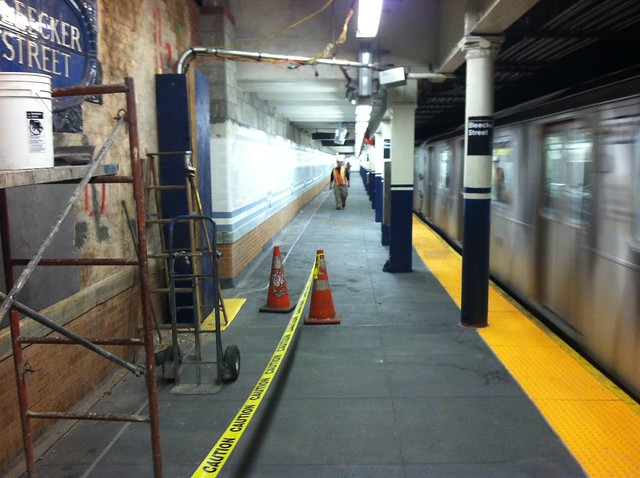
Posted by: | CommentsI found myself this afternoon waiting for an uptown 6 train at Bleecker St. The blue construction door, hiding the southern extension of the uptown platform, was locked, but I could see through a hole in the fence. Using my cell phone camera, I snuck a photo in before the 6 train arrived.
The Broadway/Lafayette-Bleecker St. rehab is an extensive one. The station will soon be ADA-compliant, and the uptown 6 platform will be connected to the rest of the complex via a mezzanine that runs under the IRT tracks. Currently, straphangers can transfer from the 6th Ave. B/D/F/M trains only to the downtown 6. To accomplish this new crossover, the uptown platform is being extended a few hundred feet south, and that’s what you see above.
Work at the station has moved relatively slowly. We glimpsed the first renderings in late May of 2007 and saw some cross-section diagrams in mid-2009. Last year, Transit went behind the blue fence and sent out some official updates. The $94 million project is still set to wrap by November of this year.
Wanting nicer stations without the inconvenience
Posted by: | CommentsI love stories such as this one. It’s a typical person-on-the-street piece from the Daily News about the station closures along the Pelham Line. As the final phase of this rehab project, the Elder and Lawrence Ave. stations are to be shut for eight months beginning next months. Some residents are unhappy with the project. Or not.
Basically, Daniel Beekman spoke to enough people to find those who want their cake and others who want to eat it too. “It’s going to be bad,” one commuter said. “Eight months is too long.” Another whose son will have to walk to another stop: “I’m concerned for my son’s safety. Why can’t they just do patchwork?” A third: “The paint is peeling. There’s a lot of graffiti. It looks terrible.”
It’s always easy to find a good number of people with varying opinions on anything in New York, and this is just another example of the tenuous relationship with transit improvements everyone has. We want our system to look good, but we don’t want to pay the price of a shuttered station for eight or nine months. Our stop needs work, but I don’t want to be inconvenienced, and as long as everyone else’s stop looks new, leave mine alone. Seems perfectly irrational to me.