Archive for Doomsday Budget
New Ravitch proposal; same stupid Senators
Posted by: | Comments
At this point, only a willfully ignorant person would claim that the MTA should not be rescued. Just a few weeks before the MTA is set to jack up fares and start cutting services, the MTA announced a higher-than-expected deficit for 2009. The future is not rosy.
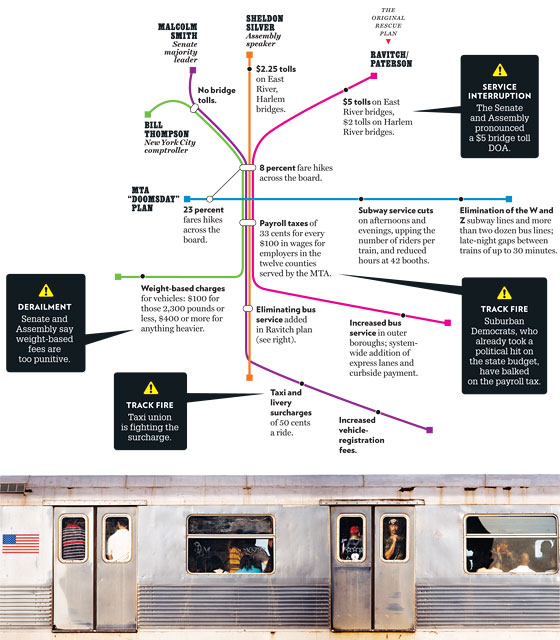
Meanwhile, Albany remains deadlocked and on vacation. Some Senators won’t support tolls; others won’t support taxes; and as a NY Magazine graphic showed, nothing is going anywhere in the Senate.
This stalemate, though, isn’t for a lack of trying on behalf of the transit supporters. In an effort to bridge some of the gaps in the Senate, Richard Ravitch, the architect of the tax-and-toll plan aimed as spreading the pain around, unveiled an amended plan that reduces some toll burdens in exchange for a few other fees. Still, the same old reactionary state Senators refuse to support a plan. Still, they pretend as though driving and tolls — and not a fully funded transit system — is some populist cause. It’s frankly getting embarrassing and angering at the same time.
William Neuman of The Times outlined the new fees and a plan to refund tolls for businesses reliant on automobile traffic across the East River bridge spans. He writes:
Seeking to win over State Senate opponents of a plan to create new bridge tolls on the East and Harlem Rivers, supporters of a financial rescue for the Metropolitan Transportation Authority offered a compromise on Wednesday that would give toll rebates to drivers traveling to medical appointments and to businesses that frequently use the river crossings…
To pay for the rebates, the state commission proposed two additional charges: a 50-cent surcharge on yellow-cab rides and an increase in the Manhattan parking garage tax. Those additional charges would raise an estimated $150 million a year.
The compromise was intended to overcome the objections of half a dozen Democratic opponents of the toll measure who have blocked the rescue plan in the State Senate, where Democrats hold a 32-to-30 margin. Senate Republicans have so far refused to support the plan and have said they have been left out of discussions.
What Neuman doesn’t say is that this compromise, crafted to address a lot of the pro-business concerns, is also aimed at attracting Republican support for the MTA. It should work; it needs to work. But the same old politicians are at it again.
We already know what the reactionary Taxi Workers Alliance thinks about this proposed plan. They won’t like it, but the real problem are the State Senators. Glenn Blain and Pete Donohue tracked down some of the more colorful and off-putting quotes from the Gang of Senate Idiots who won’t support an MTA funding plan.
Sen. Carl Kruger (D-Brooklyn), called the proposed amendment “ridiculous” and “not even worthy of comment.”
Sen. Pedro Espada (D-Bronx) said exemptions would likely be lifted at a later date, presumably by the state Legislature, and everyone would get tolled. “It just fundamentally wrong,” he said. “It is anti business. It is anti small business.”
Sen. Ruben Diaz, also of the Bronx, echoed Espada’s comments. “I am opposed to any toll,” Diaz told The Times. “They’re going to do a rebate? After two years they’re going to say no rebate. It’s a gimmick.”
Again, we have Senators from districts that rely overwhelming on mass transit — about 70 percent of Diaz’s and Espada’s constituents commute via subway — who are resorting to faux-populist arguments. At least the TWA’s position is somewhat defensible. Espada, Diaz and Kruger are simply showing why they should never have been elected in the first place.
When transit fails in the city — and it will if no funding plan is implemented — those are the men to blame. Pro transit advocates have done everything they can, but if they can’t convince the blind gatekeepers, we’re all lost.
The graphical state of the MTA funding debate
Posted by: | CommentsConfused by the state of the MTA funding debate? Not sure who proposed what or which faction support what plan? You’re not alone, and New York Magazine wants to enlighten you.
Courtesy of Jacob Gershman and the weekly mag comes a guide in subway map form. While not quite as confusing as the old Vingelli subway map, this new chart attempts to replicate a map with which we are all familiar. Check it out:

MTA to announce more service cuts soon
Posted by: | CommentsEarlier this morning, I reported the alarming news that the MTA’s deficit is growing by nearly $200 million. While the first reports noted that the MTA would consider new cuts, updates from this morning indicated that the announcement of those cuts could come before the month is out. According to The Post, the MTA is set to unveil a second round of service cuts on April 29. If Albany doesn’t act decisively and soon, New York City will be left with a crippled transit infrastructure and little hope for its immediate future.
MTA now projected an even larger deficit
Posted by: | Comments
In late February, as the MTA Board was approaching its date for enacting the Doomsday budget and funding efforts out of the State Senate had yet to collapse, I noted that the MTA deficit may wind up higher than $1.2 billion. At the time, the MTA’s year-to-date tax revenues were well below expected, and the deficit figures I tossed around were in the $1.8 to $2 billion range. The situation, in other words, could get worse before it gets better if Albany fails to find a permanent solution to the MTA’s funding woes.
Today, that scenario became one step closer to a reality. According to new financial documents released Monday, the MTA is now expecting to wind up with revenues at least $200 million less than expected. The agency may have to resort to more fare hikes and service cuts to balance its budget. William Neuman of The Times has more:
In the latest forecast, released Monday in materials for a coming bond sale, the authority said the state had informed the authority that it should expect a shortfall as large as $200 million in revenue this year from a basket of taxes dedicated to mass transit, including portions of the sales tax and a tax on corporate profits.
That is more than double what the authority projected in February when it tried to gauge how its tax revenues would be affected if the decline in the region’s economy became much worse. At that time it estimated that if the economy hit bottom, its dedicated state tax receipts could be down by as much as $82 million.
Making the picture even bleaker, the projected shortfall in dedicated taxes is in addition to a previously disclosed drop in revenue from taxes on real estate transfers and mortgages. For just the first three months of the year, those taxes were $123 million below the levels written into the authority’s budget.
In February, the MTA predicted at least a $651 million increase to the deficit, bringing the total to $1.8 billion on the year. That was before the state unveiled this bad news. Now, the deficit could reach the $2 billion mark before 2009 is out.
As I explored on Friday, this crushing debt is due to some very bad political decisions made during the Pataki Administration. In the mid-1990s, then-Gov. Pataki opted to pay for the MTA Capital Construction budget on credit, and now, the debt payments are due.
The news though for the agency keeps getting worse, and at some point, Albany will be forced to act. Whether that point arrives before the MTA is sitting on the brink of bankruptcy remains to be seen. Either way, what happens over the next few months will impact the future of New York City for years to come.
Republicans, roads keys to transit’s future
Posted by: | Comments
While the New York State Senate does not formally meet this week, the political wheels are spinning fast and furious as time is running out for the MTA. While Senate Democrats continue to consider any and all possibilities for an MTA funding plan, transportation advocates are turning toward the GOP for support.
Republicans have been loathe to support any plan. The state party feels it has been largely left out of both the budget sessions and MTA discussions. Now, though, it sounds as though enough members of the Republican contingent could be convinced to support an MTA plan — but with strings attached. Any acceptable plan probably won’t include a payroll tax, and Republicans from north of the city want equal investment in upstate roads as a condition of any MTA package.
“To just ignore the highway, road and bridge plan and go to trying to negotiate a schedule for a new M.T.A. capital plan was just not the right thing to do,” Senator Thomas W. Libous, the top Republican on the Senate Transportation Committee, said to Times reporter William Neuman today. Neuman has more on the next potential move for the MTA:
In the past, the Legislature has generally allotted equal amounts to roads and transit. That has ensured support from both parties and all areas of the state: The city is seen as benefiting most from the transit money, while upstate areas rely heavily on roadway spending. But that pattern was broken last year when Mr. Paterson chose to seek a financial rescue for the authority first…
Mr. Paterson and Mr. Silver both support the plan, but in the Senate, where Democrats have a narrow 32-to-30 majority, a group of city Democrats has blocked the toll proposal while a group of suburban Democrats has opposed the payroll tax.
That has led to appeals for support from Republicans, who have largely sat on the sidelines as Democrats bickered. Republicans have pointed to the lack of a corresponding highway and bridge program and have also said that they have been left out of negotiations about a rescue plan.
Even the most ardent of transit supporters recognize the reality that New York State may need both a transit and road plan. Politically, tying the two together could bring in enough votes to pass both. Economically, infrastructure investment in roads and transit could spur on a stagnant New York economy.
“If you brought in the bridge and highway program, that would help it become a bipartisan issue, as it’s been in the past,” Robert D. Yaro, president of the Regional Plan Association, said to Neuman. “This is a pretty fundamental economic issue for the whole state.”
Meanwhile, Neuman covers some key ground. The road bill would probably be looked to draw as much money to upstate infrastructure as the MTA would be receiving downstate. Considering the tenor of the debate currently raging among the Democrats, how can we expect Albany to act before the fares are raised next month and before service cuts begin to go into effect in June?
Politically, Gov. Paterson and Sheldon Silver aren’t the only two New Yorkers going after the GOP. The Transit Workers Union started airing ads aimed at New York City-based Republicans who won’t support transit. All in all, this is a smart move. Right now, the city needs the MTA to stay up and running. If it means investing in upstate roads at the same time, so be it. We’ll all benefit in the end.
MTA funding talks on hold for 12 days
Posted by: | CommentsAs the end of the day arrived in Albany yesterday and Passover fell, the State Senate adjourned until April 20. With a budget in the books, state representatives have all gone home for the holidays. Yet, the MTA’s uncertain future rests heavily on the Senate.
In just over seven weeks, the MTA will raise the fares a whopping 23 percent. Single subway and bus rides will cost $2.50. The 30-day unlimited MetroCards will cost $103 instead of $81. A few weeks later, the MTA will begin cutting service and firing employees across the entire New York City Metropolitan Area. No one will be happy, and the Senators seem to know this.
To that end, the Senators are still trying to come up with a funding plan for the fiscally-strapped transit agency. According to the Times Herald-Record, the various Senate plans consist of some of the following options:
- Imposing new state and/or regional fees on car registrations and driver’s licenses
- Adding new surcharges to taxi fares and parking garage fees in New York City
- Levying new fees on car rentals
- Adopting a modified payroll tax
- Increasing the MTA-dedicated sales tax
- Dedicating a percentage of the state income tax
The smartest and most equitable option — tolling the East River bridges — seems dead and buried. Despite that omission, though, this list is far from breaking news. At various points over the last year, politicians and transit advocates have proposed some combination of these factors. In my opinion, these measures will result in a temporary fix and don’t help the MTA secure a stream of revenue that would allow them to expand while meeting the demands of an operating budget. This are political stop-gaps designed by politicians and not policy-based solutions set forward by experts.
For now, though, that’s rather here nor there. As the State Senate left yesterday, though, their words were again alarming. Martin Dilan, head of the Senate Transportation Committee, stopped to talk to Politicker NY on the way out the door. “We were really trying to get something done, but this ‘rush’ thing really doesn’t work,” he said. “Basically, what’s on the table is a $25 registration fee for the 12 counties; there’s also a possibility of an additional cent or two within the 12 county region.” The fee is for keys; the tax, gas.
A few Senators have followed the bolded line of reasoning, and I don’t see the reality behind it. The Governor convened the Ravitch Commission in June of 2008, nine months ago. At that point, the entire state was put on notice that the MTA was struggling financially. Richard Ravitch released a preliminary report in September and a final report in December.
Between December and the end of March, the MTA held numerous hearings on the commission’s report and their proposed fare hikes with and without the money from that report’s proposals. During that entire time — during the past nine months — the State Senate did nothing to address an obvious and known problem. Now, after the MTA Board approved the Doomsday budget and seven weeks before it’s set to be implementing, State Senators are still bemoaning a time table they deem to be rushed.
That is, in a word, ludicrous. The time for excuses is over; the time to act is now. If the Senators need more than nine months to come up with a plan, perhaps we need some new Senators.
Dems reach out to GOP, but is the MTA reaching anyone?
Posted by: | CommentsWe join today’s episode of “As the MTA Turns” now in progress.
As the State Democrats bicker about taxes and tolls, party leaders in the both the Assembly and Senate are trying to reach across the aisle to garner GOP support. State Republican leaders, however, are loathe to embrace any MTA funding package and believe that transit proponents are overstating the severity of the financial crisis.
Newsday’s James T. Madore has more:
Assembly Speaker Sheldon Silver (D-Manhattan) warned jobs would be lost at the upstate factories making buses and commuter trains for the authority while Long Island commuters faced exorbitant fare hikes. The regions mentioned are represented by Republicans, who hold 30 of the 62 seats in the Senate.
Sen. Malcolm Smith (D-St. Albans), the majority leader, was more conciliatory, saying he appreciated Republicans’ insistence that a rescue of the Metropolitan Transportation Authority be paired with money for roads and bridges on the Island and upstate. He said a meeting Monday with Senate Minority Leader Dean Skelos (R-Rockville Centre) had encouraged him.
Smith needs GOP help because of a rebellion in Democratic ranks over funding the MTA with bridge tolls on the now-free East River and Harlem River bridges, and a payroll tax on employers in the 12 counties served by the authority. Democrats’ narrow majority means the objections of one senator can scuttle a deal.
While these politicians now seem to be fighting as hard they can for the MTA, something that I didn’t mention this morning in the PCAC report leapt out at me. It’s rather relevant considering the politicking going on in Albany these days.
Embedded in the section assessing the overall effectiveness of the MTA was this paragraph on lobbying efforts:
While there have been more visible efforts by the MTA in recent months to press the New York State legislature and the U.S. Congress for increased predictable financial support, these initiatives must be enhanced and sustained. As the largest transit system in the U.S., with a full agenda of needed improvements and rapidly growing ridership, the MTA must aggressively promote its critical role in the economic vitality of the New York City region. As part of that effort, MTA must do better in quantifying the number of jobs that will be created by its capital and state-of-good-repair programs. When its dire financial situation was accelerating in the fall of 2008, the MTA was slow to produce these figures and slow to publicize them. Information about the impact of service cuts on the constituencies of NYS legislators was also delayed. Finally, the Authority did not harness the energy of rider advocates who could serve as a powerful voice on MTA’s behalf.
That assessment is right on the mark. For too long, the opponents of a sensible funding plan — requiring bridge tolls and other fees on businesses and services that benefit from a fully functional transit agency — have been winning the PR war. The MTA, while vocal, hasn’t been an organizing factor, and rider advocacy organizations haven’t enjoyed the coherence or the support they should be showing.
With Passover nearly upon us and Easter on the horizon, straphangers may have to wait until next week for another update from Albany. As each day that passes, we grow one day closer to service cuts and fare hikes. That’s bad news for everyone.
Paterson blames [insert political group here] for MTA inaction
Posted by: | CommentsIt’s tough being David Paterson right now. The accidental governor of New York state, Paterson’s approval ratings have fallen below 20 percent, and his own party is considering jettisoning him prior to the 2010 primaries. I have to give Paterson credit though for trying to push the State Senate on the MTA funding plan. While he has no political capital, he is keeping the issue in the press.
Yesterday, Paterson again slammed State Republicans for their unwillingness to support anything despite the obvious benefits a fully funded MTA would bring to their constituents. “Right now, the Republicans could come in. They could pass the MTA budget and yours truly would have to thank them in public,” Paterson said. “That’s how you get back to being in the majority, not be being negative and hostile.” Republicans rejected the governor’s advances, and business as usual went on in Albany.
Bill de Blasio supports Silver tolling plan
Posted by: | CommentsBill de Blasio, City Council representative from Brooklyn, spoke out in favor of Sheldon Silver’s $2 East River bridge toll plan today. With his statement in support of the plan to fund the MTA, de Blasio becomes the first City Council member to take a stand on the issue. As Streetsblog reports, his support is notable because he was a congestion pricing opponent. Perhaps he is finally coming around on the issue, and we can only hope that other New York City pols take notice.
Isolating outer borough neighborhoods
Posted by: | CommentsI live in a transit-rich section of Brooklyn. I’m nearly equidistant from four train stops and have my choice of bus routes that run north-south, east-west. When the MTA’s service cuts come, I may find myself paying a bit more for service and waiting a few minutes longer during those pesky off-peak times, but my life won’t be dramatically altered.
Unfortunately, I can’t say the same for millions of New Yorkers. The elderly and infirmed who can’t navigate the many flights of stairs in the subway, the bus riders, the late-night commuters — they all stand to find themselves facing a drastically altered commute. Their trains and buses won’t come as often, and sometimes, those buses won’t show up at all.
The worst hit though will be those hard-to-reach areas of the outer boroughs — and one neighborhood in Manhattan — that doesn’t enjoy subway service. For these areas, the 24-hour transit network that most of New York City currently enjoys will fade into the past a distant memory.
Over the weekend, the Daily News tackled four neighborhoods soon to find themselves seriously inconvenienced by the MTA’s Doomsday plan. Pete Donohue tackled the impact of the cuts on the far West Side of Manhattan; Gerritsen Beach, Brooklyn; Woodlawn past the 4 in the Bronx, and Oakwood Beach, Staten Island. According to an MTA survey, residents in these four neighborhoods will face walks of up to two miles just to reach the next closest bus stop.
On the chopping block is weekend service on the crosstown M50 route…Its demise would leave some workers and residents west of 11th Ave. a mile from mass transit, according to the study.
Residents in Gerritsen Beach, a corner of Brooklyn near Sheepshead Bay, would fare worse during the wee hours of the morning. Some parts of the neighborhood would be nearly 2 miles from another bus route if the B31 is shut down as planned between 1:30 and 4:30 a.m…
On the city’s northern border, Woodlawn residents may lose the Bx34, which runs along Katonah Ave., the heart of the neighborhood, connecting with the last stop on the No. 4 subway line. Some sections of Woodlawn would be left with “no transit service within a walkable distance” during some overnight hours, the study states…In Staten Island, some residential blocks and beach areas in the Oakwood Beach area would be a mile from mass transit on weekends if the cuts go through.
The news gets worse. The MTA figures that New Yorkers will take nearly 35,000 more car trips daily as they combat the elimination of nearly 30 bus routes and two subway lines. Those trips will exact a very high economic and environmental cost on our already overcrowded and over-polluted city.
I can’t drive home this point enough: Albany has to act to do something. This isn’t about bailing out the MTA or rescuing it. Those terms make it sound as though the MTA has done something wrong when the agency has not. This is about formulating a smart and responsible transit strategy for New York City that provides for the current funding of our transit infrastructure and the future potential for growth. This about correcting past mistakes of paying everything off with future debt. This is about recognizing the economic and environmental impacts a poor transit system would have on New York City.
Each week, real Doomsday ticks closer. Those folks in these isolated neighborhoods may suffer the most, but they won’t be the only ones losing out. All of us will be too.