Archive for New York City Transit
Markowitz ponders the future at 370 Jay St.
Posted by: | Comments
When word got out that the MTA is planning on selling its headquarters in Manhattan to better utilize its existing real estate holdings, Brooklyn Borough President Marty Markowitz raised an eyebrow. He again reiterated his desire to see something — anything — happen at 370 Jay St.
He said:
“Since 2008, I, along with other elected officials and the Downtown Brooklyn Partnership, have called on the MTA to dispose of this property, which has remained nearly vacant and poorly maintained for more than a decade. The MTA’s response has been to reassert its desire to hold on to the property and to insist that the building is necessary for locating future back offices.
“Yet, while the rest of the surrounding business district has undergone tremendous and transformative growth, 370 Jay St. has languished in sidewalk scaffolding and a black scrim reaching to its highest floors to protect passersby from the structure’s crumbling facade.
The impact of this building’s neglect cannot be understated.”
The MTA’s internal report — entitled “MTA Office Space Portfolio Right-Sizing Business Plan” — features no mention of Transit’s Jay St. space, and the authority has long searched for the right funds to fix up the building. For now, it will continue to sit above a newly-renovated subway station but shrouded in scaffolding. One day, something might happen there, but it seems as though today is not that day.
More stories about subway benches
Posted by: | Comments
The latest from artist Steve Shaheen has been making the rounds online. It is, as you can see, a bench made up of 5000 MetroCards. Shaheen crowdsourced the MetroCards via Craigslist ad and spoke to the design blog Freshome about the inspiration for the project.
He said:
“Metrobench is a conceptually-driven sculptural seating element using recycled materials (New York City Metrocards). I was inspired to use these discarded objects–at once very personal and expendable–in a way that reflects the manner in which mass transit joins many diverse lives into a single moment or path together. The Metrocard represents movement for people; Metrobench is a point of rest for people. Millions of New Yorkers, with their separate lives, are brought together on the transit system every day. In this sculptural seat, each card, with its distinct and intimate history is stitched together into a fluid tapestry. Metrobench was assembled completely by hand, card by card. Using Craigslist, I harnessed the people of New York to help me gather 5,000 Metrocards in under a week. There is something very personal about handling so many small belongings that were once riding around in peoples’ pockets. There are untold personal stories in that inconspicuous, flimsy plastic.”
Fast’s Co.Design blog talks about the materials Shaheen used to keep the bench together. “Shaheen,” they say, “used various types of glue to hold the MetroCards together: Gorilla Glue for individual cards; aquarium-grade silicone to create rows; and two-part plastic epoxy to strengthen high-tension areas (like the loops inside the wheels). Ultimately, he laminated sheets of MetroCards onto the steel frame in sections using contact cement.”
The bench looks great, but it doesn’t appear to be too comfortable. Perhaps that element of it could help attract the MTA’s eye. After all, the authority has run into some problems with its benches. Up in Inwood at the end of the A line, the benches at the 208th St. subway station play host to a growing population of permanent residents. The MTA would like to do away with these loiterers, and a week ago, they removed some of the benches.
While the MTA claimed the benches were removed because the wood was starting to rot, a spokesman for the Coalition for the Homeless was skeptical. “They’ve been making it uncomfortable for people to sit or recline on benches for years,” Patrick Markee said to DNA Info.
At first, the MTA said the benches would not return. “The removal of the benches is not really an inconvenience to customers as there is usually an A train in the station, waiting to pull out for its next trip,” agency spokesman Charles Seaton said.
But eventually, the authority capitulated to neighborhood pressure. The benches will return, but as one news report noted, they are being “outfitted to make them more uncomfortable to sleep on.” That won’t, however, stop homeless people from congregating underground during spells of cold weather.
Old Infrastructure: The Steinway Tube
Posted by: | Comments
Two weeks ago, subway riders in Queens had the pleasure of experience the pitfalls of aging infrastructure. Heavy rainfalls and what the MTA termed a “preexisting water condition” damaged 800 feet of track in the Manhattan-bound Steinway Tube, and thus the 7 train could not operate into the city.
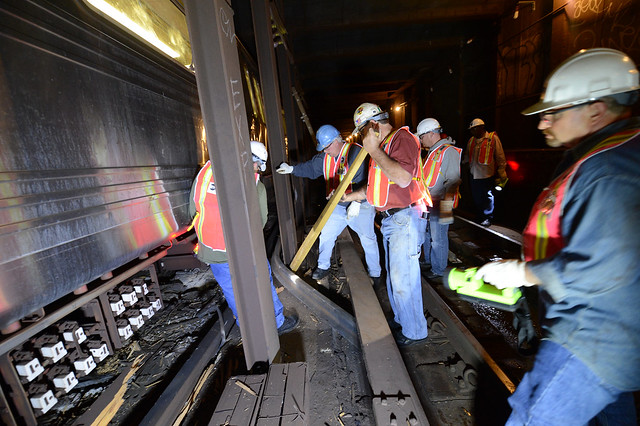
Transit sent maintenance employees to conduct the emergency signal repair work that Friday, and until midnight on Sunday, crews worked feverishly to restore this important artery into Midtown Manhattan. To complete the repairs, Transit installed new insulating materials between the rails and track ties. This work included new wiring, removing and replacing the track rails, realigning the third rail and grouting the tunnel wall to prevent future leaks.
“Thanks to the dedication and hard work of hundreds of our employees, we were able to resume service in time for Monday’s rush period,” Transit President Thomas F. Prendergast said in a statement last week. “We thank our customers for their patience while we worked to correct this problem. Our top priority is customer safety, and a fully functional and dependable signaling system is a key component to running trains safely through our system.”
Part of the reason why Transit officials were so keen to praise their repair crews concerned the confined quarters in the Steinway Tube. Daily News transit reporter Pete Donohue took a tour of the tight tube for his column this week. He writes from inside the tunnel:
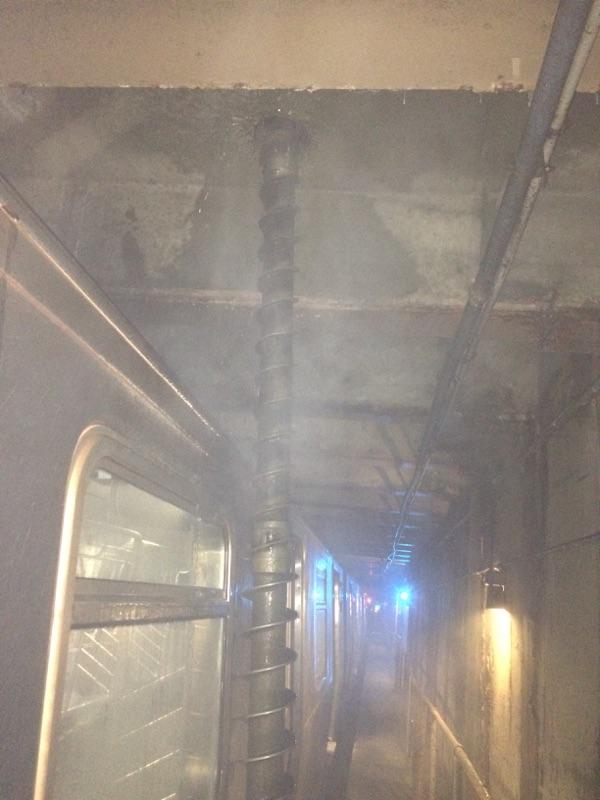
Looking west, subway tracks stretch thousands of feet toward Grand Central, a hazy blur of light looming like a star in the midnight sky. To the east, the rails run through the Steinway Tunnel, which was built at the turn of the century for electric trolley cars that carried riders under the East River between Manhattan and Long Island City, Queens. There are 13 other underwater tunnels in the city’s 468-station maze. They’re all unique, but Steinway has a dubious distinction. “This one gives us the most headaches,” NYC Transit President Tom Prendergast said as he walked the Manhattan-bound tube at 1:30 a.m. Wednesday.
Trains had been halted between 1 a.m. and 5 a.m. so track workers could inspect rails and other equipment. In the pitch black up ahead, the workers were identifiable only by their muffled voices and the beams of their flashlights, which bobbed up and down with each step like buoys rising and falling on a bay.
On other stretches of track in the sprawling system, workers can do similar equipment inspections and maintenance in the time gaps between trains, tucking themselves into concrete niches or between iron columns when a train approaches and emerging when it passes.
That’s not possible in Steinway. The two cast-iron tubes – Manhattan-bound and Queens-bound – are narrow. Very narrow. The only way to avoid getting struck by an approaching train is to scramble up a high bench wall along the tracks. It’s too dangerous and impractical to pull that off repeatedly with regular train traffic. “We can’t have people working in here at all when the trains are moving,” Prendergast said. “We can’t respond to make repairs.”
Eventually, says the MTA, they’ll have to shut down the 7 for another overnight to give the tube a thorough cleaning. It could need it.
As this story unfolded, it highlighted the never-ending quest to reach a state of good repair and why that’s an important goal to attempt to attain. When aging infrastructure reaches a certain point, it cannot withstand the daily beating it takes. That’s what happened to the Steinway Tube ten days ago, and it will likely happen again to this 110-year-old tunnel. Without the money for preventative maintenance, renovations happen only after an emergency. That seems to be the way of things underground these days.
After the snow storm, a management shakeup
Posted by: | CommentsIn the aftermath of the December snow storm that left the New York City subways paralyzed, Transit has shaken up its subway management structure, the Daily News reported yesterday. The line managers will have even less say over day-to-day deployment as Transit attempts to centralize its command structure. “We were seeing some breakdown in coordination and the pinnacle of that inefficiency was the December snowstorm,” Tom Prendergast, Transit president, said.
According to Pete Donohue, the reorganization, to be announced today, will complete a year-long effort to eliminate the line manager program. “Supporters of the Line General Managers Program said privately they were being scapegoated for blizzard response problems when top brass failed to sound the highest-level alert in time,” he wrote.
Rider advocates said they were sad to see the line manager program go. In a way, it helped give a face to the massive MTA bureaucracy. Instead, adding a layer of management to a management-heavy organization never seemed to attain that potential. “I am sorry to see them go,” Gene Russianoff said. “I thought there was lots of potential for competition among the subway lines, and it was great having a name, face and contact info of a human being in charge of a line.”
Signal worker pleads not guilty in inspection scandal
Posted by: | CommentsIlya Klyauzov, 57 and the first MTA worker to face criminal charges in the ongoing signalgate investigation, has pled not guilty to charges of tampering with public records and official misconduct. MTA investigators found photocopied signal bar codes in Klyauzov’s locker following a raid on an MTA workroom earlier this year, but the signal inspector claims he is being scapegoated. “We’re going to beat them; don’t worry,” he said to reporters this morning.
Kylauzov is the first of what should be many to face prosecution for this ongoing scandal. According to Transit investigators (and per The Daily News), he “falsely claimed in an NYC Transit division logbook that, on two different dates in December and January, the maintenance team he supervised completed inspections of 15 pieces of equipment along the No. 7 subway line…On another date, he is suspected of falsely reporting work on 20 subway relays.”
While Kylauzov’s lawyer denied the charges, District Attorney Cy Vance vowed to prosecute to the fullest extent allowed by law. “The defendant falsified the MTA’s records in an attempt to save himself from necessary work,” Vance said in a statement. “Crimes like these can lead to delays in service, or far worse. My Office will continue to work closely with the MTA Inspector General in order to ensure the safety of New York City commuters, whom we believe deserve much better.” If convicted, Kylauvoz could face up to seven years in prison.
Report: Dion drunk before Union Square accident
Posted by: | CommentsOver the past few months, I’ve been following the tale of Michael Dion somewhat closely. In mid-December, Dion fell off the IRT platform at Union Square and found himself pinned between the gap-fillers and a 4 train for 30 minutes before rescue workers could free him. In January, he vowed to sue the MTA for $15 million. At the time, I noted how his sobriety would become a major issue in the case, and indeed it has.
As both The Post and Daily News note today, the initial police report and subsequent MTA assessment allege that Dion was visibly intoxicated. “Witnesses reported seeing him staggering about the platform while holding a can of Budweiser,” the report says. It also notes that the train operator “observed a Budweiser can beside Mr. Dion, and in his opinion, Mr. Dion appeared to be inebriated.”
Dion’s lawyer, of course, denies this charge and questioned again why the gap fillers have remained as unsafe as they were when first built over 100 years ago. The beer can, the lawyer claims, was placed near Dion by another passenger. “He was not slugging beer on the platform,” Jay Dankner, the lawyer, said. “He refutes anybody saying he was carrying an open can of beer in a bag or not on the platform.” Clearly, Dion’s sobriety or lack thereof will be a major issue of fact for the jury if and when this case reaches trial. A lot of money in damages could hinge on it.
After fare hikes, evasion and arrests climb
Posted by: | CommentsAs the MTA’s fares keep going up, so too does the number of people trying to evade paying. According to Metro, arrests due to fare evasion climbed to over 2200 last month, and Transit officials are attributing the increase in jumpers to the higher costs of a subway ride. “There is usually a slight uptick [in fare-jumpers] anytime there is a fare increase,” Transit spokesman Kevin Ortiz said to Metro.
Meanwhile, fare-evasion summons were up by nearly 11 percent in 2010 over 2009. In the post-station agent era, cops made 21,803 fare evasion arrests, up from 19,567 the year before. The MTA says it is “targeting high-incidence locations” in an effort to catch those sneaking into the system. Ultimately, the station agent crowd will decry this as a sign that the system needs more eyes, but the bleed rates seem to be well within acceptable margins as total paid ridership was 1.6 billion last year.
Pondering the meaning of being on time
Posted by: | Comments
A new report questions the MTA's current on-time performance metrics and suggests a passenger-based approach instead.
One of the biggest complaints New Yorkers have with the MTA and an oft-heard excuse early in the morning is one of the more mercurial aspects of transit operations. “Sorry I wasn’t on time,” we’ll often hear. “The B train was late this morning.” What exactly does that mean?
When I head from Brooklyn to Manhattan every day, I use the B train at 7th Ave., but I don’t really leave at the same time any day of the week. When I had two early classes last semester, I could time my trip to catch a B train at approximately the same time every morning, and when there was a problem, the train wouldn’t be there. To me, that’s the traditional definition of on time.
But there are other ways to measure on-time performance. One that the MTA uses internally is a wait assessment. Intuitively, this one makes some sense. If the B train is supposed to run every eight minutes, it matters less when the B trains arrives as it does when the next B train after that arrives. As long as the interval is eight minutes — or in the MTA’s case, eight minutes plus 25 percent — the trains are still on time, and people won’t be left with empty tracks when they expect a train.
Finally, we can judge a train based upon when it’s supposed to get to the end of the run. This is another metric Transit uses to judge on-time performance. If a train is at its terminal within five minutes of the scheduled time, it is still considered on time. Anything worse means delays or one sort of another along the route. But are these any good?
In a report released yesterday, the Permanent Citizens Advisory Committee to the MTA examined the authority’s wait assessment metrics and found them rigorous but lacking. The committee praised the MTA for being among the most transparent transit operators in the country in providing wait assessments but determined that the rankings did not help passengers evaluate on-time performance. The wait analyses, in other words, are geared toward internal evaluation and not improvements for the customers.
“A schedule is a promise,” PCAC Chair Ira Greenberg said. “A late train or bus breaks that promise and the impact is lost time for the riders. People depend on the MTA’s service for their livelihood. We want the MTA to think of the rider first, before trains and buses, and we look forward to working with them to achieve this.”
The report — which I’ve embedded below — presents an extensive evaluation of the MTA’s three rail divisions and a comparison with other U.S.-based transit providers. Passengers, it finds, are left in the dark, and ultimately, PCAC urges the MTA to develop a passenger on-time performance metric that can identify the number of passengers delayed and which ones are delayed most frequently.
Most vital is the report’s recommendation that the MTA start promoting capital expenditures as a way to improve on-time performance. PCAC highlights the countdown clocks as an example of a technology that can lead to more satisfied customers even if they don’t improve the wait times. “While countdown clocks do not create performance measurements,” the report says, “they serve to moderate the rider’s expectation of performance with real time knowledge.”
It takes a stronger stance on capital improvements viewed as disruptive by passengers. “The average rider doesn’t necessarily understand what new interlockings, switches and signals are, let alone appreciate how their improvement will enhance their commute. Historically, the use of performance metrics at the MTA began as an effort to secure needed capital funds. That linkage, as a tool to promote capital programs to the riding public and elected officials, has weakened over the years,” it says. “Specific information on how an item in the Capital Program will reduce the number of delayed and canceled trains, increase track speeds, and improve the ability to recover from a major service disruption is relevant to the riders.”
Now, that just makes sense. If the MTA can convince anyone that their work will make trains run on time, shouldn’t that be a prime selling point for a project? I would think so.
Keeping people moving and making sure they get somewhere on time should be a paramount goal for any transit provider. While wait measurements and delay assessments are more important for commuter rail riders who see transit only every 30 minutes at peak times instead of every five, subway riders like to know they’ll get to their jobs and appointments on time without egregiously long waits. By presenting that information to the public in an easy-to-understand fashion that directly addresses the wait, the MTA could improve the way customers impatiently wait for trains. Time might be on my side after all.
After the jump, read the PCAC’s full report. Read More→
Building a better blizzard response
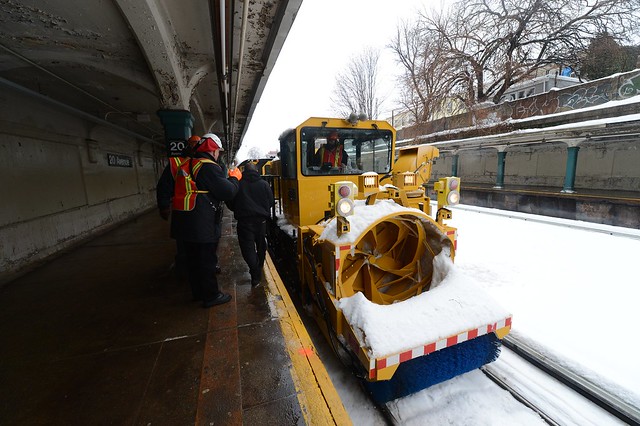
Posted by: | CommentsBefore I went to sleep last night and before the 19 inches of snow stopped falling, the MTA started to cancel services. Buses went first, followed by the above-ground shuttle routes and finally the Q train between Prospect Park and Stillwell Ave. Transit didn’t have to shut down the A train across Broad Channel or the N or D trains in the open-air parts of their routes in Brooklyn, but the authority was prepared to if necessary.
What we saw happen last night was part of the MTA’s new approach to blizzard-like conditions. As amNew York’s Theresa Juva details, the agency is working to establish a new Level V plan that would involve preemptively shutting down services before the storm becomes a major issue. It’s a way to ensure that people don’t get stranded. “It’s planning for extreme storms in which suspension of service or suspension of some services may be required,” MTA Chair and CEO Jay Walder said. It is, of course, far, far better to be safe than sorry.
Man crushed by Union Sq. platform extenders set to sue
Posted by: | CommentsWhile waiting for a train at the Union Square station last month, Michael Dion suffered one of the most horrific accidents a straphanger can experience. He may or may not have been drinking when he fell in between a train and the gap extenders on the southbound IRT express platform, and he was pinned there for 30 minutes. Onlookers and MTA employers tried to help, but it took a half an hour before someone could come to release the fillers.
Now we learn that Dion is suing the MTA and the New York City Transit Authority for $15 million in damages. According to The Post, the suit will a negligence claim on two grounds: “Dion accuses the agencies of being negligent for failing to install safety barriers that could have prevented him from falling into the gap and for failing to have trained workers on site who could have quickly extricated him.” His lawyer Jay Dankner compared Union Square unfavorably to the old South Ferry stop. “Why would you put [barriers] at South Ferry but not 14th Street?” he asked.
For the MTA — and more importantly, for farepayers who wind up footing this legal bill — this lawsuit puts them in a bad spot. Anyone at Union Square can tell you about the frequent announcements that urge straphangers, over and over again, to “please stand clear of the moving platform as trains enter and leave this station.” The issue of Dion’s sobriety at the time will come up as well. Yet, the MTA can’t protect passengers at one station and not another, and it shouldn’t take 30 minutes to find someone who can release the hydraulics in order to retract the gap fillers. It’s a messy situation all around, and Dion will get his payday.