Archive for Second Avenue Subway
Report: Bike lane added to Second Ave. Subway
Posted by: | Comments
The new Second Ave. Subway will come equipped with a bike lane, according to a report in the satirical final edition of The New York Times. The online parody, produced by a group of comedians, offers up a rather comical take on the state of transportation dialogue in New York City right now.
“Jerome Bosch” writes:
New York City Mayor Michael Bloomberg’s pro-bicycle agenda reached a new high water mark today with the announcement that a cyclists-only lane is being added to the long-under-construction Second Avenue Subway. The memo, authored by Deputy Mayor for Communications Howard Wolfson, makes the case that creating the city’s first subterranean bike-lane will reduce bicycle accidents by up to 15 percent, while costing a mere $1.4 billion dollars and delaying the opening of the Second Avenue line by only ten to twenty years.
The Second Avenue Subway bike lane is the latest pro-biking measure proposed by transportation commissioner Jeanette Sadik-Khan. Since becoming Mayor, Bloomberg has closed much of Broadway to automobiles and has overseen the addition of 225 miles of bike lanes, many of them physically separated from the main flow of traffic. This has led to some backlash, most prominently regarding a dedicated bike lane on Prospect Park West which critics say prevents only a small number of deaths, compared to how much harder it is for Senator Charles Schumer’s wife to receive deliveries at her Prospect Park West apartment from FreshDirect, Crate and Barrel, Sherry-Lehman and Interflora.
Sounds about right to me.
Second Ave. Subway breach: harmless explorers or security breach?
Posted by: | CommentsSecurity breach! Everyone panic! That, at least, is the word coming out of the Second Ave. Subway this morning, but should it be? The story, as reported sensationally by The Post, goes as follows: Four twenty-somethings who label themselves urban adventurers were arrested and charged with criminal trespass early Sunday morning when they were spotted entering the Second Ave. Subway tunnel at 112th St. The Post, trying to equate this development with a PATH tunnel breach as well, claims these incidents are indicative of a lack of security surrounding the city’s rail infrastructure. I’m not so sure the two are analogous.
What happened underneath Second Ave. is, whether we admit it or not, a common happenstance. A savvy, if unsubtle, group of explorers who know about the preexisting parts of the Second Ave. Subway well north of and disconnected from the current launch box at 96th St. hopped into the abandoned tunnel to take photos. Despite The Post’s reporting, these trespassers were not able to gain access to any areas of the Second Ave. Subway under construction. This happens at abandoned stations and shuttered areas of the subway system all the time. It’s happened at South 4th Street with the Underbelly Project; it’s happened at City Hall in that abandoned station. It simply shows that off-limits areas of the system are not immune from penetration.
The bigger question concerns our personal safety. Should we be worried about the porous nature of the subway system? I’ve written in the past about how vulnerable our subway system is, and in the post-Bin Laden era, that still holds true. It’s nearly impossible to protect and guard over 700 miles of track and open-ended tunnels. I doubt terrorists are going to target an abandoned half mile of subway along 112th St. and Second Ave, but access is easy enough for those willing to try.
Photo of the Day: At 63rd St., tearing down a wall
Posted by: | CommentsAt 63rd Street, contractors have built a blue construction wall as they ready the station for Second Avenue Subway Service. (Photo via Ben Heckscher at The Launch Box)
Many straphangers who frequent the F train into and out of Queens have no idea that the part of the 63rd St. station they see is only half of it. Behind the ugly, bright orange wall is an unused and unfinished platform that sometimes serves as a lay-up for out-of-service trains. The tracks connect to the 57th St. station along the BMT Broadway line and will one day serve as a stop on the Second Ave. Subway.
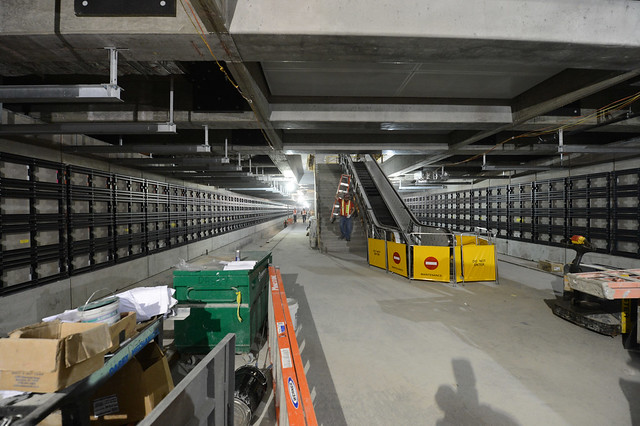
Some preparatory work on the station has already begun, and contractors are starting to tear down the false wall between the Queens Boulevard tracks and the eventual Second Ave. Subway side. Ben Heckscher from The Launch Box took some photos of station recently. Already, contractors are working on street-level infrastructure while beginning the arduous process of remodeling a 20-year-old station that looks architecturally dated already. This part of the Second Ave. Subway project is supposed to wrap in late 2014. For a glimpse of the unused platform as it exists today, browse on over to this NYCSubway.org page.
SAS hits: A contract for 86th St., small businesses suffer
Posted by: | CommentsI have a pair of Second Ave. Subway-related stories this afternoon. Let’s dive in: As the MTA’s tunnel boring machine moves southward underneath Second Ave., planning for the post-TBM construction efforts are well under way. Recently, as Tunnel Talk reported, the joint venture between Skanska and Traylor won the bid for the 86th St. station cavern contract. The JV’s bid of $302 million came in well below engineering estimates, and construction industry officials are not surprised by this figure. Due to the need to keep workers employed, companies are willing to bid low for these projects right now.
Per the report, work under this contract will include “excavation and finishing works of the 86th Street station as well as shafts and adits for the entrances, ancillaries and cross passages; demolition work in advance of entrances and ancillaries; and underpinning of existing buildings adjacent to the ancillaries and Entrance 1.” This contract, though, is not without uncertainties as the pending litigation over the relocated station entrances could delay some of the work at 86th St.
Meanwhile, Crain’s New York has yet another story on how businesses along Second Ave. are suffering amidst construction. The story is one we’ve heard for nearly three years now, and the situation isn’t going to improve any time soon. Businesses have seem revenues drop by 20 percent from 2008, and owners see no short-term relief coming their way. Of course, they do recognize the future benefits. As Ralph Schaller, owner of a grocery store at 86th St. said, “I guess business will improve when it’s over, if we’re still around.”
The view from inside the Second Ave. Subway
Posted by: | Comments
Toward 63rd Street (Photo by Benjamin Kabak)
Six hours ago, I found myself standing where few civilians have been. I am approximately 55 feet underneath Second Ave. between 91st and 92nd Streets, and I am standing inside a wet, dark, round tunnel. An industrial-sized air vent hangs above me while a set of rudimentary train tracks stretch southward as far as the eye can see. In five and a half years, the Q train, bound for Brooklyn via Second Ave. and Broadway, will rumble past that spot, but right now, it is the largest construction site in New York City.
Eleven months ago, the MTA readied the Second Ave. Subway launch box for a ceremonial start. The tunnel boring machine was set to launch, and the press and politicians gathered amidst as much pomp and circumstance as one can lend to the city’s largest ongoing public works project. I had the opportunity to attend that launch and posted the photos back in May.
Earlier today, in a far less ceremonial fashion, the MTA graciously brought a bunch of photographers and reporters down into the launch box to show the progress so far. Even as the MTA’s capital budget remains stretched to the max with a $10 billion hole, work underneath Second Ave. is proceeding at a rapid clip. The western tunnel is dug out all the way to 65th St., and the tunnel boring machine is a few hundred feet into the eastern tube. It might take another five years to finish, and the drama aboveground over station entrances and cleaner construction sites continue. There will, though, be a subway underneath a part of Second Ave. in the foreseeable future.
To get into the launch box requires a long walk down a staircase draped in scaffolding, and the first thing you notice is how truly deep the cavern is. The floor of the launch box, which will one day host the track bed and 96th St. station for the Second Ave. Subway, is around 60 feet down. While the station itself will be at around 50 feet deep, that’s more of a hike that most New York City subway riders are used to today. The next thing you notice is how wet it is. There’s water and mud everywhere, and one of the construction crews told me the wetness is natural. It’s all from the water table, and it’s all moisture that will have to be insulated so it doesn’t seep through station and tunnel walls.
Once inside, you can see just how much of a construction site it is. Heavy machinery that wouldn’t look out of place above ground sits dwarfed by the immensity of the launch box. While my photos — and these links all head to them on Flickr — look as though the launch box is well lit, it’s dark, foreboding and dirty. Sandhogs scurry about, and the subway is on its way.
I’ve embedded the slideshow at the bottom of this post, but I wanted to highlight a few photos I enjoyed: While we were underground, a crane lowered a portable toilet into the launch box. We spotted a microwave at the entrance to the western tunnel. Construction officials told us it takes around 70 minutes to walk from the launch box to the end of the tunnel at 65th St. due to the wetness and mud, and so the crews need their sustenance. The water, as you can see, is literally pouring out of the walls.
Dangling from the roof of the launch box are a series of wooden boxes. These boxes are holding the platforms that are underneath street-level manhole covers. This is infrastructure turned inside out. Above ground, federal safety regulations make sure everyone who enters the launch box is accounted for while inside the tunnel itself, it’s very dark.
After the jump, a full set of photos from the tour. Read More→
Breaking: Second Ave. Subway slashed to one track
Posted by: | Comments
Due to budget cuts, TBM Adi will not dig out a second Second Ave. tunnel after all.
Despite the news earlier this week that the tunnel boring machine digging out the Second Ave. Subway will soon start to burrow out the eastern tunnel, the MTA has again been forced to scale back the project. Due to the $10 billion gap in the capital budget, the authority will soon cancel the eastern tunnel, sources tell me. Instead, the Second Ave. Subway will be just a one-track shuttle from 57th St. and Broadway to 96th St. and Second Ave.
“With money tight and the state slashing budgets across the board, we had no choice,” an unnamed source at MTA Capital Construction said to me today. “We could either put the entire project on hiatus again while sacrificing billions of dollars in federal funds or move forward with a one-track train that can provide some service to the Upper East Side.”
For the Second Ave. Subway, this development is another obstacle in its long and tortured history. Originally set for construction in the late 1920s, the Second Ave. Subway has run into the Great Depression, a World War and numerous recessions. The latest iteration had come to fruition in the early 2000s when a robust construction economy was driving subway expansion. At the time, plans called for three tracks, but in 2008, due to rising costs, the MTA had to cancel the third track. Now the second track is gone as well.
A one-track subway would not be unique to New York. The Franklin Ave. Shuttle currently runs on only one track, but the MTA had grand plans for the Second Ave. Subway. They had hoped to ferry up to 200,000 passengers per day while alleviating overcrowding on the Lexington Ave. lines. The one-track route will still serve thousands of passengers but the configuration will mean that only one Q train at a time can go north from 57th St. or south from 96th St. The MTA estimates it will be able to run only two or three trips per hour in each direction.
On the bright side, the MTA now expects to ready the Second Ave. line much sooner than anticipated. Work on the stations will begin immediately, and the line will open on April Fools Day in 2013.
Once more unto the Second Ave. rabbit hole
Posted by: | Comments
The MTA hosted no ribbon-cutting ceremony yesterday nor did local politicians make the trek underground to mark the occasion, but this past week was a big one for the Second Ave. Subway. Adi, the tunnel boring machine that had recently finished digging out the west tunnel, got to work on the east tunnel, the MTA has announced.
Since June 2010, Adi had been hard at work digging out 7162 linear feet for the western tunnel. It mined from 92nd St. underneath 2nd Ave. to 65th Street. Crews will have to blast out the final three blocks to connect the eventually downtown track with the preexisting tunnel underneath 63rd St.
The eastern tunnel, though, will connect through to the unused half of the F train’s 63rd St./Lexington Ave. stop. The second tunnel will be 7800 feet long, and the authority described the route: “On its journey, the second tunnel will make a tight, westerly curve into the existing 63rd Street Station. Once completed, the tunnel will receive the concrete lining which provides the permanent tunnel structure.”
The MTA again reiterated that the Second Ave. Subway remains on track for a December 2016 revenue service date, but as we know, the authority’s construction timelines tend to be somewhat flexible near the end. No matter the eventual wrap date for Phase 1, it seems as though economics, politics and a tunnel boring machine will push the Second Ave. Subway off the pages of the city’s history books and onto the subway map before too many years are up. Too much work has happened for the line to fail now.
Skanska/Traylor bid leading the pack at 86th St.
Posted by: | CommentsBen Heckscher over at The Launch Box has up an interesting bit on Contract C-26008 today. For those unfamiliar with the number, that’s contract 5B for the Second Ave. Sagas for work on the 86th Street station cavern. According to Heckscher, the bid results were recently made public, and the Skanska/Traylor joint venture is in the lead with a bid of $301,860,000.
Interestingly, as Heckscher notes, this bid is well below the amount the MTA expected to spend on the cavern and mining work around East 86th Street, and that low bid is in line with what Denise Richardson of the General Contractors Associate said at the Museum of the City of New York a few weeks ago. Because these contractors are itching to keep their workers employed and their machines running, now is a good time to submit contracts for bids. Companies are willing to operate efficiently if it means more work. As the MTA’s capital budget comes due for more money, I hope Albany is paying attention.
Meanwhile, the 86th St. contract will be an interesting one to watch because the litigation over the station entrances could pay a role yet. As Heckscher writes, it isn’t clear how the lawsuit will impact this work, but for now, the cavern work can proceed apace. Not until demolition work and entrance scoping begins does the above-ground machinations affect the construction below.
Residents on 86th file suit over entrances, again
Posted by: | Comments
These proposed entrances for the Second Ave. Subway on 86th St. are the subject of another federal lawsuit.
Since the end of the days of Robert Moses, NIMBYism has become a rallying cry across New York City. Residents use it to block almost any major project while construction proponents point to it as a major cause of a lack of unified planning in New York City. No where is it more evident than in a suit filed this week by residents of the Yorkshire Towers building on the northeast corner at 86th St. and 2nd Ave.
The building is suing a variety of federal agencies as well as MTA, New York City Transit and MTA Capital Construction over what they allege was a faulty environmental impact assessment of the decision to relocate entrances from the corner of 86th St. and 2nd Ave. to mid-block on 86th St. The court filings are extensive. Thanks to Twombly’s heightened pleading standard, the initial complaint reaches 85 pages and is available for those who wish to read it after the jump. Essentially, though, the plaintiffs claim that the MTA’s decision to relocate entrances from the Food Emporium at the corner to a mid-block alternative violates a variety of laws. We’ll return to those claims in a minute.
This isn’t the first time Yorkshire Towers has filed suit over the MTA. In fact, in a related case in late November, they sued the MTA over a FOIL request. In that suit, the plaintiffs requested the documents concerning the Supplemental Environmental Assessment that showed how relocating the entrances would have no adverse impact on the neighborhood. Now, the suit alleges that the MTA and FTA were arbitrary and capricious — legal jargon that basically means they were outside the bounds of their authority — in making the changes.
The complaint itself is a slog. It appears to draw a few conclusions of law when it should be presenting facts, but thanks to increasingly murky federal pleading standards, that’s the state of procedure in federal courts right now. The suit runs through a litany of complaints concerning the impact of the new entrances and the ways in which the MTA seemingly ignored legitimate environmental changes and also the gripes of neighbors who do not want to see subway entrances appear in front of their Upper East Side apartment building.
In an interview with New York 1, the plaintiff’s lawyers tried to distill the issue down. Because of the high volume of anticipated peak-hour subway riders at this station and because of the number of people in the building, this change, they allege, could impact thousands of residents, bus service and traffic along 86th St. “There’s only going to be left about 12 feet of sidewalk space left. A 40-percent reduction in sidewalk space. And so, 3,600 people; which is about the size of an army regiment, are going to flood — during peak hour alone — in front of this building,” attorney Joseph Ceccarelli said.
Another attorney for the plaintiffs — Jeffrey Glen — offered a simple solution. “The MTA can solve the problem on 86th Street very simply: they can put the station locations right on the corner where they belong,” he said. Of course, that alternative was ruled out when it became apparent that the building could not withstand the physical demands of corner entrances. It’s something of an engineering Catch-22.
The media coverage has been, by and large, sympathetic to the residents. Take, for instances, this DNA Info piece. Despite the fact that the two entrances point away from the driveways in question, Yorkshire Tower residents are concerned about pedestrian flow on an already-busy 86th St. “It will be a problem for our driveway because there will be no end to pedestrians all day long and part of the night,” Sheil Fine, a 74-year-old resident, said. “And this building has over 200 senior citizens with various problems of not being able to move or walk.”
ABC News too ran a story with equally faux-heartfelt claims. Speaking of the projected 3600 people who will use those entrances, a tenant’s association lawyer worried about the children. Won’t someone think of the children? “That is 60 people a minute cueing to get into a subway, moving past where children are being picked up by their school buses, where the elderly are getting to be picked up to go their senior citizen centers,” Glen said.
Call my cynical, call me unsympathetic, but I think there’s more going on here. In a sense, it’s just another example of NIMBYism writ large. First, it’s important to note a self-imposed limitation in the complaint. Paragraph 33 reads, “Plaintiffs Owners and Tenants Association do not oppose the Second Avenue Subway. Nor do they oppose subway stop at the corner of 86th Street and Second Avenue. What they oppose is the arbitrary and unnecessary siting of a subway entrance, and all of its associated adverse impacts, directly in front of Yorkshire Towers and its 2000 residents without the required statutory reviews.”
Talk about a backhanded acceptance. The Yorkshire Towers Tenants Associate loves the idea of the subway — as long as its in someone else’s front yard. Now that the entrances have been placed on either side of their curb-cut driveway, someone’s legal head must roll.

The staircases at Entrance 2 have been designed to minimize passenger flow in front Yorkshire Towers by siphoning riders away from the active driveway.
Furthermore, the entrances themselves feed away from the driveway. Because of the flow of traffic, sight lines, as the above diagram shows, exiting the driveways shouldn’t be impacted all that much, and it seems to me as though the plaintiffs are overstating the material adverse impact to shoot for the unlikely hope that the entrances will move.
Ultimately, the complaint doesn’t ask for much despite its length. It wants the MTA to conduct a proper Supplemental Environmental Impact Study and gain the proper approvals. It wants to see the costs associated with the complex engineering behind the Food Emporium site. It wants to make sure procedure is followed, and if procedure is followed or has been determined to be followed already, the Yorkshire Towers plaintiffs are out of luck. Of course, they could also want a settlement prior to any trial that sees the entrances moved.
For now, the complaint alleges that, since work isn’t due to begin on the 86th St. entrances for some time, this lawsuit won’t delay the Second Ave. Subway or add to its costs. The MTA isn’t commenting on this — or any — ongoing litigation. I think it’s tough to separate the legitimate gripes from the NIMBYism, and overwhelming the court with fact-based conclusory pleadings probably won’t help. This is just another wrinkle in the ongoing saga of the Second Avenue subway.
To read the full complaint, click through. Read More→
Beautifying a construction site along Second Ave.
Posted by: | Comments
The new look for the SAS construction site tries to promote businesses along the avenue. (Photo by Benjamin Kabak)
When Adi, the tunnel boring machine hard at work beneath Second Ave., reached the end of its western end, the MTA rightly celebrated. For a project that’s been decades in the making, the end of a TBM run is cause for celebration indeed. It’s easy, though, to lose sight of the fact that the subway won’t be ready for revenue service until at least December of 2016.
The merchants and residents of Second Ave. haven’t forgotten. For years, they’ve raised a cry about the state of their avenue. From 96th on down, the bustling commercial strip has been marred by construction work, debris and a state of disarray. Crosswalks are haphazardly constructed and blocked off while dirt piles up and sidewalks trimmed to just seven feet. Nothing about it is all that welcoming for residents, shoppers or business owners, and merchants, in particular, have been asking for change for years.
At the end of last week, the MTA, the Manhattan Chamber of Commerce and various elected officials gathered on the Upper East Side to celebrate the beginning of that change. The authority announced plans back in October to beautify the construction site, and this week, they unveiled the model block between East 92nd and East 93rd Streets with more changes to come throughout the construction zone over the next few months. “We tried ask the question, ‘What can we do considering we’re going to be here for a long, long time?’” MTA Capital Construction President Michael Horodniceanu said during the press event.

MTA officials and area politicians highlight the MetroCard urging shoppers to head to Second Avenue. (Photo by Benjamin Kabak)
Flanked by Jeffrey Bernstein, chair of the MCC, Dan Garodnick, City Council member, and Jonathan Bing of the State Assembly, Horodniceanu walked through the various upgrades. For those living in the area, the most obvious improvements are physical ones. The crosswalks will have barriers to protect pedestrians; the construction sites will be wrapped more orderly; the sidewalks will be expanded to nine feet in some areas. For merchants, each street corner will feature a wayfinding sign with information about open businesses, and the construction site will broadcast those businesses that are behind the netting as well. It’s all about improving the quality of life.
“The goal of this renewed marketing strategy and the model block is to allow New Yorkers to look past the construction and see the vibrant businesses that are here,” said Council Member Dan Garodnick. “This area has been neglected for too long, so we welcome the MTA’s commitment to work with the merchants and the Manhattan Chamber of Commerce to make the entire corridor more presentable and help us send the message that Second Avenue will always be open for business.”
Beyond the construction site itself, the MTA is helping to promote shopping along the avenue. It will distribute two million MetroCards in vending machines along the Lexington Ave. IRT with a message about supporting local businesses on the back, and it is working to revamp the Shop Second Ave. website. The new slogan — “Shop Second Avenue…It’s Worth It!” — is a work in progress.

New signs at every corner will highlight businesses open on blocks obscured by construction. (Photo by Benjamin Kabak)
Of course, it’s a positive that politicians and the MTA have finally been able to come together to help merchants. As Bing noted, he has tried to win grants and tax breaks for Second Ave. businesses but had been met with resistance from both the State Senate and former Gov. David Paterson. Stil, I have to wonder what took the MTA so long to get these improvements off the ground.
During the press conference, Horodniceanu addressed that question. “We were really not doing enough,” he said. “Our contracts are not geared toward this length of time.” So to solve these problems, he, his staff and the MTA contractors tried to figure out “what small things we can do to make a difference.”
For now, as construction moves ever onward, politicians will continue to pressure the MTA to improve the work site. “We have six more years of construction,” Garodnick noted. “It’s a safe bet business owners will encounter new challenges.”
As the representatives and business owners look forward to the day when Second Ave. has both Select Bus Service and a subway, they know it will, in the words of Assemblyman Bing, have “the best transit options in the city.” The construction will disappear; the shoppers will return; and everyone will prosper. But that day is a long way away, and for now, minor changes are much appreciated. “It’s brining order out of chaos,” Garodnick said while standing across the street from the launch box. “It’s an improvement.”
Click through for more photos from the model block and press conference. Read More→