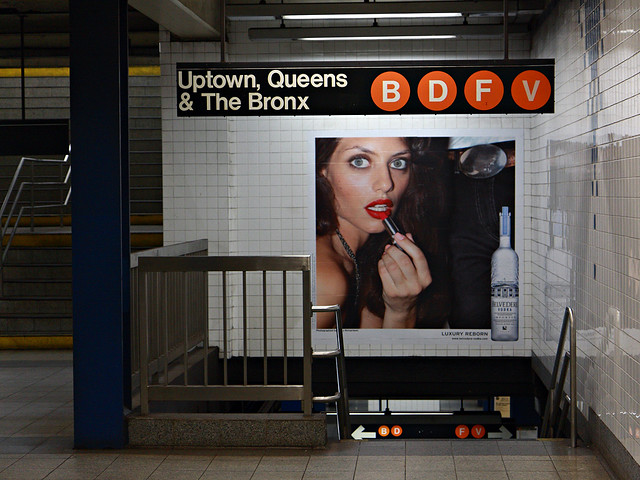
Archive for Subway Advertising

Check out this video from City Harvest. As part of their efforts at reminding New Yorkers not to waste food during the holiday season, they loaded up a subway car full of apples and filmed it arriving at the shuttle platform at Grand Central.

Well, not really. The apples are computer-generated, but the ad, shot entirely on an iPhone camera, looks pretty slick. It certainly gets the point across. Draftcb, the agency behind this subway-themed public service announcement, put out a video showing how they put this one together. Watch it after the jump.

Read More→

Categories : Subway Advertising
Comments (9)

AtheistAd Let’s talk for a minute about God. Or maybe I should say: Let’s talk for a minute about those who don’t believe God, a god, any gods exist. Now, I’m not going to get all religious on you, but a recent advertisement in the subways has raised the ire of, well, anyone religious who does not respond well to people with beliefs that may differ from their own.

The brouhaha over the ad at right started last week when Jennifer 8. Lee of The Times first reported on the impending atheist ads. An anonymous donor paid the $25,000 in order for the Big Apple Coalition of Reason to place this pro-atheism ad in 12 subway stations systemwide for one month. Deemed the cheapest advertising solution — a subway car costs $70,000 for a month and Times Square billboards go for $45-$50,000 — the ad will appear at the three 14th St. stations on the West Side; 23rd St. on the 8th Ave. line; Penn Station in three locations; 86th and 96th Sts. on Lexington; 42nd St. at Bryant Park; Lincoln Center, 72nd and 86th Sts. along Central Park West; and W. 4th St.

Of course, whenever religion is involved, people tend to grow a little hot under the collar. Jason Fink of amNew York tracked down some disgruntled straphangers. “I teach my children to believe in God and lead a life faithful to Him,” Aime Roberts of the Bronx said of the ads. “If my children see these ads that say there is no God, they’ll think their mother is lying.”

Another woman — obviously ill-informed of the Constitution — used the ad to bash the MTA. “The MTA can just do whatever it wants and get away with it,” Charlene McNair-Lawery of Brooklyn said to Fink. Of course, since the MTA is a government entity, freedom of religions and various sundry First Amendment concerns practically guarantee that this ad will appear, and an agency spokesman said that only nudity and vulgar language are prohibited in advertisements shown on MTA property.

The real fun began when Sean Hannity jumped into the fray. In one clip, the Fox News commentator posed a question, “Can you imagine the outrage if a Christian group put pro-God ads in the New York City subways? What outrage.” But as Subway Sights noted, Christians have been plastering the 41st St. walkway at Times Square with pro-Christianity placards for years, and other religious-themed materials abound underground.

So 400 words into this post, where does that leave us? With a big to do about nothing. The MTA has to place the ad, and for $25,000, they certainly will. Meanwhile, I have to wonder if subway advertising is really this insidious. Do we look at the ads we see every day? Clyde Haberman accused the Train of Thought program of being too gloomy last week, but outside of MTA PSAs and Doctor Zizmor, can anyone name something hawked in the subway?

For most of us, the subway is a chance to escape. We read our books; we do our crossword puzzles; we zone out to music on our iPods. If someone wants to preach, go for it. It’s nothing we haven’t heard before, and most of us won’t even notice it’s there anyway.

Categories : Subway Advertising
Comments (19)

The MTA’s decision, announced two weeks ago at the agency’s last board meeting, to sell the naming rights at the Atlantic Ave./Pacific St. subway station to the Barclays Center has sparked some interesting debate. Some think the MTA is sacrificing ease of system use while others — including me — have no problem with it as long as the corporate name is attached to the station and does not replace the geographic identifiers. Either way, the transit agency and other cash-strapped government entities throughout the country are thinking about expanding the naming rights program.

The city’s Department of Parks and Recreation are pondering the move, and the MTA will continue to be aggressive in its pursuit of corporate advertising dollars. After all, the authority has seen ad revenue jump from $30 million in the mid-1990s to $120 million in 2008. Advertising Age explored the thinking behind these deals in a piece last week. Until transit authorities are properly funded, these naming rights deals and other station-wide advertising efforts may just be a necessary fiscal evil.

Comments (5)

A Shuttle train sits at Grand Central, decked out in Google Maps advertising. (Photo by flickr user Paolo Mastrangelo)

Around the country, advertising revenues are dropping precipitously. From traditional bastions of print media to online news outlets, any business dependent upon advertising is feeling the crunch. The MTA is no exception.

As revenue goes, advertising isn’t really a key source of money for transit systems. In total, according to the Federal Transit Administration numbers, transit agencies drew in $334 million in revenue in 2007. That total makes up around one percent of nationwide transit revenue. Closer to home, the MTA reported over $100 million in revenue in each of the last two years.

Not this year, says William Neuman. According to The Times scribe, the agency is seeing lower-than-projected revenue from advertising due to missed minimum payments by Titan Worldwide. The advertising agency is tasked with selling ad space on buses and subways and in stations and owes the MTA around $7.5 million for a three-month period ending in April. Neuman reports:

The company, Titan Worldwide, fell short a total of $7.5 million in mandatory payments to the Metropolitan Transportation Authority from February through April, citing lower than expected ad sales. That would be enough to buy 16 new buses for the authority, which recently received a state bailout in the face of multibillion-dollar budget deficits over the next few years.

“This is another example of the M.T.A.’s exposure to the global economic recession,” said Aaron Donovan, a spokesman for the authority, which plans to raise fares and tolls by about 10 percent in June…

Another company, CBS Outdoor, sells ads in the subway system, and it fulfilled its contractual requirement of making a $55 million lump-sum payment to the authority in January for all of 2009.

Neuman’s article is chock full of interesting information about subway and bus advertising. For example, an ad on the outside of a Manhattan-based bus sells for $1500 a month this year. In 2008, the MTA could command $1800 for the same ad.

On the business side, overall sales for CBS Outdoors, another MTA advertising partner, are strong due to the new ad spots on the outside of train cars. Titan, on the other hand, still owes the agency money from last year, and the agency may have to renegotiate its deal with the MTA to avoid incurring crippling penalties and payments.

“We’re trying to work with them to find a way to keep this contract in place,” Donovan said to The Times. “Our goal is to work it out and minimize the impact on the M.T.A.’s bottom line.”

Neuman also notes that Titan’s original bid for the 10-year contract with the MTA was for $103 million more in minimum guaranteed payments than the next highest bidder. William Apfelbaum, the company’s chairman, said that the difference in minimum payments would not impact his company were the economy strong.

In the end, the MTA isn’t really relying on advertising revenue for a significant portion of its budget, but the story remains the same: A public transportation agency should not have to attempt to squeeze every last dollar out of advertising just to stay afloat. We applaud the MTA for looking at new ways to draw in revenue through advertising, but as long as that money is icing on the cake and not a key part to the budget, we would have nothing to fear.

Categories : Subway Advertising
Comments (3)

When Poster Boy attacked the MoMA installation in the Atlantic Ave.-Pacific St. station last week, an interesting tidbit emerged: One of the marketing executives behind the ad helped the Poster Boy crew access and vandalize the ads. The Museum of Modern Art has since cut all ties with Doug Jaeger and The Happy Corp. I wonder if anyone will pursue a civil or criminal complaint as well. (Hat tip to NY Mag’s Vulture blog.)

momaappromo

Generally, it costs around $20 to get into the Museum of Modern Art, but starting today and continuing on through the middle of March, savvy straphangers can visit replicas of MoMA’s most famous works for the cost of a MetroCard swipe.

As part of a rather ambitious advertising campaign, Brooklyn’s Atlantic Ave.-Pacific St. subway stop will host a full-station takeover by MoMA. The columns and turnstile arms will be adorned with museum logos, and the walls will feature true-to-life replicas of some of the museum’s iconic images. Art buffs can even download station-centric audio tours or call in to hear the guide from the nearest working payphone.

Randy Kennedy of The Times has more on what the MTA is calling a groundbreaking “station domination“:

The Metropolitan Transportation Authority and its advertising contractors routinely review the content of subway ads, keeping their eyes out for things that are too racy or rude. But they have never had an ad quite like one that came their way recently: an image of five naked women (probably prostitutes) vamping it up and staring down the viewer.

The fact that the frontal nudity is fully Cubist and was painted by Picasso more than a century ago undoubtedly made the decision a lot easier. And so on Monday, a glossy reproduction of that artwork, “Les Demoiselles d’Avignon,” took its place underground in the Atlantic Avenue and Pacific Street subway stations in Brooklyn, with copies of 57 other works from the Museum of Modern Art that will briefly transform the cavernous stations into a kunsthalle.

The museum’s publicity campaign, one of the most ambitious it has ever undertaken in the city, will cover every ad space in the two connected stations, spaces normally given over to plugs for movies, beer and podiatry treatments. In their place will be reproductions of works drawn from all parts of the museum, both well-known and more contemporary, by artists like Matisse, Hopper, O’Keeffe, Marlene Dumas, Cindy Sherman and Martin Kippenberger.

“We’ve never done a large-scale ad campaign for New Yorkers focused just on the permanent collection,” said Kim Mitchell, the museum’s chief communications officer. She said the idea had grown out of a new marketing advisory committee’s feeling — confirmed by focus groups — that many New Yorkers view the museum as a tourist-saturated place that is no longer quite as welcoming to natives.

Unfortunately, Kennedy doesn’t have a cost figure for this campaign. I’d be quite curious to find out how much the MTA is raking in from this promo.

Around the Web, some anticipation is building for the noon opening of this subterranean makeshift gallery. The Gowanus Lounge seems intrigued by what it called a bizarre preview. A Flickr set of the installation in progress offers up some tantalizing glimpses of a fun event — including a well-placed version of Piet Mondrian’s Broadway Boogie Woogie right above the Broadway line train.

I, along with over 49,999 of my closest friends, pass through that station at least twice a day. I’ll have to take a few minutes and hop off the train once to check out this museum, and, hey, at least I’ll get to save $18 over the cost of a MoMA admissions ticket.

Categories : Subway Advertising
Comments (10)

One of the less endearing aspects of the fancy new subway cars that continue to take over the system is the automated public address announcements. At some point, we just don’t need to be told, at a volume far louder than necessary, that the MTA is ready to “apologize for the unavoidable delay.” In an ideal world, we wouldn’t be bombarded with “an important message from the NYPD” every five minutes either. But if one group has its way, we may soon be hearing advertisements over the subway loud speaker.

Over the last few months, as the MTA has tried to raise revenue from every available source, the agency has started to sell open space. They have sold the windows, the turnstiles and the outside walls of entire subway cars. Now, PETA, of all groups, is calling upon the MTA to sell airtime over the subway’s public address system as well.

PETA, in fact, has this all planned out, as their press release notes. They want to inaugurate something that would infuriate subway riders with a group of pro-vegetarian ads. Says the release:

Given the Metropolitan Transit Authority’s (MTA) announcement that it will be increasing fares and cutting services to help meet its 2009 budget, PETA has contacted the MTA with a suggestion. PETA has offered to kick off the first-ever paid advertisements to be heard over bus and train public-address systems. PETA’s ads would feature the voices of pro-vegetarian advocates Casey Affleck, Kevin Nealon, and Forest Whitaker…

PETA points out that encouraging commuters to adopt a vegetarian diet would help them address their own financial woes, too, since vegetarians slash not only their grocery bills but also their risk of developing heart disease, stroke, diabetes, and certain types of cancer–not to mention the high medical bills that come with treating these conditions.

“Broadcasting PETA’s ad on public transport could help the MTA’s bottom line and save passengers’ and animals’ lives,” says PETA Executive Vice President Tracy Reiman. “Commuters have a lot on their minds, and our ads will liven things up and give them something positive to think about.”

To hear the ads that hopefully won’t be appearing in the subways, head on over to PETA’s blog.

I have to applaud the pro-animal group for its ingenuity and effort here. They recognized a situation they could exploit and became, as far as I could tell, the first group to propose in-system audio ads. But New Yorkers would absolutely positively hate these intrusive advertisements.

To most of us, the subway ride is a means to end. We’re trying to get somewhere else in the city, and we do so under less-than-ideal conditions. Can you imagine how a packed car would respond to a 30-second anti-carnivore ad blaring over the loud speaker at 9:15 a.m.? I can, and it’s not a pleasant image.

Hopefully this will be one advertising idea the MTA doesn’t adopt in its efforts to raise funds. I’d take the East River bridge tolls any day over in-system audio ads.

“All infographics should have googly eyes” by flickr user arimoore.

Categories : Subway Advertising
Comments (16)

Last week, Gothamist unveiled a short post about a new brand of advertising popping up on subway cars. New York City Transit, it seemed, had started papering over the train windows with ads, and straphangers — including Railfan Window — weren’t so keen on the ads. They blocked out the view; they blocked out the light; and they may post a security risk.

I thought nothing of it. It was just another way for the MTA to make money, and the overall concerns seemed rather overblown. They certainly are ugly, but who’s really going to miss the view of a dark tunnel walls? The safety is certainly an issue, but there are bigger safety fish to fry in the subway.

Yesterday, the MTA shed some proverbial light on these ads. In fact, they are more than ads. As Jennifer 8. Lee reported on City Room, these billboards are part of the MTA’s anti-scratchiti campaign. The Times’ reporter wrote:

Despite the M.T.A. budget shortfall, transit officials say that advertising revenue is not the main motivation for the program. Instead, the sprawling ads have a practical purpose. The first is to reduce what officials call “scratchiti,” or scratched graffiti on the windows…

Paul J. Fleuranges, a spokesman for New York City Transit, said the agency hoped that the film, called Scotchcal, would cut down on the frequency of scratchitti. The vinyl graphic film, made by 3M, is widely used to wrap buses, because a it allows a full image to be printed on the outside, while the little perforated holes allows people (in theory) to look outside.

The other benefit transit officials are hoping for is that the film will save on energy costs, as the covered windows reduce the amount of hot sun that enters subway cars. “The car equipment people have for a long time sought to use tinted windows in an attempt to cut down on that ’sun soak’ effect; just like tinted windows reduce the warmth of the sun on a passenger vehicle and help keep the car cooler and assist in the A.C. cooling the car more efficiently,” Mr. Fleuranges wrote in an e-mail message.

Fleuranges also said that the police were consulted about concerns over safety inside the cars. Reportedly, people on the outside can see in, and people on the inside can see out. I haven’t had the pleasure of riding one of the pilot cars yet. So I can’t confirm or deny that assertion.

On the one hand, these are no different from the anti-scratchiti flim the MTA already employs. The only difference is that this film has an ad. But if they truly do block the view from the platform, the MTA should reconsider. It’s aesthetically unpleasing and potentially dangerous, but until the transit authority has more money, they’re going to sell every available inch of space.

Categories : Subway Advertising
Comments (14)
Oct
02

A fully-wrapped Shuttle

Posted by: | Comments (4)

The outside of an ad-wrapped Shuttle. (Photo courtesy of the Metropolitan Transportation Authority)

Following up on this morning’s news about fully-wrapped subway cars, I’ve gotten my hands on some photographs from today’s press conference. As you can see, one of the 42nd St. Shuttles is now fully wrapped in History Channel advertising.

“We have had tremendous success growing our advertising revenue over the past decade as advertisers have taken advantage of booming ridership to reach record numbers of New Yorkers,” MTA CEO and Executive Director Elliot G. Sander said. “In light of the current fiscal crisis, we are pushing the envelope by introducing new advertising strategies that could generate millions in additional revenue for the transit system.”

While this Shuttle is a rather glaring example of a new advertising approach, the MTA isn’t stopping there. Per the agency’s press release:

As part of this October initiative, CBS will employ three additional display strategies. First, the staircase at the Grand Central end of the Times Square Shuttle will be fitted with vinyl displays. Second, one of the remaining Times Square Shuttle trains between Grand Central and Times Square stations will include exterior panel displays. In addition, these exterior panel displays will also be posted on trains that move through Grand Central Terminal and Times Square stations (numbers 1, 3, 4, and 7 trains). And, third, the turnstile arms in the Shuttle fare control areas at Times Square and Grand Central Stations will be equipped with ad covers…

In addition to the above efforts in the GCT/Times Square Area, in the first quarter of 2009 Times Square Shuttle tunnel will also become the home of the first in-tunnel advertising installation. The shuttle riders will be able to view a full motion video presentation through the window of the shuttle car. The MTA is also planning to pilot test a digital dominated station concept at two of the NYCT stations, Grand Central Shuttle Station and 42nd and 6th Avenue Station mezzanine (Bryant Park).

The MTA will also being pilot-testing digital advertising on the exterior of one of its buses and the interior of one of its commuter rail cars. The agency expects to draw in $125 million this year in advertising revenue and expects to see substantial growth if these pilot programs prove fruitful.

It might not look good, but money is money is money. I’m particular intrigued to see the turnstile arm ads, and I’ll take this commercialization any day if it means more money for the MTA’s coffers.

Click here for a photo of the wrapped train’s interior.

Categories : Subway Advertising
Comments (4)

In Toronto, even the turnstiles have advertising. (Photo by flickr user batbob)

Every few months, the issue of subway advertising rears its head. Some people call it a practical way to raise money; others decry it as yet another example of a public space reduced to a billboard. That debate will be sure to rage today as the MTA is set to unveil a fully wrapped Shuttle train sponsored by the History Channel.

At 10 a.m. this morning in Grand Central Terminal, the MTA bigwigs will gather for a great unveiling of this ad-covered subway car. Unfortunately, I have class at 10 a.m. and won’t be there to cover it in the flesh, but I’ll try to land some pictures later tomorrow.

Meanwhile, Pete Donohue has the story on other advertising opportunities the cash-strapped MTA plans to pursue:

The MTA pulled in a record $106 million last year by selling advertising space in its vast network, which includes the Long Island Rail Road and nine bridges and tunnels. In July, transit officials said they expected to generate more than $110 million through advertising this year.

Officials said they were also planning to test the projection of commercials on subway walls opposite station platforms – directly in the line of vision of riders waiting for trains.

Another plan will target straphangers on trains, with images on tunnel walls between stations calibrated to the speed of trains. The ad would unfold like a silent movie or flip book.

Donohue includes the requisite quotations from one person who doesn’t mind the advertising and the other who does. In reality, the debate shouldn’t even exist. Advertising has been and always will be a part of the subways. The owners of the private companies that operated the subways in the early 1900s sold advertising space as soon as they had the system up and running.

Meanwhile, the MTA is facing crippling financial problems, and if they can milk a few more million dollars out of something isn’t their customers’ pockets, why should we stop them? It may not be the most pleasant thing to see out the window during a train ride; it may mar some people’s sense of public space; but it’s far, far better than the alternative. Until someone does something lasting about the MTA’s finances, advertising it shall be.

Categories : Subway Advertising
Comments (6)
  • Extended Stay

    Featuring a wide range of sophisticated furnished apartments throughout the city and surrounding areas, ExecuStay can help you enjoy a New York extended stay that's both productive and relaxing.

  • Corporate Apartments

    As a resident of ExecuStay New York corporate apartments, you'll find that getting around is a snap, thanks to the many MTA subway lines, buses and yellow cabs.