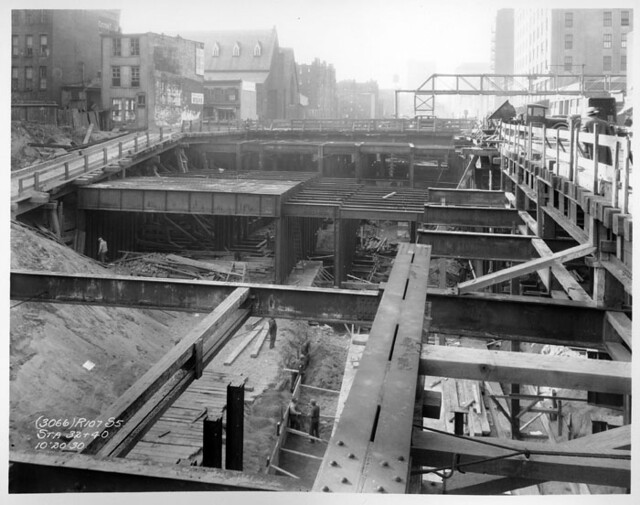
When it comes to ongoing the Second Ave. Subway work, the MTA is facing a mini crisis. Because Albany funded the current capital plan only through the end of the year and has yet to address 2012-2014, there is a slight chance that the MTA will have to freeze some big-ticket items if the politicians do not come through. Recently, the MTA has taken to urging Upper East Siders to contact their representatives, and it has some civic activists a little skittish.
In the Daily News today, one-time mayoral candidate George Spitz uses the MTA’s politicking to issue a familiar call: light rail for Second Ave., he says. It’s an idea that just won’t die, but it’s time is rapidly expiring. While Spitz wants an avenue-long LRT line along the East Side, that’s not feasible right now. I’ll get to that shortly, but first, Spitz’s argument:
With the decades-in-the-making Second Avenue subway line still a distant dream, it is time to think of new ideas for East Side public transport. Specifically, it is time to examine less costly and otherwise more feasible alternatives, particularly light rail, for relief of serious congestion on Lexington Avenue, especially since the first 1.7 miles of the Second Avenue (from 96th St. to 63rd) line won’t be open until 2016, at a cost of several billions dollars.
The need for a new plan for East Side public transit relief became obvious on June 22, when MTA Senior Vice President for Capital Construction William Goodrich came to a meeting of Community Board 8 on the upper East Side and pleaded with board members to press local state senators and Assembly members for more money from Albany.”Without additional funding, we won’t really have the ability to procure the remaining three contracts,” Goodrich told those present….
That’s why light rail is a perfect solution. With estimated construction time of only two years and stops every two blocks – as opposed to every ten or even twenty – light rail provides faster and more convenient relief for congested Lexington Avenue subway ridership. New York’s first grooved-rail tracks were laid in 1852; however, trolleys were soon supplanted by subways. But maybe it’s time for that trend to finally reverse…
Of the $1.3 billion the George W. Bush administration granted for Phase 1 of the Second Avenue line, I estimate that less than half could be used for light rail instead. There would be no need for higher state taxes or increases in subway, bus and toll bridge fares. Moreover, the left-over money could be used to create much-needed transit improvements in the outer boroughs, which need the help no less than Manhattan.
Spitz’s take is filled with some strange claims. In a section I omitted, he bemoans the fact that there are “only” three stops — at 72nd, 86th and 96th Sts. — planned for Phase 1 and blames Lexington Ave. IRT congestion on the SAS stop spacing. That simply doesn’t make any sense because, due to the popularity and population of those neighborhoods, even just those three stops will alleviate much of the IRT congestion.
The second problem is one of politics. Spitz notes that in the early 1980s, President Reagan allowed New York to reallocate Westway funds to subway improvements, and he proposes doing the same thing here. This idea ignores the fact that Washington has not taken kindly to localities’ decisions to reappropriate earmarked federal funds. We need look no further than the Hudson River to see what happened when Gov. Chris Christie tried to claim even $271 million worth of ARC Tunnel money. Here, we’re talking about billions.
Third, Phase 1 of the Second Ave. Subway is too far along to torpedo. The tunnels from 63rd St. and 3rd Ave. to 96th St. and Second Ave. are completed, and while it will still take another five years to finish the tunnels and build out the stations, it would be foolhardy to leave these completed tunnels — and awarded contracts — to rot.
That said, Spitz’s proposal could work with a few amendments. The MTA should finish Phase 1 of the Second Ave. Subway, and it should take advantage of the completed sections of tunnel north of 96th St. to build out Phase 2 as well. The Q — or some other BMT Broadway train — would then run north from 57th and Broadway to 63rd and Lexington and then underneath Second Ave. After that, the city could consider building light rail down Second Ave. to Hanover Square for a fraction of the cost of subway construction. An LRT route would have to operate as part of the MTA with a similar fare structure and transfers to crosstown buses and connecting subway routes, and the city would have to appease businesses and drivers who make a stink over lane appropriate. With the right approach, it should work.
Ultimately, the time for a full-length light rail line along Second Ave. has passed. The SAS is too far along with too much invested into it for the MTA to pull out. Spitz might be right to worry about Goodrich’s statements, but with construction lobbyists, the MTA and various other interests pushing for capital funding, Albany will have no choice but to come through. Light rail will have to wait.