Author: Benjamin Kabak

  • The problems with PATH’s planned Newark extension

    A PATH extension could be a useful plan, but only at a reasonable cost.

    Late December is always a good time to remember how tough it can be to get to and from the region’s airports. We’re constantly reminded of Gridlock Alert Days, and travelers heading out of town for the holidays have to leave extra time for traveling just to get somewhere to travel. It is also a time for the Global Gateway Alliance, a group nobly lobbying for better regional airports, to remind us of the deficiencies of the region’s airport.

    Last week, the group released results of a transit race to Newark Airport. From Lower Manhattan, members of the GGA tried to reach Newark via the subway and New Jersey Transit, PATH, and a taxi. Obviously, the taxi won but at a very high cost while the subway/NJ Transit connection came in second, and PATH came in dead last. That’s to be surprised as PATH drops commuters off at Newark’s Penn Station with another connection to New Jersey Transit required. It’s also the cheapest, thus proving the maxim that you get what you pay for. (The full results of the study are in this pdf.)

    In the release touting this competition, various stakeholders spoke out in favor of the Port Authority’s planned $1.5 billion PATH extension to the Newark Airport AirTrain station, currently under review by HNTB. Jessica Lappin, head of the Alliance for Downtown New York, called it “indispensable” to Lower Manhattan’s future, and RPA Executive Director Tom Wright noted how it would “benefit the entire region.”

    Joseph Sitt, founder of the GGA, was effusive: “This race affirms what we already know to be true: millions of travelers need easier, faster and more cost efficient access to our airports. That’s why our coalition supports the PATH extension creating a direct ride from the World Trade Center to Newark Airport. It’s a win for the airport, the region and the passengers who will reap the benefits of 21st Century transportation access.”

    On the one hand, I don’t dispute these assertions that airport access will be an integral part of New York’s future. On the other hand, we’re talking about a $1.5 billion, 2.5-mile extension at-grade along a preexisting right-of-way to an AirTrain stop. At $600 million per kilometer, the costs are absolutely insane in a vacuum, and drilling down on the project doesn’t assuage my concerns. Let’s take a look at the problems — which are admittedly related:

    1. The AirTrain Problem. Off the bat, the PATH extension isn’t to Newark Airport; it’s to a train station that serves as the terminus for a very slow AirTrain ride to the airport terminals. As the GGA admitted to me on Twitter, a direct connection to the airport would be “great,” but as the Port Authority has shown in Lower Manhattan, $1.5 billion doesn’t get you much.

    2. The Cost Is Too Damn High. The Port Authority is currently spending $6 million to study this extension; they plan to start construction in 2018, if approved, and open it for service in 2023. If it still costs $1.5 billion by then, I’ll eat a hat. And as I mentioned, without considerable additional pieces, this construction shouldn’t approach such a lofty figure and probably shouldn’t even sniff a high nine-figure cost, let alone 10.

    3. Low Ridership Projections. As NJ.com reported back in October, ridership projections for a Newark Airport PATH extension top out at around 6000 per day. The riders are expected to pay around 35-40% of the extension’s operating costs. (For what it’s worth, the RPA, a big backer of this project, estimated significantly higher ridership figures.) With these ridership projects, a cost-benefit analysis would raise serious questions about this project’s viability.

    4. No Intermediate Stops. As now, the plan calls for a one-stop extension from Newark’s Penn Station to the airport. Without intermediate stops, this proposal doesn’t help those who live in between Newark and the airport and are in need of better transit service. For $1.5 billion, this project should include another station or two.

    5. Other Problems In Need Of Money. The universe of transit dollars is a limited one, and $1.5 billion spent here means $1.5 billion less on a trans-Hudson tunnel. And that, more than a PATH extension to the airport, is what will drive the region’s economy, reduce congestion and be an “indispensable” part of New York’s future. It is, simply put, an issue of prioritization and needs.

    I ultimately don’t dispute the need for improved transit accessibility for our region’s airports. They remain frustratingly close and yet seem out of reach. Sometimes, I worry that squabbling among groups that are all ultimately pro-transit can divide the movement, but as Josh Barro aptly noted on Twitter, “We need more squabbling among transit activists to stop stupid projects like the PATH terminal” from going forward. Maybe all this fighting can better contextualize a problematic proposal and ultimately work to put it on the back-burner until the region’s real mobility problems are addressed.

  • PATH service returns; weekend work affects eight subway lines

    A bit of trans-Hudson good news: After nearly a year’s worth of work for Sandy-related repairs, the PATH Train’s tunnel between Exchange Place and the World Trade Center is now reopen on the weekends. The bad news is that in the second half of 2015, the Journal Square-33rd Street segment of the system will experience weekend shutdowns, and the Exchange Place-WTC segment has more work to go yet. Crews are working on desalination, train operations systems upgrades and safety improvements.

    Meanwhile, it’s a slow weekend for service changes as the holidays descend on New York City.


    From 3:45 a.m. Saturday, December 20 to 10:00 p.m. Sunday, December 21, Wakefield-241 St bound 2 trains run express from E 180 St to Gun Hill Rd.


    From 11:45 p.m. Friday, December 19 to 4:45 a.m. Monday, December 22, A trains are suspended in both directions between Ozone Park-Lefferts Blvd and Rockaway Blvd. Brooklyn-bound A trains skip Rockaway Blvd and 88 St. Free shuttle buses operate between 80 St and Ozone Park-Lefferts Blvd, stopping at 88 St, Rockaway Blvd, 104 St, and 111 St. Transfer between free shuttle buses and A trains at 80 St.


    From 10:45 p.m. Friday, December 19 to 5:00 a.m. Monday, December 22, Norwood-205 St bound D trains run express from 145 St to Tremont Av.


    From 5:30 a.m. to 11:00 p.m. Saturday, December 20 and Sunday, December 21, G trains run every 20 minutes between Long Island City-Court Sq and Bedford-Nostrand Avs. The last stop for some G trains headed toward Court Sq is Bedford-Nostrand Avs. To continue your trip, transfer at Bedford-Nostrand Avs to Court Sq-bound G train.


    From 11:45 p.m. Friday, December 19 to 6:30 a.m. Sunday, December 21, and from 11:45 p.m. Sunday, December 21 to 5:00 a.m. Monday, December 22, N trains are rerouted via the Q line in both directions between Canal St and DeKalb Av.


    From 5:45 a.m. to 6:00 p.m. Saturday, December 20 and Sunday, December 21, Coney Island-Stillwell Av-bound Q trains run express from Prospect Park to Sheepshead Bay.


    From 6:00 a.m. to 12 Midnight, Saturday, December 20, and Sunday, December 21, R trains are rerouted via the Q line in both directions between Canal St and DeKalb Av.

  • Second Ave. Milestones: A complete station cavern at 86th Street

    Although the 7 line has limped to a finish line that always seems to be receding into the future, the MTA insists that Phase 1 of the Second Ave. Subway will open for revenue service in December of 2016 as promised. To that end, the agency announced today that the $332 million contract to complete the station shell at 86th St. has wrapped. Additional finishing work, including on HVAC systems, those pesky elevators and escalators and other architectural details continue, and to commemorate this milestone, the MTA released a new set of photos (embedded above) showing the progress. It’s beginning to look a lot like a subway.

    Phase 1 of the Second Ave. Subway is a $4.4 billion extension of the Q north from its current sometimes-terminus at 57th St. and 7th Ave. Using preexisting tunnels, the subway will head north to the unused side of the F train’s 63rd St. station (with a new entrance at 3rd Ave.) before heading north through new tunnels underneath 2nd Ave., making stops at 72nd St., 86th St. and 96th St. Money for the Phase 2 extension to 125th St. has been included in the 2015-2019 Capital Plan, but the MTA, controversially in some circles, has not yet set a firm budget for the project. Meanwhile, the MTA says work on Phase 1 is 76 percent complete, and despite those troubles on the Far West Side, the agency promises an on-time opening. As the cliché goes, only time will tell.

    As a coda, the 86th St. station may bring up memories of the second Yorkshire Towers lawsuit against the project. As you may recall, Judge Furman of the Southern District threatened to sanction the attorneys for bringing a frivolous suit and failing to adequately represent previous lawsuits in their 2013 filings. The case was shortly dismissed voluntarily by the plaintiffs thereafter, and all has been smooth sailing, legally, for Phase 1 of the Second Ave. Subway ever since.

  • On the L train and taking advantage of a bad Sandy situation

    For the MTA, it’s hard to find much good in the outcome from Superstorm Sandy. The saltwater that flooded the city’s subway tunnels significantly sped up an already-looming aging process, and the agency has had to spend federal dollars and manpower on restoration rather than, say, expansion. R and G train riders suffered through a lengthy service shutdown, and A and C train riders are in for a year of weekend service changes as the MTA rebuilds systems taken out by Sandy. But out of a crisis comes opportunity, and the L train is set to be the beneficiary of a bad situation.
    As I mentioned over the weekend, the L train is finally — finally! — getting an upgrade New Yorkers have asked about for years. The 1st Avenue station will get an entrance at Ave. A. It’s not quite as good as a new stop at, say, Avenue C, but as I understand it, the slope and depth of the tunnel make that a near impossibility. Rather, the MTA will improve access for both Alphabet City residents and disabled riders as the new entrance will be handicapped accessible.

    The work is part of a $300 million request to the FTA for Core Capacity funding. As L train ridership has nearly doubled since 1998 — the MTA cites a 98% increase over 16 years — the MTA is desperately seeking ways to handle the crowds. As part of the grant proposal, the MTA will add two trains per hour for an increase in service of around 10 percent, and the agency plans to add elevators at Bedford Ave. and a new street entrance as well. That stop has seen growth of 250% since the late 1990s and may see more yet. That’s an impressive figure for a line that could have been cut entirely in the late 1970s.

    “More than 49,000 customers use the 1 Av and Bedford Av stations on an average weekday, and the stations experience overcrowding during peak periods. The area around the Bedford Av station has been rezoned to allow for almost 10,000 new residential units, and ridership is expected to continue to rise,” said New York City Transit President Carmen Bianco. “We have to increase capacity on the Canarsie Line and improve customer flow at stations to meet this increasing demand, and securing federal funding for a project of this magnitude will go a long way toward achieving that goal.”

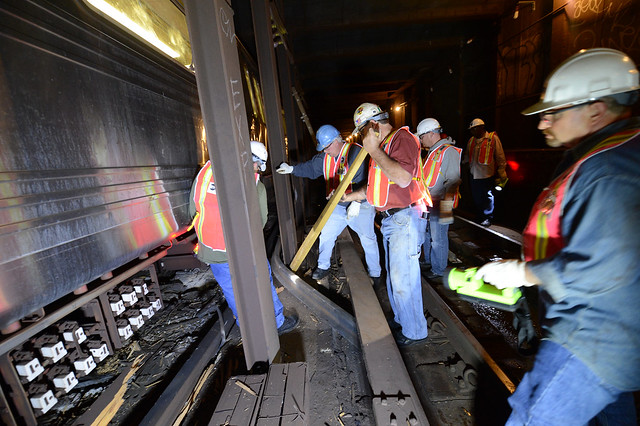
    So what does all this have to do with Hurricane Sandy? As the MTA noted in its press release regarding the funding request, the work at the 1st Ave. station will start first, and it will “be coordinated with planned repairs to the Canarsie Tube, which was flooded during Superstorm Sandy.” In other words, as a few people with knowledge of the situation have said to me, without the looming Sandy shutdowns for the L train, the new station at Ave. A wouldn’t really be feasible. The GOs for the L will enable the MTA to perform the focused work needed to build out a new entrance around a tight two-track line.

    There are still some questions surrounding this work. It’s not clear how much the station improvements at 1st and Bedford Avenues will cost or how much of the money is going toward the capacity upgrades. We don’t yet know the timing either, and considering the damage to the city, it’s hard to praise Sandy for positive results. But the MTA is seemingly making the most out of a bad situation, and for that, East Village residents can now look forward to transit upgrades.

  • You’ll never guess what’s delayed again. (Hint: It rhymes with ‘eleven fine’)

    This ain’t his problem any longer. (Photo: Benjamin Kabak)

    For a long time, I took to calling the 7 line extension the “Train to Nowhere.” It’s not that it would always be the train to nowhere, but when it was supposed to open in late 2013, it would be the train to not very much. The first major Hudson Yards building still isn’t set to open until later in 2015, and the entire complex won’t be completed until the mid-2020s if all goes according to plan. And then the delays struck.

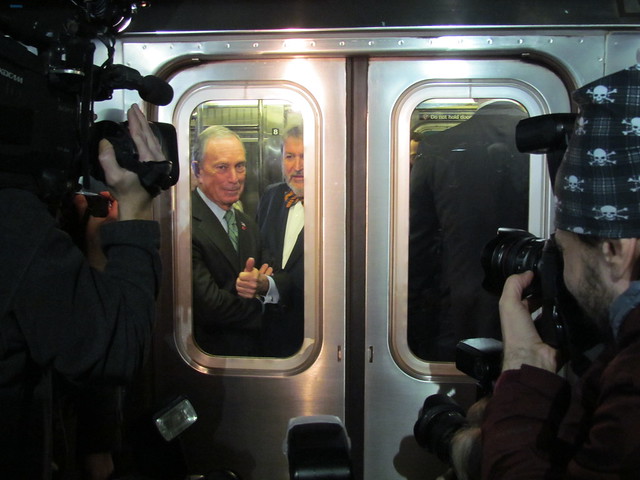
    During Monday’s MTA Board committee meetings and in materials made available over the weekend, the MTA announced yet again that the opening for the 7 line would be delayed. While they’re holding out hope that the one-stop extension to 34th St. and 11th Ave. will open in late February, an Independent Engineering Consultant expects the line to enter revenue service some time during the second quarter of the year, and MTA officials did not dispute this finding during the meetings on Monday. Thus, potentially 18 months after Mayor Bloomberg’s ceremonial ride, the 7 line might open.

    A problem of course is that 10 Hudson Yards is inching toward completion. The Subway to Nowhere will soon morph into the Somewhere Without a Subway, and the cushion between the projected opening of the 7 line and the projected opening of the Hudson Yards office buildings is disappearing before our eyes. If the MTA can’t deliver this project on time, what hope do we have for the Second Ave. Subway, which is supposed to open two years from now?

    To add insult to insult to injury, the problem remains technologies that aren’t exactly new. Yet again, the inclined elevators are behind schedule, and this time, the fire alarm testing has not gone as planned. While the MTA notes that “all parties are working together to bring the construction
    completion as close as possible to the original agreed upon date,” with no contingencies remaining in the schedule, the IEC sees the second quarter as a more likely revenue service start date.

    I’ve said what I’ve had to say about these seemingly never-ending delays. In ten years, we’ll forget about it, but it’s imperative for the MTA to use this experience as a learning point if they are to continue to grow our transit network. We’ve gone from a short delay to November to eventually in 2014 or maybe 2015 to February and now to the second quarter of next year. The MTA just can’t get this project across the finish line, and if that’s not a metaphor for the capital construction issues, I don’t know what is.

  • F train derailment report fingers four for discipline

    MTA crews inspect a derailed F train. A report on the May incident highlighted track-inspection deficiencies. (Photo: Marc A. Hermann / MTA New York City Transit)

    Laid end-to-end, the tracks of the New York City subway system total more than enough to extend to Chicago. Every day, over 8000 subway trains pass through these tracks, and the system never shuts down. Thus, it’s a challenge for the MTA to keep everything in working order, and it requires diligence and an attention to detail to ensure nothing that could cause injuries or cost passenger lives is amiss. In May, that process broke down, and now the MTA is seeking to hold four workers accountable.

    As you may recall, back in May, a Manhattan-bound F train derailed in Queens, snarling train traffic through the area for a few days. While no one was seriously injured, a fully train had to be evacuated, and it was the MTA’s first major subway derailment in some time. (The MTA’s derailment rate remains well below national average.) Still, the agency, as it should, takes these investigations seriously, and on Friday, Transit released a report fingering deficiencies in the track-inspection process. Four workers, the agency, said, will be disciplined for their failures.

    “Nothing is more important than providing the safest transportation possible for our customers and employees, so determining the cause of this derailment was a top priority for us,” New York City Transit President Carmen Bianco said in a statement. “We immediately took corrective action to ensure we always focus on identifying and correcting track defects. This will minimize the risk of future derailments.”

    The full report is available here as a PDF. The essence of it is that a series of minor defects that should have been caught by track inspection personnel and subsequently corrected were missed. The train operator, signal system, rolling stock and rail manufacturers were deemed to escape responsibility for the incident, but three Maintenance Supervisors and a Track Inspector are in the MTA’s crosshairs.

    Here’s how the MTA summarized the findings:

    New York City Transit’s Office of System Safety reviewed video data from prior automated inspections where the derailment occurred. The videos showed that a metal plate and fasteners under the rail had been broken for at least one year before the derailment but were not replaced. The wooden tie under that plate was also in poor condition. Maintenance records also showed that in the eleven months before the derailment, two other broken rails had been reported and replaced in the same 19-foot, 6-inch section of rail.

    The combination of the broken plate, broken fasteners and deteriorated tie should have been prioritized for repairs. The report concludes that Division of Track personnel did not identify, document and correct the track defect at that location, either during regular inspections or when the two prior broken rails were replaced. They also did not adequately investigate the underlying causes of the broken rails.

    Additionally, the report found that the top of the rail that broke was installed with a 1/8-inch vertical mismatch where the new rail met the slightly worn existing rail. In addition, the metal joint bars used to fasten the two rails together were reused, and one of them had a sharp edge where the top of the joint bar met the underside of the rail head. In addition, one of the six bolts required to secure the joint bar was not present.

    To address these issues, the MTA has instituted new procedures regarding broken rails. This includes replacing broken plates and fasteners as soon as possible, and personnel will spend more time inspecting corridors with the highest number of broken rails. The agency will deploy ultrasonic inspection cars, and Division of Track is working to replace bolted joints with continuously welded rail. This should also allow trains to run faster through these corridors. All in all, it’s hard work to inspect hundreds of miles of underground track with trains constantly running over them, but as the MTA is keen to admit, that’s ultimately no excuse.

  • The L train for Ave. A, and weekend work on 10 subway lines

    Big news: The MTA has requested federal funding for some L train improvements including a long-awaited entrance to the 1st Ave. station at Avenue A. In all my years writing this site, the most frequently asked question regarding the subway is about that station. It’s hard to believe it’s taken this long for Transit to plan an Alphabet City subway stop. In an ideal world, they’d build a station at Avenue C, but this is much-needed upgrade nonetheless. More early next week on the rest of the $300 million request.

    Christmas draws near. The weekend work is slowing up considerably. Don’t forget to check out the Holiday Nostalgia Train, running every Sunday on the M line this month.


    From 3:45 a.m. Saturday, December 13 to 10:00 p.m. Sunday, December 14, Wakefield-241 St bound 2 trains run express from E 180 St to Gun Hill Rd.


    From 12:45 a.m. to 4:00 a.m. Saturday, December 13, Woodlawn-bound 4 trains run express from 14 St-Union Sq to Grand Central-42 St.


    From 12:45 a.m. to 4:00 a.m. Saturday, December 13, Pelham Bay Park-bound 6 trains run express from 14 St-Union Sq to Grand Central-42 St.


    From 11:45 p.m. Friday, December 12 to 4:45 a.m. Monday, December 15, A trains are suspended in both directions between Ozone Park-Lefferts Blvd and Rockaway Blvd. Brooklyn-bound A trains skip Rockaway Blvd and 88 St. Free shuttle buses operate between 80 St and Ozone Park-Lefferts Blvd, stopping at 88 St, Rockaway Blvd, 104 St, and 111 St. Transfer between free shuttle buses and A trains at 80 St.


    From 10:45 p.m. Friday, December 12 to 5:00 a.m. Monday, December 15, Norwood-205 St bound D trains run express from 145 St to Tremont Av.


    From 11:45 p.m. Friday, December 12 to 5:00 a.m. Monday, December 15, World Trade Center-bound E trains run express from Forest Hills-71 Av to Roosevelt Ave.


    From 5:30 a.m. to 11:00 p.m. Saturday, December 13 and Sunday, December 14, G trains run every 20 minutes between Long Island City-Court Sq and Bedford-Nostrand Avs. The last stop for some G trains headed toward Court Sq is Bedford-Nostrand Avs. To continue your trip, transfer at Bedford-Nostrand Avs to Court Sq-bound G train.


    From 11:45 p.m. Friday, December 12 to 6:30 a.m. Sunday, December 14, and from 11:45 p.m. Sunday, December 14 to 5:00 a.m. Monday, December 15, N trains are rerouted via the Q line in both directions between Canal St and DeKalb Av.


    From 5:45 a.m. Saturday, December 13 to 6:00 p.m. Sunday, December 14, Coney Island-Stillwell Av-bound Q trains run express from Prospect Park to Sheepshead Bay.


    From 6:00 a.m. to 12 Midnight, Saturday, December 13, and Sunday, December 14, R trains are rerouted via the Q line in both directions between Canal St and DeKalb Av .

  • A messy Thursday commute with warnings for Friday

    Here’s some news Gov. Cuomo isn’t rushing to announce: After a disastrous evening commute on Thursday, the MTA is warning some customers to expect more of the same on Friday morning. Following a manhole fire south of West 4th St. that damaged signal power cables on Thursday evening, Transit expected that a.m. service on the 8th Ave. A, C and E lines will “be impacted” in the morning. They’ve offered no other details, but if tonight was any indication, the chaos could spread to the 6th Ave. line too.

    I sometimes hate to draw widespread conclusions from isolated incidents, but Thursday was tough. In the early evening, the MTA reported delays on all numbered lines, and at one point, the track-facing doors on the Shuttled opened at Times Square, as Eric Bienenfeld noted to me. In a way, Thursday was a prime example of what could happen if the next five-year capital plan is cut back or left unfunded.

    And so while we can’t always draw an argument from bad days, we can view it as a warning and one that legislators should heed: Fund the five-year plan or this will become the norm. For anyone trying to get home tonight, it’s a scary thought indeed.

  • The Straphangers unveiled the city’s slowest bus. You’ll never believe what happens next.

    As part of their annual ritual highlighting just how slow and unreliable our city’s local bus system can be, the Straphangers have announced that the M79, with averages speeds of 3.2 miles per hour, is the city’s slowest bus route. The local M15 — subject of many complaints in the post-Select Bus Service era — was named the least reliable with 33% of buses arriving in pairs or worse. Outside of Manhattan’s congested streets, Flatbush Avenue’s B41, the Bronx’s Bx19, Queen’s Q58, and Staten Island’s S48/98 were named the slowest in their respective boroughs, though the latter two attained speeds of at or over 8 mph. The Straphangers have released a full table of their 34 surveyed routes, and the top ten are all in Manhattan.

    “New Yorkers know from bitter daily experience that bus service is slow and unreliable,” said Paul Steely White, executive director of Transportation Alternatives. “But there is real hope for dramatic improvement in Mayor de Blasio’s plan to build a rapid network of 20 ‘Select Bus Service/Bus Rapid Transit’ routes.”

    So what happens next? As the Straphangers note, Select Bus Service has improved travel times along those routes that have undergone these upgrades, but as I’ve pointed out again and again, incremental changes such as pre-board fare payment shouldn’t be lauded as much as they are. New York still doesn’t have any true bus rapid transit corridors, and bus lane enforcement is continually under attack by City Council members who prioritize drivers over transit riders. Meanwhile, there is the issue of de Blasio’s 20 bus routes: We’re one year into his administration, and while initial planning is underway, implementation is not exactly around the corner. I’m not holding my breath for 10, let alone 20, and to achieve that goal, de Blasio would have to get seven SBS/BRT routes per year on the streets. For now, local buses remain a blight on the city’s mobility.

  • Re-revisiting the faults behind the PATH Hub

    The WTC PATH Train Hub is nestled amidst the hustle and bustle of Lower Manhattan. (Photo by Benjamin Kabak)
    The WTC PATH Train Hub is nestled amidst the hustle and bustle of Lower Manhattan. (Photo by Benjamin Kabak)

    At the risk of, as I put last night, tilting at windmills, I’d like to re-revisit the PATH Hub, and David W. Dunlap’s Times article on the many ways in which this project has gone wrong. In yesterday’s post, I framed it again, as I’ve done many times, as a project plagued by a starchitect’s ego. In my view, he ran rough-shod over a sloppy political process, and an agency beset with leadership problems. That’s not far incorrect, but it’s not the issue facing the World Trade Center PATH Hub.

    The rust I focused on last night probably isn’t rust; the fireproofing wasn’t necessarily the fault of the person who sketched out a vision too grand for a subway stop. In the end, I’ve likely been too hard on Calatrava, if that’s possible, while giving the political drivers a pass. So let’s look again at some gems from Dunlap’s article.

    We start with George Pataki. He was actually the governor when this crazy saga began. That’s how long it’s taken to build this thing!

    George E. Pataki, a Republican who was then the governor of New York, was considering a run for president and knew his reputation would be burnished by a train terminal he said would claim a “rightful place among New York City’s most inspiring architectural icons.” He likened the transportation hub to Grand Central and promised — unrealistically — that it would be operating in 2009.

    But the governor fully supported the Metropolitan Transportation Authority’s desire to keep the newly rebuilt No. 1 subway line running through the trade center site, instead of allowing the Port Authority to temporarily close part of the line and shave months and hundreds of millions of dollars off the hub’s construction. That, however, would have cut an important transit link and angered commuters from Staten Island, a Republican stronghold, who use the No. 1 line after getting off the ferry. The authority was forced to build under, around and over the subway line, at a cost of at least $355 million.

    It’s unclear as well how much additional time building around over the subway line took, but I sometimes wonder if that argument is a spurious one. Considering how long it’s taken to build, there’s no way anyone could have survived politically with 1 train service to South Ferry out of commission for so long.

    How about Bloomberg?

    Michael R. Bloomberg, who was then the mayor, demanded in 2008 that the memorial be completed by the attack’s 10-year anniversary. That meant part of the hub’s roof, which would be the decking under the memorial plaza, had to be built first, adding about $75 million to the budget.

    And how about the Port Authority?

    A 2005 construction contract was supposed to set a guaranteed maximum price, but to accelerate the work, several expensive subcontracts were approved. And in 2008, the authority rejected money-saving suggestions worth over $500 million.

    And the security state from the post-9/11 mindset so pervasive in the early 2000s?

    And there were many hitches. The Bloomberg administration upended the project in 2005, when a Police Department security assessment compelled significant revisions. To improve blast resistance, the Oculus had to have twice the number of steel ribs. The birdlike structure began to resemble a stegosaurus.

    And that pesky problem of leadership churn that has rendered the Port Authority impotent and ineffective for the better part of a decade?

    Consistent direction was rendered almost impossible by constantly changing leadership: four New York governors who appointed five executive directors of the authority, and five New Jersey governors who appointed four chairmen. Complicating matters even more, different projects were undertaken within inches of one another at ground zero. For a time, a plastic tarp was all that separated the hub from the National September 11 Memorial Museum. Contributing to the bloat in the budget was the authority’s practice of using it as a catchall for any related work performed on abutting sites, on common passageways and on shared mechanical, electrical and plumbing systems — over $400 million in all…

    The authority did move to trim costs in 2008 by reducing the size of the Oculus and eliminating the movable roof. Still, it rebuffed suggestions from independent engineers and architects that the Oculus be even smaller, that parts of the temporary station be reused and that columns, rather than a bridgelike structure, carry the No. 1 subway line through the hub’s interior.

    There’s more in Dunlap’s story, and if you didn’t read it last night, read it tonight. In a way, Santiago Calatrava is a red herring, though Dunlap’s story traces how his demands too helped contribute to the problem. This is about the faulty political process and the politicalization of the Port Authority, and again, I ask if we’ve learned anything. When the Hub opens, Shiny New Toy Syndrome will push the cost problem into the background, and we’ll forget how, even at $2 billion, this thing was overpriced. What comes next?