Author: Benjamin Kabak

  • A glimpse into Albany’s approach on transit

    As transit rank-and-file go, few workers are more vulnerable than bus drivers. For years, they sat behind the wheel with no protection between them and their passengers as New Yorkers of all stripes filed past. They weren’t asked to actively put themselves at risk, but to fare jumpers, disrespectful riders and those looking to do more damage, bus drivers were sitting ducks.

    A few years ago, the MTA, under pressure from its unions, started installing partitions, and many — but not all — buses now afford their drivers some protection. Plans include an aggressive roll-out of partitions in the future, and with BusTime and the technology upgrades, the MTA is primed to protect its drivers and respond quickly to emergencies. You would think the New York State Senate would appreciate — or at least know of — these efforts, but instead, they’ve taken an interesting approach.

    Earlier this week, the New York State Senate passed a bill requiring that the MTA install partitions in every busy by 2019 and ensure that all buses have a GPS system that can synchronize with alarm by 2016. The bill, which you can read right here, now awaits Assembly action, but it is an amazing example of shutting the barn door after the horse escapes. The State Senate has, in effect, ordered the MTA to do something that, with regards to GPS, it has already accomplished and, with regards to partitions, it is well on its way toward wrapping up.

    Now you can accuse me of skepticism; I am, after all, no fan of the way Albany treats transit. Plus, this legislation, if it passes the Assembly and earns Gov. Andrew Cuomo’s signature, could protect future bus drivers as well. But to me, this is indicative of the way Albany reacts to transit. That is, they don’t. They latch onto something the MTA is doing on its own, mandate that it happen, and then try to take credit for the solution. Instead of examining the city’s traffic issues, transit’s funding problems or future growth, State Senators are content to put a good face on nothing. What a shame.

  • Video: New Yorkers Barely Missing the G Train

    The day job has been very busy, and I haven’t a chance at night to delve into a longer post. So instead, enjoy this amusing video of New Yorkers just missing the G train. It is equally applicable to every subway line though and not just the poor, abused G train (which, I’ll always contend, isn’t nearly as bad operationally as its reputation). If you were to follow me on Twitter, you could have seen this video last night. More soon, hopefully.

  • Ep. 18 of ‘The Next Stop Is…’ on the 7 line extension, Vignelli and ferries

    NextStopis We’re back with an all-new episode of “The Next Stop Is…,” the only Second Ave. Sagas’ podcast around. Eric and I talked today about delays, strikes, and ferries. Oh my?

    We start with a discussion on the 7 train extension’s recent troubles and what it may mean for other MTA capital projects. We talked about the LIRR union’s offer to postpone a strike from July to September and delved once more into the love affair with ferries. We ended with some words on the sad passing of Massimo Vignelli.

    This week’s episode runs about 20 minutes, and if you haven’t left work for the day, give it a listen on your ride home. (But don’t worry; it will still be timely in the morning.) You can grab the podcast right here on iTunes or pull the raw MP3 file. If you enjoy what you hear, subscribe to updates on iTunes as well and consider leaving us a review. If you have any issues you’d like us to tackle when we return in two weeks, leave ’em in the comments below.

  • On the elusive finish line for the 7 line extension

    Toward the end of December as his days in office dwindled away, then-Mayor Michael Bloomberg rode a 7 train from Times Square into the still-unfinished station at 34th St. and 11th Ave. It was the first — and so far the only — train to make the ride, and while it wasn’t quite a ribbon-cutting, it was a valedictory ride. If all had gone according to plan, the mayor would have inaugurated the station he funded while still in office, but all did not go according to plan.

    Since late 2013, all we’ve heard about the 7 line extension are delays. Completion was pushed back from 2013 to early 2014, then mid-2014, then late summer, early fall and now before the end of the year. The MTA is so close to wrapping this project, but with around $60 million worth of work remaining, the finish line has remained frustratingly out of reach. Last week, Matt Flegenheimer explored a source of the delays in a Times article that focused on the station’s incline elevator.

    Because the new station had to burrow underneath the 8th Ave. IND, Port Authority underpinnings, the Amtrak tunnel into Manhattan and the Hudson Yards, and the Lincoln Tunnel, the station at 34th St. is very deep. Most riders will be surprised by just how deep it is when they first arrive there, and to build out the station to ADA specifications, the MTA has gone with incline elevators. This is hardly a new technology, but it’s new to New York. That is a recipe for problems, and the elevator failed initial testings last summer. Here’s Flegenheimer’s take on the tale to date:

    This is the anatomy of a transit delay — pocked with tales of an ambitious plan, the vagaries of an Italian summer, an unusual funding model and a complex elevator design that had roots in a global landmark and a pyramid-shaped casino, but not in New York’s transportation system…The station, and its unusual elevator, provide a useful case study in the difficulties of capital construction in the city. The idea for a diagonal elevator — two, actually, to go with the station’s escalators and vertical elevators — dates to the project’s genesis more than 10 years ago, the authority said. Angling the structures at an incline was thought to be less expensive than tunneling in relatively straight lines, down and across.

    It would also prove a boon to wheelchair users, officials said. A traditional vertical elevator from the upper to the lower mezzanine would have left such passengers about 150 feet from a second elevator that could take them to the platform. But because the incline elevators run parallel to the escalators, Mr. Horodniceanu said, “you are providing a similar experience, irrespective of your handicap.”

    Before construction began, the transportation authority led an international search for elevator manufacturers, recommending two companies to Skanska, the project’s general contractor: Maspero and Huetter-Aufzuege, in Germany.

    Maspero’s résumé was impressive. Its angled lifts, calling to mind Jetsons-style transport pods, have been chosen to climb slopes in the French Riviera, the Kek Lok Si Temple of Malaysia and a Renzo Piano building in Genoa. The company was selected for the New York elevators. But project administrators preferred that the software and other components come from American companies with whom they were more familiar. (The authority said its contractors, not the agency itself, made these decisions after being presented with performance specifications.) The controller was made on Long Island. The speed governors, or limiters, came from Ohio. Other pieces, like buttons and speakers, were manufactured in Queens.

    Dr. Michael Horodniceanu, head of MTA Capital Construction, calls this elevator a “mutt,” and officials have subsequently blamed winter, Italian summers and time for delays in retesting. (It is not the only cause of the delay though as tunnel ventilation tests are delayed and fire protection tests await.) Still, this elevator the description raise some concerns. Though the MTA tells me the “hodgepodge” approach shouldn’t impact maintenance or reliability, there sure are a lot of cooks stirring the soup. It’s concerning that something as relatively simple as an elevator should be so problematic.

    Meanwhile, the 7 line can afford this delay. Though some 27,000 daily riders are one day predicted to arrive at this station, that number is dependent upon the completion of the full Hudson Yards project. It’s still years away, and no one will really notice if this station opens now or in 10 months. (In fact, in twenty years, no one will care, but that’s besides the point.)

    I bring this up though because uptown and to the east, another subway is growing, and this one is more complicated. It features three new stations and one retrofitted old one. It too will have relatively deep stations, modern ventilation structures and the requisite fire proofing. The Second Ave. Subway is due to wrap in December of 2016, just 31 months from now, and the MTA has vowed to stick to that date. But one would be forgiven for casting a skeptical eye on the Upper East Side as the issues with finishing the 7 line station on time come to the fore.

    It’s tough to cross that finish line. We saw a platform gap a few centimeters too wide at South Ferry, and now we’re seeing incline elevators fail testing at Hudson Yards. What troubles await the end of the Second Ave. Subway? Eventually, we’ll find out.

  • Weekend work affecting 11 lines

    The weekend shutdowns on the 7 line return. Otherwise, nothing too crazy.


    From 11:30 p.m. Friday, May 30 to 5:00 a.m. Monday, June 2, 1 trains are suspended in both directions between 96 St and Van Cortlandt Park-242 St due to brick arch repair work at 168 St and 181 St, and repair work in area of 125 St. AC trains, M3 and free shuttle buses provide alternate service.


    From 11:30 p.m. Friday, May 30 to 5:00 a.m. Monday, June 2, 2 trains are suspended in both directions between Franklin Av and Flatbush Av-Brooklyn College due to switch renewal north of Nostrand Av. Free shuttle buses provide alternative service, making all subway stops between Franklin Av and Flatbush Av-Brooklyn College.


    From 11:30 p.m. Friday, May 30 to 5:00 a.m. Monday, June 2, 3 trains are suspended due to switch renewal north of Nostrand Av. 2 trains and free shuttle buses provide alternate service. In Brooklyn, free shuttle buses operate between Franklin Av and New Lots Av. Transfer between 2 trains and free shuttle buses at Franklin Av. In Harlem, free shuttle buses serve 135 St, 145 St, and 148 St. Transfer between 2 trains and free shuttle buses at 135 St.


    From 11:30 p.m. Friday, May 30 to 5:00 a.m. Monday, June 2, 4 trains are suspended in both directions between Atlantic Av-Barclays Ctr and New Lots Av due to switch renewal north of Nostrand Av. 2 trains and free shuttle buses provide alternate service. Transfer between 2 trains and free shuttle buses at Franklin Av.


    From 2:00 a.m. Saturday, May 31 to 4:30 a.m. Monday, June 2, 7 trains are suspended between Times Square-42 St and 74 St-Broadway in both directions due to track panel installation north of 69 St. EFNRS and free shuttle buses provide alternate service. Shuttle buses operate along two routes:

    • Between Vernon Blvd-Jackson Av and Queensboro Plaza making station stops at Queensboro Plaza, Queens Plaza, Court Square, Hunters Point Av and Vernon Blvd-Jackson Av.
    • Between Queensboro Plaza and 74 St-Broadway making station stops at 33 St, 40 St, 46 St, 52 St, Woodside-61 St, and 69 St.


    From 11:45 p.m. Friday, May 30 to 6:00 a.m. Sunday, June 1, and from 11:45 p.m. Sunday, June 1 to 5:00 a.m. Monday, June 2, Inwood-207 St-bound A trains run express from Canal St to 125 St due to track tie and track plate renewal at 59 St-Columbus Circle.


    From 6:30 a.m. to 11:30 p.m. Saturday, May 31, and Sunday June 1, 168 St-bound C trains run express from Canal St to 125 St due to track tie and track plate renewal at 59 St-Columbus Circle.


    From 9:00 a.m. to 7:00 p.m. Saturday, May 31, and from 11:00 a.m. to 6:00 p.m. Sunday, June 1, E trains run more frequently between Manhattan and Queens due to CPM duct bank work north of Times Square-42 St, and track panel installation north of 69 St on the 7 line.


    From 11:45 p.m. Friday, May 30, to Monday, June 2, Coney Island Stilwell Av-bound F trains skip Sutphin Blvd, Briarwood-Van Wyck Blvd, and 75 Av due to rail work south of Parsons Blvd.


    From 11:30 p.m. Friday, May 30, to Monday, June 2, Coney Island Stilwell Av-bound F trains run express between Jay St-MetroTech and Church Av due to signal work at Church Av.


    From 11:00 p.m. Friday, May 30 to 5:00 a.m. Monday, June 2, G trains are suspended between Church Av and Hoyt-Schermerhorns Sts due to signal work at Church Av.

    (42 St Shuttle)
    From 12:01 a.m. Saturday, May 31 to 6:00 a.m. Monday June 2, due to work on the 7 line, the 42 St Shuttle operates overnight due to CPM duct bank work north of Times Square-42 St, and track panel installation north of 69 St on the 7 line.

  • The politics of a potential LIRR strike delay

    Here is an interesting bit from Newsday: While the UTU has not officially requested a 60-day delay for its looming summer strike, union officials have floated the idea of pushing the strike back from the summer to mid-September. The strike would begin on September 17 instead of July 19, seemingly sparing Long Island’s summer tourism season.

    “Our members care about Long Island and its economy,” Anthony Simon, general chairman of the Sheet Metal, Air, Rail and Transportation Union/United Transportation Union, said to the Long Island newspaper. “All we would need is the MTA to mutually agree on the extension.”

    The MTA seems willing to entertain the request, thus giving both sides more time to work out a deal. Overall, though, this is an interesting political move by the UTU. It shows their willingness to recognize the public need, and it pushes the strike date closer and closer to Election Day. I have a hard time believing Gov. Andrew Cuomo, looking for a resounding victory, would allow a strike seven weeks before New York voters head to the polls, and the UTU knows this as well. As always, stay tuned.

  • Great moments in ferry advocacy

    As any regular SAS reader well knows by now, I have very little tolerance for the current love affair New York’s politicians have with ferries. To me, it reeks of a fetish that helps these elected officials avoid tough financial decisions and combative NIMBYs without actually solving the region’s mobility problems. The current ferry routes are the best ones available, and everything else suffers from low ridership, diminishing returns and either high fares or higher subsidies.

    Yet, ferries continue to be the Next Big Thing, and on Wednesday, officials were so excited to call for more ferry service that they ran aground on one. Dana Rubinstein broke the story:

    A Seastreak ferry ran aground in Jamaica Bay this afternoon, forcing the fire department to remove all 29 passengers, none of whom were injured, according to an FDNY spokesman and news reports. The ferry was not part of the regular Rockaways service, but was a private ride organized by a local ferry advocate to explore ways of expanding service, possibly to JFK Airport.

    The ferry ride included, among others, representatives from the offices of Assemblyman Phil Goldfeder and Queens borough president Melinda Katz.”There was no big thump,” said Goldfeder, who wasn’t on the boat, but spoke to people who were. He said passengers didn’t even realize they were stuck until they tried moving. Goldfeder said the incident shouldn’t be used to paint ferry service as unreliable or prone to delays. “For every minor ferry incident, you can probably locate 50 subway delays,” Goldfeder said. “It’s just so inconsequential.”

    The incident will not impact ferry service to the Rockaways, which carries about 400 people daily, according to Kate Blumm, a spokeswoman for the city’s Economic Development Corporation.

    Now, there’s a lot going on here. First, Goldfeder’s right in one sense, but on the other hand, we’re talking about 400 people. For every one person who rides the ferry to and from the Rockaways, 15,000 ride the subway, and the cops don’t send out rescue squads every time a train is delayed due to a signal problem. We’ll come back to that 400 figure in a minute. In the meantime, don’t think too hard about how a ferry to JFK would work, where it would dock that would be at all convenient to suitcase-laden passengers, or why we need boats to the airport in the first place. You’ll only give yourself a headache.

    In response to Wednesday’s incident, Queens’ politicians quickly tried to protect their ferry advocacy. “Today’s incident does not take away from the fact that is imperative that ferry service between Manhattan and Rockaways be made permanent,” Borough President Melinda Katz said. “Permanent ferry service would do more to promote economic development in the Rockaways than just about anything else that has been proposed in recent history. It is essential that the Rockaway ferry be made into a permanent mode of transportation.”

    The emphasis is mine, and I’d like you to mull on her statement for a bit. The Borough President of Queens believes that a ferry with 400 daily passengers is the biggest thing to hit Queens since sliced bread (or, perhaps, the 63rd Street Connector). As a point of comparison, on a typical weekday, an average of 400 passengers per hour use the BMT Brighton line station at 7th Ave. near Prospect Heights and Park Slope. It’s certainly not promoting economic development in the way Katz’s talks.

    Meanwhile, there is something that reaches toward the Rockaways that could create more economic development not just for the Rockaways but for much of Queens, and that is of course the Rockaway Beach Branch, a dedicated rail right of way with a connection through Queens to the IND Queensboro line. That would be worthy of a concerted political effort. But here we are, trumpeting a ferry that carries 400 of the Rockaways 130,000 people as a success. How our standards have fallen.

  • Massimo Vignelli, 83, redesigned the look of the NYC subway

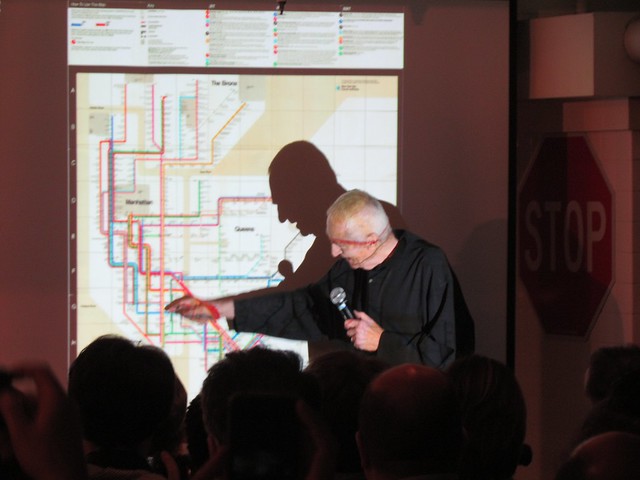
    Massimo and his map. (Photo by Benjamin Kabak)

    Whenever I unfold one of my original 1970s Massimo Vignelli subway diagrams, I’m always struck by how small they are. Compared with the maps the MTA hands out today that lend themselves to awkward interactions that clearly indicate someone unfamiliar with the subways, the city or both, Vignelli’s maps open smaller than even a tabloid newspaper. They were meant to be stuffed into a pocket and consulted when needed. They also launched a thousand endless debates of form over function. To honor Vignelli, who passed away on Tuesday at the age of 83, let’s have another.

    For the vast majority of New Yorkers — or at least the vast majority of New Yorkers who have heard of him — the name Massimo Vignelli conjures up images of a very distinctive style in subway map history. For 42 years, in fact, New Yorkers have debated this map, and in the minds of this city’s millions, it will be Vignelli’s lasting legacy even as our lives are infused with his designs for American Airlines, for National Parks brochures, for Big Brown Bags, for countless other items that use and exploit the stark lines of Helvetica, his preferred font.

    Over the past few years, I had the opportunity to see Vignelli speak, first on a panel and later in a presentation. He had a sharp wit and a good sense of humor, but he also had a clear stubborn streak. He always felt, long after the MTA pushed him away and then brought him back into the fold, that his subway diagram — definitely not a map, mind you, but a diagram — was better than anything before it and certainly better than the overloaded mess of a map the MTA has tried to streamline in recent years. It had smooth angles, clear lines and obvious colors, and it was designed to get a straphanger from place to place underground, not from place aboveground to place aboveground via the underground.

    Simplicity was key to Vignelli. During a 2012 talk at the Transit Museum, Vignelli spoke of his philosophy while heaping criticism on the current map. His design featured straight lines at 45-degree angles of various orientations. As he put it, “Line, dot, that’s it. No dot, no stop.” While looking at the current map with its curved route lines and angled text, he asked, of the Montague St. tunnel, “Who cares if the subway has to go around like that?”

    New Yorkers of course hated it. Their subway map had been an amorphous blob of shades of grey, red and green, and the new Vignelli map was a shock to the system. It had so many colors and lines and angles, and for some reason, parks weren’t the right shape and 50th St. and 8th Ave. was east of 50th St. and Broadway. That, from day one, seemed to be the sticking point. Vignelli’s diagram, designed to be used by those with a modicum of knowledge about the city’s grid and in conjunction neighborhood maps that, to this day, still populate subway stops, was a geographic mess. After seven years of complaints, the MTA torpedoed his subway diagram in favor of the first version of the map we know and use today.

    Over the years, Vignelli would harbor grudges against those at the TA who pushed him out, but he eventually reached a detente and a reconciliation. He redesigned his map in 2008 for Men’s Vogue, and the printing sold out nearly immediately. The diagram appeared on a dress at Nordstrom’s in 2009, and he reproduced a 2012 version that currently hangs in my living room. His design formed the basis for the MTA’s Weekender app and the Super Bowl’s Regional Transit Diagram. Long a piece in the Museum of Modern Art, his diagram is seeming here to stay in some form or another.

    Massimo’s legacy extends well beyond this controversial map. In addition to the ways in which his designs have created conversation and controversy, he also streamlined signage in the subway system. He and Bob Noorda, who passed away four years ago, reimagined the way signage works and appears in the subway system. With a few changes, his Helvetica designs remain in place (though he, like I, never embraced “Exit Middle of Plat” as an appropriate shorthand for anything). The general philosophy behind subway signage lives on in the Graphics Standard Manual.

    Vignelli’s passing leaves that role of stubborn, funny, cantankerous man to someone else. His map, his subway diagram, his angles and font will forever live on.

    For more on Vignelli, I recommend the obit in The Times, and a piece penned in The Wall Street Journal by friend-of-SAS Keith Williams. Michael Beirut offered up his memories of Massimo as well.

    The Vignelli map, in wearable form.
  • Fare hikes, service increases and the LIRR situation

    When the MTA adopted a proposal, nearly five years ago, to shore up their finances by, in part, raising fares every two years, the plan of attack involved biennial increases of around 7-8 percent. The rate of these fare hikes outpaced inflation but was designed to overcompensate for years of fare policies that didn’t align with inflation. After a fare hike last year, though, Tom Prendergast announced that the 2015 hike would be only four percent, and I wondered if the MTA had jumped the gun.

    At the time, the MTA had still been pressing for a net-zero labor increase, and it wasn’t clear how strong the MTA’s finances would be, even in the face of an improving economy. Now, we’ve been led to believe that the MTA can afford something more than net zero without rigid work rule reform, at least for the TWU, and the Long Island labor dispute has become the center piece of the battle over MTA dollars. Last week, it seemed as though a summer strike would be more likely than not, and the question on everyone’s mind concerns the money. While the Presidential Emergency Board again failed to account for the MTA’s razor-thin margins and lack of financial flexibility, the PEB still awarded the LIRR union 18 percent raises. Where would this money come from?

    In a piece last week in the Daily News, Pete Donohue attempted to answer. For starters, Prendergast said at least week’s MTA board meetings, the fare hikes won’t be increased, but what about everything else? Donohue summarized:

    Prendergast said that if an agreement calling for 17% raises for LIRR workers were reached, there would be an impact on MTA budget models, but members of the authority’s board still want to limit next year’s fare hike to 4%, as previously planned. “Fares we’re pretty firm on,” Prendergast said after an MTA board meeting on Wednesday.

    MTA officials will meet with LIRR union leaders and attempt to negotiate a less expensive contract, Prendergast said. LIRR workers have been without a contract for more than three years. Union leaders have said they will call a strike if they don’t have a deal by the July deadline. Federal law permits strikes by commuter railroad workers after a multi-stage process of independent mediation and cooling-off periods.

    Prendergast said “we’ll have to see” if the MTA would be able to afford service improvements if its budget plans had to be adjusted to accommodate LIRR raises in line with the mediation panel’s non-binding recommendation. Top transit officials last week had begun discussing implementing a package of service increases and improvements that could total $20 million, the Daily News reported.

    If the MTA has to dole out more dollars than it anticipated to the LIRR union, the riders wouldn’t see planned service increases, but more alarming are the unsaid sources of revenue. The MTA would possibly have to figure out a way to use pay-as-you-go capital funding to cover labor wages for a union in bad need of reform. Such a move would leave fewer dollars for emergency repairs, component upgrades and maintenance and upkeep efforts. Clearly, that’s not a positive.

    I don’t know what will happen. No one wants a strike, but as I said last week, there are some long-term gains to be had from a strike. Still, it’s important to remember that the MTA’s finances are better but still on shaky grounds, and the most vulnerable monies are the ones the agency needs the most. Instead, those dollars could go to the UTU as the city’s transit system faces a potential capital crisis.

  • Weekend work affecting 10 lines

    A lot of this work stretches through Memorial Day, and trains will be operating on a weekend schedule on Monday. On the bright side, SBS M60 service debuts Sunday. The bus lane isn’t nearly as long as we’d like, and the Community Board highlighted everything wrong with transit expansion in New York City. But there you go. Stay safe. Enjoy those BBQs.


    From 11:30 p.m. Friday, May 23 to 5:00 a.m. Tuesday, May 27, 2 trains are suspended in both directions between Franklin Av and Flatbush Av-Brooklyn College due to switch renewal north of Nostrand Av. Free shuttle buses provide alternative service, making all subway stops between Franklin Av and Flatbush Av-Brooklyn College.


    From 11:30 p.m. Friday, May 23 to 5:00 a.m. Tuesday, May 27, 3 trains are suspended due to switch renewal north of Nostrand Av. 2 trains and free shuttle buses provide alternate service. In Brooklyn, free shuttle buses operate between Franklin Av and New Lots Av. Transfer between 2 trains and free shuttle buses at Franklin Av. In Harlem, free shuttle buses serve 135 St, 145 St, and 148 St. Transfer between 2 trains and free shuttle buses at 135 St.


    From 11:30 p.m. Friday, May 23 to 5:00 a.m. Tuesday, May 27, 4 trains are suspended in both directions between Atlantic Av-Barclays Ctr and New Lots Av due to switch renewal north of Nostrand Av. 2 trains and free shuttle buses provide alternate service. Transfer between 2 trains and free shuttle buses at Franklin Av.


    From 12:01 a.m. Saturday, May 24 to 5:00 a.m. Monday, May 26, Inwood-207 St-bound A trains run local from Canal St to 125 St due to track tie and track plate renewal at 59 St-Columbus Circle. Far Rockaway/Lefferts Blvd-bound A trains run local from 59 St-Columbus Circle to Canal St due to Mulry Square vent plan upgrade.


    From 9:45 p.m. Friday, May 23 to 5:00 a.m. Sunday, May 25, Bronx-bound D trains skip 182-183 Sts due to ADA work at Kingsbridge Rd.


    From 12:01 a.m. Saturday, May 24 to 5:00 a.m. Monday, May 26, Bronx-bound D trains run local from 59 St-Columbus Circle to 145 St due to track tie and track plate renewal at 59 St-Columbus Circle.


    From 12:30 a.m. Saturday, May 24 to 5:00 a.m. Tuesday, May 27, E trains run local in both directions between Queens Plaza and Forest Hills-71 Av due to CPM signal modernization at Forest Hills-71 Av and Kew Gardens-Union Tpke.


    From 9:45 p.m. Friday, May 23 to 5:00 a.m. Tuesday, May 27, Queens-bound F trains are rerouted via the E line from 47-50 Sts-Rock Ctr to Queens Plaza due to Second Avenue Subway construction work.


    From 12:30 a.m. Saturday, May 24 to 5:00 a.m. Tuesday, May 27, F trains run local in both directions in Queens due to CPM signal modernization at Forest Hills-71 Av and Kew Gardens-Union Tpke.


    From 5:00 a.m. to 12 midnight, Saturday, May 24 to Monday, May 26, G trains run every 20 minutes between Long Island City-Court Sq and Bedford-Nostrand Avs due to Sandy recovery work in the Greenpoint Tube. The last stop for some trains headed toward Long Island City-Court Sq is Bedford-Nostrand Avs.


    From 3:30 a.m. Saturday, May 24 to 10:00 p.m. Monday, May 26, J service is suspended between Marcy Av and Broadway Junction due to track panel work from Flushing Av to Myrtle Av, and track repairs near Broadway Junction. Free shuttle buses operate between Marcy Av and Broadway Junction stopping at Hewes St, Lorimer St, Flushing Ave, Myrtle Av, Kosciusko St, Gates Av, Halsey St, and Chauncey St.


    From 3:30 a.m. Saturday, May 24 to 10:00 p.m. Monday, May 26, M service is suspended due to track panel work from Flushing Av to Myrtle Av, and track repairs near Broadway Junction. Transfer between J trains and free shuttle buses at Marcy Av. Free shuttle buses operate between Middle Village Metropolitan Av and Marcy Av, stopping at Fresh Pond Rd, Forest Av, Seneca Av, Myrtle-Wyckoff Avs, Knickerbocker Av, Central Av, Myrtle Av, Flushing Av, Lorimer St, and Hewes St.