Category: Congestion Fee

  • Sander calls for a congestion fee

    The MTA is banking its financial future on some form of congestion fee revenue, and MTA CEO and Executive Director Elliot “Lee” Sander began his congestion fee push with a stridently pro-congestion fee op-ed in Metro. It throws the weight of a very powerful MTA head behind a plan that is no sure thing.

    In a short, concise and effective piece, Sander gets right to the heart of the matter:

    Revenues generated by congestion pricing — hundreds of millions of dollars each year — would be used to provide a steady and predictable revenue stream to the MTA to make the capital investments needed to improve service throughout our system.

    The new revenue is critical to the ambitious capital plan that we will present to Albany in March. The MTA hopes to move ahead with big expansion projects while investing in new technologies to improve existing service. For subway riders, that means more trains and less waiting. But congestion pricing would do even more for bus riders. It would allow us to purchase new buses to increase frequency on many routes, and to create new bus routes throughout the city.

    Even better, it would speed trips for bus riders and make each bus less expensive to operate.

    Furthermore, Sander notes, disarming critics, the increase in subway ridership expected due to the congestion fee is but a small percentage of the current ridership totals. With the added revenue, the MTA would be more than able to keep up with the increased demand.

    Sander closes with a point that a lot of activists have been pushing lately. MTA ridership, he writes, “is projected to grow by another 20 percent by 2030 as the city is expected to grow by a million people and the region by 3 million. In order for the MTA to handle all those new riders, we must have robust funding streams in place, like the one provided by congestion pricing.”

    For those of us supporting a congestion fee, Zero Hour is heading our way. With the panel set to issue a series of recommendations soon, the future of transportation and air quality in the New York area will soon come into view. But for the subways, this issue of funding should transcend congestion fee revenue. As I noted yesterday, the city and state should guarantee dedicated funding for the MTA outside of any money the MTA may take in from the congestion fee. The MTA really is that important to the economic well-being of New York State to warrant such an investment, and while the congestion fee should be implemented, the MTA’s future should not hinge on such a politically volatile proposal.

    Meanwhile, it is refreshing and exciting to see Lee Sander come out in favor of a congestion fee. But to see his voice limited to the low-circulation Metro dampens some of that enthusiasm. Maybe next time, the important voices will find their way to the pages of the city’s more influential newspapers.

  • Money for congestion fee may not go to transit

    It’s been a while since we’ve checked in on Mayor Bloomberg’s proposed congestion fee. As the various panels have examined the plan and proposed lesser alternatives, news has been slow. Last week, however, we heard that the plan enjoys greater public support if they money goes toward improving mass transit. Today, the news is worse.

    According to two reports — one in the Post and one in the Daily News — the money from the congestion fee may not go to transit. I don’t think this guy is going to be too happy to hear this one.

    Adam Lisberg from the News’ City Hall Bureau has more:

    Drivers may soon be forced to pay up to $8 to drive into Manhattan – but there’s no way to ensure the money would go for mass transit as promised, the head of the City Council’s Finance Committee said Sunday.

    “There is no guarantee that any of that money would be specifically earmarked,” said David Weprin, who represents a part of eastern Queens with poor subway access. “We shouldn’t be taxing the middle class if it’s not going to make a difference…”

    Mayor Bloomberg and the MTA say the money should be used for bus and subway improvements that would get more drivers out of their cars and onto mass transit. But Weprin and former Councilman Walter McCaffrey fear government could instead use that money to offset other transit funding, or even to pay for projects upstate.

    This statement by Weprin is not good, to say the least. First, without beating around the bush, it would be a tragedy if Albany used New York City’s congestion fee revenue to pay for upstate projects or use it to offset transit funding. I wouldn’t put past our upstate representatives who seem to have little love for this tiny geographical sliver of the state that is responsible for nearly the entire New York economy.

    But more important is the money. Any money the city draws in from the congestion fee should, after paying for congestion enforcement efforts, go toward improving mass transit. If the congestion fee is implemented, a good number of drivers will eschew their cars for the cheaper confines of the subway and Bus Rapid Transit lanes that should be in place. But for the MTA’s various systems to handle the increased volume, they will need increased funding. That money should come from Albany and the congestion fee. It should not come only from the congestion fee with Albany’s thinking that they can slouch off on their financial contributions.

    Right now, 60 percent of New Yorkers would support congestion pricing if the money goes to mass transit. The MTA and the mayor both expect those funds to go to mass transit, but Albany could still throw a wrench into their plans. Hopefully, our state representatives won’t do that. With Albany, however, all bets are off, and the congestion fee plan and mass transit upgrades are facing yet another hurdle in the state capital.

  • Bloomberg, not yet willing to pony up, criticizes fare hike plans

    It’s time for another episode of When Politicians Attack. We join Mayor Mike Bloomberg as he berates the MTA, the congestion pricing panel and everyone in between.

    As the MTA rushes headlong into its key fare hike board meeting next week, the political digs are coming fast and furious, and this time, Bloomberg is getting in on the act. The fun started on Tuesday when Bloomberg started rattling his congestion pricing saber. Lobbying in support of his congestion pricing plan, Bloomberg said that the revenue from the plan could help stave off future fare hikes.

    Now, Bloomberg sure does have a point: The projected revenue from the congestion fee plan could, in essence, be a part of an effort to stave off future fare hikes. But that money is more hypothetical than anything else right now. Congestion pricing is far from guaranteed, and even then, the initial revenue will go toward repaying the city for installing the congestion pricing monitoring. Optimistically, the MTA won’t see any congestion fee revenue until 2010. The agency certainly can’t wait that long to shore up its financial future.

    As Tuesday turned into Wednesay, Bloomberg grew a little more belligerent. He laid the blame for the New York area’s seemingly sub-par mass transit at the feet of the MTA. “There are too many parts of this region that have not been provided with mass transit and people don’t have any choice other than to use their cars,” Bloomberg said. “And there are too many parts of our mass transit system that are not as fast, efficient and pleasurable as they should be.”

    The mayor even went so far as to claim that the city is funding the 7 line extension because he “can’t wait for the MTA to act.”

    Hold the phone, Mike. Let’s clear some things up. First, why is the MTA in this financial pickle without the funds necessary to ensure better mass transit access in the region? Because your predecessor helped starve the system, and you haven’t exactly picked up the financial slack. Bloomberg claims the city doesn’t have the funds available to give more to the MTA. Right.

    Meanwhile, the city isn’t funding the 7 line extension because the MTA is too slow to act. The city is funding the 7 line extension because it’s hardly a top priority. In the comments on Tuesday, Scott called this project “the pointless extension to nowhere.”

    To be fair, this 7 extension isn’t completely useless; there are some obvious benefits to the Hudson Yards and Far West Side. But the city is spending $2.1 billion on a one-stop extension that right now is more of a luxury than anything else. The MTA is using their $2.1 billion to build a much-needed and much-delayed subway line. I have to side with the MTA on this one.

    Bloomberg, by the way, still didn’t promise more money for the beleaguered MTA today either. But a few lawmakers think he should. Both TWU Local 100 Preident Roger Toussaint and Straphangers Campaign Lawyer Gene Russianoff called on Bloomberg this week to send more money to the MTA. “You can build a world class transit system, or you can nickel and dime it to death. You can’t do both,” Toussaint said. “Mayor Bloomberg can be helpful to millions of New Yorkers who rely on mass transit and to the local economy that it powers – all he has to do is speak up.”

    “How New York City has gotten off the hook for a system that moves its residents and fuels business and tourism is pretty unbelievable,” Russianoff noted.

    Yet for all of this political in-fighting, the biggest news may be the worst of the MTA: The panel currently considering congestion pricing may recommend to cut the fee from $8 to $4 and move the toll barrier south 26 blocks to 68th St. Needless to say, this would significantly reduce the $390 million the mayor claims the MTA stands to reap from congestion pricing.

    It’s just another day on “As the Congestion Pricing/Fare Hike Debate Turns.” Stay tuned for more. In politics, there’s always more.

    Photo of the old tokens and a Metrocard by flickr user MacRonin47.

  • Congestion fee plan could lead to a $767 million MTA outlay

    As the congestion fee debate and plan formulation has dragged on through the last few months, I’ve diligently noted that the congestion fee will drastically alter the state of public transportation in New York City. For better or worse, more people will flock to the subways and buses while more money should flow into the MTA’s coffers.

    But there is a hidden cost behind the implementation of the congestion fee, and today, The New York Times delves right into the issue. According to an MTA report, preparing the public transportation infrastructure for the estimated increase in ridership due to the congestion fee could cost as much as $767 million and probably more. With tens of thousands of new riders on the horizon, the five-year expenditures for a rapid upgrade of an aging and crowded system will be substantial.

    Robert McFaddin has more:

    The total, the authority said, comprised $284 million in 2008 and 2009 for 367 new city and suburban buses, 46 new subway cars and many station renovations and service enhancements; $163 million for other subway and bus improvements from 2010 to 2012, and $320 million for two new bus terminals in Queens and Staten Island.

    The agency said its estimates assumed that an additional $184 million would be provided by the United States Department of Transportation under an agreement covering some costs of the congestion pricing plan. It said $56 million would be needed for improvements even before congestion pricing went into effect in 2009, and that maintaining the expanded service would cost $104 million a year.

    Eventually, the transit agency said, revenues from congestion pricing would help cover the costs. New York City has estimated that the plan, which would begin in 2009 with a three-year pilot, would raise $400 million a year and would eventually cover half the cost of the transit improvements. But the report acknowledged that none of the anticipated costs were provided for in the authority’s current financial and capital plans.

    These numbers from the MTA are based on the assumption that 78,000 commuters would switch to public transportation and 72,000 of those were head to the buses or subways. For those looking out for the MTA, these numbers are troubling. The cash-strapped agency, while in need of these upgrades, simply cannot afford hundreds of millions of dollars in capital costs right now. Without a guarantee of funds from the congestion fee, the MTA should not be expected to front these costs from its own pockets.

    Meanwhile, for proponents of the congestion fee, these numbers are troubling. Where will the money come from to cover these costs? Richard Brodsky, a member of the New York Assembly from Westchester and a major opponent of the plan, noted how the anti-congestion fee faction will shape this issue. “You’re bumping up against almost $1 billion in unfunded capital costs,” Mr. Brodsky said to The Times. “Both reports are saying there are tremendous uncertainties. You have to have all these mass transit improvements in place before the plan goes into effect. And you’re probably going to see the $8 fee doubled almost immediately.”

    While Brodsky is being rather extreme, these numbers are troubling. How the city responds to this MTA report will go a long way toward once again determining the fate of public transportation in this city. We need a fully-funded congestion fee plan, and that’s the bottom line.

  • Breaking: NYC to get $354 million for congestion pricing

    Sewell Chan at the Cityroom blog reports that the Feds are kicking back $354 million to the City for Mayor Bloomberg’s congestion pricing plan. This is a victory for the environment, for the MTA which will enjoy the benefits of the plan, and for opponents of a city overrun by automobiles.

    However, despite this grant, there is still no guarantee that the congestion pricing plan will escape Albany gridlock. We can only hope for the best. Chan has more:

    The secretary of transportation announced this morning that the federal government will provide New York City with $354 million to implement congestion pricing in New York City, if the State Legislature acts by March 2008 to put in effect Mayor Michael R. Bloomberg’s proposal for charging traffic fees in Manhattan.

    The announcement is a major step forward for Mayor Bloomberg’s plan, but it does not guarantee that the congestion fees will pass muster with Albany and the City Council…Nonetheless, the substantial federal support for the project gives enormous leverage to the mayor as he continues to press for his proposal…

    To receive the $354 million, Ms. Peters said, the commission must agree to a traffic plan that meets the “same performance goals” as Mayor Bloomberg’s plan. Ms. Peters made it clear that she believed congestion pricing was an essential element of that plan, saying “it would be difficult for them to meet those performance objectives” if the commission arrives at a plan that is “substantially different” from the mayor’s.

    As the news filters in, advocacy groups on both sides of the aisle are offering up their views. I’ll have more from later. For now, let’s just celebrate the good news. The city, with some common sense in Albany, could be $354 million richer and healthier.

    Update: Streetsblog has a run-down of the responses from opponents and proponents of the congestion fee plan. Nothing Earth-shattering there, and Walter McCaffrey is still wrongly claiming the fee is a regressive tax that affects the poor more than the rich. Who drives more, Walter? Answer me that.

  • New York should take its cue from London Transport

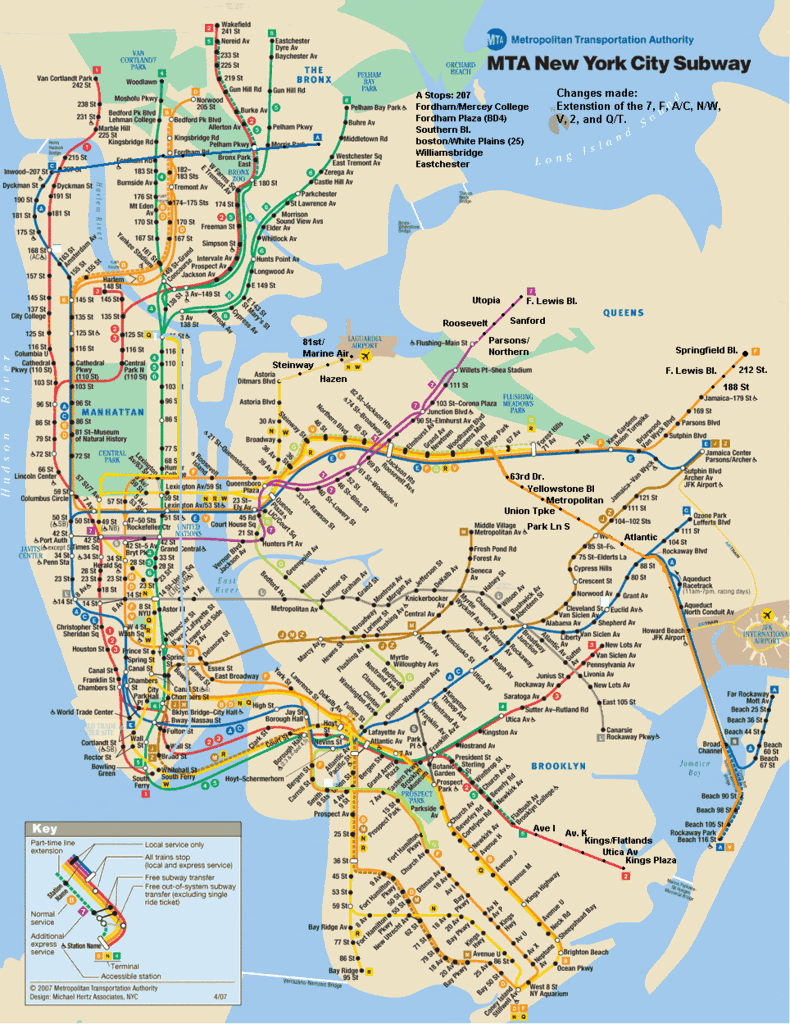
    futuremta.jpg

    Every subway rider has his or her own vision for a better subway system. (Click here or on the image for guypak’s full version.)

    Every few months, a thread such as this one pops up on the Straphangers Riders Diaries board or on Subchat. One person proposes the ways in which the New York City subway system could be extended to be a more inclusive system.

    In the future MTA system linked above, the 7 goes beyond Main Street in Flushing and the F extends past its eastern terminus in Jamaica. The V journeys through a now-neglected part of Queens before meeting up with the A out to Far Rockaway. The 2 extends to Kings Plaza; the G permanently stops at Church Ave. (instead of its current planned temporary excursion into Kensington); the A runs a cross-Bronx line; and the N and W finally deliver subway riders to LaGuardia Airport.

    While this map doesn’t include F/V express/local service in Brooklyn or the West Side extension of the 7 train, the 28 new stops would address many of the inadequacies of the current system, which, mind you, hasn’t been extended in over 80 years. Meanwhile, as we New York transit buffs dream of a future, plans for expansion seem noticeably off the table.

    For the last few days, the MTA chiefs have been trying hard to justify a fare hike (and some pols think the MTA should just ask for more money from Albany). But in all of the talk of fare hikes, nary a word has been uttered about expanding subway service. Sure, the Second Ave. subway is under construction, but what about the rest of the city? At a time when the mayor is trying to push for fewer cars and better public transportation, more rail service is exactly what this city needs.

    As a model for its expansion plans, New York City should look no further than London. While its taken more than 10 years to get this project off the ground, London Transport announced plans last week for the long-anticipated Thameslink rail project. The project will deliver more comprehensive commuter rail service through London. This includes a 300-percent increase in the number of trains reaching center London and an increase in the number of seats available during peak hours by 14,500.

    The article contains a kicker that should ring some bells with New Yorkers:

    Network Rail says the Thameslink upgrade is needed because 70% of all rail journeys begin or end in London and the south east and London’s population is projected to grow by nearly one million people in the next 20 years.

    Those numbers sound suspiciously similar to Mayor Bloomberg’s estimates of the projected increase in New York’s population over the next 23 years. In London, the British are addressing projected population growth by preparing for it now. In New York, we’re sitting idly by while politicians whittle away the one good plan — congestion pricing — that would have boosted funds available for public transportation infrastructure. We’re not even considering increasing LIRR or Metro-North service either.

    So as the fare hike debates heat up and the congestion pricing debates heat up, New York should turn to its sister city in the UK for inspiration. After 80 years of pining for a Second Ave. subway and a JFK Raillink, I would hope that the city would have learned its lesson. Planning now for the future seems obvious to me. Maybe we just need a reminder.

  • Congestion pricing deal relieves MTA CEO

    At 1:50 p.m. yesterday, the MTA breathed a sigh of relief. For now, it seems, there is a flicker of hope for the financial future of the city’s transportation authority. This relief came in the form of four words from State Senate Majority Leader Joseph Bruno: “We have a deal.”

    This deal, of course, concerns the now-dead/now-alive congestion fee plan. Three days after a deadline to secure federal funds, the state government agreed to establish a commission to study the congestion issue. In doing so, amNew York’s Tracker blog reports, they’ve put themselves back in the running for a grant of up to $576 million from the federal government.

    A few days ago, I reacted with bitter feelings toward the opponents of the Mayor’s plan. Today, I’m guardedly optimistic that the state will still do the right thing when it comes to the congestion pricing plans. The Times has more about the deal:

    A commission will be created to study congestion and come up with a plan to mitigate it. The commission would not be limited to considering Mayor Michael R. Bloomberg’s plan to charge a fee to drivers who enter Manhattan, and could also consider other traffic mitigation strategies.

    The City Council would be required to approve whatever plan the commission recommends, and the Legislature would have until the end of next March to approve it, Mr. Bruno said.

    The agreement appeared far more modest than what the mayor originally proposed. Still, state and city officials said they had been in talks with Bush administration officials and believed New York might still qualify for as much as $500 million in federal aid, despite the passage of an ostensible Monday deadline for cities to submit congestion plans to the Department of Transportation.

    The commission, as Streetsblog reports, will consist of 17 members. The Mayor, Governor, City Council, State Senate Majority Leader and State Assembly speaker will all have three appointments to make. The Senate and Assembly minority leaders receive one appointment each. Considering the various viewpoints, you can bet that the plan the commission develops will be a watered down version of the Mayor’s original groundbreaking congestion fee plan.

    Still, we have much to celebrate. The opportunity is there for New York to become a nationwide leading in combating traffic issues, and the state still has the chance to ensure financial support for the Metropolitan Transportation Authority, one of the key agencies that can help combat congestion. While Sewell Chan at the CityRoom blog has the reactions from various city leaders, as this is a subway blog, I wanted to highlight MTA CEO Elliot “Lee” Sander’s statement.

    “The MTA is thrilled that an agreement has been reached to advance congestion pricing, which is critical to funding the long-term needs of the transportation system. We look forward to working with the City, USDOT and the commission to pursue the goals of reducing congestion, protecting the environment and investing in public transportation, “Sander said. The CEO is still optimistic that a deal can be reached that satisfies us all, and so am I.

    As an editorial in The Times noted on Thursday, New York needs to combat its congestion problem, and the federal government is willing to pay big bucks to make it happen. Finally, some common sense prevailed in New York State politics. For now.

  • Left for dead, congestion fee lives

    Live from a Blackberry at LAX, it’s the return of the congestion fee.

    When last we saw the congestion fee plan, it was dead in the water, and New York had just lost out on $500 million from the feds. Well, the funeral may have bee premature. As Streetsblog summarizes, the congestion fee plans are alive and kicking. The dtate legislature and executives have agreed to establish a commission to address the congestion problem

    I’ll have more later when I can get to a computer. For now, check out Streetsblog.

  • A post mortem on the congestion fee

    Yesterday’s post on the fall of Mayor Bloomberg’s congestion fee left many feeling raw about the way Albany mistreats New York. Today, the finger-pointing reined supreme.

    But no matter how the state Assembly members tried to spin, the blame ultimately rests on their shoulders. It’s their fault that Bloomberg’s plan didn’t pass. It’s their fault New York is stuck with no solution to its congestion problem and no solution to the looming financial problems that could plague the MTA for years.

    The New York Times noted that Mayor Bloomberg was not happy at all with the state legislature but may have to shoulder some of the blame. While SUBWAYblogger noted that Bloomberg knew his plan was the right one, Diane Cardwell of The Times explained how Bloomberg didn’t adequately convince the state legislature of this fact:

    At a news conference in Brooklyn yesterday, Mr. Bloomberg denounced lawmakers for failing to even take up his plan, suggesting that they lacked “guts” and that their inaction would result in children being exposed to polluted air. “Albany just does not seem to get it,” he said …

    [But] Rather than engaging either Gov. Eliot Spitzer or legislative leaders from the beginning, they said, Mr. Bloomberg and his aides sprang a complex proposal on the Legislature at the end of its session, seemed unprepared to answer questions or revise details, missed opportunities to sway legislators, and then used the deadline to apply for federal financing as a bludgeon to shove the plan through.

    “The constant drumbeat of the deadline may have done more harm than good — people got their backs up,” said Assemblyman Richard N. Gottfried, who favored the plan. “People don’t like to have a gun to their head.”

    While The Daily News came down more firmly on the side of Mayor Bloomberg, they too noted that political machinations doomed the congestion pricing plan. Republican Senate Majority Leader Joe Bruno, who couldn’t muster all of his troops behind the plan, blamed Gov. Eliot Spitzer for a failure of leadership, and The News noted that the Assembly has grown tired of caving to a powerful executive (in this case, Bloomberg).

    While the state missed the July 16th deadline that would have ensured over $500 million in federal funds for the implementation of the congestion fee, not everyone is ready to declare the plan dead forever. Sewell Chan at the CityRoom blog notes that the Straphangers have urged the state to continue work on a congestion fee plan. Other are using this opportunity to push other ideas — such as bike sharing — that would hopefully get cars off the road.

    The Streetsblog advocates, major proponents of the congestion fee, responded yesterday as well. In fact, they went so far as to print a letter from the man who killed the congestion fee. Richard Brodsky, an Assembly representative from Westchester whose constituents would have the most to lose from the plan, work tirelessly to fight the pricing plan. Earlier this month, Streetsblog noted that Brodsky took in more from the parking industry than any other representative. Brodsky claims he was working for the democratic process and that the parking industry money he takes in had nothing to do with his stance on the congestion fee. And I have a bridge to sell you.

    No matter where everything stands today, though, we have to remember that the congestion fee isn’t dead forever. It’s just dead for now and no longer can enjoy the possibility of a $500 million federal grant. A reader of mine — an ex-pat Jerry living in Prague — says he visits London frequently and notes that the congestion fee works in reducing traffic. One day, New York will take some responsibility for its transportation and environmental future and become like London. We lost this round, but we can’t give up this fight. The congestion fee in New York will happen, and it will happen soon.