Category: Fare Hikes

  • Brooklyn council members to vote down fare hike over F express plan

    culverviaduct.jpg

    The construction on the Gowanus Viaduct is quickly becoming an issue in the F Express plan. (Photo courtesy of Wikipedia)

    Everyone likes the F Express plan. Over 3600 people have signed the petition, and MTA board members have voiced their support. The plan would even give meaning to the neglected V train. But the MTA is throwing up a roadblock.

    Over and over again, the MTA keeps saying that construction on the Gowanus Viaduct renders this plan impossible until 2012. Now, those of us who have been most vocal in the push to get this plan approved have never really understood how the work on the viaduct renders express tracks — unused tracks that would cost literally billions of dollars to build today — out of service.

    Yesterday, we learned, via the Kensington (Brooklyn) blog, that two city council members agree with us. The MTA just hasn’t adequately explained why the F Express plan must suffer. The two politicians — Simcha Felder of Borough Park and Dominic Recchia of Coney Island — write:

    The MTA has said that an express F train cannot be considered until 2012, upon competition of the Gowanus Viaduct restoration. As you know, in addition to the two unused express tracks between Bergen St. and Church Ave., a single unused track exists thereafter up to Kings Highway. Anyone who has ridden the elevated portion of the Culver line has seen the single express track between Church Ave. and Kings Highway used sporadically despite the scheduled Gowanus Viaduct project. We fail to understand what relevance the Viaduct has to the elevated express track between Church Ave. and Kings Highway, or, for that matter, the underground express tracks beyond the Viaduct, from 7th Ave. to Church Av. Additionally, we remain unconvinced that the MTA’s 2012 goal is reasonable timeframe for the completion of work on the Viaduct, and, transitively, full restoration of express service.

    The MTA has also cited insufficient demand as an argument against restoration of express service on the F line. Based on the community’s loud voicing of their concern over this matter, including an online petition with more than 3,500 signatures, we believe the demand will be particularly evident when service is improved, and the MTA is offering its riders a more reasonable commute. At a time when the city’s leadership is attempting to convince more New Yorkers to step out of their cars and into mass transit, a fare hike without tangible improvements would severely undermine this effort.

    While, as the Gotham Gazette notes, it’s not politically risky for anyone to oppose a fare hike, Felder and Simcha are using their platform to make a good point. We want more information on the Gowanus Viaduct. Will it really take until 2012? Is there no way to accommodate express service on the rest of the BMT Culver line in Brooklyn?

    This line would have a positive impact on many people’s lives in Brooklyn. It should happen, and we shouldn’t have to sit through anymore vague answers as the MTA stalls on another construction project.

  • The great student MetroCard swindle

    City Comptroller William C. Thompson, Jr., tried to help out the straphangers, but the weather would have none of that. Literally lost in yesterday’s flood was his report proclaiming the impending MTA fare hike could be avoided if Albany and the city fulfill their fiscal obligations to the MTA.

    While a pesky flood captured the city, Thompson’s report deserves another look. An analysis of the six ways in in which, combined, the MTA could draw in enough revenue to fend off a fare hike for now, Thompson’s work serves as public support for the subway rider, and buried in his report is a gem.

    Recommendation five concerns the ever-popular Student MetroCards. A favorite of students around the city who abuse this program for all its worth, this program is supposed to be covered by allocations from the City and State, but, unsurprisingly, the City and State are shirking their responsibilities. Thompson notes that an adjustment of the school fare reimbursement to “fully reflect the cost of all authorized student bus and subway trips” would provide the MTA with $71.5 million more.

    In other words, the City and State are not paying what they should be for the city’s students to ride the subways for free. He goes more in depth into the economics:

    The City should increase its reimbursement to NYCT for fares for schoolchildren. Such increases would make up for unilateral decreases in school fare reimbursements during the mid-1990s. Currently the City and the State each contribute $45 million per year to subsidize school fares.

    NYCT recently provided the Office of the Comptroller with data regarding student MetroCard use during the 2005-2006 school year. During that school year, students took 133.4 million subway and bus rides at a cost to the transit system of $161.5 million, based on average non-student bus and subway fares. After subtracting the combined City and State fixed school fare reimbursement of $90 million, NYCT provided $71.5 million of unreimbursed service last year.

    The emphasis there is mine, and yes, you read that correctly. The City and State seem to expect the MTA to simply foot the bill for student riders at a loss of $71.5 million to a cash-strapped Authority. That’s outrageous.

    Many politicians in and around New York City like to give lip service to the fare hike. We’ll do what it takes to avoid it, they say. Well, here’s your chance. End this ridiculous practice and reimburse the MTA for rides it gives to students. The MTA is under no obligation to provide this service, especially considering how many students abuse the privilege of these MetroCards. If the city and state refuse to reimburse the Authority for the service, the program should end. It’s as simple as that.

  • NYC Comptroller: With help from state, MTA could avoid fare hike

    Two weeks after the MTA announced a 2008 fare hike, the New York City Comptroller has issued a report concluding that the MTA could avoid a fare hike if the City and State were a little bit more willing to subsidize mass transit.

    The comptroller’s report is condemnation of the ways in which the State of New York has inappropriately re-appropriated money earmarked for downstate mass transit. They’ve hijacked supposedly dedicated streams of funding and are using them to fund upstate transportation networks used by a relatively miniscule amount of the state population. At the same time, the City of New York isn’t doing enough to meet its financial obligations to the MTA.

    According to Comptroller William C. Thomspon’s report, the City and State should enact six sensible measures that would right these economic wrongs. These measures would guarantee the MTA enough money to avoid fare hikes for now and enough financial solvency going forward to minimize the impact of a potential future hike. Let’s take a look at his proposals:

    (more…)

  • New York should take its cue from London Transport

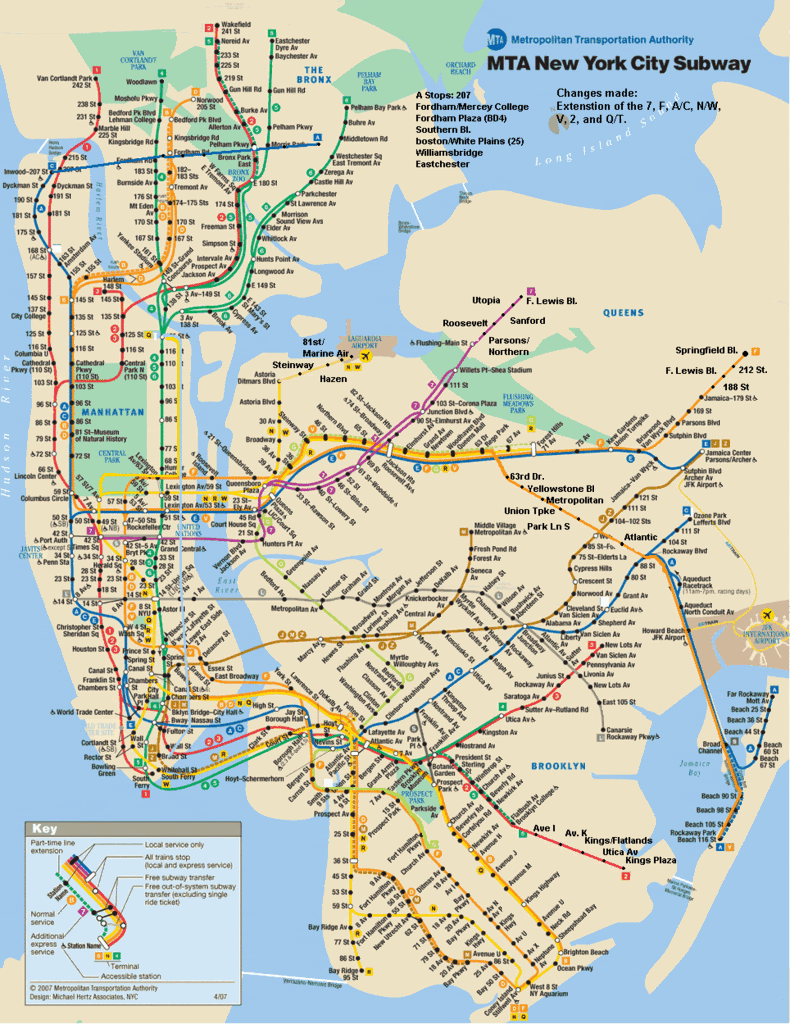
    futuremta.jpg

    Every subway rider has his or her own vision for a better subway system. (Click here or on the image for guypak’s full version.)

    Every few months, a thread such as this one pops up on the Straphangers Riders Diaries board or on Subchat. One person proposes the ways in which the New York City subway system could be extended to be a more inclusive system.

    In the future MTA system linked above, the 7 goes beyond Main Street in Flushing and the F extends past its eastern terminus in Jamaica. The V journeys through a now-neglected part of Queens before meeting up with the A out to Far Rockaway. The 2 extends to Kings Plaza; the G permanently stops at Church Ave. (instead of its current planned temporary excursion into Kensington); the A runs a cross-Bronx line; and the N and W finally deliver subway riders to LaGuardia Airport.

    While this map doesn’t include F/V express/local service in Brooklyn or the West Side extension of the 7 train, the 28 new stops would address many of the inadequacies of the current system, which, mind you, hasn’t been extended in over 80 years. Meanwhile, as we New York transit buffs dream of a future, plans for expansion seem noticeably off the table.

    For the last few days, the MTA chiefs have been trying hard to justify a fare hike (and some pols think the MTA should just ask for more money from Albany). But in all of the talk of fare hikes, nary a word has been uttered about expanding subway service. Sure, the Second Ave. subway is under construction, but what about the rest of the city? At a time when the mayor is trying to push for fewer cars and better public transportation, more rail service is exactly what this city needs.

    As a model for its expansion plans, New York City should look no further than London. While its taken more than 10 years to get this project off the ground, London Transport announced plans last week for the long-anticipated Thameslink rail project. The project will deliver more comprehensive commuter rail service through London. This includes a 300-percent increase in the number of trains reaching center London and an increase in the number of seats available during peak hours by 14,500.

    The article contains a kicker that should ring some bells with New Yorkers:

    Network Rail says the Thameslink upgrade is needed because 70% of all rail journeys begin or end in London and the south east and London’s population is projected to grow by nearly one million people in the next 20 years.

    Those numbers sound suspiciously similar to Mayor Bloomberg’s estimates of the projected increase in New York’s population over the next 23 years. In London, the British are addressing projected population growth by preparing for it now. In New York, we’re sitting idly by while politicians whittle away the one good plan — congestion pricing — that would have boosted funds available for public transportation infrastructure. We’re not even considering increasing LIRR or Metro-North service either.

    So as the fare hike debates heat up and the congestion pricing debates heat up, New York should turn to its sister city in the UK for inspiration. After 80 years of pining for a Second Ave. subway and a JFK Raillink, I would hope that the city would have learned its lesson. Planning now for the future seems obvious to me. Maybe we just need a reminder.

  • Fare hike returns seem meager

    As the MTA tries to figure out whether or not there are better ways to raise revenue than implementing a fare hike, some of the details of the fare hike have been seemingly ignored. What, for instance, are we subway riders going to get for our increased fare?

    Well, the MTA has released preliminary details of the specific service improvements, and the returns are, in my opinion, quite lacking. Here’s what the MTA is promising us for all of our fare hike problems:

    • Additional rush hour, weekday off-peak and weekend service on the L Line.
    • Additional evening service on the Nos. 1, 4, 5 and 6, and additional weekend service on the No. 7.
    • Increased Staten Island express bus service on weekends, weekdays, middays and nights, in addition to the new S89 service to Bayonne kicking off this fall.
    • Bus Rapid Transit initiative scheduled to begin with implementation along two routes.
    • Next year, a total of five subway station rehabilitations are scheduled to be completed, all made newly ADA accessible.

    Wow. Not much, eh? The L service is a step in the right direction. For months and months, we’ve heard about how the MTA had not anticipated the population explosion in Williamsburg and points east. Finally, they’re addressing problems of overcrowding and unreliable service along a vital artery line into Brooklyn.

    The increased evening and weekend service along the IRT lines sounds nice. But I don’t know too many people complaining that the 4, 5 and 6 suffer from lack of off-peak service. The 7 train service will benefit John Rocker’s friends.

    The other benefits are niche improvements. I wrote recently about the Bus Rapid Transit lanes. As I said two weeks ago, those will work only if the MTA and NYPD figure out a way to keep cars out of the designated bus lanes. I like the idea as a pilot program; I’m less than thrilled that this is one of the top five pressing needs for New York City Transit. Ideally, if this pilot is a success, the city could add more BRT lines with the arrival of the congestion fee.

    The five subway stations scheduled for rehabilitation intrigue me. I get a lot of search hits as people look for information about the plan to connect the Uptown IRT platform at Bleecker St. with the rest of the Broadway-Lafayette stop. When I wrote about it in May, it was hard to tell if the MTA would follow through with this now or in the indeterminate future. There’s still no indication of this plan’s fate.

    In addition to those changes listed on the MTA’s site, amNY’s Tracker Blog highlights a few more additions for us. These changes included longer weekday operating hours for the B and W as well as that long-promised G train extension to Church Ave. in Brooklyn.

    For fans of the MTA’s rolling stock, the Authority will add new R160 cars along the J, Z, L, M, N and Q Lines. That’s great for the L, N and Q, but by adding new cars to the J, Z and M lines, the MTA is targeting barely-used train lines. Those cars are the oldest, but they are also the least frequented of any subway line in the city.

    Overall, then, we’re getting a mixed bag of service upgrades. We’re not seeing a commitment to the Broadway-Lafayette plan or the plans to paint many of the subway stations. I like new subway cars as much as the next guy, and I like increased off-hours service. But why is the MTA targeting lines that aren’t underserved? And where’s our F/V express service? Not yet here, it seems.

  • Details emerging about upcoming fare hike

    Update: As expected, the MTA’s announcement jibes with the details we already knew. Of note is that the MTA is committed to provide more service to complement these fare hikes. The public will be much more accepting of this hike if more servide becomes a reality. More later.

    =====

    As the Day of the Fare Hike progress, details are emerging about the direction in which the MTA will head today. While not great for commuters, it sounds like this won’t be the most drastic fare hike in recent times.

    Notably, as William Neumann of The Times notes, the MTA is looking to raise toll and fare revenues by 6.5 percent. The overall inclusion of tolls and fares is an important point to highlight. It’s up to the MTA to determine how they will draw in this revenue. They could opt for a large toll increase and a smaller subway and bus fare increase.

    Neumann writes:

    The plan..does not specify how much the base subway fare, unlimited ride MetroCards or bridge and tunnel tolls would go up, but it calls for an overall increase in fare and toll revenues of 6.5 percent…Based on annual fare and toll revenues of approximately $5 billion, a 6.5 percent fare and toll increase would generate about $325 million a year in additional income for the authority.

    At a time when the MTA’s future revenues are largely relying on volatile property tax rates, the agency is also looking to implement an inflation-based measure that would feature modest fare hikes every two years. I think this is a great idea.

    For decades, the New York City subways fell into disrepair because the independent companies that owned the various lines were afraid to hike the rates up from a nickel. For over forty years – from 1904 until 1948 – the fare was a nickel, and it doesn’t take an economic genius to know that a nickel in 1904 went a lot farther than a nickel in 1948. Sticking with inflation would ensure a steady stream of money from the MTA.

    As the MTA board gears up to discuss these fare hike plans, they seem to be against cutting service and maintenance. Here lies one of the reasons why the public may feel up for stomaching this fare hike. People understand that the subway system can’t afford more deferred maintenance or delayed service.

    And finally, with talk of the congestion fee swirling, the MTA has quickly noted that they wouldn’t see a penny of congestion fee money until 2010 at the earlies. As many have noted, the Authority cannot count on money they may or may not receive until the end of the decade as they contemplate their budgets for the next year. So here comes a fare hike.

  • MTA likely to implement ’08 fare hike

    Remember how Eliot Spitzer, during his campaign for governor, said that an MTA fare and toll hike would come about only a last resort? Well, get ready for that last resort.

    News reports indicate that, when the MTA announces its proposed 2008 budget this Wednesday, fare hikes will be a part of the deal. Pete Donohue of the Daily News has more:

    The MTA will put fare and toll hikes on the table next week in its preliminary 2008 budget but the agency won’t cut services next year, sources said yesterday.

    The preliminary budget envisions raising hundreds of millions of dollars by charging more for buses, subways, commuter trains and Metropolitan Transportation Authority bridges and tunnels.

    Sources said the plan – to be unveiled at the MTA board’s monthly meeting Wednesday – also envisions others sharing the burden of closing the gaps. It will call for administrative streamlining, better use of technology and increased revenues from state taxes.

    This is of course bad news from those of us who are watching our wallets, and it does, as the News pointed out, fly in the face of Spitzer’s campaign promises. But transit advocates are at least accepting of the fare hike.

    “In the face of large budget deficits, reality has to strike,” Neysa Pranger of the Straphangers Campaign told Donohue. “If that means everyone pitches in a bit more, including the riders and the state through dedicated taxes, I think that would be reasonable. But at the same time, riders can’t bear an unreasonable share, and possibly should get something in return if they are paying more.”

    Gene Russianoff, also of the Straphangers Campaign, took a similar stance. “Any fare hike proposal should only be seriously considered at the same time the governor wins congestion pricing and new transit aid, which would raise billions of dollars to fix transit and take pressure off the MTA’s budget,” he said. I agree; the MTA should find a way to adequately distribute their budge deficit. It shouldn’t just be incumbent upon the riders to shoulder that burden.

    Meanwhile, it seems to me that one of the ways the MTA may go about raising revenue and the fares will be through fewer discounts. Because of pay-per-ride discounts and unlimited ride passes, the average subway ride now costs around $1.30, lower than it did in 1996 before the widespread use of Metrocards. The reality is that the MTA cannot operate on such a low fare.

    But if the MTA raises fares, riders are right to expect better service. The increased fares and added revenue should go toward better service – such as an F/V express option in Brooklyn – and more frequent service during off hours. On Wednesday, we’ll have a general sense of what the MTA’s revenue targets are. We won’t know about the nitty gritty of the fare hikes for a while. But be prepared for one; it seems inevitable.

  • Hemmerdinger mum on possible ’08 fare hike

    It’s all Hemmerdinger, all the time, this week at Second Ave. Sagas. After news about his appointment and news about cranky GOP leaders, we’ve got news about everyone’s favorite MTA topic: the possible 2008 fare hike.

    Hemmerdinger, not yet officially the new MTA chair, hasn’t taken a stand on the potential fare hike looming on the horizon. To this, I say, “Duh.” Hemmerdinger isn’t going to give state legislators any reason to block his nomination; why would he make himself the least popular man at the MTA before his first day on the job? He also won’t lie and say that a fare hike is avoidable when it seems clear one is heading our way.

    The Daily News has more:

    Dale Hemmerdinger, the head of Atco Properties and Management, an international real estate company, said he’d have to delve further into Metropolitan Transportation Authority matters – and be confirmed by the state Senate – before he could offer an opinion on whether an increase is warranted.

    The fare is only part of the equation, he said. Government subsidies pay for much of transit operations. “In terms of whether it’s fair or not, the idea is to keep it as affordable as possible, and that’s determined by how much in subsidies there is coming in…,” he said.

    Hemmerdinger’s recent experience with transit policy suggests that he will be in favor of a fare hike in the near future. Last year, he was head of the MTA’s Citizen’s Budget Commission, an external audit group that urged the MTA to raise fares in order to meet its operating budget.

    For me, the issue of a fare boils down to one point: If the MTA raises the fares, then they should be willing to provide better service. They should provide more trains an express options when tracks are available. They should make sure the money is pumped back into the system in a way that benefits riders.

    While Hemmerdinger for now has to politick his way to the MTA chair position, when his job is more secure, I would expect a fare hike. Maybe that fare hike won’t be a bad thing either.

  • ’08 fare hike could target Unlimited Ride Metrocards

    To hike the fares or not to hike the fares? That is the question, and MTA CEO Elliot “Lee” Sander is coming down on the side of hiking the fares.

    Last week, I speculated that the MTA’s unexpected tax windfalls could stave off an announced 2008 fare hike. But not so fast, said Sander. Metro, on of the city’s free dailies, has more:

    Sander said this year’s surplus wouldn’t ward off a fare hike.

    “Nothing on that has changed,” he said.

    That’s because the MTA has to pay back massive debts incurred to pay for capital projects, to fix infrastructure and to buy new trains and buses. Ballooning deficits have been predicted to reach $1.9 billion by 2010.

    In other efforts to reduce this debt, Mayor Bloomberg announced that the city would contribute $200 million a year to the MTA. The last time the City gave so much to the MTA was during the Koch Administration.

    “There is a direct connection between the withdrawal of that support by the city and the large operating deficits that we face in ’08, ’09 and ’10, so we really appreciate [Bloomberg’s] focus,” Sander said. “The contribution to the capital program significantly diminished after 1994, and that certainly had a role in the amount of borrowing that the MTA had to do.”

    Interestingly enough, the Unlimited Ride Metrocards could be the biggest victims of the fare hike. In fact, I believe the only hikes will affect those who use Unlimited Ride Metrocards. On Monday, SUBWAYblogger directed my attention to an article in The Post noting that we riders save close to $1 billion using Unlimited Ride Metrocards.

    Since the average cost of an Unlimited Ride averages out to about $1.31 per ride and only 12 percent of all subway riders pay the full $2 fare with no discount, the MTA will look to recoup some of the money it gives up by offering these discounted MetroCards. It’s bad for those of us who rely on the subways to commute, but the MTA needs the money. Hopefully, they’ll use the funds to offer us better service and more trains.

    We’ll know for sure in July when Sander makes his final announcement on the fare hike. So stay tuned until the dog days of summer when our wallets may get just a little thinner each night.

  • Tax revenue could stave off ‘08 fare hike

    Just the other day, I took the MTA’s new CFO to task for his gloom-and-doom scenario involving the MTA’s financial picture and tax revenue. Well, today, I have better news: Because of the increase in taxes collected by the MTA, the planned 2008 fare increase may be off the table.

    With the MTA collecting over $184 million more than planned, The Daily News speculates that this surplus could cover the gap that the fare increase was supposed to meet. Pete Donohue has more:

    Since January, key real estate taxes have generated nearly $600 million for the MTA – $184 million more than anticipated.

    If that pace continues, those taxes would fill the $800 million gap the Metropolitan Transportation Authority had projected for 2008.

    “God bless the housing market,” Gene Russianoff of the Straphangers Campaign said. “It helped generate a $1 billion surplus in 2006 and, hopefully, it will hold off a fare hike in 2008.”

    (By the way, I’m going to count up how many MTA articles appear in the New York press and in how many of those Gene Russianoff appears. My guess is upwards of 90 percent.)

    So that’s good news. The MTA, with some massive projects on tap, is facing a better-than-expected financial picture. Of course, the MTA officials aren’t quite as quick to celebrate, and I don’t blame them. The last thing they want to do is say the fare increase is off the table and then watch as the real estate market tanks in August. In fact, an MTA spokesman said exactly that.

    “Revenues from real estate taxes are extremely volatile and it’s too early in the year to know where revenues will end up,” MTA spokesman Jeremy Soffin said. “We will not consider a fare increase until we have exhausted all other options.”

    The final decision on a fare increase will come in December. Hopefully, the real estate market will stay healthy and robust until then. I wouldn’t mind sticking with my $76 monthly Metrocard. Enough of my hard-earned money goes to the monthly card as it is.