To replace a damaged MetroCard involves, as with many things at the MTA, a process. A rider has to get a form from a station agent, figure out how to fill it out and mail it back to the MTA in a postage-paid envelope. Over the course of a year, Transit processes 170,000 for demagnetized cards or for those scanned twice, and the average turnaround time is 7-11 days.
Lately, though, this cumbersome process has been slowed because the envelopes have become a scarce commodity. As the New York City Transit Riders Council President’s Forum a few weeks ago, a station agent spoke on how the postage-paid envelopes hadn’t been restocked in months, and Pete Donohue noted earlier this week that the envelopes were in short supply.
Today, the News reports that the MTA is going to use a nascent technology called the Internet to improve the MetroCard trade-in process. Beginning in the second quarter of 2011, when customers encounter a faulty card, they can fill out an online form to process an exchange. That move online should allow the MTA to cut down on administrative and mailing costs and should also speed up the exchange. The online upgrade, reportedly in the works since 2009, has been a long time coming, but what’s taken so long?
Juan Carlos Pinto's MetroCard Mona Lisa is now on display in DUMBO.
Take a look at this baby. It is a Mona Lisa MetroCard by artist Juan Carlos Pinto. The Guatemala-born artist has been working in New York City for the past ten years, and he uses non-biodegradable plastic objects as his medium. He slices, dices and pastes them to create visual images.
“The idea of using these non-biodegradable cards is to reinforce recycling and prolonging its use indefinitely while providing the artist with a source free material. It is also a way of reminding us about the danger this material can cause if left to seep into the earth,” he says on his website.
Pinto’s work is currently on display at the DIS Micro Gallery at 147 Front Street in Brooklyn. Always a sucker for a good “Mona Lisa,” I like MetroCard Che as well. Viva la fare hike revolucion.
A swipeless, credit card-based fare payment system could be in our subway-riding future.
Since taking his spot atop the MTA hierarchy, Jay Walder has overseen a push to bring 21st Century transit technology into a system that has long been resistant to modernization. It was that drive that led Gov. David Paterson to appoint Walder to the authority’s top spot, and while many headline-generating projects — the MetroCard replacement program, the countdown clocks — have been in the works for a few years, Walder has seen them move from concept to reality.
In a few years, we could be mourning the death of the MetroCard as transit agencies around the world look to move toward an international fare payment standard. For the past six months ending on Tuesday, the MTA conducted a pilot program with Mastercard’s PayPass and Visa’s payWave technologies. In the final segment of my interview with him, Walder discussed the future of fare payment technologies and the eventual end of the swipe.
Second Ave. Sagas: Improving the fare technology has been a major push of yours over the last year. Where do things stand now? People ask me all the time about improving bus loading times, getting rid of MetroCards, what the next-generation fare payments are going to look like. How soon do you see that technology coming online and what will it look like?
It may well be that the single most demonstrative benefit of a new fare collection system would be on the buses.
Jay Walder: I’m glad you raised bus loading times because it may well be that the single most demonstrative benefit of a new fare collection system would be on the buses. The loading times are horrific on buses, and it’s due, in a large extent, to the fare collection system. The difference is that a MetroCard can take several seconds to dip and an Oyster Card in London is 200 miliseconds. We’re talking about a fundamental shift if we’re able to do it.
The good news out of the pilot program that we’ve had running along the Lexington Ave. line and eight connecting bus routes and express buses is that the system has technologically proven to be satisfactory and has met the objectives that we set out to achieve. It operates off of a standard payments technological platform which I think is beneficial to us going forward. There are some wrinkles that are exactly the sort of thing you would get in a pilot process so better to be doing it in a pilot than otherwise.
The pilot will end at the end of this month, and that’s important because the history of some of the technology pieces is that we did a pilot to get to the next pilot and then we did the next pilot to get to the pilot after that. The point of the pilot ending is that we are concentrating on moving out into the production phase of getting this done, and I think you will see contracts early-to-mid next year that will be moving this forward for the subway and bus system. They will be done in a way that can and should work with the Port Authority and New Jersey Transit. So we can potentially break down the barrier of the Hudson River that way. Also, we’re moving forward with some tests on how we can incorporate some of this into the commuter rail environment as well so that we might think of changing our fare collection process there.
Second Ave. Sagas: Do you anticipate that it will look pretty similar to the Pay Pass system as it’s been set up for the trial?
Walder: There are two parts of it. The actual technology of how this looks will be pretty similar. It might be slightly different, but again we’re trying to stay with standard technology. We’re not trying to build something that’s a custom fit. The second part is that there are elements of what we need to do that are not the norm of what Pay Pass does and we need to find ways to be able to do that as well.
You’ve also seen, if you look at some of what we’re doing on bridges and tunnels right now, we’ve entered into a pilot program there with Visa at a number of stores across the metropolitan region that may well be a model for how we might use the retail environment to refill cards as well. We’re looking at a whole range of things that are involved in that. I think you’ll see us moving to production phase next year.
One of the things we have to work out is the degree to which we do this to a parallel, sort of a side-by-side to the MetroCard or do the degree to which we really do this and have it implemented in a wider range of places but don’t really look to turn it on until we know we can take away the MetroCard. We’re trying to figure that out right now.
Second Ave. Sagas: When will this come online? Is there a year?
Walder: I’m staying away from giving you a year for the moment because we really need to take all of the results of the pilot into account. We need to develop firm plans for the way we’re going to roll this out, and I’m a little worried about being a hostage to fortune unless I give our people time to look at that.
But the direction of travel is very clear, the benefits are very clear. It will be something that is simpler for customers and provides more flexibility in the way we utilize our fare structures. I expect a lot more flexibility in the way that you may be able to get cards, reload cards, and do anything like that, including using the Internet in much different ways in which we do right now. We’ll be using the retail environment in much better ways than we’re able to do it right now. We’ll be potentially moving much more of the payments process away from the MTA and into the payments industry which may be a beneficial thing for us to do. Finally, I think it provides a degree of service, customer service, that people will appreciate. I think anybody who uses a cross-town bus will immediately appreciate it.
To better capture profits from fare revenue, the MTA knows it needs to cut down on the costs of collecting fares. A savings of just a few pennies per swipe can result in tens or even hundreds of millions of dollars in added MTA revenue for the year, and right now, the gold standard would be a contact-less fare system based off of a credit or debit card. The MTA wouldn’t have to build, support and maintain a costly proprietary fare-collection system, and the savings would be tremendous.
But the authority is still a few years away from implementing such a system, and instead, they’re going to try to encourage MetroCard recycling by instituted a $1 surcharge sometime next year on new in-system MetroCard purchases. By doing so, the authority thinks it can reap approximately $20 million annually from the $1 surcharge and the lessening demand for new MetroCards. Riders will be encouraged to refill their cards — and the unlimited cards will become refillable too. The authority will not charge riders to replace damaged cards, and straphangers can avoid the surcharge entirely by purchasing fare cards out of the system.
Through this surcharge, the MTA will print fewer cards per year and clean up fewer cards per year. From environmental and cost perspectives, it’s a no-brainer charge for the authority. “Overall, the MTA prints 170 million MetroCards each year at an annual cost of nearly $13 million,” Aaron Donovan, MTA spokesman, said to The Post. “Many cards wind up as litter in the system, which has its own cleanup costs that we haven’t quantified.”
MetroCard error messages seem to be an increasingly common phenomenon. (Photo by flickr user Triborough)
One day in the not-so-distant future, the MetroCard will die an ignoble death. Instead of an extraneous piece of plastic with a sensitive magnetic stripe, New Yorkers will wave their smart chip-enabled credit cards at a reader to pass through a swipeless entry point. It will speed of the city’s buses and eliminate the need for those annoying tics and error messages so prevalent at subway entrances.
For now, though, the MetroCard, outdated for years and clunky in its uniqueness, lives on. In his subway column today, Daily News writer Pete Donohue looks at the state MetroCard Vending Machines and finds maintenance and service lacking. As the system and technology grows older, it is, unsurprisingly, breaking down more frequently. He writes:
Transit workers have been called to repair the machines 234,170 times this year through September – approximately 870 times a day, Metropolitan Transportation Authority data show. This year, each defect went uncorrected on average 6.18 hours, up from 5.08 hours two years ago…
There are 1,648 MetroCard machines. Even with a defect, a machine regularly will still work to some degree. It might not accept dollar bills but will process a debit or credit card. It might sell MetroCards but not single-ride tickets…
You can thank those shifty-looking guys standing by the turnstiles for some of your MetroCard woes. The aptly named “swipers” swipe people through turnstiles for less than the $2.25 fare. They jam different machine components, like the bill-handling unit, to increase demand for their services. Still, even these ubiquitous scammers aren’t prolific enough to cause an average 26,000 repairs a month. Only 30% of repairs are attributed to tampering, the data show.
The machines are relatively old, and definitely cranky. They were installed about a decade ago and never replaced. They are at the edge of their “useful life,” an MTA spokesman said.
Donohue notes that Transit employees 124 workers who can service these machines. Based on these numbers, each worker must make approximately seven service calls per day to machines that could be anywhere in the system. Keeping the MVMs operating at top shape then is a Sisyphean task.
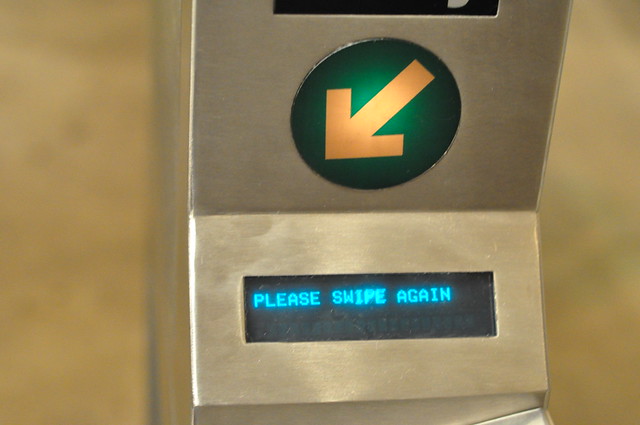
Meanwhile, as the MVMs break down, I’ve noticed an increasing number of error messages on the turnstiles themselves. “Please Swipe Again” has never been so abundant. Perhaps that’s because of the decreasing number of MTA station agents turnstile cleaners who are around to remove build-up from the magnetic card readers. Perhaps these error messages are due to the “useful life” of the technology. Most likely, the problems are a combination of the two.
Ultimately, the end-of-life problems that we’re seeing with the MetroCard technology is indicative of the issues with proprietary technology. Back in 2000, the Village Voice ran an exposé on Cubic and its multi-million-dollar relationship with the MTA, and the alt weekly highlighted the Closed Loop problem. Many of the problems mentioned in the article have since been addressed, but the MTA is still working with a clunky technology designed in the early 1990s that hasn’t achieved widespread adoption outside of the city. It will inevitably break down, and if the failure happens before the MTA’s next-generation fare technology is in place, it will be both costly and disastrous to maintain this aging infrastructure.
Those in charge at the MTA are well aware of this problem. In my conversations with the MTA officials, I’ve heard about the need to bring the contactless fare payment system online sooner rather than later. Still, we’re a few years away from that reality, and the MetroCard machines and card readers must last until then. Frequent breakdowns will just become a fact of life as the technology nears its 20th anniversary.
The MTA is currently engaged in a far-reaching plan to replace the MetroCard with something more futuristic, but this weekend, the fare payment world paused as Raymond deKozan, the man credited with inventing the familiar gold-and-blue card, passed away at age 74. deKozan died at his home in San Diego after a brief illness.
Crain’s New York offers up a biography:
An electrical engineer by training, deKozan founded what eventually became Cubic Transportation Systems in 1972. The San Diego-based company is a subsidiary of the Cubic Corp., a major defense contractor. The company provides automatic fare collection systems for cities around the world. But its best-known product, at least to New Yorkers, is the MetroCard, that piece of yellow plastic with the magnetic stripe that has become an indispensable tool of city life…
deKozan was born in Richmond, Va., on Feb. 21, 1936. He obtained his degree in electrical engineering at the University of Virginia, and was first employed by the Glenn L. Martin Co. in Baltimore in 1957 as the space race heated up. The Soviet Union had just launched Sputnik, and deKozan was hired to help the company and the country develop its first satellite systems. deKozan moved to Cape Canaveral but was soon recruited by Ryan Aeronautical in San Diego, where he eventually was hired by Cubic.
While San Diego became deKozan’s home, he often moved with his family to the cities where the company had major projects. He lived with his family in New York in the early 1990s while pursuing the MetroCard contract with the MTA. He was also a longtime Yankees fan.
deKozan’s creation has become an icon of New York life, but it too is not long for this world. This MTA is engaged in a trial with both MasterCard and VISA that will eventually see the MetroCard replaced with a contactless payment system. Ideally, this new system would be an international one, and although the MTA once said it is trying to bring a replacement online by 2014, the real timeline is anybody’s guess. Today, though, we send our thoughts out to the deKozan family and mourn the creator of a technology that revolutionized New York City transit.
Ever so slowly, the MTA is forging ahead with a pilot to bring next-generation fare payment technology to New York City. The MetroCard with its swipe and magnetic strip has been outdated since the day it was introduced to the subway system, and Jay Walder, who helped usher in the age of the contactless Oyster Card in London, is pushing forward with a plan to tie subway entrance fees into credit cards with smart chips in them. By reducing the costs of fare collection by just a few cents, the MTA would save tens of millions of dollars every year, and New Yorkers wouldn’t have to carry yet another piece of plastic around with them.
Today, we learn that Transport for London is working on its own plans to bring a credit card-based contactless payment system to the Underground, and they’re doing so in conjunction with the MTA, among others. According to The Telegraph, Transport for London officials are in talks with a number of international cities to ensure a common standard for next-gen fare payment plans. These cities include New York, Boston, Chicago, Paris, Sydney and Manchester.
Needless to say, a fare cooperative on an international level would be a boon for travelers. It would encourage even more subway use among tourists as negotiating potentially foreign fare systems would no longer be an obstacle to use. This is forward-thinking policy on a global scale.
Since Jay Walder arrived at the MTA nearly one year ago, the MetroCard and its future have been on the minds of New Yorkers. Picking up on internal fare-media development efforts, Walder has all but declared war on the familiar blue-and-gold piece of plastic that allows us unlimited access to the city’s subways and buses. While New Yorkers may be fond of the swipe and the seemingly ubiquitous messages urging us to “swipe again at this turnstile,” many at the MTA see the MetroCard as a symbol of the subway’s touchy relationship with technology. The MetroCard is early 1990s — or even late 1980s — technology, and it’s the Twenty Teens. Let’s get with the program already.
And so the battle for the MetroCard replacement has been launched. In late 2009, Walder announced that the MTA hoped to implement new fare payment technology by 2014, and the effort for a replacement would extend beyond the current market leaders. London’s Oyster card and the WMATA’s SmarTrip program may seem high-falutin’ to New Yorkers who have no exposure to contactless cards, but even those technologies are out-of-date. The follower for so long, this time around, the MTA wants to be a leader.
So far, the MTA has offered the public glimpses at its long-term strategy. A small pilot program currently in place in station salong the East Side IRT and numerous Manhattan bus routes involves automatic fare deductions from credit and debit cards. MasterCard led the pilot with its PayPass technology, and yesterday, Visa announced that its payWave would now be accepted at these stations as well. Furthermore, a new smartphone app will allow straphangers to use cutting-edge mobile payment technology as well. This — and not an RFID smart card — is how the MTA sees the future of subway fares.
The question, of course, remains why. Despite some glitches, the MetroCard appears to do the job. So what is pushing the MTA to kill it after just 16 years? In an extensive overview of the quest to kill the MetroCard, Cody Lyon at the Gotham Gazette answers just that very question. It is, not surprisingly, a matter of cost. As Lyon writes and as I’ve explained in the past, the MTA spends 15 cents per fare dollar on maintaining MetroCard infrastructure and collecting money. The MTA employs 124 workers whose sole tasks involve keeping MetroCard Vending Machines up and running, and Transit says it received 28,456 service calls for those machines in one month — this past July.
What, then, can smart cards do? By reducing fare infrastructure costs, the MTA says it will save $55 million for every cent they shave off that 15-cent total, and the proper new technology could result in nearly $200 million in increased revenue. “Transit industries across the country are finding it costs them a lot of money, in machines and service, and collecting cash out of them, to be able to operate the transit ticketing and fare payment services they offer,” Randy Vanderhoof, the Executive Director of the Smart Card Alliance, a group meeting with the MTA this week, said to Lyon. “Anything transit agencies can do to reduce the number of tickets they have to sell, and the number of machines they have to supply in the stations, will allow them to save money.”
Lyon’s pieces touches upon other goals and concerns with a charge card-based system. As he notes, the concerns focus around those who do not have credit or debit cards. For that not-insignificant percentage of New Yorkers, the MTA would have to make pre-paid cards of some shape available for purchase, and the authority wants to better integrate fare payment across its subagencies before wading into that economic experiment.
So how soon will the post-MetroCard era dawn? Walder’s early 2014 prediction may be too optimistic. MTA officials told Lyon that the timeframe may, in the grand tradition of MTA projects, be elongated. “The new smart card program will see full subway and train implementation in the coming years,” Aaron Donovan, authority spokesman, said. It’s anybody’s guess how soon that will be.
As the MTA forges ahead with plans to bring next-generation fare payment technology to the subways, Visa announced yesterday that its users can pay for their transit fares with both the payWave contactless technology and a new mobile application. While Visa’s payWave joins MasterCard’s PayPass trial, the ability to pay for transit fares with a mobile phone application at stations along the East Side IRT and on select bus routes forges new ground for the MTA.
“Transit agencies the world over have one primary goal – to get their customers to where they need to go quickly and efficiently. What transit agencies and riders recognize is that using Visa on buses, subways and trains is the logical evolution in terms of improved speed, security and convenience,” Jim McCarthy, a Visa executive, said in a statement. “For commuters, paying with Visa means no more fumbling for change or worrying about lost transit cards. For transit authorities, accepting Visa means better customer service, integrated collections and the potential for increased ridership.”
Visa explains that the New York pilot uses a small electronic chip embedded in either a mobile phone or payment card that communicates with the contactless readers at the fare gates. Simply by holding payWave-enabled cards or phones near the designated reader will deduct a fare from the chip, and open the gate. Visa has also issued a payWave-enabled commuter benefits card called the TransitChek QuickPay Card. This card allows those participating in the trial to pay their fares using the so-called “tax-advantaged flexible spending accounts.”
According to BankTech, iPhone users who opt in to the Visa payWave trial can’t use only their phones to pay. Because iPhone technology doesn’t include a memory card slot, iPhone users will have to keep a MicroSD chip in their cases. Other smartphone users should be able to install the proper chip into the memory card slot.
For the MTA, bringing Visa on board for the last few months of this six-month trial represents the next step in the hunt for the future. By allowing smartphone payments, the MTA is trying to skip what is, in essence, already preexisting fare payment technology. Various transit agencies throughout the world have used RFID-enabled contactless cards for years, and one of the MTA’s goal in searching for the MetroCard replacement involves finding something not already obsolete. I’ll have more on that aspect of this fare payment trial tomorrow.
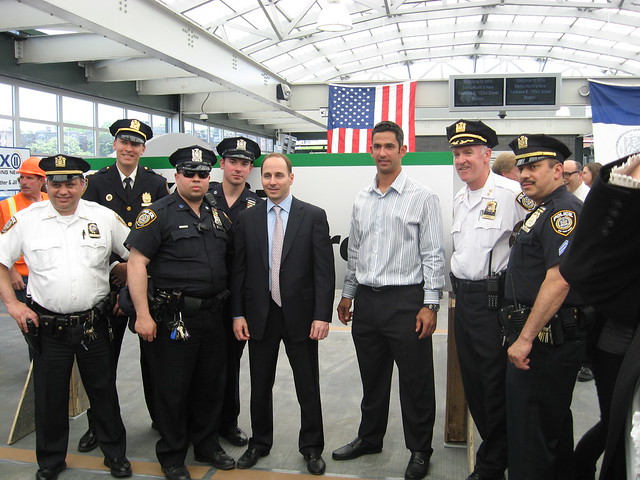
Brian Cashman and Jorge Posada pose last May at the opening of the Yankee Stadium Metro-North stop. (Photo by Benjamin Kabak)
For twenty years, MTA officials and city politicians spoke about securing Metro-North access to the South Bronx. The tracks were there, and the draw — a popular baseball stadium — ensured high demand for a good portion of the year. But as long as the Yankees threatened to leave the Bronx, no party wanted to commit to spend $90 million on a station that wouldn’t see much traffic otherwise.
When the Yankees announced plans for their new stadium, though, everyone sprang into action. The city paid $39 million to help build the station, and the MTA covered the remaining $52 million. Since then, as Judy Rife explores in the Times Herald-Record this week, the station has seen increased ridership and has been deemed a success so far. She writes:
Metro-North Railroad’s statistics are something of a wowser, too. In June, the first month when a year-over-year comparison was possible, about 44,500 fans took the train to the game — a whopping 45 percent increase. The new Yankees/153rd Street station opened last year.
And, yes, there were two more games this June than last, but Metro-North is still registering significantly higher average ridership for the season to date — 3,219 for weekday games and 3,819 for weekend ones. Not bad for a year-old service to a 51,800-seat stadium, where attendance is usually in the mid-40,000s.
Bob MacLagger, Metro-North’s vice president for planning, shamelessly calls the new station a “grand slam” and waxes promotional in recounting the reviews it’s received: “It’s better, faster, quicker, cheaper, easier — no driving, no traffic, no parking, no brainer.”
Transit advocates too have praised the station for its high ridership in its infancy. “There are all sorts of spin-off benefits to the station,” Jeff Zupan of the Regional Plan Association said.” But I think what it has done, perhaps more than anything else, is introduce people who may not have used public transportation before to the train.”
The new station certainly has made getting to and from Yankee Stadium easier for many people, and it’s opened up the new Gateway Center at the Bronx Terminal Market to transit as well. Yet, although we should be praising this new station, its success and its long and tortured history showcases how integration between the city’s commuter rail lines and the five boroughs is generally lacking. It shouldn’t take a baseball stadium to provide Metro-North service to the South Bronx just as it shouldn’t take a massive real estate complex to ensure a Metro-North access point at West 60th St. and the Hudson River.
As a Yankee fan and a transit supporter, I’m certainly pleased to see this Metro-North stop siphoning cars away from the South Bronx and providing the neighborhood with another alternate means of transportation. Next time, hopefully, it won’t take twenty years for a station so obvious to see the light of day.


 The MTA is currently engaged in a far-reaching plan to replace the MetroCard with something more futuristic, but this weekend, the fare payment world paused as Raymond deKozan, the man credited with inventing the familiar gold-and-blue card,