Category: MTA Absurdity

  • Does anybody really know what time it is?

    wrongtime.jpg

    Location: Approximately two-thirds of the way uptown on the uptown-bound 8th Ave. A/C/E platform at West 4th St.

    Actual Time: 9:39 a.m.

    The MTA is not known for its accuracy in time-keeping. As Chris pointed out yesterday, those signs on the L train platforms, just a few months old, are already fairly useless. As trains enter and leave the stations, the signs proclaim the train is still seven minutes away.

    So enter the West 4th St. station. Every morning, I see the clock pictured above – but not Photoshopped quite so much – wishing straphangers a good day. The sign hangs above the escalators leading up to the 8th Ave. platforms from the 6th Ave. trains on the lower level. This clock has never been right. Furthermore, it’s an hour and 14 minutes off.

    Now, if you’re like me, you’re wondering how a clock manages to be an hour and 14 minutes off. I have no idea, but it’s been like this for months. In a few weeks, I’ll get to find out if this is a system-wide error or if this clock is just messed up. When Daylight Savings time ends on November 14, this clock will either be just 14 minutes wrong or an hour of 14 minutes wrong. I doubt it will have the right time.

  • LED lights on the 7 detail express or local service

    New signs illuminate the 7 train. Wonder express or local no longer. (Photos by Ryan O’Horo.)

    On and off for the last few months, I’ve gotten questions about the 7 train. Take, for example, this one from my friend Carla: “How about doing an expose on why the 7 can’t get its damn local/express signage right?”

    While I don’t ride the 7 train much — two trips to Shea this summer and one to the U.S. Open — I’ve wondered this lately myself. A few years ago, 7 express trains were demarcated by the diamond 7, and locals operated under the traditional round purple bullets.

    But earlier this year, something changed. These signs, used interchangeably on the same trains, stopped meaning anything. Passengers had to rely on increasingly inaudible announcements to determine which trains were local and which trains were express. Well, not anymore.

    This week, loyal reader Ryan O’Horo e-mailed about me about a 7 train equipped with LED lights that are designed to differentiate between express service and local service. A thread on Subchat corroborated the story. It seems like the MTA is testing out a way to allow passengers to tell the difference. The lights are hanging on only a few cars on the 7 line. Here’s what Ryan had to say:

    Spent a good amount to time checking it out. It’s only this one train and the displays are mounted in the front, side and rear rollsigns both inside and outside the car. Simple modules that look custom and they’re just kind of hanging out in the rollsign, no fancy mounts.

    According to the Subchat thread, the signs — using EXP for express and LCL for local — are supposed to go green or red, respectively, depending upon the service. So far, we haven’t seen that happen. But we have seen a lot of the signs as Ryan took a set of photos I uploaded to flickr. The thumbnails of a few images below lead to the larger images. For more shots, the photoset is here:

    img_3525-800x600.JPG lllrotate.jpg img_3537-800x600.JPG

    While clearly still an experimental stab at identifying trains, these LED signs are a good step in the right direction. I will forever wonder why the diamond-bullet variances couldn’t work to identify express and local services. I am also a little mystified as to why the MTA is invested in LED lights when they already have signs that should tell the difference between express and local service. But as long as the Authority is willing to listen to those Queens-bound customers who didn’t know if their trains were express or local, we can’t complain too much now.

  • Alstom Transport awarded for tardy deliveries with a contract extension

    In the world of train car construction, there aren’t too many choices. Alstom and Kawasaki dominate the field, and both enjoy hundred-million-dollar contracts from the MTA. But Altsom, who made headlines a few years back for tardy delivers after their cars suffered major damages, is at it again.

    This time, Alstom has fallen another five months behind schedule in delivering R160s to New York, and the MTA doesn’t seem keen on penalizing the company. Bruce Golding of The Post has more:

    The problem-plagued French company building New York’s new high-tech subway cars has fallen five months behind schedule without being penalized by the MTA, The Post has learned. Alstom Transport even won a contract extension in July for $700 million more of the cars, despite its dismal deliveries.

    Alstom’s upstate Hornell factory has only turned out about 80 of the R160-model cars since starting production last year, an industry source told The Post. The company was supposed to have delivered about 200 of the total 400 cars under its original contract.

    According to Golding’s article, the contract Alstom signed with the MTA contains a late-delivery provision. Allegedly, Alstom must pay $800 a day for late deliveries on four-car trains and $1000 a day for five-car trains. So far, no fines have been levied against the Paris-based company.

    Now, doesn’t that strike you as silly? The MTA is foisting a fare hike on the public because they won’t have enough money soon. Well, if these charges against Alstom are true, the MTA not has kept rewarding a perennially delayed company but also has some free money awaiting them. Just enforce the terms of the contract, and voilà, cash.

  • MTA, eyeing 2010 hike, blames the machines for the 2008 raise

    What’s in The Daily News? I’ll tell you what’s in The Daily News. A story about the MTA blaming the MetroCard Vending Machines for what otherwise would have been a smaller fare hike. That’s what in The Daily News.

    My apologies to all of those fans of Guys and Dolls out there, but seriously. The MTA is saying that a flaw in the way the MetroCard Vending Machines are programmed is one of the leading reasons why the 2008 fare hike is set to a quarter instead of just 10 cents. That, ladies and gentlemen, may be a first.

    Pete Donohue, transit writer for The Daily News, has more:

    The Metropolitan Transportation Authority acknowledged yesterday that one BIG reason it wants a 25-cent bus and subway hike is because its vending machines can dispense only dollar coins and quarters.

    MTA spokesman Jeremy Soffin defended the increase as fair and said upping it by a nickel or dime wouldn’t be enough. “The limitations of technology would make a $2.10 fare extremely costly to implement and would provide a much poorer quality of service,” Soffin said.

    Oof. This may go under that ever-special category of Things You Keep to Yourself. Subway guru and Straphanger lawyer Gene Russianoff was outraged for the lot of us. “It’s not acceptable for them to say, ‘The machines are making us do it,’” he said to Donohue. “What are they going to [do] if next time they think there should be a 35-cent hike? Round it off to 50 cents and make us pay?”

    In response to this spate of bad publicity, the MTA announced that they are looking at technological alternatives to the current vending machines. Considering that only 14 percent of subway riders pay in case, searching for something that doesn’t rip off everyone would probably be a good solution here. The MTA is also considering some sort of card for low-income subway riders, but the Authority refused to discuss any details whatsoever of those mysterious program. Maybe they should just step on it with those plans to adopt Smart Card technology.

    In other fare hike news — and I use that term loosely because anyone reading Second Ave. Sagas won’t be too surprised by this information — New York newspapers are making a big stink over the fact that the MTA has plans to raise the fares in 2010. For as long as the MTA has debated this upcoming fare hike, MTA CEO Elliot “Lee” Sander has repeated warned the public that the Authority prefers and would pursue two smaller fare hikes in 2008 and 2010 instead of one larger fare hike when the MTA’s financial picture became too dire.

    As the public becomes more aware of this looming fare hike and its long-term ramifications, people are going to get more annoyed at the MTA. Just you wait.

  • Rickety accounting mars nostalgia train rides, says Comptroller

    Subway buffs enjoy a ride on a Nostalgia Train. The Comptroller hates these. (Courtesy of flickr user bifteck)

    With Second Ave. Sagas firmly entrenched — or is that floating underwater? — during old subway car day, let’s venture over to the economics of maintaining the rolling stock of yore. Old train rides, according to the New York State Comptroller, aren’t economically-efficient. Oh, the horrors.

    The tireless Sewell Chan at The Times’ Cityroom blog reported last week on a New York State audit’s findings that the NYCT nostalgia train rides are a losing proposition for the MTA (Audit in PDF form here). But it’s not nearly as cut-and-dry as it sounds. Take it away, Sewell:

    A new audit by the office of State Comptroller Thomas P. DiNapoli has found that the M.T.A. did not adequately keep track of the money raised from the Nostalgia Train trips. Furthermore, the audit found that New York City Transit, the largest arm of the M.T.A., had to pay to restore and maintain the vintage train cars, but did not, in turn, benefit from the money raised from the train excursions. In other words, subway riders and taxpayers have been subsidizing the history-evoking train rides…

    The Nostalgia Train program earned revenue of $23,035 in 2004 and $12,110 in 2005, according to the audit, but the cost of the crews to run those trains was $31,566 in 2004 and $20,576 in 2005 — so the program operated at a net loss.

    Now, I know the MTA is rather strapped for cash right now. But as one comment on Cityroom aptly noted, how much do you think the audit costs?

    As much as I prode the MTA over its financial mishaps (student Metrocards anyone?), I will staunchly defend these nostalgia-laden train rides. And for its part, the MTA does an apt job defending itself. Chan notes:

    The M.T.A. responded to the audit with several points. It argued that the maintenance and repair costs associated with the Nostalgia Train excursions are “immaterial” when compared with the overall cost of maintaining the entire subway car fleet. It also noted that the Transit Museum is run for historical and educational purposes and is not expected to turn a profit.

    In reality, we’re talking about a deficit of $8,000. Considering that the MTA’s financial problems could run into the hundres of millions, arguing over less than $10,000 of money put toward an educational and historical purpose seems petty. The Comptroller’s office should stick to big picture items such as the looming fare hike.

    To be fair, the MTA should work on its accounting practices. What it implements at the micro level with the Transit Museum could serve as a model for the finances of the Authority and NYCT on the whole. But let’s not unnecessarily rain on the parades of those who enjoy these train rides. As Tom on Cityroom said, “Of the billions that the MTA spends, this was the biggest budgetary scandal you could find? Twenty grand is a rounding error in an agency this size. If it was used to renovate the director’s bathroom that would be a different story, but these trips clearly have value as a service to the many people interested in the city’s history.”

  • Where do old subway cars go when they die?

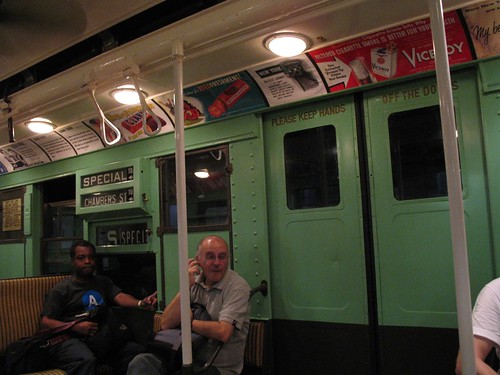
    They don’t go heaven where the angels fly. (Photo courtesy of NYCSubway.org)

    Welcome to Old Subway Car Day at Second Ave. Sagas. I’ve got two stories lined up today about our old subway cars and where the rolling stock ends up after its reached the figurative end of the line.

    Let’s start down the coast a little bit in New Jersey. Or more accurately, let’s start off the coast of New Jersey, in the world’s largest artificial reef. That’s right; the waters off the coast of the Garden State feature the world’s largest artificial, and it’s made of old subway cars. For more on that fascinating story, check out this National Geographic missive from 2006, featuring some excellent photos.

    For a while, New Jersey had stopped accepting old subway cars for its artificial reef over asbestos concerns. But, as The Press of Atlantic City reports, the state’s top environmental official has given the go-ahead to add 600 new old subway cars to the reef. The article — aptly and hilariously headlined “NYC subway cars may sleep with the fishes” — talks about the approval process and more:

    They won’t hurt the marine environment, but they will attract black sea bass, tautog, cunner and other fish for anglers to catch. That’s why New Jersey’s top environmental official has given enthusiastic approval to taking 600 subway cars from New York City for the state’s artificial reef program.

    “Both New Jersey’s fishing and sport-diving communities would directly benefit from the addition of the stainless steel subway cars on the artificial reef network,” concluded Commissioner Lisa P. Jackson of the state Department of Environmental Protection.

    Jackson recently completed a scientific review of whether asbestos in the subway cars would pose any risk to marine life. She determined exposure to marine life from the asbestos fibers would be minimal.

    The story goes more in depth into the structural state of subway cars buried under water for the last 14 years. These cars are 67 percent in tact and have not substantially shifted. They are, in other words, perfectly suited to serve as artificial reefs, and the stainless steel cars heading New Jersey’s way are expected to last longer than the ones currently under water.

    Meanwhile, New Jersey will have to amend itss reef management plan and the federal Army Corps permit to make provisions for subway cars under the artificial reef guidelines. Oh, the joys of bureaucracy.

    So these subway cars will live on under the water. For decades they shuttle people, packed like sardines in a can, around New York City. Now, the sardines, or at least their acquatic counsins, will get to enjoy the subway cars as an artificial reef environment. How apt.

    For some excellent pictures of the Redbird reef currently resting deep under the Atlantic Ocean, check out this photo set on NYCSubway.org. And come back at 1:30 p.m. for the second Old Subway Car story. It’s all about the economics of old subway cars.

  • NYPD called out for blocking the exits at Yankee Stadium

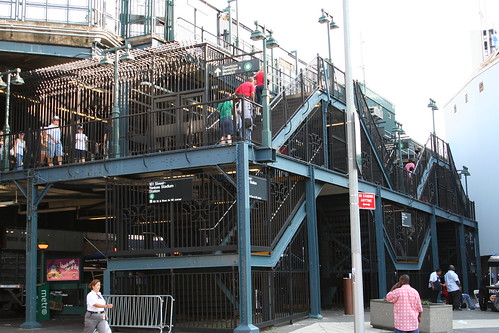
    Barriers, bottom left, are used to stop fare jumpers and emergency exiters alike. (Photo courtesy of flickr user The Sean)

    Remember when Andy Van Slyke got busted for fare-jumping at Yankee Stadium two weeks ago? Well, the New York City Transit Police’s efforts at catching Yankee Stadium fare jumpers just landed them in some hot water.

    The ever-vigilant New York Post noticed that the police barriers in place at Yankee Stadium to stop fare jumpers on the 4 platform were blocking three of the five emergency exits. Rupert Murdoch’s rag would have none of that. Transit Reporter Jeremy Olshan has the story:

    At the busy Yankee Stadium No. 4 subway stop, three out of the five emergency exits have been routinely blocked with metal barricades.

    Station agents and police assigned to the 161st Street-River Avenue stop said the barriers were put in to deter passengers from using the gates for non-emergency purposes or to beat the fare…Two of the three exits on the mezzanine were barricaded, and one downstairs at the B and D entrance also had a handwritten sign that read: “Please use other exit.”

    The MTA employers were as helpful as they usually are. “People are people, they’re going to try to beat the fare,” a station agent said to Olshan. “I don’t know who put up the barricades, but it’s not my job to move them.”

    Bronx Borough President Adolfo Carrion expressed the necessary outrage as this bit of MTA absurdity, and supposedly, the barriers have since been moved. While I’ll be able to confirm that tonight, I have to think that the Post may be making a mountain out of a mole hill here. For a few minutes while the cops monitor the turnstiles — always replete with fare-jumpers after baseball games — some of the emergency exits can be blocked.

    As long as they’re unblocked in a timely fashion, I’ll take the increased fare monitoring. The ramped-up police presence should secure the rest of us in case of an emergency anyway.

  • Hanging ten atop the subway cars

    This is really just a terrible idea. (Photo courtesy of flickr user tombo PRS)

    So yesterday morning, I had the sheer pleasure of an early-morning physical therapy appointment. Thus, my train crossed the Manhattan Bridge at around 8:35 — or thirty minutes earlier than I generally pass over the East River. Lucky for me, it seems.

    On Wednesday morning, at a approximately 8:40 a.m., New York City Transit halted service over the Manhattan Bridge, north of DeKalb St., when an operator of an oncoming train spied a train surfer a top a Manhattan-bound Q train. amNew York reports that NYCT held the train for 40 minutes while workers attempted to get the moron rider off the top of the train car.

    Now, what, you might be wondering, is train surfing? It is only the single dumbest thing a person can do in the subways. Train surfing is the extreme activity of riding atop a train in motion. Generally, as Jinx Magazine tells us, it involves “ducking low overpasses, dodging 3,300-volt electrical wires, and maintaining one’s balance, all while atop a subway train moving.”

    In New York, train surfing is particularly challenging. While our third-rail voltage doesn’t approach the 3,300 figure of other countries’, our subway system’s tunnels offer low or no clearance in most places. Beams, signals and wires provide hazards for everyone to enjoy. It’s no surprise, then, that NYCT Spokesman Charles Seaton issued a fairly morbid comment on the incident: “It’s happened before, and usually when it happens, the person gets killed.”

    Train surfing is, by many accounts, a 30-year pastime for bored teenagers looking for a heart-racing thrill. Seven years ago, in a fascinating and terrifying piece, The Village Voice delved into the underground of train surfing. The story, with descriptions vivid enough to make the reader’s heart race, details the deaths and injuries of train surfers in New York: a teenager dead after striking a signal light, two drunk revelers who were struck in a Jackson Heights tunnel. The injuries and stories are horrific.

    So now that school in the city is back in session, kids are laying claim to — and wreaking havoc on — the subways. As SUBWAYblogger noted, at least three teens resorted to knives at 110th St. on the West Side to settle a dispute just a few hours after this subway-surfing incident. Fun times.

    Meanwhile, even though these train surfing incidents are few and far between, nothing strikes me as being quite so ripe for a Darwin Award as someone who tries to ride on top of a subway train in New York City. It may be a thrill, but you almost have to pine for the good old days of sex, drugs and rock ‘n roll instead of train surfing.

  • Van Slyke, Tigers’ first-base coach, can’t avoid that fare-jumping ticket

    Every day, I see a few hits here from people searching for information on transit cops handing out tickets to turnstile jumpers. It’s always an amusing topic.

    From personal experience, I’ve noticed that the New York City Transit Police are fairly vigilant about fare jumpers at crowded stadiums. Take Sunday, for example. On my way back to Manhattan from Yankee Stadium, I witnessed two people jump the turnstile in their efforts to reach the D train at 161st St.

    Well, the transit cops were standing six feet away on the other side of the turnstile, writing tickets to another group of fare jumpers. The two most recent turnstile jumpers were quickly corralled by the cops. To say they were irked by their $60 tickets would be an understatement.

    Recently, the transit cops ticketed someone a little more famous than your average subway fare jumper. They nailed Detroit Tigers first-base coach Andy Van Slyke a few weeks ago when the Detroit Tigers were in town to play the New York Yankees. Danny Knobler, one of the Tigers’ beat writers, has more:

    Van Slyke was trying to get back to the Tigers’ Manhattan hotel with his family Saturday night. He said that the subway tickets he bought for him and his wife wouldn’t work, so they finally jumped the turnstyle.

    The only problem was that two police officers saw them, and handed each of the Van Slykes a $60 fine.

    “They had us standing there, and people were walking by pointing at us, and yelling, ‘Jumpers! Jumpers!’ ” Van Slyke said Sunday morning. “It’s great. It’s New York City. A guy walked by and said, ‘Andy, I don’t think I can get an autograph now, can I?’”

    Oops.

    Now, you and I know that Van Slyke was trying to swipe his MetroCard and was probably just growing sick of the that “Please Swipe Again” message. So he did what he though was the sensible thing and jumped the turnstile. That is a no-no.

    According to other accounts of the incident, fans leaving Yankee Stadium recognized Van Slyke and joked around with the Tigers coach. The transit police, however, were unamused.

    And this goes to show you that’s it’s far better to pay that $2 fare than it is to risk a $60 ticket, especially at Yankee Stadium.

    The hat tip on this one goes out to Mike A. at River Ave. Blues.

  • MTA stalls on onNYturf’s FOIL request

    With Google Transit’s plan to map the New York public transportation system still very much in its infancy, among the best places to which to turn for Google-compatible transit information is onNYTurf.com’s NYC Subway Google Map Hack. It uses a variety of information — including staircase locations on stations in Manhattan — to provide a comprehensive overview of the subway and PATH systems.

    Recently, the site’s owner Will announced his plans to update the map. This update will include more user customization as well as stairwell locations for stations in the Bronx, Brooklyn and most of Queens. What it won’t include is detailed schedule information about the subways because the MTA is taking its sweet time in responding to Will’s Freedom of Information request for this information.

    According to Will, he has been trying for two months to procure the information — schedules and travel times between stations — that the MTA is reportedly willing to give over to Google. Rightfully so, he’s a bit irked by this news:

    The question this begs is will Google be the only party getting the data, or map artwork, or anything else from the MTA? Anything the MTA gives Google should also be available to the public.

    The MTA schedule data should be made available to the public at large in an easy to use structured data format, so that anyone interested in developing a web service based on it can do so. To work with Google’s Transit directions sytem, the MTA will have to create just such a data feed. When they do, they should make access to it completely public. After all we all pay for it with taxes and fares.

    Will goes on to note that the MTA claims they don’t keep the information on hand. Meanwhile, New York City Transit is supposedly researching whether or not they have a data dump, and the city’s other agencies have engaged in similar stall tactics.

    Now, I know what you must be thinking: Why would onNYTurf really want the scheduling data for the MTA when everyone knows it’s unreliable? Well, au contraire, mon frere. I’ve noticed that New York City Transit does adhere to a set schedule. If there are no train delays, the same trains arrive at the same stops at the same time every morning. During peak hours, when trains are bunched and subject to delays caused by passengers, the time difference may be a minute or two, but the trains run like clockwork. I’ve even timed my commute to them.

    This suggests to me that the MTA knows the schedule and that they probably have it in a form that Will would be able to use for his map. Will wants this data for a very rational purpose. “One thing you can do with schedule data is you can analyze the reach of a transit system. You can make maps that show what area can reach a target destination in say 30 min or 1 hr,” he said. “It is also vital to modeling expansions or changes to transit services. Put in the public’s hands anyone can explore where might be the best places to build a new downtown, or how effective a new rapid bus service might be relieving congestion on existing subway services.”

    The MTA, a public benefit corporation, would be doing the public — which supports the corporation through taxes (look at your gas bill) and other fees — a favor. If the agency has the wherewithal to work with Google, they should good Will what he needs. It’s plain as that.