Category: Public Transit Policy

  • Building a home for Amtrak they can’t afford

    A cutaway of Moynihan Station as seen from Penn Station.

    Over the past decade and a half, spurred on first by Daniel Patrick Moynihan and later by supporters who wanted to continue his efforts, well-connected New Yorkers have fought for an expansion of Penn Station into the Farley Post Office. Part of their reasoning is to boost train service and ease customer congestion underneath Madison Square Garden while the rest of their efforts are driven by the idea of a Great Public Work. Penn Station, they rightfully say, is an eye sore. It’s dirt, dingy and ugly, and the post office would provide a setting of grandeur that could right the wrong of destroying the original Beaux Arts building.

    To that end, the project has been divided into two parts. Phase 1 includes better egress points into the current Penn Station, and it is currently funded and ongoing. Phase 2, which will cost upwards of $1 billion, involves moving Amtrak’s operations into the Moynihan Station area and perhaps readying the station for high-speed rail if the stars and money align properly. That is more of a dream right now than anything else.

    Lately, news about Moynihan Station has been scarce. After the October 2010 groundbreaking, the project has moved quietly forward, and only an announcement that the Port Authority will oversee the new station made a ripple earlier this year. Now, though, Amtrak is making noises about its eventual potential move to Moynihan Station. In fact, they won’t be able to pay the rent.

    Bloomberg News had the report shortly before Chirstmas (and Eric Jaffe at The Atlantic Cities picked it up as well). Wrote Lisa Caruso:

    For Amtrak to move more passengers on trains between Washington and Boston, its only profitable route, it must move out of New York’s Penn Station, said Drew Galloway, assistant vice president for the eastern region. The new space it covets is across the street, where New York state and two developers plan to transform the 97-year-old James A. Farley Post Office into a $1 billion train hall and retail complex.

    The rub: Officials at U.S. taxpayer-subsidized Amtrak, which lost $1.3 billion last fiscal year, say they can’t afford to leave Penn Station, which the railroad owns, unless their new home is effectively rent-free. With the development’s finances unresolved, New York officials haven’t made guarantees.

    …Amtrak won’t have to help pay to build its new home, Gilchrist said. How much it will contribute to operations is under discussion, though Washington-based Amtrak won’t occupy it if it faces more than a “modest increase” from costs at Penn Station, Galloway said in an interview.

    Now, Amtrak can hardly be faulted for their stance here. After all, Moynihan isn’t their idea. In fact, David Gunn pulled Amtrak support from the Moynihan project because it does nothing to add track capacity into or out of New York City. It is simply an expensive cosmetic upgrade that helps ease overcrowding across the street. It is, Gunn said, “an example of how the whole transportation planning system has broken down. It was controlled by a bunch of rich developers.”

    Current Amtrak officials are going to attempt to get creative with funding. They could lease out their current Penn Station space to offset costs, and developers in the area may look to throw in some millions as well. Yet, it’s the same story as the one we’re seeing downtown where billions are being spent on a PATH train that doesn’t add capacity while the upgrades at Fulton St. aren’t worth the dollars.

    In a time when transportation money is scarce, the available dollars are being burned on things that look good instead of things that deliver better transportation service. If that seems backwards to you, well, that’s because it is, and until things change, we’ll be left with fancier train stations and no better service than what we already have.

  • On La Guardia, NIMBYism and a master planner

    Twelve years after neighborhood opposition torpedoed a subway connection to La Guardia Aiport, the city is hoping to improve bus access instead.

    New York City as we know it today exists under the shadows cast by the ghost of Robert Moses. From the bridges that connect the boroughs to roads congested with automobiles to the elevated highways that cut through neighborhoods to the lack of airport-centric transit options to the parks and greenspaces we so enjoy, Moses’ influence runs far, wide and deep. We might even miss him.

    Last week, as I took a few days off to spend some time in the Caribbean, I left up a short post on the upcoming plans to turn Robert Caro’s The Power Broker into a movie. Who, I asked, should play Robert Moses, and in doing so, I offhandedly called him the villain of the story. The reaction from regular readers was loud: Robert Moses was a man of many hats, but to call him a villain is an oversimplification. By the end of his career, the Master Planner single-handedly set the stage for decades of growth and stagnant transit development, but he also realized a vision for New York City that wasn’t all bad. Although Caro’s book, written at the city’s nadir in the mid-1970s, may have needed Moses to be that villain, his legacy is far more complicated than that.

    For all the good Moses did early in his career, he is best known through the prism of Caro’s biography. We know Moses as the man who built low overpasses in order to limit bus access and the people who ride buses to the area around Jones Beach. We know him as the man who wouldn’t move his highways one block over in both the Bronx and Brooklyn, thus destroying two vibrant neighborhoods in the process. We know him as the planner who refused to allow for a rail right-of-way along the Van Wyck to provide better access to Idlewild Airport.

    Yet, through the prism of today, we see Moses as the man who got things done, and since the state decentralized the planning process that Moses once helmed, things rather get done with any efficiency and speed. As the conversation flowed on my post last week, I kept thinking about the recent alternatives analysis NYC DOT is conducting for access to La Guardia. The city is trying to figure out how best to improve surface transit into and out of La Guardia airport while tying in those routes with Manhattan and the rest of the city’s transit network. It is a plan a long time coming.

    As I’ve revisited from time to time, Mayor Giuliani in the light 1990s tried to grow support for a subway extension to the airport. He secured funding but lost out to Queens NIMBYs. As I’ve dug into that history, I’ve learned that New York City along with the MTA and FTA had engaged in some serious planning. By early 1999, they had identified two alternate routes for the subway extension that would have been included in an environmental impact study. The Federal Register from the time explained:

    The 19th Avenue Alternative would be an extension of the BMT Broadway-Astoria Line (“N” Train service) beyond its present Ditmars Boulevard Terminus. From that point, the line would be extended northerly as a modern aerial transit guideway structure along the centerline of 31st Street up to 20th Avenue. From there, the alignment would curve easterly across the Con Edison property to 19th Avenue, where it would continue along the avenue. At 45th Street, the alignment would swing northerly and then enter a tunnel section, in which the alignment would remain as it crosses onto the airport property. After serving the Marine Air Terminal and passing around the runway at the airport’s western end, the alignment would rise onto an aerial section, and extend to two other on-airport stations–one at the Central Terminal Building (CTB) and a second to jointly serve the USAir and Delta terminals.

    Sunnyside Yard Alternative would be a branch of the BMT Broadway-Astoria Line (“N” Train service) starting at the Queensboro Plaza Station in Long Island City. From that point, the alignment would extend as a modern aerial transit guideway structure along the northern side of the Sunnyside Yards, and would then pass over and run along the eastern side of AMTRAK’s Northeast Corridor tracks. At approximately 30th Avenue, the alignment would turn east and run along the northern side of 30th Avenue before turning north along the Brooklyn-Queens Expressway (BQE). At that point, the alignment will enter a “depressed section” (where the tracks are below grade but in an “open cut” section rather than enclosed in a tunnel) as it travels along the southern side of the Grand Central Parkway (GCP). As it approaches the airport, the alignment would rise and cross over the GCP to enter the airport. On-airport stations are projected to be provided at the CTB and USAir/Delta terminals as noted above for the 19th Avenue Alternative.

    The problem, of course, was that “modern aerial transit guideway structure.” The 19th Avenue alternative included nearly 12 blocks of a new elevated structure through some residential neighborhoods. The Sunnyside Yard plan also would have included new elevated tracks, albeit through neighborhoods not quite as residential as the northern ends of Astoria. Neither were good enough for certain factions of Queens’ politicians. City Councilman Peter Villone, the loudest opponent, called it a “horrible, loud, noisy ugly elevated train line through the heart” of a vibrant neighborhood. “Extending the elevated track will cause unnecessary hardship to residents and businesses in the area,” he claimed in 1999.

    Eventually, this NIMBYism killed the project, and today, we’re left with a study that may call for something resembling better bus service. Our dreams and goals certainly have shifted downward over the past 12 or 13 years.

    As this torturously slow La Guardia planning process plays out — whatever alternative is selected won’t debut until 2013 — I kept thinking about Moses. Does New York need a Moses that can work through neighborhood opposition to realize a plan that would benefit the city as a whole? We want a Moses whose ideals are aligned with ours when it comes to transportation planning. We want a figure who can cut through countless Community Board meetings and the red tape of planning. But we don’t want a Moses who will run roughshod over too many neighborhoods.

    In Queens in the late 1990s, the memories of devastating elevated structures still percolated in people’s minds. These New Yorkers remember what happened along 3rd Ave. in Brooklyn when Moses refused to move the Gowanus to the more industrial 2nd Ave. They saw the way the Cross-Bronx Expressway cut through Tremont. They didn’t want the same, and we’re still paying the price in a never-ending planning process to improve access to a nearby but inaccessible airport. With NIMBYism on the creep and threatening to rise as the population ages, it all almost makes me yearn for Robert Moses and his power to move mountains.

  • On Greyhound and connecting transit modalities

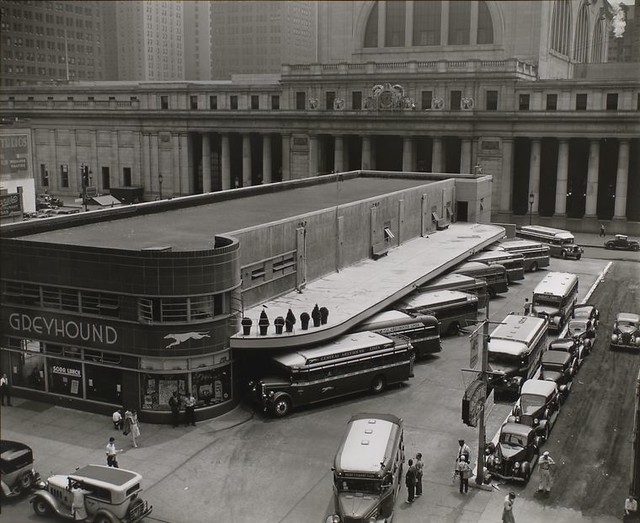
    The Greyhound Bus Terminal on 33rd and 34th Streets between Seventh and Eighth Avenues shown here in 1936. (Photo via the New York Public Library)

    Whenever New Yorkers grow nostalgic over Penn Station, it is by and large on aesthetic grounds. The current Penn Station is a far cry from a Great Public Building. There are no iconic images of light spilling into a grand hall. Rather, it is a dank, cramped, dirty and smelly station that doesn’t inspire kind feelings.

    In addition to their looks, though, railroad stations serve functional roles as well. They need to have capacity to shuttle commuters into and out of the central business district of their host cites and should allow for intermodal connections as well. To a certain extent, both Penn Station and Grand Central realize that goal as New York’s two main rail depots offer easy connections to numerous subway lines. But what of the buses?

    In an ideal world, bus terminals and rail stations would go hand-in-hand. In Boston and Washington, DC, for example, Greyhound delivers its riders to the main rail station. South Station serves as the terminus for Amtrak and the rides to Boston while DC’s Union Station features a Greyhound stop around back. In New York, the main bus depot at Port Authority is a subway ride away from the Amtrak stop at Penn Station and a subway ride away from Grand Central. It may offer up subway connections, but it leads to some convoluted rides.

    It wasn’t always like this. In The Times this weekend, Christopher Gray delves into the history of a forgotten Greyhound depot that used to live where One Penn Plaza is now. In 1963, the terminal was torn down after Greyhound and Port Authority spent years fighting over the building. The PA wanted Greyhound to move to its then-new terminal at 42nd St. while Greyhound wanted to maintain its spot above Penn Station. Gray writes:

    Greyhound was a consortium of different lines, including Pennsylvania Greyhound, half owned by the Pennsylvania Railroad. In 1935 the railroad cleared a through-block site just north of the station, from 33rd to 34th, for the new Pennsylvania Greyhound Bus Terminal….

    In 1945, the Port Authority proposed its own single consolidated bus terminal, at Eighth Avenue and 40th Street, saying that intercity bus traffic jammed the streets. Part of the plan was a rooftop landing strip, 500 feet long, for what the authority called “the flying bus of the future.”

    By this time the modernistic Greyhound terminal was not just a stop for travelers, but the haunt of vagrants, delinquents and petty criminals. In 1947 a police inspector called it the worst spot in Midtown. Five years later two escapees from the Matteawan State Hospital for the Criminally Insane waiting for a bus to Baltimore were caught by police officers with drawn guns. Nonetheless, Greyhound resisted the Port Authority plan. It liked its central location just fine, and had no need to help small operators gain the advantage of a union terminal. The city retaliated by prohibiting any bus terminal expansion in Midtown. The Port Authority completed its big, bland terminal in 1950, counting on Greyhound’s eventual capitulation — it was the biggest dog by far among the carriers.

    The Port Authority’s bus terminal is located with direct access to the Lincoln Tunnel and out of the way of surface streets. Today, though, buses have made a resounding return to the Penn Station area as many of the discount offerings such as Bolt Bus provide pick-up service on the streets near 34th St. in order to avoid paying the PA’s gate fees.

    As Gray notes, no one in New York expresses much nostalgia over the fate of the art moderne terminal. It didn’t spark debates over historic preservation as tearing down Penn Station did. But its place in history serves as a reminder of a time when, by design, ownership and economics, the city’s bus terminal offered up something more than a subway ride as a connection with the commuter and long-distance rail hub. It was a more sensible approach toward intermodal transit connections.

  • The Tappan Zee as New York’s ARC mistake

    Plans drawn up in 2010 that included rail tracks across the Tappan Zee replacement will not see the light of day.

    Let’s build a bridge. Let’s stick it across the widest part of the Hudson River. Let’s spend 10 years making sure various state stakeholders — transit advocates, municipalities on either side — agree on the form of the bridge. And then let’s torpedo these plans when the federal government dangles some easy-access dollars in our face. Let’s cancel the transit aspects of the plan, proclaim the desire to have the bridge last 100 years and promise that we’ll build the transit connection, you know, later.

    If that sounds like an idea straight out of the 1950s, well, that’s because it is. Apparently New York’s Gov. Andrew Cuomo didn’t get the message. Today, the Governor revealed the state’s new plans for the span that will replace the aging Tappan Zee Bridge. For a few billion dollars, the state will build a massive bridge, and it won’t include transit options. It won’t have bus lanes for true express service; it won’t provide a cross-Hudson rail link. Located barely 28 miles north of Times Square, this bridge will just service cars. It is New York’s very own ARC Tunnel mistake.

    The Tappan Zee story is one I’ve followed closely over the past few years. When plans were put forward in 2008 to replace the Tappan Zee, transit was a centerpiece, and over the intervening years, transit remained part of the plans. A year ago, we espied renderings with rail, but funding remained scarce. And then barely a week ago, we learned that in order to fast-track the Tappan Zee span, transit had been cut. The uproar has been tremendous.

    “I am troubled by the proposed design’s absence of a mass transit component that would help alleviate congestion,” Westchester County Executive Rob Astorino, one of many politicians speaking out against the new project, said. “A new bridge — without a mass transit component — would already be at capacity on the day of its opening.”

    From both sides of the Hudson, from politicians and transit advocates alike, the decision to temporarily set aside a cross-Hudson transit connection has been slammed, but there’s a problem: No one knows who is responsible. As Streetsblog detailed this week, neither US DOT nor New York State officials have new scoping information packet is awkwardly silent on the decision to roll back a decade’s worth of planning.

    “While advancing financial analysis,” the document says rather passively, “it was determined that funding for the corridor project (bridge replacement, highway improvements, and new transit service) was not possible at this time. The financing of the crossing alone, however, was considered affordable. Therefore, it was determined that the scope of the project should be limited, and efforts to replace the Hudson River crossing independent of the transit and highway elements should be advanced.”

    Yesterday, the state unveiled more details concerning the Tappan Zee replacement span. It will be designed to last 100 years; it will leave some space for future transit improvements — improvements that will cost more to build and likely will never materialize; and it will be wide. It’s an alluring vision but one that rests upon fault assumptions. As Cap’n Transit recently explained, bridge traffic cannot continue on an upward trajectory for much longer without causing some congestion that would seriously drain the economies in Rockland, Bergen and Orange.

    In a way, then, this decision is worse than New Jersey Governor Chris Christie’s move to cancel the ARC Tunnel. There, he simply let the status quo stand. Here, Cuomo and the Feds are on the verge of funding something that will move transit-oriented progress backward in time. Even if the state or D.C. eventually found the money to add transit to the middle of the bridge, a wider roadway already in use won’t move the region forward.

    It’s not too late for the Tappan Zee. The public comment period on the scoping document will last another three weeks, and already the public is making its voice heard. Yet, government officials say they had no choice. The money, they say, simply wasn’t there. Yet, New York could probably get away with tearing down the Tappan Zee and building nothing if they spent the $5.2 billion on improving rail service. That’s the 800 pound gorilla in the room.

    For now, we wait. In one year’s time, we’ve seen transit projects in the form of the ARC Tunnel and the Tappan Zee replacement span flushed down the drain. In the future, adding transit will require another round of environmental impact studies, and rail routes after the fact rarely see the light of day. The stick is dangling, but the carrot is a rotten one.”The same thing was said when the George Washington Bridge was built,” Yonkers City Council President Chuck Lesnick said. “That magnificent structure celebrated its eightieth anniversary, and we’re still waiting for the train to come on that bridge.”

  • With ridership high, East River ferry seeks a higher subsidy

    Since Mayor Michael Bloomberg decided to invest precious city transportation subsidy dollars in East River Ferry service, I have been highly skeptical of the offering. The ferries seemed to target areas with limited populations that already had access to nearby subway stations without incorporating fare payments for the boats into the MetroCard system. Perhaps I was a bit premature in my assessment.

    In today’s Times, Patrick McGeehan explores how the ferry service has been more successful than anticipated by both the city and its operators. He reports:

    According to data supplied by city officials, nearly 350,000 people have paid to ride the ferries since late June, far more than the 134,000 they had projected. On weekdays, the number of riders has averaged 2,862, almost double the forecast of 1,488.

    The weekday riders have not all been commuters, either. On Friday evening, two visitors from Zurich, Michael Luetscher and his 13-year-old daughter, Bignia, rode from Pier 11 near Wall Street to the Greenpoint apartment they had been staying in all week. They were returning from shopping and checking out the Occupy Wall Street demonstration, which Mr. Luetscher said was smaller and calmer than he had expected.

    The big surprise for the ferry operator has come on the weekends, when ridership has averaged almost 4,500, more than six times the city’s projection. On Sunday, Oct. 9, the service carried about 6,500 passengers, said Paul Goodman, the chief executive of BillyBey, which operates under the flag of New York Waterway. “The enthusiasm that we’ve seen from these communities tells us that even though the city was in some manner hoping to encourage development along the waterfront, we’ve tapped into demand that was already there,” Mr. Goodman said.

    There is, of course, a catch. With chillier autumn months nearly upon us, the ferry operators are concerned that their planned reduction in service will dissuade customers from sticking around, and they want the city to fork over more dough in an effort to subsidize increased service. Goodman has asked for a “more favorable financial arrangement” in exchange for more money, but city officials do not want to increase taxpayer expenditures in what Seth Pinsky of the Economic Development Corporation termed “an era of limited resources.”

    Without an increase in subsidies, New York Waterway will, of course, have to raise its fares — which could lead to a decline in ridership anyway. It’s the great battle for public dollars that we see played out with the subways on a regular basis. Ultimately, ferry service has the potential to service a rather niche group of commuters who live in high-priced condos along the waterfront and want faster access to Lower Manhattan or Midtown. Without a deeper understanding of who rides the ferries and why, it’s tough to say the city should pony over more dollars.

    For now, we know that summertime ferry service can be a success. What happens over the next six months will likely determine the fate of this three-year East River ferry experiment.

  • Tapping across a new Tappan Zee, but not taking the train

    Plans drawn up in 2010 that included rail tracks across the Tappan Zee replacement will not see the light of day quite yet.

    In an effort to get money flowing to important infrastructure construction sites, the Obama Administration announced this week that they would “fast track” a series of near-ready projects, and included among those is our own Tappan Zee. The 56-year-old bridge, well older than we would all like, has long been the subject of replacement studies, and most of those called for some combination of railroad tracks and dedicated bus lanes in order to improve transportation across the Hudson River. Now, transit is off the table.

    As LoHud.com’s Khurram Saeed reports today, the Tappan Zee replacement project will not include mass transit in its current iteration. To lop $10 billion dollars off the price tag, the fast-tracked span will not include rail lines or bus lanes. While engineers will leave space for such upgrades in the future, that’s rarely a guarantee for future funding or construction work.

    Advocates recognize the importance of moving the replacement bridge project from the study phase to reality, but they bemoaned this move as an opportunity lost. “We’re missing a grand opportunity here,” Kate Slevin of the Tri-State Transportation Campaign said. “The whole idea was to reduce congestion and provide a focal point for development for the Hudson Valley region. Commuters are still going to be stuck in traffic unless there’s an alternative. You’re basically doing nothing for congestion.”

    Rockland County Executive C. Scott Vanderhoef echoed this charge. “You can’t just throw a bridge down there and say we’ll build the rest of it later,” he said.

    The ultimate issue is one of price. Under New York State’s expensive proposal, a true multi-modal replacement would cost $16 billion. Of that total, the bridge would clock in at $6.4 billion with $1.9 billion set aside of highway improvements while transit costs would run to $7.7 billion — $1 billion for the bus rapid transit lane and $6.7 billion to run a rail line from Suffern to Tarrytown. The feds will instead throw in a little over $5 billion, and we will once again make the wrong decision with respect to the Tappan Zee Bridge. Funny how history just keeps repeating itself.

  • Thoughts on spending on design vs. capacity

    A $3.8 billion PATH station will not bring increased capacity to the rail system.

    As the United States’ economy remains in a slump and the MTA has been forced to scramble for construction dollars, how the authority spends its billions has often come under the microscope. Along the East Side, Phase 1 of the Second Ave. Subway will deliver three stations for $4.5 billion. While those costs are high, at least SAS is increasing transit capacity. The same cannot be said for other projects.

    Down in Lower Manhattan, various stakeholders — the federal government, the Port Authority — have contributed billions to two projects that are more ostentatious than functional. The Calatrava PATH terminal has been billed as part of the rebirth of Lower Manhattan after September 11, but for $3.8 billion, all we’re getting is a giant porcupine. The Fulton Street Transit Center will be a hub for the subway in name only as the $1.4 billion renovation includes a fancy above-ground entrance and some reconstructed walkways.

    For over $5 billion, then, New York is getting a few buildings that may or may not be visually appealing, and no added transit capacity. I’ve long believed that to be a waste of precious resources, and I’m not alone. Over at Forbes, Stephen Smith of Market Urbanism fame writes about spending priorities. Starting his argument with a nod toward Japan’s train system, Smith notes that the country’s rail hubs are not architecturally attract. “Shinjuku doesn’t even seem nice by modernist Japanese standards,” he writes, “and the most extravagant post-war station I can find is Nagoya, which doubles as the skyscraper headquarters of the country’s biggest Shinkansen company.”

    Moving along, Smith says that the spending patterns in New York are “indicative of our warped priorities” when it comes to transit spending. A greater proportion of dollars are funneled toward aesthetics rather than capacity. He writes:

    Spending a lot of money on flashy stations is also not something that Spain, the world leader in cheap and efficient tunneling projects, recommends. In a report on railway expansion in Madrid, tunneling expert Manuel Melis Maynar writes: “Design should be focused on the needs of the users, rather than on architectural beauty or exotic materials, and never on the name of the architect.” And it makes sense – the point of transit is to transport. Money buys movement, and funds are finite. When a system is running well, people aren’t sticking around to stare at the ceiling, anyway.

    As always though, America must be the exception. Spain would never spend $3.8 billion on a single starchitect-studded station, but its own Santiago Calatrava was happy to build one if New York was footing the bill. Calatrava’s original design called for an enormous bird-like World Trade Center PATH station whose walls would open up in a sort of flapping motion, but it was scaled back for security and cost reasons. The wings were clipped and evolution was set back a few hundred million years – the bird will now be a ”slender stegosaurus.” Even the originally projected $2.2 billion cost would have been more than Paris spent on its entire new 9 km-long Métro Line 14.

    And then just one block away from the WTC boondoggle, we find the $1.4 billion Fulton Street “Transit Center” (a.k.a., subway station). Back in 2002 there was talk of selling off air rights above the station, the largest undeveloped parcel in Lower Manhattan, but that never happened…If American cities are ever going to grow beyond their currently stunted sizes, they’re going to need new transit infrastructure. But no amount of government subsidies will ever be enough to build more than a line here and there until we get our astronomical costs under control.

    Expensive design isn’t the only driver of cost in the U.S., but particularly in Lower Manhattan, design gives transit spending a bad name. It’s tough to justify spending billions on two projects within a few blocks of each other that do next to nothing to increase ridership, but that’s what politicians want. It doesn’t make much sense.

  • From LI Bus, a case study in the purpose of transit

    Here’s an interesting question for you: Should public transit systems and the public authorities that run them be trying to turn a profit? In other words, at what point should authority heads such as Jay Walder cease running a transportation network as a public good and start running it as a business?

    The answer to this question isn’t an easy one in an age of austerity. By and large, public transportation networks are inherently not operated as a business as the service level. In New York, for instance, the MTA runs mostly empty trains at 3 a.m. and allows buses to run routes with a cost-per-passenger high enough to make any private CFO cry. That’s how New York City exists as a huge economic hub and tourist destination today, and that’s how mass transit is operated as a public good.

    On the other hand, though, are a few competing demands. First, the MTA must operate these services efficiently through a streamlined bureaucracy and a procurement process that isn’t beset with red tape. Second, it cannot become an organization beholden to pension costs and lifetime benefits. Third, it will require public subsidies from a government whose constituents depend on public transit for their daily lives, and politicians will have to recognize that the MTA or a similarly situated organization may not operate as efficiently as a corporation that answers to stock-holders. The demands are different, and the expected benefits are different.

    Recently, a few good minds in the transit realm have been debating the way transit authorities operate. David Levinson has called for financially sustainable mass transit systems while Jarrett Walker has called upon those funding transit systems to better outline their goals. The competing demands of ridership vs. coverage are at odds with financially self-sustaining transit systems. I’ve simplified their arguments, and it’s worth reading their pieces at length because we’re seeing this debate play itself out in real life on Long Island.

    The Long Island Bus saga has been a debacle. In its original agreement with Nassau County, the MTA agreed to operate the service as long as the county paid for it. Over the years, the county’s contributions had decreased while the MTA’s had increased, and the authority threatened to pull out of Nassau if County Executive Edward Mangano didn’t agree to upping the county’s contributions from $9 million to $26 million. Mangano called the MTA’s bluff and decided he could run the bus system for less by farming it out to a private company. He claimed no service cuts or fare hikes would follow.

    From the start, the privatization process has been a mess. The county used a non-transparent process to pick Veolia, a company with close ties to Mangano’s campaign, and they failed to meet a July deadline for an agreement. The MTA will operate the buses until December 31, and at that point, Nassau County will reduce its contributions to just $2.5 million — $6 million less than the cost of fuel alone. Veolia will then be expected to cover the difference. Without subsidies, no one, including the company’s CEO, knows how.

    Earlier this week, Michael Setzer spoke about how the company would save the millions it stands to lose from the MTA and state when it takes over the LI Bus network. “You can’t save $35 million by turning off the lights,” Setzer said. In other words, there’s virtually no way Veolia can operate the bus system with its current route structure and fare system while breaking even or turning a profit.

    On their website, if you read closely enough, Veolia has said as much. They are threatening “adjustments” of bus timetables that will reduce frequency, and while they say there is no plan in place to raise fares next year, they also say that “it’s possible that modest service redesigns and fare increases will be recommended.” You can’t just save $35 million by turning off the lights.

    Veolia is a private company long used to operate bus systems with large public subsidies. If they can’t turn a profit in Nassau County with a meager subsidy and the current route plan or fare structure, something will have to go. Relatively empty buses that provide a transit lifeline for people who can’t afford anything else will be cut, and fares will go up. A public good won’t be so public any longer.

    As this grand experiment rushes toward a launch, we’ll watch Nassau County closely. It could be a model for how transit agencies can operate, but it sounds as though it’s going to be an example in government failure and the decline of a once-proud bus system. Perhaps Nassau County will come to its senses and recognize the purpose of its bus system before it’s too late, but I’m not counting on it.

  • A digression on parking rates and spaces

    Over the years here, as I’ve tried to develop a semi-coherent argument for public transit investment at the expense of automobiles, I’ve occasionally returned to the idea of the parking space. Two years ago, I said the city could fund transit by raising on-street parking rates, and I’ve argued in favor of residential parking permits as a way to raise revenue for anything from street repair and maintenance to public transit investments.

    My biggest complaints about parking spaces concern the way we use space and the way we charge for it. In New York, everything costs a lot. Housing prices are high; office rates are high; parkland is at a premium; even sidewalk space has whittled down over the years. Yet, cars get away with parking for free. In essence, you have around two tons of inert metal taking up precious urban space and paying nothing for in exchange for the privilege.

    In his City Room column today, Clyde Haberman plays off of the deactivation of the last Manhattan parking meter to wax poetic on parking spaces. Much like the death of the token brought about thought-provoking reflections on mass transit, so too has the death of the parking meter. Muni-meters, after all, free up space. No longer are cars bound by parking meters, and that can be both good and bad for on-street parking.

    Haberman’s point, though, is a different one. “Why,” he asks, “is public space, a most precious commodity in this city, allowed to be used as a private storage area?” He continues:

    Years ago, I asked in a column if it would be all right for a New Yorker in a crowded apartment to put a chest of drawers on wheels and leave it at curbside — observing all parking rules and taking a chance on theft. The very idea was, of course, absurd; you can’t store personal property on the street.

    Why, then, is it O.K. to do that when the wheeled property is called a car?

    If public space is to be used for this private purpose, perhaps what the city needs to do is greatly expand the areas where people must pay for the privilege.

    Not that this could be done without fierce resistance from some on the City Council and in the State Legislature. Generally speaking, when it comes to the proper place of the automobile in this crowded city, what we have, as Cool Hand Luke found out in his own way, is a failure to communicate.

    I don’t believe cars are inherently evil. My family has lived in New York City for my entire life, and we’ve always owned a car. I’m enrolled with the AAA and and card-carrying member of ZipCar. I’m also sympathetic to those who say that fees and taxes in New York are getting out of hand. Parking, though, is a market-based solution. If the market is willing to support significantly higher parking rates, why does New York continue to squander a money-making resource while it gives premium space away for free?

  • On travel speeds and improving commute times

    The other day, when I took my painfully slow ride home from LaGuardia Airport, I clearly chose the worst route possible. As many commenters here pointed out, taking the Q33 to the Queens Boulevard line or hopping on the Q train in Astoria would have sped up my trip by a few minutes, but the fact remains that the trip was sluggish and slow from the US Airways terminal to the exit from the airport. No amount of better planning would have improved that trip, and a taxi will always be faster, if significantly more expensive.

    An article I came across yesterday had me revisiting that commute. It’s a piece from The Globe and Mail in Canada about some transit reluctance. Despite traffic in two big Canadian cities, commuters aren’t embracing transit alternatives because they’re just too slow.

    According to a recent Canadian study, a whopping 82 percent commuted by car while just 12 percent rode public transit. The Canadian Press explained the why of it:

    “Commuters who used public transit took considerably longer to get to work than those who lived an equivalent distance from their place of work and went by car,” says the study. Nationally, users of public transit spent 44 minutes travelling to work, compared with 24 minutes for those who went by car.

    Commuting times are door-to-door, StatsCan notes. Times for public transit are generally longer because its use can involve walking to a transit stop and waiting for a bus, it says. In the six largest cities, the average commuting time was 44 minutes for public transit users and 27 minutes by car. The gap in average commuting time was slightly larger in mid-sized metropolitan areas — 46 minutes on public transit and 23 minutes by car.

    “The gap was not a result of distance travelled,” the agency says. “Among workers in (cities) with at least 250,000 residents who travelled less than 5 kilometres to work, car users had an average commute of 10 minutes, compared with 26 minutes for public transit users. The same held true for longer commutes.”

    Now, on the one hand, this isn’t a surprising result. By and large, public transit is going to be slower than personal automobiles. They stop more frequently than cars do; they don’t deliver commuters directly from point A to point B; and despite pre-board payment technologies, bus in particular aren’t adept at picking up passengers in a speedy fashion.

    These factors clearly matter to many. People in New York dislike the bus system because for many routes, it’s faster to walk. Once you calculate waiting time and travel speeds, buses aren’t great time-savers. Even the subways over great distances at off-peak hours provide little to no time savings. It’s only during congested rush hour commutes that public transit can save significant time.

    While I’m not as familiar with the ins and outs of Canadian transportation policies and politics, in New York, cost as well as speed plays another factor. I was willing to take the bus to the subway on Monday because I had all the time in the world and didn’t feel like dropping $35-$40 on a cab. For Manhattan-bound commuters, the costs of daily parking often outweigh any time benefits that may accrue from driving, and those costs help push commuters toward environmentally and socially friendly transportation options.

    Yet, it’s important to note the results of studies such as these. Speed and the perception of speed matters. New York City buses — and buses in various locations through the world — are artificially slowed because transit agencies haven’t yet embraced pre-board fare payment systems. They don’t have enjoy dedicated lanes or signal prioritization. Some subways — such as those old IRT routes that run through Downtown Brooklyn and Lower Manhattan — simply stop too frequently. These factors create inefficient and slow systems.

    As the MTA looks to encourage more transit ridership, it would do well to assess travel speeds. It shouldn’t take me 20 minutes to leave LaGuardia because everyone waiting to board the bus has to dip their MetroCard as lines form. Buses, especially during peak hours, shouldn’t be at the whims of surface traffic. If you make the rides faster, they will come.