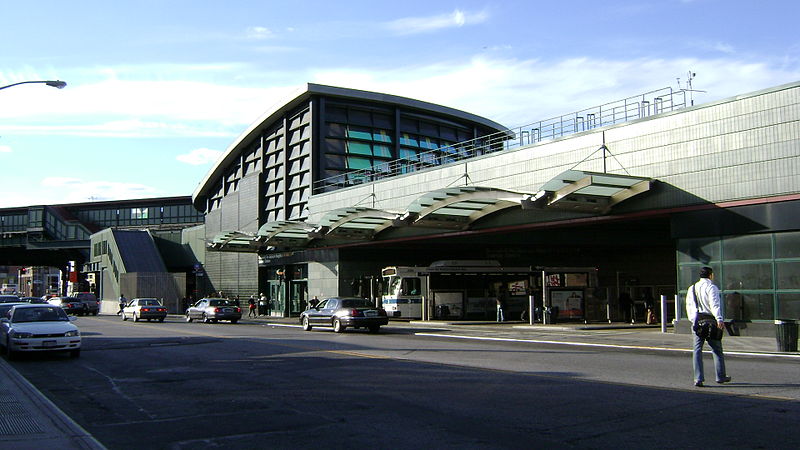
The new connection between the 7 and G at 23rd Street and Jackson Avenue opened this morning. (Photo by Benjamin Kabak)
With 7 trains clanking past on its elevated tracks, Transit officials and local politicians gathered in Long Island City this morning to celebrate a long-awaited station opening. Shortly after 10:30 a.m., state Assembly member Catherine Nolan cut the ribbon to mark the official opening of the Court Square Station and the new ADA-compliant and fully covered connection between the 7 and G trains. The long rumored dispute between Citi and the MTA has finally been resolved.
Noting that the connection should see 20,000 passengers per day who can now avoid an out-of-system transfer, Transit President Thomas Prendergast spoke of the ways in which the authority is connecting key station. “The creation of this complex will facilitate travel for customers heading to and from Queens and give choices in the case of a disruption on any of the lines,” he said. “This is very similar to our project in Downtown Brooklyn, where we linked two stations, Jay Street and Lawrence Street into the Jay Street-MetroTech complex and improved travel options for thousands of subway riders from day one. There is also a project underway to provide a free transfer between the Sixth Avenue Line to the uptown 6 at the Broadway-Lafayette and Bleecker Street stations.”
A glimpse down the walkway connecting the G platform to the elevated 7 tracks. (Photo by Benjamin Kabak)
The new transfer area features a variety of upgrades for customers. There are two protected escalators, three elevators and a new staircase and passageway. The entire station complex has also been renamed as Court Square.
Overall, the project cost a total of $47.6 million, and Transit picked up $13.9 million, most of which went toward ADA compliancy. Later this month, the TA will award a contract that will overhaul the 7 platform as well. That work will include full platform replacement, new windscreens and ADA-compliant boarding areas. For now, the saga of Court Square has come to an end, then, many months later than it should have.
After the jump, a full slideshow of photos from the ribbon-cutting.(more…)
The never–ending Court Square saga appears to be coming to an end. A SAS tipster sent in the following photo yesterday, and it features good news for Queens commuters who have been dying for the new station complex to open.
So there you have it. Incontrovertible photo proof that after years of wrangling between the MTA and Citi, the station complex and its new entrance will finally open, countless months late. It’s about time, eh?
As the economy improves, the retail spaces at 74th St./Roosevelt Ave. in Jackson Heights should fill up.
Following years of conflict with its Jackson Heights neighbors as well as one failed lease attempt in the mid-2000s, the MTA Board will vote today to rent nearly 3000 square feet of empty space at the 74th St./Roosevelt Ave. station to the Famous Famiglia restaurant, according to documents released this week. In approving the 20-year lease, the authority should put an end to what one city councilman called in November a “shining example of MTA incompetence” while appeasing neighborhood groups who have clamored for just about anything to go into the space.
According to the MTA documents, this two-level space, subject to much hand-wringing over the last five years, had been leased to a company called Cosanba, Inc. in 2006. The company was to open a Korean bakery but was “unable to complete the process of submitting plans for code review.” The MTA decided to cancel the least last year and relet the space. Last December, they requested proposals for a 20-year lease, and Famous Famiglia’s bid of nearly $2.6 million topped a list of 13 that included Ottomanelli & Sons, Starbucks and McDonalds.
The pizza restaurant, known throughout the New York region, will operate a 24-hour restaurant at the popular subway hub. The menu will include pizza, pasta, salads, sandwiches and breakfasts, and the MTA, per the documents, is confident that the company can take a challenging space and turn it into a successful restaurant. Famous Famiglia, for better or worse, has buit a business on doing the same in airports, sports stadiums and shopping malls throughout the country.
Famous Famiglia’s proposal, the highest by nearly $1 million, and it “exceeded the appraised value of the space.” Those expecting a pizza joint to open soon though might be in for a bit of a wait. The company will have to bring a gas line into the building and will have to develop a “raw” space. “Famous Famiglia has had significant successful experience in building out spaces,” the MTA document says, “and has demonstrated that it has the financial resources sufficient to complete construction.”
For the MTA, that this lease will represent a big increase over the initial one may portend a sign of better commercial real estate options for the authority. As it seeks to lure an Apple Store into Grand Central, it has netted itself a fine establishment for a space that has remained empty for far too long.
Still, those in the neighborhood are going to be a bit wary until construction starts. This story first came to light in November, over six months ago, and those in the neighborhood told me then that they expected the space to remain empty until late 2012 at the earliest. Perhaps Famous Famiglia’s past experience can speed up the process, but for now, this empty eyesore is moving closer toward a tenant. It’s a clear step in the right direction.
For the past few months, commuters and politicians along the IRT Flushing line have grown even more impatient with the MTA than they usually are. At various points this winter and spring, the 7 line has faced numerous unplanned delays due to its aging signal infrastructure and flood-prone tunnels. To speed up repairs, the MTA will institute a series of weekend outages, Transit announced today.
This weekend and again for a weekend in June and one in July, there will be no 7 service between Queensboro Plaza and Times Square so that crews can work in the Steinway Tunnels. The work, says Transit, includes signal circuit repair, removal of silt and muck from the roadbed, power system improvements in the area and grouting of tunnel walls to address water intrusion. This work will provide some short-term relief as the longer-term installation of a new signaling system is ongoing.
“The recent deterioration in service illustrates clearly why this work is so vital and why we must perform it at this time, and I have to be frank, performing this vital work will require major planned service disruptions for some time to come,” NYC Transit President Thomas F. Prendergast said. “We are committed to improving service along the Flushing Line and we will keep everyone informed of service changes and how the work is progressing.” As of now, there is still no word on the Court Square entrance, another long-term problem plaguing part of the 7 line.
The new transfer between the E, M, G and 7 trains at Court Square was supposed to open in February. In March, the MTA renamed the 23rd St.-Ely Ave. station in anticipation of an April opening. Now, as May 2 is upon us, the transfer remains completed but closed as Citi Corp., the owner of the building through which the new transfer runs, and the MTA have failed to come to terms on a Memorandum of Understanding that would dictate the use of the space. It is a bureaucratic mess.
In the Queens Chronicle this week, Elizabeth Daly delves into the conflict over the transfer. She speaks with antsy commuters who have waited years for an enclosed escalator transfer and rehashes the vague details surrounding the conflict between Citi and the MTA. While the authority claims the entrance will open this spring, local politicians are annoyed. “It’s already a year late,” State Sen. Michael Gianaris said. “We shouldn’t let bureaucratic inertia slow down infrastructure improvement.”
Ultimately, this is a tale of the conflict between the MTA’s work and private interests at its finest. Citi is apparently hesitant to agree to certain obligations over entrance maintenance to which the MTA asks all of its real estate developers to adhere. One day, a transfer will open. One day.
Long Island City hasn’t always been the next frontier of gentrification and development in Queens as it is today. In fact, for much of its history, it’s been an industrial neighborhood that has served as the staging grounds for the Long Island Rail Road and many other area train lines. Now, though, as rents increase, luxury buildings go up and the area grows, residents are upset with idling trains.
As New York 1 reports, some new residents have called upon the MTA to power down their trains because the idling is driving them nuts. “It’s really horrible. I mean, like I wake up to this noise every morning,” Lillian Marchena said.
The news station’s Queens reporter Ruschell Boone had more:
Over the last two years, the LIRR has turned off some of the engines during the day and placed some trains in other parts of the rail yard as part of a compromise, but some residents said the noise is starting to increase again. “From 7:30 in the morning ’til 5:30 at night, Monday through Friday,” said Community Board 2 Chairman Joe Conley.
It is a harsh reality for new residents moving to the once-industrial area. The rail yard has been there for more than 100 years, but residents want the diesel engines turned off during the day. LIRR spokesperson Joe Calderone said while the Metropolitan Transportation Authority has been addressing some of the community’s concerns, shutting down all the trains during the day is not going to be possible.
“It can take up to two hours to get it started again. If you shut it off for a four-hour period, you need to do a brake test under federal rules,” said Calderone. “Those are just a couple of the reasons we can’t just shut them off and turn them back on.”
Calderone noted that the LIRR will try to power down more trains as temperatures increase. They don’t have the same need to keep the trains warm during nicer days, but federal safety rules and timing concerns are driving the idling.
Meanwhile, as the East Side Access project moves forward, train-related noise will only increase for Long Island City residents. Within the next five years, more trains will head into Grand Central via the area and the rail yard will continue to serve as a holding pen for eastbound trains. For a century, as New Yorkers eschewed the area, the trains weren’t a problem, but with gentrification comes complaints. Unfortunately, for residents though, the train yard isn’t going anywhere.
The sign, sent out to reporters by the MTA a few minutes ago, pretty much says it all — except for when the Court Sq. transfer between the G and 7 will open.
Updated (5:05 p.m. with a correction): While the immediate opening date of the Court Sq. transfer between the 7 and G train remains unknown, New York City Transit has announced that the 23rd Street-Ely Ave. station on the Queens Boulevard local line is now Court Square-23rd Street. The name-change, says Transit, is “in anticipation of the opening of the free transfer” that was supposed to have opened in February. It’s current status is unknown, but the new station name will begin appearing on subway maps and train announcements soon. New signage as well will go up at the station.
The press release though is vague on the connection. It says that debut of the new transfer is expected “sometime this spring,” but that’s been the party line for months. I recently heard that disputes over Citi’s obligations and some slow work on the escalators are responsible for the delays.
When the transfer is complete, the 7 stop at 45th Road-Court House Square will also be renamed Court Square, and the G station will no longer carry the “Long Island City” moniker on the subway map. The entire station then will be Court Square-23rd Street.
The press release also included a bit of New York City history: “Opened in 1939, the station is located on 44th Drive between 23rd and 21st Streets in Long Island City, Queens. Ely Avenue was the original name of 23rd Street before streets in the borough were given numbers by the Queens Topographical Bureau in 1915. It is the last station in the borough on the Queens Boulevard line before crossing the East River through the 53rd Street tunnel into Manhattan.” One day, our free transfer amongst the E, M, G and 7 trains will come.
Update (11:47 a.m. Thursday): The long-awaited transfer between the 7 at Court House Square and the G at Court Square in Long Island City is one of those MTA projects that just can’t finish up on time or, seemingly, at all. Initially due for an early 2010 completion, the MTA’s own board materials released in November said the project would open in January of this year while a New York 1 report in December promised a February opening. As February goes zooming past, though, the entrance has shown no signs of opening any time soon, and straphangers are growing antsy.
Today, a source who has been in contact with the line manager of the 7 train informs me that the MTA is now anticipating a “mid-March” opening date. John Hoban, the line manager, says the the work at Court House Square is under the auspicies of a contractor working for Citibank, and the work has yet to be completed. While many who are waiting for the transfer have noted that the staircase appears ready, the MTA and Citibank apparently cannot, due to ADA requirements, open the stairway until the elevators and escalators are ready for service.
The MTA tells me that “quirks” with the testing of the escalators is the primary motivation behind this delay, and they anticipate adhering to the mid-March opening. In the meantime, Queens commuters will just keep waiting for a convenient transfer that never wants to be ready for use.
As far as minor subway construction projects go, none generate more interest among riders than the long-awaited transfer between the 7 at Court House Square and G at Court Square. The project was supposed to be completed in early 2010, and it has stretched ever onward. Today, though, NY1’s John Mancini brings word that the connection will finally open in February. Riders will now have an in-system transfer between the E, M, G and 7 and will no longer have to cross Jackson Ave. or pay two fares.
Meanwhile, Mancini tells us that another new subway connection — the pedestrian tunnel between Jay St. and Lawrence St. in Downtown Brooklyn — will open on December 10, ahead of schedule. This new transfer point between the A/C/F and R trains is part of a $108 million rehab of the Lawrence St.-MetroTech and Jay St.-Borough Hall Stations. When the project is completed, the new station complex will be called Jay St.-MetroTech. For a video on the new transfer point, check out this July post. Now if only Transit would connect the L and 3 trains at Junius and Livonia.
As the economy improves, the retail spaces at 74th St./Roosevelt Ave. in Jackson Heights should fill up.
Updated (4:10 p.m.): The MTA’s vast real estate holdings make for easy political fodder. Politicians do not want the authority to raise fares or cut costs until every single cent has been squeezed out of the MTA’s air rights, commercial retail space and office buildings. On the one hand, when it comes to deals such as the highly problematic Vanderbilt Yards sales, politicians are right to cast a wary eye on the authority’s deal-makings, but sometimes, the MTA’s vacant commercial real estate holdings face criticisms out of touch with the economic times. This is not one of these cases.
On Friday, NY1’s John Mancini produced a piece on Jackson Heights’ recently renovated 74th St./Roosevelt Ave. hub. The station underwent a five-year, $132-million rehab earlier this decade, and it was supposed to be home to a series of retail establishments as other subterranean hubs are. The MTA, though, has had trouble filling three of the 14 spaces, and politicians are unhappy.
“This is a shining example of MTA incompetence,” Queens Councilman Daniel Dromm said while standing in front of two vacant, street-level spaces. “They promised me that this store right here behind me would be open by September as a pizza parlor. As you can see, they’ve had a lot of success.”
At first blush, it seems as though Dromm is needlessly picking on an authority doomed by bad timing. After all, commercial retail vacancies are up across the city, and the MTA can’t do much to fill spaces. But after a few discussions with sources close to both Dromm and the retail space, this does indeed sound as though the MTA dropped the ball.
First, take not of a Times article on the situation. Fernanda Santos explains some of the details:
The transportation authority first requested proposals for the space on Roosevelt Avenue in 2006 and got back a single response, from a Korean businessman who wanted to open a bakery, agency officials said. The businessman signed a 10-year lease in 2007, paid a $40,000 deposit and then an additional $75,000 in 2008, when he told the agency that he needed more time because of problems with the architect he had hired for the project.
The second space — a triangular store of about 200 square feet — cannot accommodate a ventilation system because of its odd configuration, making it impossible to house a pizza parlor that someone had intended to open there, the officials said.
No lease has ever been signed for the smaller space, and the lease for the larger one was not voided until September 2008, almost two years after it was signed. Though the Korean businessman forfeited his deposits, he never paid any rent on the space.
“That’s the ultimate absurdity of this whole deal,” Mr. Dromm said. Mr. Dromm is particularly troubled by the impression that the shuttered stores might leave on visitors. The subway station is a gateway to the neighborhood and “it’s not a good thing if the first thing you see is boarded-up commercial space,” he said.
The backstory grows deeper though. When the MTA rebuilt the Roosevelt Ave. hub, they turned the biggest space — the still-empty storefront — into a two-level store but did not install the ADA-required elevator. Instead, the terms of the lease they are trying to negotiate with businesses requires that the leaseholder install the necessary elevator at a cost. Because elevators are expensive, locals anticipate that this will add at least $500,000 to the cost of opening a business. The space too currently is just a shell with no floor subdividing the levels.
Dromm has suggested a variety of solutions for the MTA. He has asked them to subdivide the space and use the lower level for storage while renting out the top. He’s asked them to turn it over to the city so that he can use Council funds to attract a non-profit. He’s even requested temporary bike parking spaces to fill the vacancy.
In essence, this empty storefront has created what neighborhood activities are terming “blight” in front of the focal point of Jackson Heights. The subway stop is among the most active in Queens, and people see bordered-up windows as they go to work in the morning and come home at night. It needs to be a magnet for people and small business, but right now, it’s a sore spot on the very visible face of an up-and-community community.
Meanwhile, although The Times says that the MTA has untangled itself from the bakery lease, sources close to Dromm tell me that won’t speed up the process. As of July, the two sides were still haggling over the lease, and once the MTA is free of that commitment, it must again prepare an RFP and hold it open for six months. The authority seems to believe this will prevent them from picking a tentant for at least nine months, and it could be another two or three years before the space is filled. The station rehab wrapped years ago.
The authority’s real estate department is working on new approaches. “Expectations are that it’s not high-quality retail. And by high quality, I don’t mean expensive, I just mean interesting, good design,” MTA Director of Real Estate Jeff Rosen said to NY1. “The kind of place you’d want to stop and pick up something for convenience, but also for fun.”
That it remains empty highlights the tensions between community needs and MTA planners. This time, it seems, the authority had unrealistic assumptions and did not work closely enough with Jackson Heights leaders to make it work. The resolution too is still a few years away.