As we mark the six-month anniversary of the day Superstorm Sandy swept through the region, South Ferry garners the bulk of the media attention for a variety of reasons. It was the MTA’s newest station, and it suffered dramatic damage, all of which occurred underground and in Lower Manhattan. But it wasn’t the only part of the subway system that suffered.
In Queens, all those miles and neighborhoods away from South Ferry, the subway system that connects the Rockaways to the rest of the city suffered as well. The Broad Channel crossing was wiped out completely, and the infrastructure on the peninsula was heavily damaged. In late March, the MTA said it was targeting a June date for A train service to be restored, and that date holds true today.
I checked in with MTA spokesman Kevin Ortiz this morning, and he tells me that the agency is still on track to restore Broad Channel service by the end of June. Simply running trains over the channel doesn’t mean work will stop, and crews will contain to combat the corrosive effect of saltwater for the foreseeable future. Yet, restoring subway service will be a big lift for this storm-ravaged area struggling to stay afloat after Sandy.
Three New York politicians have called upon the federal government to deliver funding for a study on reactivating the city’s long-dormant Rockaway Beach Branch. Tying such an effort into both Sandy-related infrastructure investment and improved mobility for Queens and Brooklyn residents who currently face very long rides into Manhattan, Congressmen Hakeem Jeffries and Greg Meeks joined New York State Assembly Representateive Phil Goldfeder this weekend in requesting that some federal Sandy relief aid be earmarked for the project.
“Although Superstorm Sandy destroyed our coastlines and paralyzed our communities, we have an opportunity to rebuild the City in a smart and sustainable way that proactively addresses our future needs,” Rep. Jeffries said during a Sunday press conference. “Residents of Southern Brooklyn and Queens currently face the longest commute averages in the City because of the lack of reliable transportation. Restoring the Rockaway Beach Rail Line would not only ease the commute for hundreds of thousands New York City residents, it would also spur job growth and revive local businesses that have been struggling since the Great Recession hit in 2008.”
Goldfeder has been a leading political voice expressing support for the rail line, and enlisting Meeks and Jeffries should bring some further attention to the idea. It may not be as au currant or sexy as a High Line-style park, but expecting a High Line-style park to pop up in central Queens is foolish at best. Rail’s impact, as these politicians pointed out, would be far more beneficial for everyone.
“Immediate investment in this project would offer a permanent and viable transit solution for the millions of hard-working families all across Queens,” Goldfeder said. “It became evident after Sandy that we need to increase public transit options and improve our infrastructure for our neighborhoods in Southern Queens and Rockaway. Restoring the rail line will help prepare our communities to become more resilient for our future and allow our local economy to thrive for many years to come.”
Now, as park activists push forward with an RFP, we just have to wait for Washington to respond.
A sheet wall will help protect vulnerable subway tracks from future storm surges. (Photo via Kevin Ortiz on Twitter)
If all goes according to plan, A train service to the Rockaways could resume in June, Transit spokesperson Kevin Ortiz tweeted today. Ortiz posted a series of photos of ongoing work on Broad Channel as crews are busy repairing and hardening the system. Including in the work is a 40-foot sheet wall across Broad Channel that will provide a seven-foot-tall wall against future storm surges.
The wall will diminish the once-grand views as the A train crosses the channel, but it’s a small sacrifice if it can better protect these vulnerable tracks from future wash-outs. Of course, the storm surge from Sandy topped seven feet in many areas. Hopefully, this wall will be tall enough to adequately protect key infrastructure.
As supporters of QueensWay await RFP responses, the movement to restore rail to the Rockaway Beach Branch line has gained some political allies from Washington, D.C. Hakeem Jeffries and Greg Meeks — two members of New York’s congressional delegation — will throw their support behind those arguing for the rail option this weekend, according to numerous reports.
Supporters of restoring rail service to the long abandoned Rockaway LIRR line may be about to get a major break in their favor. A source familiar with the plan to bring transit back to the line, which runs from Rego Park to the Rockaways and has been abandoned since 1962, said it will get the backing of the two Congressmen representing southern Queens.
The source says Reps. Hakeem Jeffries (D-Brooklyn) and Greg Meeks (D-Jamaica), whose districts meet at the Ozone Park section of the line, will endorse the proposal and push to allocate federal transportation subsidies to study a plan for bringing rail service back.
The rail idea has been championed by officials in the Rockaways, especially Assemblyman Phil Goldfeder (D-Rockaway Park). Supporters of reactivating the line, which connects to the LIRR’s main route into Penn Station at Rego Park, say it would drastically cut commute times for Rockaway residents, which are among the highest in the city. When the LIRR went to Rockaway Park in the 1950s, it took only about 40 minutes to get from the peninsula to Penn Station. Today, a ride on the A train could take more than twice that. Supporters also argue that the rail line would help spur development in an area that was devastated by Hurricane Sandy.
Essentially, Jeffries and Meeks are poised to deliver on the line I’ve been pushing here for a while: If we’re going to spend taxpayer dollars studying the park option, we must also do a thorough assessment of rail reactivation. Any rail usage of the Rockaway Beach Branch right-of-way has the potential to be far more important for Queens’ development, its economy, and its post-Sandy recovery than a park that won’t see much usage.
Still, while the park has generated its own set of opponents, a rail line reactivation would as well. As No Way QueensWay’s Neil Giannelli said to the Chronicle, “Out of all the residents who signed this [anti-park] petition on the block, only one person wanted a train, and he’s a 6-year-old boy who likes choo-choos. Everybody else wants it to be left alone.” How’s that for literal NIMBYism?
I started the week off yesterday with a look at Penn Station Access, a Metro-North program that would add six stations in the Bronx and a West Side terminal for riders from points north. It’s a project that has a real chance of being a part of the MTA’s next five-year capital plan set to start in 2015. Another rail plan I’d love to see added to the capital program is a reactivation of the LIRR’s Rockaway Beach Branch line, but we’re a long way from that reality.
Right now, the Rockaway Beach Branch line is the subject of other goings-on in Queens as a group of very well-connected Community Board members are overseeing a push to turn the disused rail right of way into a High Line-style park. I’ve discussed how the High Line, through a confluence of circumstances including geography and tourism, is far more well suited to be a park than QueensWay ever will be, but this is an effort that just won’t go away.
With a $500,000 grant from New York State in hand — and no corresponding grant to study rail reactivation — the Trust for Public Land has issued a Request for Proposals for the QueensWay park. The request, available here as a PDF, essentially spends that grant on a feasibility study with an examination of the engineering required to turn the ROW into a park and the economic impact such a project would have on the neighborhood. It’s not really a new development, but it’s a firm step toward assessment.
Reaction to the news has been all over the place. DNA Info ran a rather pro-QueensWay article, giving only a nod in the final paragraph to those who want to see rail return. Gothamist is treating this RFP process as a clear sign that the park will happen, but that’s exceedingly premature. The results from the RFP will show a very expensive project with limited impact and few easily identifiable funding partners.
Meanwhile, on the ground, the opposition at NoWay QueensWay is irate. Neil Giannelli is laying the groundwork for an economic argument against a trail. Unlike a park, he says, trails do not increase property values. The problem though with Giannelli’s opposition is that he’s also adamantly against rail use as well. He wants to maintain the status quo, and although that’s the utter definition of NIMBYism, in this instance, the status quo doesn’t preclude future rail use or an assessment or rail reactivation. So for now, the enemy of my enemy is my friend.
In the end, I’m still left with the same request I’ve issued in the past: If the QueensWay group is getting $500,000 to study a potential park or trail conversion of the rail right-of-way, the pro-transit groups calling for rail reactivation should receive the same grant for their own study. Maybe we’ll find out that rail service is impractical. After all, it’s been over 50 years since the last rail cars ran down this ROW, and any build-out would likely carry around with it a 10-figure price tag. It’s clear, though, that these areas in Queens need better transit access, and the hardest part about building out rail — an identifiable right of way — already exists. We owe to ourselves and future generations of New Yorkers to exhaust all possibilities.
The city has spent too many years eschewing rail for, well, just about anything else. Have we learned from our mistakes or are we doomed to repeat them?
One proposal for the Rockaway Beach Branch Line involves sending the R train to the airport. (Map via Cap’n Transit)
As the effort to convert the Rockaway Beach Branch Line into a park gains state funds and media recognition, transit advocates are starting to raise their voices against the plan. As I’ve written in this space recently, we need to give rail its due as well. At the least, rail should be placed on equal footing with the QueensWay option, and at the most, reactivating a disused right-of-way should take clear precedent if it is technically feasible.
A few fine gentlemen both in need of promotions have gotten the proverbial ball rolling. Capt. Subway and Cap’n Transit have launched a petition urging Gov. Cuomo to reactivate the rail line, and Capt. Subway, writing on Cap’n Transit’s site, offers up his idea. He wants to send the R to Howard Beach via the Rockaway Beach Branch and restore G train service to the Queens Boulevard line.
Here’s a snippet of the argument:
Unfortunately the local tracks, while also theoretically capable of 30 trains per hour, are presently only running at about 20 trains per hour in the peak period. This is necessitated by the terminal at 71-Continental, which can only turn around about 20 trains per hour at the limit, and that not very well. For this reason the 63rd St connection to Queens Boulevard required a “robbing from Peter to pay Paul” switcheroo: the “G” line had to be cut back to Court Square and its slots on Queens Boulevard given over to another, Manhattan oriented service, first to the “V”, and now to the “M”. (For the first few years the “G” line ran to and from Forest Hills nights and weekends, when there was no “V” train service. But this passenger friendly part-time service died to make weekend service changes more doable).
Of course it needn’t be that way. Even in the original MTA plans from the late ‘60s “G” service would have remained intact. The express by-pass alone would have insured this. This is where the old LIRR Rock Line comes into play. By connecting this line to the Queens Boulevard line east (subway north) of 63rd Drive station – the tunnel bell mouths are there specifically for that scenario – the path to another local service terminal would be created, i.e. now the “G”, along with the “M” and “R” could run along the Queens Boulevard local tracks, with one of these service branching off after 63rd Drive and heading off to a new terminal at either Howard Beach or, it would be hoped, JFK, and thus not threatening to overwhelm 71-Continental as a terminal. In this way peak trains per hour on the Queens Boulevard local tracks could be raised from the present day 20 trains per hour up to 27 ½ trains per hour, given the current timetables on those three lines. This would be a significant improvement in service, especially if the “G” were equipped with full length trains.
These are the transit advantages of reactivating the Rockaway Branch as a subway line. Neighborhoods like Woodhaven, Rego Park and Ozone Park get quicker service to Midtown. Greenpoint and Williamsburg can be reconnected to Astoria and Jackson Heights with revived G train service. Local stations on the Queens Boulevard line see seven more trains an hour.
I have very little commentary to add. This proposal is an ideal one for many reasons and would require far less capital investment than building a new line from scratch. At a time when mobility matters and vulnerabilities have taken center stage, reactivating the rail line deserves as much attention, if not more, than the QueensWay initiative. So check out the two Captains’ efforts and give that petition a good skim.
The Rockaway Beach Branch Line has fast become most discussed unused rail right-of-way around. (Map via The Queens Tribune)
Despite The Times’best efforts at minimizing the rail option, the Rockaway Beach Branch may yet have a champion in a position of some power. A few weeks after Gov. Andrew Cuomo’s office awarded a $500,000 grant to the group championing the QueensWay rails-to-trails proposal, Assemblyman Phil Goldfeder of Ozone Park has called upon the governor to give money to a feasibility study for rail as well.
“The restoration of transportation on that line is good for the entire borough,” Goldfeder said to The Queens Tribute this week. “It is good for creating short term jobs and it’s good for spurring our economy.”
The Tribune’s Luis Gronda had a bit more in an article replete with interesting tidbits:
Assemblyman Phil Goldfeder (D-Ozone Park) announced at last week’s Community Board 10 meeting, which covers Howard Beach, Lindenwood South Ozone Park, Tudor Village and parts of Ozone Park and Richmond Hill, that he would be meeting with Governor Andrew Cuomo’s office sometime this week to discuss getting money to do a feasibility study to revive the Long Island Rail Road (LIRR) train line that used to run in southern and central Queens…
Goldfeder said at the meeting that he will continue to push forward with the idea of revitalizing the LIRR because people living in the Rockaways and Southern Queens desperately need better transportation options than the ones that are currently available and because it would benefit all of Queens.
Goldfeder said that while he has met with the governor’s office before regarding reviving the LIRR line and improving public transportation options in general, this latest meeting is in response to the QueensWay getting the grant money for the study. “I wanted to make sure that they were aware of the many different options and desires for that land,” he said.
According to The Tribune, residents in southeast Queens are more in favor of a rail reactivation than those further north up the unused right-of-way. Such a rail line would provide better connections to subway lines and could ease congestion on Cross Bay Boulevard. But their neighbors to the north have a different take on things as they worry that a rail reactivation would impact the Forest Hills and Rego Park houses unwisely built on top of a rail line.
Meanwhile, Goldfeder and the Woodhaven Residents’ Block Association are engaged an interesting war over ideas as well. The right-of-way runs along the eastern edge of Woodhaven, and residents there feel both the QueensWay and the Rockaway Beach Branch reactivation would have a negative impact on property value and quality of life in the area. So not only is this response the Grand Poobah of NIMBYism, but it’s blatantly wrong as well. Although it pains me to admit it, an active park would have a positive impact on property values and so too would the rail line. Goldfeder has said before that doing nothing that benefits no one is not an alluring option.
And so a great land use and transportation debate takes shape in Queens. On the one hand are park advocates, on the other are rail advocates and on the third are people who just want to be left alone. The NIMBYs might actually win because moving forward on either a park or a rail line may face too many political and economic obstacles right now. Goldfeder, however, deserves the support, and if he can become a leading voice for rail reactivation, such a cause could have an ally to rally around in Albany.
A 3.5-mile right-of-way should once again see train service. (Map via The New York Times)
Over the past six years following the ins and outs of transit policy in New York City, I’ve read nearly every article about trains, buses, taxis, roads, bikes and everything in between published in all of this great city’s illustrious daily newspapers. Some do a better job than others of covering the policies behind transportation and the lack of political support for adequately funding transit. Others treat the transit planning process and transit news as a game of “Gotcha” populist journalism where the MTA is the big bad guy and the rest of us are just getting our proverbial pockets picked. In other words, coverage is uneven.
Where coverage is not uneven — and, in fact, is often quite glowing — is when the Next Big Thing arrives. Now that Chelsea’s High Line is so over, the Next Big Thing is in Queens, and it’s the QueensWay. I’ve burned a lot of pixels speaking out against the QueensWay plan lately. It’s the gimmicky idea to turn a 3.5-mile rail right-of-way into a park. I want rails-to-trails initiatives to disappear and would prefer to see a renewed effort to reactive the Rockaway Beach Branch line. In the aftermath of Sandy and with space for transit at such a premium in New York City, giving upon a dedicated, if disused, right of way that could be reactivated is a major mistake.
That’s not, however, how The Times sees it. I’m a big fan of The Gray Lady. Mocking Twitter account aside, I read The Times every day, and I usually find their coverage of most issues to be on target. This article, however, has left me both speechless and full of words. It’s a glowing profile of the QueensWay effort that simply and utterly dismisses the idea of rail as though it were the worst idea in the history of bad ideas. Shall we dive in?
It has been abandoned for five decades, a railway relic that once served Queens passengers on the old Rockaway Beach branch of the Long Island Rail Road. For all those years, no one paid much notice to the ghostly tracks, long overgrown with trees and vines, as they ran silently behind tidy houses in Rego Park, dipped through ravines in Forest Park and hovered above big-box stores in Glendale.
That is, until the High Line expanded the possibilities of a public park.
Now, the three-and-a-half-mile stretch of rusty train track in central Queens is being reconceived as the “QueensWay,” a would-be linear park for walkers and bicyclists in an area desperate for more parkland and, with the potential for art installations, performances and adjacent restaurants, a draw for tourists interested in sampling the famously diverse borough.
That wascally welic of a wailway. Five decades! Fifty years! Completely abandoned. No one — except for those cranks who have long called for its return to service — has paid it any attention. But don’t worry: The High Line will save it. After all, as it is similarly located in a booming area within walking distance to major city tourist attractions as the High Line is in Chelsea, millions of tourists will be sure to flock to a park that isn’t near anything and runs through a ditch for most of its 3.5 miles.
Lisa Foderaro solders on…
“It’s Queens’s turn,” said Will Rogers, president and chief executive officer of the Trust for Public Land, a national nonprofit group that has joined local residents in promoting the idea. “The High Line led to the redefinition of the neighborhoods in Manhattan, whereas the QueensWay will be defined by the neighborhoods it passes through. Essentially, it will be a cultural trail.”
The involvement of the Trust for Public Land, which has 36 offices nationwide, including in Manhattan, has given the project new momentum, bolstering the efforts of the Friends of the QueensWay, a group with about 2,500 supporters. It did not hurt that the trust hired Adrian Benepe, who recently stepped down as the New York City parks commissioner.
Last month, Gov. Andrew M. Cuomo, a native of Queens, awarded the trust a $467,000 environmental protection grant through the state’s Office of Parks, Recreation and Historic Preservation. The grant will help pay for a community planning survey and a feasibility study that will include environmental, engineering and financial assessments of the project, including consideration of the condition of the railway’s trestles, bridges and embankments.
Setting aside my snarky retort for a minute, we come across a major problem I have with the political approach to the QueensWay folk. The government backing is incredible. The Trust for Public Land has led rails-to-trails efforts in places as diverse as Chicago, Toledo and Florida. Furthermore, from Adrian Benepe who has the ear of city leaders to Gov. Cuomo’s decision to award the Trust with nearly $500,000 to study the QueensWay proposal, New York is welcoming this idea with open arms. Where’s the competing grant to study reactivating the rail line though? This feasibility study will explore turning this ROW into a park, but it won’t offer up what should be Plan A: rail.
And then we get to the graphs that had me steaming:
But bringing the park to fruition will not be easy. The modest neighborhoods and light industrial areas through which the abandoned rail line passes cannot provide the tens of millions of dollars that were raised privately by Friends of the High Line, the nonprofit group managing the construction and maintenance of the elevated park on Manhattan’s West Side.
Nor is everyone on the same page about the Queens railway’s destiny; at least one elected official has called for a simultaneous study of reviving the rail line to provide better train service to the increasingly popular Rockaway beaches, damaged as they might be in the short term by Hurricane Sandy. (Mr. Benepe, who is well schooled in community opposition, imagined the potential horror of nearby homeowners at the prospect of the train line’s rumbling to life again.)
The first paragraph is self-explanatory. It can’t replicate the success of the High Line because it’s not the High Line. It connects Ozone Park to Forest Hills, and it’s not, as I mentioned, in an area to which tourists are flocking. It is, however, in an area that could use some faster rail options, but who wants that? Certainly not a bunch of homeowners who knowingly purchased houses that back up on a rail line’s right of way. Just think of that “potential horror” — a parenthetical one at that — of better access to Manhattan and a faster ride to the city’s job centers. What a nightmare.
The best part though is the kicker graph:
Unlike the High Line, the QueensWay would welcome bicycles. While the trestles are relatively narrow, long stretches are wide enough — up to 25 feet — to accommodate walkers and bicyclists. New bike paths could connect the park to Flushing Meadows-Corona Park to the north, as well as an existing bikeway in Jamaica Bay to the south. About 250,000 residents live within a mile of the proposed park, and its backers see all kinds of ancillary benefits, from health to traffic. “That’s a lot of carbon footprint,” said Marc Matsil, the trust’s New York state director.
“That’s a lot of carbon footprint.” What the *&!% does that even mean, Marc Matsil? The QueensWay was provide ancillary biking benefits at most as it’s generally, in my opinion, a bit too far from the city to be a part of bike commuters’ routes. It would be for mainly recreational biking and weekend strolling if it’s used as much as its proponents claim it will.
We live in a post-Sandy New York, one in which a state panel recently called for an increased investment in our transportation infrastructure. We have a dormant right of way — a very valuable one in a city that doesn’t have too many underutilized rail corridors or much open space — just sitting there waiting for rail. Before we turn it over to a rails-for-trails group that wants to build a novelty act in the middle of Queens, we have to be sure we can’t reclaim this ROW for rails. Right now, rail is a relic, an inconvenience and something that would run literally through a bunch of NIMBYs’ backyards. It will take a concerted effort to wrest this away from the QueensWay crowd, but that effort should not and would not be in vain.
A schematic shows the Rockaway Beach Branch service from 1955 until it was shuttered in 1960. (Courtesy of Railfan.net)
The battle over an abandoned rail line in Queens is starting to heat up. Pointing to the success of the High Line, some community activists in Queens have issued a call to turn the Rockaway Beach LIRR Branch into a park, and while some politicians have pushed back on the idea, Governor Cuomo’s office has put some monetary weight behind the Queensway plans.
Last week, Cuomo’s office gave the Trust for Public Land nearly half a million dollars to explore the Queensway idea. “That is the first step toward making the Queensway a reality,” said Christopher Kay, a member of the group, said to The Wall Street Journal. Lauro Kusisto has more:
Locals have advocated for the idea for years and received a boost about a year ago when the Trust for Public Land, which has successfully undertaken similar projects in Chicago, Seattle and Atlanta, agreed to lead the effort in conjunction with a local group, Friends of the Queensway. Mr. Benepe joined the Trust in September as a director of city park development. But even if the elevated tracks turn out to be free from environmental or structural issues, huge challenges would remain as nonprofit backers work to clean and revitalize a site that has suffered from a half-century of neglect…
The city has added vast swaths of parkland even as land prices have soared—including the High Line, Hudson River Park and Brooklyn Bridge Park—but some have faced funding challenges and called on private support. It remains an open question if the cash-strapped city can afford to shoulder the burden of building Queensway. “We are adding a lot of parkland to the city and we’re seeing a decline in the maintenance budget,” said Holly Leicht, executive director of New Yorkers for Parks. “How do you ensure that we have the maintenance dollars in place?”
Garnering private funding is also likely to be much more difficult for a park that runs through immigrant-heavy and industrialized neighborhoods. One possibility raised by the Trust: incorporating ethnic eateries along the Queensway, with food revenues helping to offset maintenance costs. Another idea—likely to be more controversial—would have Major League Soccer help fund the Queensway. The sports league is negotiating with the city to build a soccer stadium inside Flushing Meadows Corona Park, and such a project would trigger a legal obligation to replace the parkland under the stadium with equivalent land.
There are a lot of “what if’s” involved with the project as it currently stands. It’ll cost a lot of money to realize this dream, and as the Queensway wouldn’t exactly be in the heart of a tourist destination as the High Line is, there’s no guarantee it will be a similar success. The funding could come from a soccer stadium project fraught with its own issues, and the idea of incorporating restaurants seems a bit far-fetched.
The other “what if” involves rail, and in that regard, The Journal and the Trust for Public Land has been utterly silent. During this latest round of publicity, the Queensway opponents who would rather reactivate the Rockaway Beach Branch have not gotten much ink, but they’re out there. In the aftermath of Sandy, we’ve seen why the rail line, which runs from Rego Park through Ozone Park, would be incredibly useful and utilized. But turning it into a greenway would forever preclude rail.
No matter the final project, the price tag will be significant. A 3.5-mile park through the neighborhood and the upkeep required to keep it going won’t come cheap, and readying the abandoned right-of-way for rail would be even more expensive. But the discussion has to involve both options. In a city screaming out for an expansion of the transit network, we cannot casually turn rail into a park without an eye toward the future.
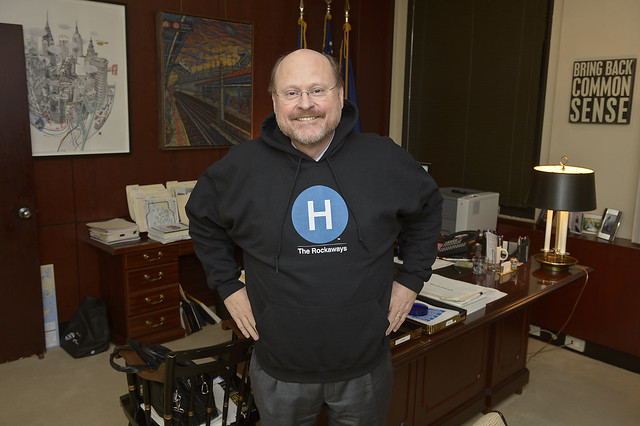
MTA Chairman & CEO Joseph J. Lhota sports “H The Rockaways” hooded sweatshirt in his Midtown office. (Metropolitan Transportation Authoirty/Patrick Cashin)
When the MTA announced the temporary H train for the Rockaways, it drew a flurry of attention. MSNBC’s Rachel Maddow profiled the trucking of trains across the Channel while politicians hailed it as an important step on the road to recovery. Railfans were thrilled to see the blue-bulleted H make its first return to the rails since 1994.
So how are things for the H? In The Times this week, Matt Flegenheimer profiled the new train, and he finds an odd mixture of Rockaway residents trying to forge normalcy out of their uprooted lives, FEMA workers and and rail fans snapping photos of this subway oddity. “It’s like they found the holy grail here,” one MTA conductor said of the rail fans. “It’s a job for us; it’s a passion for them.”
The MTA is not unaware of the fervor and interest surrounding the H train, and today, in conjunction with the Transit Museum and The Graybeards, a not-for-profit organization aimed at helping the Rockaways, the Authority announced the launch of new line of merchandise. Called the Rockaways Relief Collection, these items are a limited line of H train-related items, and all proceeds will benefit The Graybeard. These items include t-shirts, sweatshirts and magnets and are available for sale online. More products may be added to the line.
“We were looking for a way to use our licensed products to help out in the recovery efforts taking place in the Rockaways,” Mark Heavey, MTA Director of Marketing & Communications, said. “The H Line has piqued a lot of interest in subway service in the Rockaways and, with the help of a few of our product licensees, presented us with a unique opportunity to promote the service and to provide tangible assistance to efforts to rebuild that community.”
The H train has a unique history tucked away in its little corner of Queens. It began service as the HH in 1956, running on LIRR tracks from Euclid Ave. to either Rockaway Park or Mott Avenue. That service was discontinued in 1972, but the shuttle returned as the CC in the late 1970s. It was given the H designation in 1986 and turned into just another grey S train in 1994. Now, it’s back, and its return can spark some fundraising efforts as well.