Category: Subway History

  • At Columbus Circle, an antique wall emerges

    As the Columbus Circle station rehab has progressed, MTA work crews have uncovered an impressive array of subway history. Three years ago, a plaque from 1901 resurfaced after over a century behind brick and tile, and last week, another 109-year-old mosaic reared its head.

    The Times first broke the story last week with an excellent headline — Behind an Old Subway Wall, a Glimpse of an Even Older One — and David Dunlap provided us with the story. Much like the circa-1901 plaque, this newly discovered old wall was part of the Heins & LaFarge testing ground for various subway station designs. He writes:

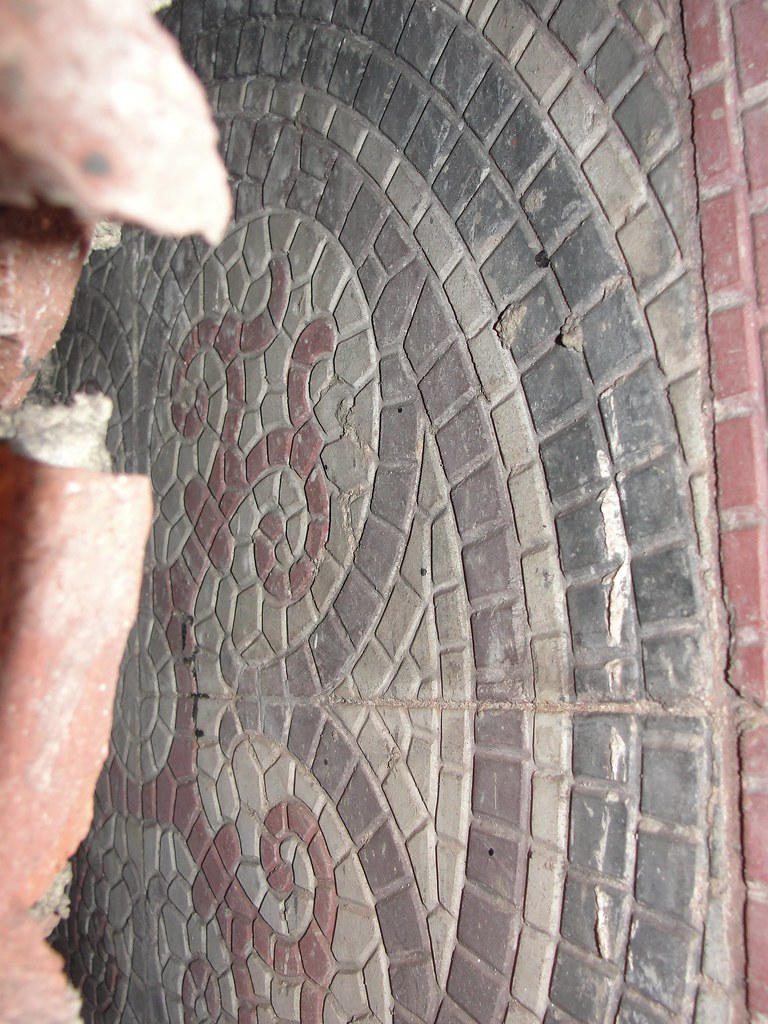
    Another keyhole to the past opened recently on the uptown platform of the No. 1 train at the 59th Street-Columbus Circle station. Through a gap in the current wall, under one of the ceramic plaques of Columbus’s flagship, an unusual pattern can be discerned dimly: an interwoven guilloche pattern — sort of like a two-dimensional challah crust — in red and yellow mosaic tiles.

    Viewed from a perch on the nearby bench, the wall reveals more of itself. (We spread out a newspaper on the seating area, taking advantage of the broad utility of the print medium.) Next to the guilloche border is a large blue-gray mosaic medallion, enclosing a four-lobed pattern known as a quatrefoil. It’s unclear whether it is a true mosaic, with individual tiles, or a mosaic pattern stamped on to a large surface.

    What we do know is that it stretches far back into the past; to 1901, in fact, three years before the subway actually opened. In “Silver Connections” (1984), his monumental history and description of the New York subway, Philip Ashforth Coppola described the Columbus Circle station as having played a critical role in the development of the system. “It was virtually the first station to be completed in structural form,” he wrote. “Because of this, the architects used its walls as an art gallery, experimenting with decorative ideas in various colors of tiles and other materials.”

    New York City Transit officials know that this wall is quite historic, and they hope to conserve and display it. “We are well aware of the historical significance of this find,” Charles Seaton said to The Times, “and we are working on a design for a window in the wall so this treasure can be shared with the public at some future date.”

    Meanwhile, after 109 years of isolation, the wall, as of Friday, was on display on the northbound 1 platform for all to see. As I snapped some photos — embedded after the jump — two other New York City history buffs wandered over to espy this bit of subway history. Were we were among the first people to see something buried since the McKinley Administration? Perhaps so.

    Click through for a brief slideshow of photos from the Columbus Circle station. Most of the mosaic remains hidden behind the wall, but it’s possible to see glimpses and fragments of it. (more…)

  • Underneath 42nd St., a conveyor belt that wasn’t

    City and Board of Transportation officials gather around a working model of the conveyor belt proposed to replace the 42nd St. shuttle. (Edward Haunser/The New York Times)

    The 42nd St. shuttle was always supposed to be a temporary train route. It is funny then, that 92 years after it first entered service, the shuttle is one of the most necessary and crowded routes as it ferries commuters in between Grand Central and Times Square. Imagine, if you will, a similar route but filled with open-air cars on a conveyor part as was once proposed and prepared for the underground stretch of track in between the East and the West Sides.

    On September 28, 1918, the Interborough Rapid Transit company opened service on its so-called H routing. With the 7th Ave. line south of 42nd St. serving customers and the Lexington Ave. line north of 42nd St. playing host to trains, the original east/west routing that connecting the southern half of the IRT on the East Side with the northern half on the West Side was to become a shuttle, ferrying passengers from Grand Central Terminal to Times Square. From the start, the service was an engineering disaster. “We called the H system for more reason than one,” William Jerome Daly, the Board of Transportation secretary, said with a wink and a smile in 1949.

    On opening day, The Times said that service started smoothly, but the article and subsequent tales from underground described a scene that was anything but. Straphangers complained of the long walk from the Lexington Ave. IRT line to the shuttle station. They complained of the crowds and of the way the lighted signs announcing the next train did not give ample warning as customers had to run to catch the next train. The complained of cramped spaces and generally poor engineering as support beams at the West Side interfered with movement. “Shuttle service faulty,” said one 1942 letter to The Times.

    By the time 1949 rolled around, the temporary shuttle — called such because the Board of Transportation had never funded upgrades to the Times Square end — still drew the ire of the city’s straphangers, and it was with great fanfare that the Board of Estimates announced an overhaul. For the princely sum of $3.5 million, the Board planned to build double platforms at Times Square to ease the crowd and allow for boarding on one side and detraining on another. The Grand Central terminal would be extended 200 feet east to cut walking distance from the shuttle to the IRT station. Still, these upgrades were “pretty far down” on the list of overall subway improvements, and it took a while to get the ball rolling.

    After a few years of fits and starts, the Board of Transportation hit upon another idea: Instead of upgrading the shuttle, the city would instead replace it with a people-moving conveyor belt. As Time Magazine described in a 1954 article, “The jammed, jolting old subway shuttle train between Grand Central Station and Times Square, half a mile crosstown, will be replaced by a gigantic conveyor belt carrying an endless chain of lightweight passenger cars. Riders will step onto a belt moving at 1½ m.p.h., and from there into cars which will then speed up to 15 m.p.h. for the two-minute trip to Times Square and slow down again to let them off.”

    A 1951 rendering of the 42nd Street conveyor belt in action.

    The project was to cost $5 million — $3.8 million for the conveyor belt system, $1.2 million for necessary tunnel updates — and The Times loved it. Proclaiming the novelty factor, the editorial staff opined, “The conveyor belt has proved itself on many jobs. We have faith that the engineers of today can make this new shuttle idea a working reality…Admitting that it is something of an adventure into experiment, we hope city officials have enough of the pioneering spirit to try it in curing an old ill at a busy crossroads of the city.”

    Unfortunately, City Comptroller Lawrence E. Gerosa wasn’t feeling that pioneering spirit. In an August 1955 report condemning the plans, Gerosa warned of “high maintenance charges and risk of injury to passengers.” Noting that this system would be both more expensive than anticipated and the first of its kind anywhere, he issued a warning: “New York City cannot afford to be the guinea pig for such a costly and complex investment particularly in one of the most congested areas in our subway system.”

    Two months later, the conveyor belt plan died an ignoble death. Instead of a new investment, the Transit Authority promised to reengineer the Grand Central bottleneck and invest in rolling stock upgrades for the much-maligned shuttle. Thus ended one of the great thought experiments in New York City transit history.

    Today, the shuttle suffers from some of the problems described in those missives from the 1950s. The Grand Central IRT stop is still a long walk away from the shuttle, and commuters still have to sprint to catch the train at Times Square when the “next train” sign lights up. The shuttle is a microcosm for improvement plans that were never funded yesterday and aren’t on the table for the future.

    From the start of the 1950s onward, The Times repeated a call for a river-to-river shuttle that would service the Hudson River ports, the Port Authority Bus Terminal, Times Square, Grand Central and the UN area on the East Side, and it still doesn’t extend that far 60 years later. An island-wide route would have revolutionized crosstown access and would have been a true international subway. Instead, the TA and the Board of Estimates settled for a patched-up shuttle, and New York’s transit riders are still today hoping for river-to-river rail along the avenue I’m taking you to, 42nd Street.

  • A history of futility for Utica, Nostrand extension plans

    The proposed Second System subway expansion plans issued in 1929 called for subway lines down Nostrand and Utica Aves.

    In the annals of New York City subway history, the Second Ave. Subway carries with it the grand stigma of futility. First proposed in 1920, the SAS went through various iterations, groundbreakings and funding crises before the current construction efforts relaunched in 1995. Barring an economic catastrophe, at least Phase 1 of the Second Ave. line will open before the end of the decade, and the Second Ave. Subway will pass from myth to reality.

    Elsewhere, though, other subway expansion plans have languished for nearly as long as the Second Ave. Subway. While none of these plans have as tortured a history as the future T line does, many of them are common-sense system expansions that have been on and off the city’s transit table since the early days of New York’s subway system. Take, for instance, the Marine Park-Sheepshead Bay-Gerritsen Beach area.

    Although Brooklyn’s subway service is nearly as comprehensive as Manhattan’s, a glance at the borough map reveals a large gap in service in the southern reaches of eastern Brooklyn. The Marine Park-Sheepshead Bay-Gerritsen Beach triangle is serviced only by the B and Q along Flatbush Ave. to the west and a bunch of local buses. To the north, the Flatbush Ave./Brooklyn College stop serves as a terminal for the 2 and 5 trains, and with Nostrand Ave. running south from that station, that road would serve as the natural starting point for new service.

    In fact, that’s long been the dream of city planners, and that final stop on the 2 and 5 wasn’t built as such. Rather, it was supposed to lead into the Nostrand Ave. subway line. Talk of the Nostrand and Utica Ave. subway extensions pop up as early as 1910 when The Times discusses future expansion of the young system into Brooklyn. A century ago, planners anticipated a branch of the subway running out to the ocean, and the IRT awarded its Brooklyn expansion plans in two contracts. Only the first part saw the light of day, and when Flatbush Ave./Brooklyn College opened in 1920, no one knew this station would become the de facto terminal for the IRT.

    In 1929, when the city unveiled its ambitious Second System proposal, both Nostrand and Utica Ave. extensions were included. The Nostrand spur would have completed the IRT’s early 1910 plans for subway expansion, and the Utica Ave. route would have been the southern part of the new Williamsburg train lines. A 1939 post-Depression version of the Second System had the Utica Ave. line reaching Floyd Bennett Field.

    The 1939 plans for subway service to Floyd Bennett Field.

    As we know from the history of the Second Ave. subway, though, a World War interrupted the city’s ambitious expansion plans, and the Nostrand and Utica subway lines were once again shelved for nearly 15 years. As the mid-1950s dawned and the city looked to build the Second Ave. line, so too did it give approval for the Nostrand and Utica Avenue extension plans. The Nostrand spur would again see what we now call the 2 and 5 extended south while the Utica Avenue plans were scaled back. Instead of a new line coming south from Williamsburg, the 1950s plan called for a spur from what is today the end of the 4 line in Brooklyn. The extensions were estimated to cost $82.15 million — or around $656 million in today’s money — and be ready for service by 1960.

    A proposed rendering from 1969 of the Utica and Nostrand Avenue subway expansion plans.

    But the city’s debt and deferred system maintenance led to a different reality. By 1957, it was clear that the two subway lines in Brooklynwould not see the light of day, and as transportation money went to modernization instead of growth, the plans laid dormant for another ten years. In 1968, the city again approved a massive subway expansion plan that included the Nostrand and Utica Avenue lines, and again, the city’s financial situation would intervene. Over the next three years, the bond request that would fund these expansion plans became a hot political issue. The city and state had no money, and many transit watchers did not believe the price tags for the capital plans were accurate. With Theodore Kheel, a current advocate for free transit, banging the financial drum, voters turned down the transportation bond request, and although another bill would pass a few years later, the Nostrand and Utica Avenue subways died in 1971.

    On March 21, 1971, The Times penned a requiem for these plans. City planners thought the Utica Ave. routing would lead to even more overcrowding on the already-stuffed IRT lines and wanted to extend the Canarsie BMT — today’s L train — instead. The price tags for the two projects had reached $350 million in 1971 or $1.8 billion today, and no one believed that estimate to be accurate. These concerns still ring true today, and when Kheel attained his victory in the early 1970s, the Nostrand and Utica Ave. plans would become but another unbuilt relic of the subway system.

    Today, the areas that would have enjoyed subway system 80 or 90 years ago are among the more isolated and car-dependent neighborhoods in Brooklyn. While the Second Ave. line, whose fate was seemingly intertwined with the Nostrand and Utica Avenue plans, is now under way, no one is advocating for service in southern Brooklyn even though the city would be better off for it.

  • A history of connecting the disconnected borough

    Schematics of a 1912 plan to connect Staten Island with the BMT via a subway tunnel under the Narrows. Click to enlarge.

    Staten Island is often called the forgotten borough by New York’s transit literati. With only some local and express bus routes connecting through to other boroughs and the Staten Island Railway as its only train line, the borough plays host to a high car ownership rate and is relatively disconnected from New York City Transit’s extensive four-borough subway network. For nearly 100 years, Staten Islanders have clamored for a subway connection to nearby Brooklyn or Lower Manhattan, and at every turn, the project has been shunted aside over costs or worse.

    A 1912 article in The New York Times introduces us to a plan to build a subway to Staten Island under the Narrows. The piece focuses on how real estate values in Tompkinsville and Rosebank were on the rise amidst rumors of a direct subway connection to Manhattan’s Broadway line via a tunnel from Brooklyn that would parallel 67th St. in Kings County, and developers were excited about the future of Staten Island real estate. “In the first place, all Staten Island will not be greatly benefited because there is a large portion of the Borough of Richmond where there are no trolley lines connecting to with the future subway,” William E. Harmon said.

    Harmon also mentioned the proposed terminus of this underwater subway route. “The end of the Staten Island subway is, according to present plans, to be at Arrietta Street, about five minutes’ walk from St. George’s Ferry,” he said. Today, Arrietta St. is better known as St. Marks Place, and the subway would spurred both south and north to make a connection with the Staten Island Railway.

    Even though the Board of Estimates approved this subway connection to Staten Island on July 11, 1912 and the Mayor William Jay Gaynor followed suit on July 16, the subway was slow to materialize. A 1915 letter to the editor of The Times from Robert T. Cone highlights how borough activists were dying for a subway. Cone noted how travel took three times as long as it should have on the ferry and how Staten Island, if developed properly, could house 3 million taxpayers. He advocated for a two-track subway connection as well as a two-track freight connection from Staten Island to Manhattan. It was an ambitious plan indeed.

    A 1919 proposal for a subway from Staten Island to Manhattan. Click to enlarge.

    Four years later, the issue of a Staten Island subway connection again reared its head. Proponents of any subway plan had decided that a connection to Brooklyn via the 67th St. tunnel would be too indirect and the trip too long, and so they proposed a direct Manhattan-to-Staten Island tunnel. The Staten Island Subway Committee called for one of two routes: either a direct route to Battery Park via Ellis and Bedlow Islands under “the shallows of the bay of Robbins Reef and thence under Kill Van Kull” or by subway via Ellis Island to “within the bulkhead line below Communipaw [in Jersey City]; thence on an elevated structure just within the bulkhead line to a point near Robbins Reef; thence by subway under the Kill Van Kull.” The committee declined to include any cost estimates but assumed the net increase in tax assessments would eventually cover the price of this lengthy subway expansion.

    In 1921, optimism was on the rise as the city promised residents of Richmond a subway expansion. For $25 million, the city would build a tunnel under the Narrows and connect Staten Island with the BMT routes in Bay Ridge. In present-day values, that $25 million would be approximately $297 million — or the equivalent of a few blocks of the Second Ave. Subway. At the time, the Board of Estimates had yet to determine if the subway to Staten Island would go under 67th St. or continue from the BMT’s terminal at 86th St.

    In 1925, with the BMT in dire fiscal straits, the city’s engineers seemingly torpedoed the subway. That optimistic $25 million was far too low, they said. According to a survey, the real cost in 1925 would have been at least $40 million, and city engineers said they could build a bridge spanning the Narrows for $90 million. “But where a tunnel, if built, could be used only for rapid transit,” The Times said, “a bridge could carry not only vehicular traffic, on which tolls could be charged, but might be so constructed as to afford an outlet for freight cars.”

    And thus died the subway to Staten Island. The plan for a bridge meanwhile laid dormant for decades. In the mid-1950s, Robert Moses revived the plan to span the Narrows, but much to the chagrin of The Times, writing in 1955, Moses declined to provide space for rail service on what would become the Verrazano-Narrows Bridge. When the bridge opened in 1965, the paper called it “more of an esthetic and engineering marvel than a way to get to Staten Island.” Without rail, it would become dominated by cars, and Staten Islanders were left waiting for that rail connection to the rest of the city. It’s 2010 now, and they’re still waiting.

  • Remembering a fire at Chambers St.

    A 2005 fire at Chambers St. relay room threatened to derail service on the 8th Ave. line for years. (Photo by flickr user Remon Rijper)

    As the Long Island Rail Road struggles to overcome a fire that has knocked out much of its service, the fragile state of the city’s transit infrastructure has again come under the microscope. The signal tower that burned on Monday dated from 1913 and was scheduled to modernized next year, and while it’s amazing to think that 100-year-old technology can still run the nation’s busiest commuter rail, that the system hasn’t been updated since Woodrow Wilson’s first term as president is a sad commentary on transit investment.

    This isn’t the first time in recent that part of the MTA’s signal technology has been taken out by the fire. The last high-profile incendiary incident came in January 2005 when a homeless man at Chambers St. searching for warmth amidst a snowstorm started a fire that destroyed a key relay room for the 8th Ave. IND. Initial reports featured tales of a subway system in chaos. C service was suspended as the V ran to Euclid Ave., and the A train had to run local and at slow speeds while drivers relied on the subway equivalent of manual transmission.

    Reports from Transit were just as dire. “This is a very significant problem, and it’s going to go on for quite a while,” Lawrence G. Reuter, the president of New York City Transit, said. He said that would cost millions of dollars to restore the signal system and that service along the A and C lines would be slowed for three to five years. Could damage to 70-year-old technology really cause such inconvenience?

    The impact was immediate. Transit had to cut rush hour service from 26 trains in each direction to just eight in the aftermath of the fire, and the 600,000 commuters who relied upon the A and C trains were struggling to find faster ways around town. But then a funny thing happened on the way to the signal modernization project: The MTA’s timeframe for restored service grew shorter and shorter.

    Just a few days after the fire brought dire predictions of five-year service outages, Reuter had to admit that he vastly overstated the importance of the burned relay room, and less than two weeks later, full service along 8th Ave. had nearly been restored. Reuter changed his story after the fire and claimed he meant to say that the signal repairs would take 3-5 years, Service, he maintained, would always be restored quickly. “I must have misspoke or didn’t clarify myself very well on that, he said. “I am sorry.” In fact, repair work on the burnt-out signal room did not commence for over a year after the fire.

    But in the aftermath of the incident, the TA’s overall point remained: It would take a very long time to modernize the subway’s signals. At a City Council hearing a few days after the fire, then-Senior Vice President for Subways Michael A. Lombardi said it would take 45 years and hundreds of millions of dollars to bring the system up to date. While City Council members at the time called it “inadequate,” “inefficient and irresponsible,” no developments over the last five years have changed that outlook. The $88 million project to restore and modernize signal service at Chambers St. wrapped this May, five years and three months after the 2005 fire, but the rest of the system remains without a timeframe for these badly-needed upgrades.

    Meanwhile, as Long Island-based commuters struggle to get into the city today, we see the importance of keeping technology up to date. Currently signal systems have built-in redundancies and better fireproofing technology, traits absent from those towers built in 1913. Without investment, the infrastructure ages to the point where one fire at the wrong point in the system can knock out an entire rail network, and that’s a problem for New York.

  • When it was a train: the Culver shuttle

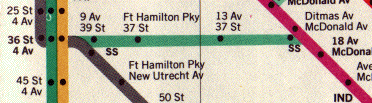
    The 1964 subway map shows the Culver shuttle’s connecting the 4th Avenue lines with the 6th Avenue lines well north of Coney Island.

    Over on Subchat this morning, Newkirk Images posted a photo of the now-abandoned lower level of the 9th Ave. station in Brooklyn. Sitting in the center of the photo is a two-car train that has largely been lost to the history of the New York City subway system. That trainset is the Culver Shuttle.

    The Culver Shuttle, as Joseph Brennan details at his Abandoned Stations site, had its origins in the late 19th Century steam-powered railroads that would take vacationing New Yorkers to the seaside resorts at Coney Island. With various elevated lines providing access throughout Brooklyn, the immediate history of the shuttle, says, Brennan is “fairly complex.” He writes:

    Up to 1931, 5 Ave El trains provided all the service, and 9 Ave must have been busy with Culver passengers changing to the West End subway trains for a faster ride and access to many more places. The wooden el trains were slow and ran no farther than the end of the Brooklyn Bridge at Park Row, Manhattan.

    When the Nassau St loop in lower Manhattan finally opened in 1931, the BMT began operating a mixture of subway and el services to the Culver line. Subway service ran Monday to Saturday, to Kings Highway in rush hours and summer Saturdays, and to Coney Island midday and other Saturdays. El service went to Coney Island rush hours, nights, summer Saturdays, and all Sundays, and otherwise ended at 9 Ave station. Is that clear? The BMT didn’t have enough subway cars for full service, so at rush hours and summers, the el had to pick up the service to the end of the line, so the subway trains could shortline. 9 Ave lower level saw its peak train service in these years, with both el and subway trains, and el trains reversing in the middle track during some hours…

    The Transit Authority fulfilled a longstanding Board of Transportation plan in October 1954 when the IND subway was connected to the Culver line at Ditmas Ave station and took over all service to Culver stations beyond that point. BMT Culver service from a single track terminal at Ditmas Ave continued as before on weekdays, but nights and weekends it was a shuttle to 36 St. Ridership dropped, and in May 1959, it was made a shuttle full time, between Ditmas Ave and 9 Ave only.

    As the subway system decayed throughout the 1960s and early 1970s, the Culver Shuttle keep chugging along. It ran the BMT standard subway cars up through the early 1970s, and Brennan notes how the way Transit didn’t maintain this little-used station echoed the collapse of the system as a well. “The dark, deteriorating lower level at 9 Ave, and the partly dismantled elevated line gave it a mood of decay,” he writes. “There was just one track, the center at 9 Ave and the west side on the el, and one train operated all the service. The end was obviously in sight, but it somehow hung on until 1975.”

    That year — 1975 — saw the demise of the Culver Shuttle amidst the now-familiar refrain of budgetary problems. Only 1000 people a day used the shuttle, and most of those were making the round trip to and from work. The MTA estimated it would cost $1 million it didn’t have to rehabilitate the elevated structure, and the shuttle, which once ran into Manhattan via the 4th Ave. line and Nassau St. loop, would be shuttered instead, with residents offered a free bus transfer as a replacement service.

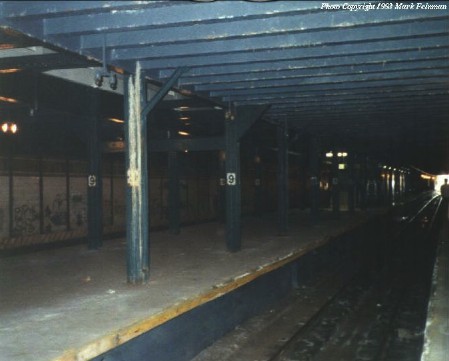
    The abandoned 9th Ave. platform as seen in 2002. Photo via NYC Subway.

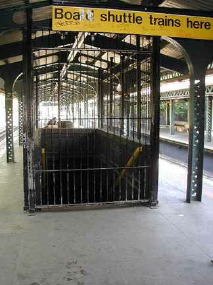
    These days, not much remains to remind New Yorkers of the Culver Shuttle. A sealed staircase leads to an abandoned platform, and the platform itself is in terrible shape. The rails too are but a memory as they were demolished in 1984. The rights of way between 9th Ave. and Ditmas Ave. have generally long since been sold to private developers, and houses in Brooklyn now mark the tracks of the old Culver Shuttle. Today, only stub tracks remain, a remnant of this rich history of rail travel in Brooklyn.

  • Remembering a subway on the rise

    Today, I hopped onto a J train at Chambers St. and took it to Broad St. to run an errand at lunch time. Even though the cavernous Chambers St. is in bad need of a rehab, I thought nothing of waiting on a mostly empty platform for a train I wouldn’t have dared ride alone (were I old enough) 20 years ago. The subways, as long-time New Yorkers are wont to say, have come a long way in a few decades and are no longer as closely associated with crime and a lack of safety as they once were.

    New York’s subway renaissance has had two driving factors: capital investment pushing the system toward a state of better repair and more fare-payment and unlimited ride options that encourage ridership at all hours. By making the subways relatively cheaper for everyone and improving travel conditions and safety, suddenly, mass transit saw its ridership in New York City climb to near-record heights. Although a recent recession has slowed the ridership growth, the subways are safer and generally more reliable today than they have been in decades.

    Yet, a storm is brewing as the MTA wants to scale back on unlimited ride MetroCards. While we don’t yet know how a 90-ride cap on 30-day cards will change ridership, the move hearkens back to another era, one when people weren’t keen on paying for every ride. At their Metropolis blog, the Wall Street Journal

  • The MTA’s days of wine and roses

    When details of the 2011 fare hike got out on Friday, to many New Yorkers, threats of increased unlimited ride fares and a MetroCard surcharge came as no great surprise. The MTA had, after all, raised fares in both 2008 and 2009, and the authority has spent nearly all of 2010 pleading poverty. That the fares aren’t going up in 2010 is only a matter of semantics; due to the payroll tax funding package, the MTA can and will raise fares on January 1, 2011.

    Yet, life wasn’t always all about fare hikes for New York City subway riders. Although the MTA raised the fares regularly throughout the 1990s and early 2000s, straphangers could take solace in the fact that these hikes were often little more than cost-of-living adjustments. The MTA then didn’t have to live fare hike-to-fare hike as it does today, and once upon a not-so-long-ago time, the authority had enough money in its coffers to grant its riders a holiday reprieve from the full fare.

    Our story starts on October 18, 2005. On that day, the MTA announced plans to offer a fare discount between Thanksgiving and New Year’s Day. Since the MTA had a balance sheet that was, at the time, projected a surplus that could have reached $900 million, the authority wanted to give something back to its riders. “It’s unprecedented,” Gene Russianoff said at the time. “I’ve never seen any holiday-related discounts for riders. I think it will encourage people to use transit during the holiday season at a time when gas prices are going through the roof. It’s a smart way to reward customers.”

    The discounts included relief for everyone. The base fare was to be $1 while bonus days were to be added to unlimited ride MetroCards and commuter rail passes. The MTA estimated that the giveaway would cost $50 million overall with an expected increase in ridership covering from the lost fare revenue. The rest of the budget surplus was to go pension relief, security projects and service improvements, and because the MTA had to have a $0 balance at the end of the year, the money had to be spent.

    The next day, the headlines were decidedly less friendly. New York’s liberal and conservative political groups called the fare giveaway an irresponsible marketing gimmick. Because the MTA had been anticipated budget deficits in both 2007 and 2008 — deficits that came to pass — for some time, fiscal experts, such as James A. Parrott of the liberal Fiscal Policy Institute, wanted the authority to plan for long-term budget stability and a source of revenue flow for capital projects. Others, such as the Manhattan Institute’s Ed McMahon, wanted the dollars to cover the MTA’s pension obligations. Then-Governor George Pataki called for the MTA to use the money to cover construction costs at South Ferry or the Fulton St. transit center.

    Most commentators figured the good will earned by the temporary fare relief would be short lived. “Whom does this actually benefit?” Preston Niblack, from the city’s Independent Budget Office, said. “It does not really solve any structural issues. It’s great from a public relations point of view, but it does not address long-term needs.”

    When the MTA Board held its October meeting, the fare holiday garnered approval amidst a contentious debate. A vocal minority of board members paid heed to the looming financial crisis, and they urged the MTA to, in the words of Andrew Saul, “bank the money” to lessen the pain of future deficits. “I’m not sure in the long term that this is really in the interest of the riders,” Saul said. “This agency is facing tremendous financial stress going forward.”

    In November, as the MTA’s surplus ballooned to $1 billion, the discount December was a foregone conclusion. Even as the MTA tried to pare down its future debt, the authority went forward with a plan that many figured was nothing less than bribery and nothing more than a public relations move gone bad. If New Yorkers saw the discount fares and assumed the MTA could afford such a program, these New Yorkers would forever be skeptical of the MTA’s claims of poverty and deficits.

    In the end, the program was neither a success nor a failure. The MTA lost approximately $46 million in lost revenue, but few people had changed their fare-buying or ticket-purchasing behavior. As 77 percent of customers said the program saved them money, the MTA even budgeted $50 million for another fare holiday in 2006, but it was not to be as the MTA canceled the 2006 discount in order to postpone an impending fare hike.

    Today, the fare discount lives on in memory only. Instead of a holiday reprieve this year, we’ll be preparing for another fare hike as the MTA looks to close a budget deficit nearly as large as the surplus from five years ago. The $46 million the MTA gave up to provide that discount fare wouldn’t have made a huge discount today, but it served as a portent of bad times to come. From now until the real estate market recovers, we’ll be suffering through fare hikes and not holidays.

  • The high-priced origins of the Chrystie St. Cut

    The 1972 Vignelli map showed the now-defunct K train making use of the Chrystie St. Cut.

    When New York City Transit announced that, as part of their service cuts, the M train would run from Middle Village to Forest Hills via Sixth Ave., many riders were confused about this routing. While those in the know knew about the Chrystie St. Cut, only New Yorkers around for the death of the K train in 1976 could lay claim to knowledge of that connection, and after 34 years of silence, the tunnel connecting Essex St. on the BMT Nassau St. line with Broadway/Lafayette on the IND Sixth Ave. had been lost to the sands of subway time.

    Today — two days after Doomsday — we know all about the Chrystie St. Cut. We know that a train with 60-foot cars only can slowly wind its way from Essex to the Sixth Ave., and we know that residents in northern Brooklyn and southern Queens are enjoying the new one-seat ride to Chelsea and Midtown. They ought to, after all; it was an expensive connection to build.

    Our tale starts in 1954, nearly 15 years before initial revenue service on the Cut would begin. That year, the Transit Authority, the precursor to the MTA, asked the Board of Estimate for $172 million for capital improvements. In their request was a $37 million outlay for the entire Chrystie St. Connection that would allow BMT trains coming off of the Manhattan and Williamsburg Bridges to transfer over to the IND tracks in Manhattan. In 2009 dollars, that would be akin to a $292 million price tag, small beans considering the cost of the Second Ave. Subway and 7 line extension.

    From the get-go, the project faced a lukewarm reception. New York City planning officials worried that the connection would be a “possible detriment to efficient rapid transit traffic movement” to and from Lower Manhattan. In 1957, however, these objections were put to bed, and the TA promised a three-year construction timeline. The Board of Estimates authorized a $10.2 million expenditure for the first phase, up from $9 million a year before, and on November 25, 1957, officials gathered for the groundbreaking. The price had risen to $58 million or $437 million in 2009 dollars. Even in the 1950s, the TA couldn’t control construction costs.

    In 1961, a year after the TA’s initial deadline, trouble began. One report accused the authority of wasting money on the modernization project. As 1961 turned into 1962 turned into 1963, the costs rose from $60 million to $70 million. By the end of 1963, one report had the project’s cost at $74.8 million or $518 million in 2009 dollars. In 1964, the new connection was still supposedly one year away from being ready for service, and the city started a clean-up effort that involved restoring parks and removing unsightly barriers.

    Finally, a decade after beginning work, in November of 1967, the Chrystie St. Connection went into service. While the passengers were confused, the Manhattan Bridge connection proved to be a hit. The Williamsburg Bridge/Chrystie St. Cut sections suffered though. The KK, a skip-stop service to Jamaica, went into service in the summer of 1968, and commuters were unhappy. The routes were slow and often indirect. By 1975, the MTA had announced plans to pull the plug on the Chrystie St. Cut, and in August of 1976, amidst budget crises and deficits, the KK was no more. In the end, construction of the Chrystie St. Connection took 10 years while K trains ran through the Cut for just eight.

    When the last K train rolled down that line, little did New Yorkers realize that a useful subway connection would be severed from the Beame Years until the reign of King Bloomberg. It is ironic too that service originally cut due to a budget deficit was this time restored for the same reasons. I’ll have more riders of the M train later today, but it is a fascinating history. The Chrystie St. Connection remains vital today as trains coming off of the Manhattan Bridge have used it for decades, and now, after just eight years of initial use and nearly four decades of neglect, the Williamsburg connection has been restored. Through it all, we’re still waiting for both a properly funded transit system and the Second Ave. Subway, an original impetus for the Chrystie St. work all those years ago.

  • The tribulations of bringing AC to the subways

    The R-17, shown here in operation as the Shuttle in 1982, was the first subway car outfitted with air condition. (Photo via Steve Zabel/NYCSubway.org)

    For the last few days, New York City has been enjoying some unseasonably warm weather. Although temperatures should dip back into the 60s over the weekend, the days of sun and 80 degrees remind me of the summer to follow. Summer in New York — with free concerts, long days and, of course, baseball games — is my favorite season but for one thing: The subways are utterly unbearable.

    The worst part of riding around New York City in the summer are the underground waits. With train cars spewing heat from industrial-strength air conditioners, the stations themselves see temperatures sore beyond tolerable levels. The stagnant air induces sweat at hours of the morning far too early for that kind of heat, and only the blessed air conditioning of the train cars makes a commute tolerable.

    These days, we take our air conditioned subway cars for granted. The MTA undertook its current air conditioning efforts in 1967, and the thought of a summer ride without AC lives on only in the memories of long-time New Yorkers. So as we sit on the cusp of summer and Transit turns on the AC, let’s hop in the Wayback Machine to a time when the New York City Transit Authority just couldn’t quite get air conditioning right.

    Our journey begins in September of 1955, an odd time to test air conditioning as the heat is already dissipating by then. On a day that saw the outside temperature hit just 62 degrees, NYCTA ran a successful test of its first air conditioned subway car, an outfitted R-15 car. As station temperatures hit 81 degrees and the mercury climbed to 87.5 in un-air conditioned cars, the test car saw temperatures fluctuate between 68 and 73 degrees. The authority proclaimed this one-day test a success, and plans to outfit the entire subway fleet at a cost of $700 per car were drawn up.

    This was short-lived optimism. A year later, the NYCTA unveiled another test run of the air conditioned cars. Six R-17 cars equipped with loud speakers, air conditioned and in-route music provided, of course, by Muzak, made headlines as Transit officials again extolled the virtues of air conditioning. At the time, Transit planned to test these cars along various IRT routes but ran into early troubles.

    The authority tried to test it on the Shuttle route, but the short trip did not provide for ample testing time. “The run between Times Square and Grand Central takes one minute,” wrote The Times, “apparently too brief a time to cool the hot subway air taken in during the stops of one and one-half to two minutes at the shuttle terminals.” Passengers complained as well of stale air and high humidity.

    By 1962, the promise of air conditioning had failed to materialize, and the NYCTA declared the $300,000 experiment a failure. Even after the successful test runs, Transit found humidity levels well beyond acceptable. “As humidity built up and breathing became difficult,” The Times said in 1962, “passengers fled to the fan-ventilated cars…To add to passenger discomfort the cool air was dissipated when doors opened at stations, while the humidity remained unchanged.” While PATH announced air conditioning, NYCTA was left searching for solutions.

    Five years later, the city struck air conditioning gold. After tinkering with the technology, Transit found a costly solution, and early test runs were again successful. This time, the humidity levels were kept in check, and railfans began to stalk the air conditioned cars, riding them along the F line from terminal to terminal to bask in the cool air. With a grant from the government and $15 million from the city, Transit finally promised to outfit its rolling stock with AC.

    Even still, the going went slowly. By August of 1970, finding an air conditioned car was likened to finding a needle in a hay stack, and a 1973 proposal called for full air condition only be 1980. Throughout the 1980s, those struggles continued. At various points in the decade, air conditioning either didn’t work or was on the verge of breaking down. In 1983, while Transit officials alleged that 50 percent of cars were air conditioned, one rider found himself with AC during only 20 percent of his trips.

    Today, with new rolling stock and a better maintenance program in place, the subways are blissfully air conditioned, a haven from the heat outside and in the station. I’m too young to remember those days of un-air conditioned trains, but I have vague recollections from the mid-to-late 1980s of stiflingly hot rides in graffiti-covered cars. Even if the new rolling stock can seem somewhat sterile at times, I’ll take that air conditioned as the mercury rises and summer descends upon us.