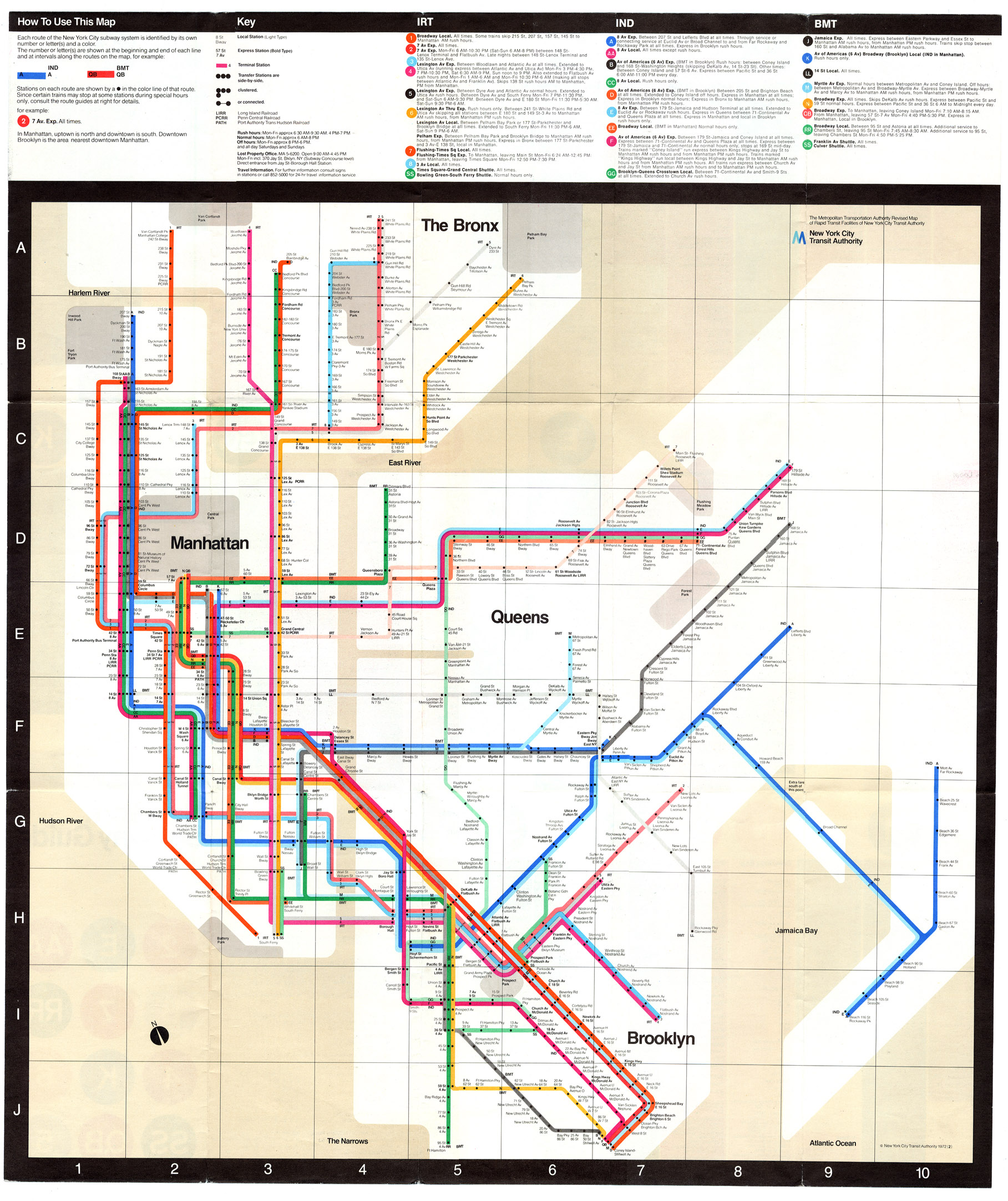
I have a secret love affair with New York City subway maps. I currently have an extensive collection of historical maps that date back to the mid-1940s and possess more than my fair share of the rare Vignelli maps. Throughout the decades, as I’ve written in the past, the New York City Transit Authority and later the MTA have struggled to balance the purpose and design of the subway map with geography first taking a back seat to design and, more recently, design falling behind geography as the driving force behind The Map.
With the MTA set to eliminate the V and W and change the M’s Manhattan trunk line from the BMT Nassau route to the IND Sixth Ave. line, the authority has decided that now is as good a time as any to redesign its familiar map. While the authority hasn’t gone so far as to adopt Eddie Jabbour’s Kick Map or re-embrace Massimo Vingelli’s masterpiece, the MTA has refreshed the map. It now features more Manhattan, less Staten Island and the return of City Island.
The new map, according to Michael Grynbaum of The Times, is supposed to help unclutter something that has become overgrown with unnecessary information. The confusing spreadsheet of service times will be removed from the bottom of the map, potentially creating confusion as subway routes shift with the hours and days of the route. The call-out boxes that provide mostly useless bus connection information will be drastically reduced. Instead, map-readers will be urged to check out the MTA’s website for up-to-date service information. Considering that cell service underground is nearly non-existent, the map’s goals and its instructions seem to be at odds with each other.
Grynbaum has more on the MTA’s in-car efforts to improve the map:
A separate, stripped-down map will also be produced, to be displayed only inside subway cars. Neighborhood names, parks, ferries and bus connections will not appear on this version, making for a less cluttered composition that may be easier to read over a fellow rider’s shoulders. The authority says its goal is improved clarity — but the redesigned map also marks the latest salvo in a long debate over how to best represent a complex system that can bedevil tourists and natives alike…
[In 1979], the authority wanted geographical accuracy so that passengers would not be confused upon ascending back to the street. Hence, subway lines that wiggle and curve, reflecting the exact route of the train, and a simple street grid that highlights popular attractions and neighborhoods. Over time, however, the map acquired new elements like ferry routes and obtrusive balloons showing bus connections.
The authority now concedes that the map became overcrowded. “In its desire to be complete and provide a great deal of information, it took away from some of the clarity you would have with a simpler map,” said Jay H. Walder, the authority’s chairman, who encouraged his marketing staff to make changes.
For the latest iteration, Mr. Walder decided that the service guide, which purports to show a weekend schedule, was theoretical at best. The guide was removed, along with a growing list of handicapped-accessible stations that had begun to dominate the bottom right corner. Small wheelchair symbols will continue to denote those stops.
In addition to these changes in the way the map will be used, the authority opted to refresh the design as well. The subway lines themselves now have a grey shadow to highlight the routes. The water’s blue is a darker shade while parks are denoted in an olive green. Various other geographical features that have appeared and disappeared from the maps — smaller parks, islands unreachable by the subway — will show up as well.
But enough about words. What good is a subway map post without images? The Times has put together a great comparative graphic of the new map as it stacks up against the pre-Vignelli, Vignelli, 1979 Hertz version and the latest iteration of The Map. A few comparative shots are below.
Queens

In the old map, the Queens routes are a bit convoluted. The G train’s supposed trek to Forest Hills is demarcated by a dotted green line. The bus routes to LaGuardia make the area tough to decipher, but those dotted blue lines aren’t going away in the new version.

Now, we see the G terminate in Long Island City, and Rikers Island makes an appearance just to the northwest of LaGuardia Airport. The M has turned orange.
Brooklyn

Gone is the M from 4th Ave.
Manhattan

Although the Chrystie St. Cut connects Essex St. to Broadway/Lafayette via the local tracks, the map shows the M meeting up with the B/D just north of Grand St. It is a subtle way of showing a new service pattern. The W is gone from this map, and NoHo makes its first appearance as the MTA-sanctioned neighborhood name. Additionally, the new iteration of the subway map features a Manhattan far wider than it actually is. The island has grown 31 percent and is now 83 percent wider than it is in real life.