In the mid-1960s, when Massimo Vignelli redesigned the New York City Subway signage, he had to unify a disjointed set of informational and wayfinding signs that were a typographer’s worse nightmare. Fonts from the remnants of the IND, IRT and BMT battled it out, and many signs suffered from informational overload. Generally, those live on only in old photos and at the Transit Museum.
Yet, despite Vignelli’s generally clear modular approach to transportation graphics, some idiosyncrasies remain, and a few signs just don’t work. I’ve written before about my issues with late-night service pattern explanations which require an extensive knowledge of the subway system and also, seemingly, 99-percentile reading comprehension skills. Another sign that irks me is the one I photographed above.
That one is hanging at the rear of the Manhattan-bound platform at 7th Ave. on the BMT Brighton line, and for the sake of spacing the “-form” has been separated from its “plat.” Conceptually, it makes sense, but it requires a logic leap that a good wayfinding system wouldn’t impose upon its users. “What’s a plat?” one might wonder before landing on “platform.” And all of that just to save a little it of blank space.
The problem is one of flexibility. This sign is, in Vignelli’s terms, a 1×3 — one row of three squares of equal size. Adding the “-form” suffix would require an additional square that would be mostly blank. It wouldn’t look clean enough for an Italian designer who’s work revolves around straight lines and clean angles. You could perhaps put “Exit Middle” and “of Platform” and two separate lines, but then the text would bleed over the edge of the 1×1 square.
The best solution would require doing away with modular designs entirely so that the entire sentence can fit on one sign. There’s enough room along the platform to hang such a sign. Or else, you could do what long-time SAS reader Todd suggested and replace it with a sign that says “No Exit. Turn around.” That’s far more in line with the bluntness New Yorkers know and love.
For more scenes from the New York City subway system, be sure to check out my Second Ave. Sagas Instagram profile, and give me a follow if transit infrastructure photography is your thing.
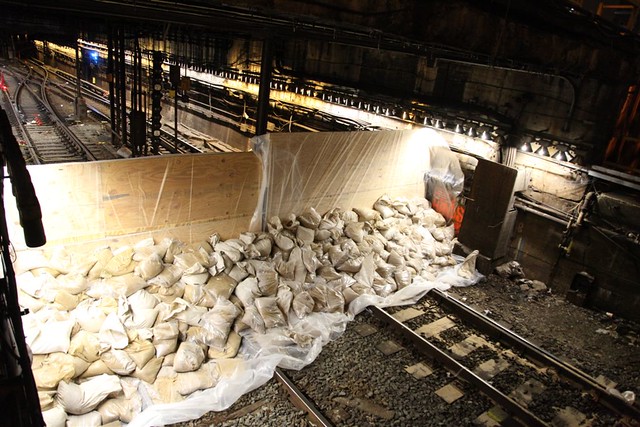
Updated (Tuesday, 12:30 a.m.): According to reports from the MTA, water entered the under-river tubes connecting Manhattan to Brooklyn as the Sandy storm surge overtook the city as well as the 1 train tunnel between Chambers St. and South Ferry.
We can confirm that there has been water infiltration into the New York City Subway tunnels under the East River. We cannot confirm a depth.
Additionally, Ted Mann of The Wall Street Journalreported that water had entered all five subway tubes that run between Lower Manhattan and Brooklyn as well as the 7 train’s Steinway Tubes. Various stations and tunnels have flooded as well.
Earlier in the day, the MTA offered up some information on salt water interacting with the subway system. Even after removal, salt remains on sufaces, and the salte can accelerate corrosion. Any surface impacted by flooding has to be cleaned or replaced. It’s difficult to estimate the time required to clear a flooded tunnel and bring equipment and stations back into service. The timeline depends upon the height of the storm sturge, its speed and the extent of flooding. Generally, the longer a tunnel is flooded, the longer it will take to return to service.
According to the MTA, up to four feet of water entered a Lower Manhattan station as well earlier on Monday. Kevin Ortiz, Transit spokesman speaking on CBS 2, stressed that it could take anywhere from 14 hours to more than four days to restore service if the tunnels are flooded. Once salt water hits switches and signals, all bets are off for any quick service restoration until the system can be inspected and repaired.
Speaking with The Wall Street Journal, MTA Chairman Joe Lhota said the extent of flooding is “quite serious.” Despite earlier rumors that suggested we could go a week without subway service, Lhota cautioned against such a set timeline. “We’re trying to get an estimate of what if anything we’re dealing with here,” he said.
Still, one MTA source told Ted Mann that “it could be a long time” until full service is restored. No official estimates will be released until the extent of the flooding and damage can be determined, and the MTA repeatedly downplayed early rumors of a week-long service outage:
Rumors are wrong. The MTA cannot assess damage until Tuesday. It is way too early for a subway reopening timetable.
Meanwhile, speaking on WNYC, transit reporter Andrea Bernstein said that Bowling Green is the station under water. Pumps are operating on generators and are independent of the power outages currently plaguing Manhattan south of 39th Street. It’s unclear how the rest of the system is impacted right now. I’ll keep updating this post as more information comes in (and, with the lights flickering, as long as I have power).
Crews have prepped the Lenox Terminal at 148th Street in advance of a potential storm surge. Photo: MTA New York City Transit / Leonard Wiggins
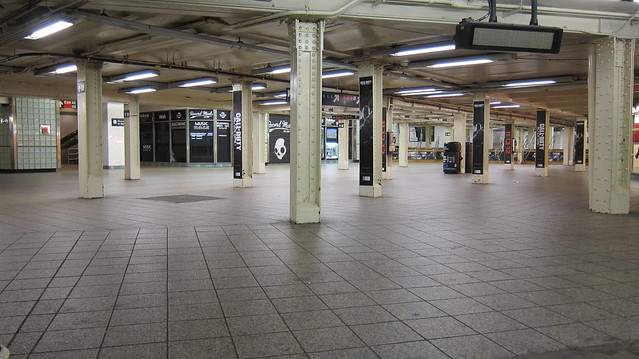
As water has begun to creep over the Battery, we’re in the not-so-calm before the worst of the storm and an accompanying surge hits the New York City area. Transit services have been offline since last night, and an eerie calm has descended over the city. Some people are out and about, and some local businesses are open. But right now, we’re just waiting for the worst to arrive.
The MTA though is not sitting idly by. They spent the night shoring up the system, and at a press conference with the Governor a few minutes ago, MTA Chairman Joe Lhota spoke about the risk to the system. Salt water, he explained, can have a very bad impact on the system. It can corrode switches “quite easily” and would seriously damage the signal system as well. Essentially, without switches and signals, the subways cannot run.
By 7:45 p.m., the mezzanine at Times Square was devoid of its usual hustle and bustle. Photo: Metropolitan Transportation Authority / Aaron Donovan
As of now, the MTA has no plans to return subway service to normal until well after the storm passes. Once we’re in the clear weather-wise — which may still be 24-36 hours from now — crews will have to inspect the system for damage. I’ll have any updates as they emerge, but right now, the city that never sleeps seems to be taking an extended nap.
As Transportation Alternatives’ Stefanie Gray has embarked on her task of setting a new world record for travel through the New York City subway system, I’ve been following along via her personal Twitter account and the TransAlt account. Since early Tuesday, Gray has been charting her progress throughout the subway system as she tackles the record. Now around an hour off pace, she was stymied by a very long wait in the Rockaways and is currently suffering from a lack of bathrooms in the subway system. In other words, it sounds like a typical day underground.
As Stefanie has sent in her updates from throughout the city, I’ve thought about my own trips this week and how the subway tests our patience. I had two back-to-back commutes that were far from problem-free. On Monday night while coming home, a sick passenger on a 2 or 3 train at Nevins St. combined with a previous delay on the 4 and 5 trains made my usual 30- to 35-minute commute take over an hour. On Tuesday morning, what I eventually learned was a fatal accident at 137th St. caused long waits and numerous problems. Not once did the MTA provide an in-system announcement with details or a warning of the problem.
I’ve written about this communication gap before, and even a cursory glance at the MTA’s archive of service alerts reveals the problem. Sometimes the delays are reported; sometimes the alert doesn’t go out until after the issue is cleared. It’s an imperfect solution for a very complex system that has to move millions in short order. New Yorkers demand something close to perfection, and Transit often doesn’t — or simply cannot — deliver.
In no small part, this complaint reaches the core of the city’s relationship with its subway system. The city exists because of the subways, and yet, we love to hate it almost as we love and need it. In fact, as the subway serves as a melting pot, spanning races, classes, neighborhoods, the subway showcases the worst of us too. We grow impatient as trains are delayed, and we exhibit behavior not socially acceptable anywhere. Do we treat our kitchens and living rooms as we do stations and subway cars?
And what of personal behavior underground? From the crush capacity rush hour trains on which straphangers can’t find it within themselves to say “excuse me” to the pole-huggers, the seat-hoggers and the door-cloggers, the people on the train can make our rides a real test of our ability to cope with everyone else in very close quarters. In an individualistic society, it’s not always easy to suffer through those 20- or 30-minute subway rides twice a day. Somehow, we make it work.
Ultimately, the MTA often bears the brunt of our frustrations. I grow exasperated at the lack of communication, at the eight-minute waits for a train at 8:15 a.m. and the bunching that then occurs when the next two trains are one minute apart. It’s exceedingly annoying when a train’s doors close in your face, and the wait for the next train reaches seven minutes. It seems as though service is suffering, but it’s easy to forget as millions travel throughout the day that those operating the system can’t win. Even when service is good, steady, fast and reliable, we want more of it for less money.
So as Stefanie Gray wraps up her trip with some excursions through Queens, northern Manhattan and the Bronx tonight, may she serve as a reminder of the reach of the subway system. It truly goes (almost) everywhere, and it definitely needs more political support than it gets. As we curse a long wait, a sick passenger, a stalled train, we should remember the good to go with the bad. They can coexist along those 722 miles.
Signs posted in the pilot stations urge riders to take their trash with them.
In late August, Transit removed trash cans from eight more stations around the city in an effort to both cut down on garbage collection costs and reduce the number of rodents underground. To many people, the MTA’s logic has been counterintuitive. How does reducing the number of trash cans cut down on garbage? Yet with collection limited to the fixed tracks of the subway system, it’s a proposal that should actually work.
So far, at least, politicians and straphangers are mixed on the pilot, but it seems to me to be a case of misunderstanding the cause of the problem and the MTA’s potential solution. Take a glance through this short Daily News article on some of the pilot stations. The short of it is that Midtown riders are skeptical while Lower Manhattan stations seem much cleaner.
In one survey conducted online by City Council member Jessica Lappin, two-thirds of respondents said litter had increased at 57th St. while Pete Donohue’s own inspection of Rector St. revealed only an errant empty water bottle. The Daily News writer has more:
“As you might expect, taking away the trash cans doesn’t mean people magically stop producing garbage,” said Councilwoman Jessica Lappin (D-Manhattan), whose office conducted the survey. “The MTA should toss out this plan and put the garbage cans back.”
Despite the complaints, the MTA is not planning any immediate change in the program…The MTA said it would keep a close eye on the situation at 57th St. and at the other nine stations now in the pilot program.
At the Rector St. station on the No. 1 line — one of the can-less stations — the platforms Friday afternoon were almost completely void of trash. There was one empty water bottle on the uptown platform and one small plastic bag on the other side. “Every once in a while, there might be some trash near the benches, but nothing significant,” said Leah Bebatchenko, 25, a Manhattan graduate student.
Lappin’s comments seem particularly misguided. Of course people aren’t going to stop producing garbage, but it just isn’t that hard to take it to street level and use Department of Sanitation trash cans. If subway riders are littering on their own, that’s an indictment of their own behavior and not the MTA’s. Furthermore, trash in the cans that then sits on the platform and attracts rodents is the overall problem; litter is a social ill outside the scope of this program.
It takes a bit of creative thinking to see how eliminating trash cans cuts down on trash collection, and in a society which needs its hand held when it comes to refuse disposal, politicians are often slow to grasp the broader implications. For now, though, this pilot program should continue.
In a day and a half, one of the more annoying out-of-system transfers will be eliminated.
At 12 p.m. on Tuesday afternoon, after decades of frustration and months of waiting, the transfer between the uptown 6 train at Bleecker St. and the B/D/F/M trains at Broadway/Lafayette St. will finally open. For thousands of riders, this transfer will cut down on travel times and improve one of the oddities of the system. The project may be months late and millions over budget, but it’s welcome nonetheless.
In The Times today, Matt Flegenheimer tried to get to the root of the transfer’s history. Why weren’t the north and south platforms at Bleecker St. aligned? Even though the BMT station opened 30 years after Bleecker St., it took transit planners another 70 years to correct the problem. “There’s no real documentation” concerning the origins of this decision, a Transit spokesman said.
I’ve heard various theories over the years. Some have said that the streets weren’t wide enough to accomodate two platforms and four tracks all in parallel while others have pointed to real estate costs, the curvature of the streets or the political reality aboveground at the time the IRT was laid out and constructed. Ultimately, the historical why of it isn’t really important. It’s been corrected, and anyone who takes the subway for the first time on Tuesday afternoon won’t know any better.
With this saga behind us — although I still think a public accounting for the delays and cost overruns would be appropriate — I took a look at the subway map to assess a few other spots that could use similar treatment or at least a free transfer. In no particular order, I’ve laid out my top choices. Here we go:
1. Junius St. (3) and Livonia Ave. (L)
The 7th Ave. IRT and the L train meet once in Manhattan, and that’s it. Meanwhile, the 3 train crosses over the L as the former nears Junius St. and the latter Livonia Ave. While these two stops are in a neighborhood miles removed from the Chelsea station, such a transfer would provide a streamlined ride for those heading to Canarsie or through Bushwich and into Williamsburg. A walkway overpass leads from one end of Junius St. to the L platform at Livonia Ave. over the Bay Ridge Branch for the LIRR, and the area has long clamored for a free transfer.
2. Hewes St. (J/M/Z) and Broadway (G)
Here, we again have a spot in Brooklyn where an elevated line crosses over another, and yet, there is no free transfer in place. The Hewes St. station has a shuttered entrance that leads to, well, Hewes St., two short blocks away from the G train. Building an in-system transfer here would be fairly costly and possibly challenging with the South 4th St. shell in the way, but an out-of-system transfer would easily connect G train riders with a two-seat ride into Midtown or Lower Manhattan. At some point soon, Transit is going to have to assess how it treats the G train, and putting in place a free transfer at this spot in South Williamsburg would be a good start.
3. Jay St./Metrotech (A/C/F/R) and Borough Hall (2/3/4/5/R)
That the R stops at both of these stations is a strong argument against such a transfer. Costs, predicted to be steep, is the other. Still, once in Brooklyn the A, C and F don’t intersect with the IRT lines, and a transfer could better deliver straphangers to the Fulton and Culver Lines. Still, Fulton St. is only a few stops away, and all of these lines, less the F, meet up there.
4. Fulton St. (G) and Atlantic Ave.-Barclays Center (2/3/4/5/B/D/N/Q/R)
Here, an underground tunnel would be far too long, far too costly and far too complicated to engineer. It would to skirt BAM and the LIRR’s Atlantic Terminal, and it would probably require some serious reengineering of the underground space to improve passenger flow. The station’s main passageways are on the other side of the B/Q tracks. Still, an out-of-system free transfer would help traverse the 600 feet or so between the lonely G train and this major hub. As it stands now, the G connects with trains to Manhattan at isolated points, but it never runs into the IRT lines or the BMT lines. Such a transfer would correct this problem.
Beyond these four, it’s hard to spot too many other places on the map where adding a free out-of-system transfer or creating new in-system transfers would make much sense. Maybe one could make an argument for a 2/3 stop at 103rd and a transfer to the B/C station there, but it’s likely more cost and trouble than it’s worth. Still, in a few spots the system could be more passenger-friendly, and with Bleecker Street’s quirk resolved, it’s time to look at a few others.
The battle between benches and bucket seats is raging in Chicago. (Graphic via Chicago Tribune)
The MTA’s current rolling stock is quite a mess of seating choices. We have trains that feature bucket seats far too narrow and center-facing seats to maximize standing room. We have trains with forward-facing bucket seats that lead to awkward passenger flow and cramped quarters. And we have all of our bright and shiny new rolling stock with center-facing benches that should, ostensibly, cram more people into the train cars while creating a more comfortable experience.
None of it works entirely properly. No matter which way the seats are oriented, Transit’s bucket seats — like bucket seats around the nation — are too narrow. In the winter, anyone with a warm coats winds up taking up too much space, and even the skinniest of riders will find themselves contained by the dip. Meanwhile, oftentimes, straphangers will either sit on top of each other or leave three quarters of an empty seat just sitting there. The forward-facing bucket seats on the R68s encourage riders to congregate around doorways, and riders on the bench seats — the best of three layouts — tend to take up more room than they should.
For New York City, though, the future is in benches. While a full R68 set has 560 seats and a full R142 set contains around 432 seats, the R142s fit far more standees, and thus, center-facing buckets rule the day. For the foreseeable future, all new rolling stock orders will be equipped with those grey-blue benches, and the forward facing cars, with their views out the window, will become relics.
Around the nation, though, consensus has not be quite as easy to reach. The Metro down in DC still has forward-facing seats, and trains quickly fill up at rush hour as passenger flow crawls to a stop. Now, Chicago is debating its approach to passenger seating. Calling the CTA’s latest iteration of buckets “New York-style seating,” Jon Hilkevitch of The Chicago Tribune opined on the right approach:
The center-facing scoop seat on the CTA’s new 5000 Series rail car, a departure from the forward-facing seats on the CTA’s older railcars, is only 17.5 inches wide. The design assumes 17.5 inches is a comfortable seat width for everyone. But if the “average-sized rider” is bookended by two larger passengers who are spilling over their allotted seat space, the poor commuter in the middle feels like a ham sandwich in a George Foreman Grill.
Benches, on the other hand, allow for some latitude and help each passenger have a little personal space.”We only have a few cars with scoop seating. Our R142 cars (delivered in the early 2000s) are bench-style and the new R179 cars that we ordered this year will have benches,” [New York City Transit Charles] Seaton said…
CTA riders who have ridden on the MTA cars know that the 5000 Series cars are not New York-style, despite the center-facing seat format. “CTA cars are nothing like New York cars,” said CTA rider Colman Buchbinder. He noted that the aisles are wider on the MTA fleet, “allowing a feeling of space,” and the grab poles are located in the middle of the aisle, instead of being wedged between the seat dividers on the CTA cars.
As for the bench design, “Big people take up big spaces and small people take up small spaces. That’s a huge difference from Chicago’s setup of narrow individual bucket seat forms that force people to squeeze or leave an empty seat,” Buchbinder said. “If you think it’s bad now, wait until winter when the coats come on.”
Chicago, it seems, has irked its customers by providing bucket seats too narrow for those who secure a seat, and aisles too narrow for passengers trying to make their ways through the cars. It’s a classic example of how seat and car design can impact subway mobility and rider happiness. While we all want to aspire to a seat, the reality is that most people in a packed subway will not be seating, and then, making sure straphangers can enter and exit quickly and easily becomes a paramount concern.
Ultimately, I think we’ll see center-facing benches become the norm, but it’s a slow adjustment. DC and Chicago aren’t quite there yet, and even international subway systems that can be a bit more progressive with their policies are finding it tough to let go of the forward-facing seats. A subway though isn’t a commuter rail, and I’ll give the last word tonight on benches to a CTA rider. “Smooth benches allow for a seating free-market of sorts, where wide and narrow find their own equilibrium,” James Jenkins added. “The molded forms don’t allow for that nirvana.”
The MTA’s announcement yesterday that they would be eliminating trash cans at eight more stations throughout the city was not exactly met with applause. Despite the fact that the pilot has apparently led to fewer rats and lower trash collection costs without a corresponding increase in litter or track fires, New Yorkers seem to fear counterintuitive change, and press coverage is replete with riders outraged at being asked to carry their garbage all the way up a flight of stairs to the nearest Department of Sanitation receptacle on the street. I can’t say I’m too surprised there.
What is surprising though are some of the excuses transit rider advocates are putting forward. In covering the story today, Matt Flegenheimer of The Times spoke with Straphangers’ head Gene Russianoff. As is the nature of his organization, Gene is very defensive of changes to the subway system that could impact riders whether these changes lead to a net gain or not. His take: “If you have a big, drippy ice cream cone, what are you going to do? Stuff it in your purse?”
Besides the fact that, as a long-time reader noted, one eats the container when devouring a big drippy ice cream cones, I had another question: What is anyone doing eating a big drippy ice cream cone on the subway in the first place? The subways — not exactly known for cleanliness — are hardly the spot for a meal, let alone something that’s going to cause a mess, and it’s debatable whether someone should be eating anything that requires much clean up while traveling around.
So perhaps we’re looking at this the wrong way. Perhaps the solution is to examine why people are eating underground, what they’re eating underground and whether we should continue to allow people to eat underground. Plenty of subway systems — DC, Singapore and even our own PATH system — don’t allow food and don’t have trash cans, or rodents, all over the place. No one yet has succumbed to a subway food ban-induced starvation.
The MTA and advocates for New York’s disabled have been in a seemingly decades-long fight over accessibility. Faced with an unfunded federal mandate, the MTA agreed to make 100 key stations ADA-accessible by 2020, and although the authority is on pace to do just that, it hasn’t always gone above and beyond what’s required by the letter of the law. Furthermore, as stations themselves become accessible, significant kinks in the system remain.
This week, Michele Kaplan, a wheelchair-bound New Yorker, and DNA Info reporter Janet Upadhye toured the subway system, and from the eyes of one who cannot walk, the picture painted in the article is a grim one. Even as stations themselves are wheelchair-friendly, gaps remain between the train and platform that are too wide or too steep to navigate. Those of us with full use of our legs may not notice the slight step, but it can be a real barrier for wheelchair users. “The elevators make it accessible for me to get to the platform,” Kaplan said. “But some trains are so high above the platform that my wheelchair cannot make it onto the train…This happens all the time. After a long day it’s the worst, because I never know what time I’ll get home.”
The problem persists because train and platform heights are not identical throughout the system, and short of rebuilding every non-conforming platform, the MTA is left with few options. Ramps, employed by commuter rail systems, aren’t practical for the subway, and frustration seems to rule the day. Kaplan has started a Tumblr to document the problem and hopes to raise the issue with MTA head Joe Lhota. A resolution is a long way off.
In about a month, Apple will unveil its latest iPhone, a smaller iPad and iOS 6, the latest iteration of its popular operating system. A few months ago, when the tech giant unveiled the contours of its new operating system, we learned that transit directions had been eliminated from Apple’s native Maps app. Although I wasn’t a fan of it, some developers argued that Apple’s new API would actually enable the creative among us to develop better transit interfaces. Still, native directions that didn’t require a user to seek out another app or add-on struck me as more conducive to encouraging transit. It is a debate with no right answer.
Meanwhile, the development has not sat idly by as time has ticked on. Some are working on apps that use the Apple Maps interface to overlay transit information on the new Maps app while others are working on their own standalone programs. Today, I want to talk about one of those standalone development efforts as OpenPlans, the organization that developed Streetsblog, looks to Kickstarter to wrap up a $25,000 fundraising effort.
The developers at OpenPlans started working on OpenTripPlanner Mobile when news of Apple’s decision to drop transit directions came out, and they want to create something that isn’t just a hyperlocal app for people in one city or another. They’re using all available GTFS data from transit agencies throughout the country, and they’re incorporating that with bike routes and walking directions to create a more accurate portrayal of how Americans use transit.
The kicker though for this killer app is their funding approach. OpenPlans has engaged in a month-long effort to fund the app via a Kickstarter proposal, and as of this writing, they have 39 hours left to raise $4,291. As OpenPlans say on its project page, “The more funds we raise the more features and data coverage we’ll be able to add.”
So it’s not impossible for the organization to raise the the final 20 percent it needs to see the project fully funded, but it won’t be easy. If you have a few spare bucks, consider making a pledge. If 400 of you gave $10 each — or the cost of around five subway rides — iOS users will get to enjoy a fully functional urban transportation app.
Over the years, I’ve long argued for a comprehensive, open approach for transit data. As American society grows ever more mobile and technologically-minded, access to information has become an urban currency. We grow impatient when we can’t find out what’s wrong with our train, where the next one is or how to get somewhere new or unfamiliar. Such information makes transit more rider-friendly and encourages use. Right now, apps are the wave of the information future, and this one is a particularly worthwhile project. So kick a few buck its way. Finding your way around can get only easier.