When the Apple Store opened in Grand Central Terminal, the lease deal between the MTA and Apple came under fire for being of the sweetheart variety. Even though the MTA had managed to significantly boost its revenue stream from the space, the per-square-foot price was still markedly lower than what Apple had paid at other locations throughout the city. Still, the MTA noted that if Apple delivered the traffic gains as predicted, other businesses in the terminal would see a rise in sales, and for every percentage increase in sales through Grand Central, the MTA would enjoy $500,000 more in revenue.
Today, we get the early word that the Michael Jordan Steakhouse enjoyed a seven percent boost in business since the Apple Store opened. Its owners say the bump happened not when Metrazur closed but when the Apple Store finally opened its doors. “We know their customers are coming here,” Matthew Glazier, the owner’s son, said to Crain’s New York. “I’m always looking for the little white bags.”
Of course, Apple’s GCT opening coincided with the busy holiday season, and it remains to be seen if other businesses enjoyed a similar bump in foot traffic and purchases. From my experience, the Apple Store has been perennially crowded, and other businesses appear to be enjoying the success as well. It will be a few months before we know the extent of the economic boost Apple will lend to the Grand Central shopping mecca, but this supposed sweetheart deal may just end up as a good one for the MTA yet.
I didn’t have a chance on Friday to swing by the Apple Store in Grand Central. Even though my office is a few blocks away, the day just slipped away from me. Over the weekend, with Santacon descending upon the city and vistors flocking to the new store, Grand Central looked like a madhouse, and it’ll probably stay that way through the end of the holiday season. So if crowds aren’t your thing, beware.
The MTA, though, in an effort to highlight the new store and combat some lunacy from our politicians, can take you on a tour. On Friday afternoon, the authority released the above video on YouTube. It features Jeffrey Rosen, the MTA Director of Real Estate, discussing the way the new store fits in with the historic train station. His defense of the new store is more subtle than Pete Donohue’s, which properly chides our politicians for pettiness even as they allow the state to strip MTA funding with nary a protest.
Even if Apple products aren’t your thing, the new store allows for some great views of the main hall at Grand Central that were formerly limited only to patrons of Metrazur. For the views alone, it’ll be worth it to check out the space once the crowds die down.
As Thanksgiving morphed into Black Friday a few days ago, the transit stories were dominated by something that didn’t happen. Despite rumors stretching back into the spring, Apple did not open its Grand Central flagship store by the time the day of sales rolled around. Instead, construction has continued apace, and the computer giant finally revealed its temporary signage at the former Metrazur space.
According to reports on 9to5mac, an Apple insider blog, rumors are now percolating of a December 9 opening date. That’s just a week and a half away now and still within the frenzied month of shopping that feeds into Christmas. Grand Central, already overrun with tourists during the holiday season, will soon play temporary host to legions of iPad-toting technologists as well.
For Apple and the MTA, the deal for the space is one made in fiscal heaven. Apple paid Metrazur, the restaurant that once called the mezzanine home, $5 million to terminate its lease early, and the deal with the MTA is a lucrative one. Apple will pay at least $800,000 a year for the space and another $300,000 for ancillary storage facilities. The MTA believes the mere presence of Apple could boost sales to other businesses in the landmarked terminal by a few million a year as well.
But what of the store itself? Does it fit in with the ethos of Grand Central Terminal and what it has become in the years after its renovation and renaissance?
A few weeks ago, my dad and I had lunch at the Oyster Bar, another iconic Grand Central locale, and our discussion turned toward the Apple Store. My dad, who has seen his favorite New York stores — the Tower Records locations, the local bookstores, anything on the Upper West Side that isn’t a bank or a Starbucks or a Gap — close over the years, wasn’t too impressed with a corporate behemoth of an Apple Store opening up in Grand Central.
When the MTA renovated the space and agreed to lease it to the restaurants, the balcony spaces were to be open for all as an open-air display of grandiosity and good food. With an understated presence, Metrazur simply blended in, and my dad wondered if the Apple store would do the same. Of course, Metrazur wasn’t exactly an egalitarian restaurant. Lunch combination plates started at $27 with prix fixe dinners topping $50 — before drinks. These weren’t Aureole prices, but they were steep enough.
The Apple Store, on the other hand, is a transient place. To those of us in my generation, the Apple Store is a public realm where we can take a break to check our email, browse the Internet or look up nearby attractions or restaurants. We don’t have to pay $12 for a Caesar Salad just to enjoy the views from the Apple Store; rather, we can walk in, look around and walk out without paying a dime. As long as Apple keeps its own signature stylings to a minimum, it’s hard to imagine a space as all-encompassing and welcoming as a computer store opening up in Grand Central.
The ultimate issue with the incoming Apple Store won’t concern the ease of access though. Rather, it will concern crowds. How will Grand Central cope with an influx of people streaming toward the Apple Store as harried commuters rush to and from their trains? What happens on days with big product launches when the lines at other Apple Stores stretch for blocks and blocks? How can the world’s largest computer retailer co-exist with the nation’s busiest rail terminal? The Apple Store will be open space for the public to use, and perhaps as they climb those stores, they can stop to appreciate the rest of what makes Grand Central so grand.
After much pestering by reporters and silence from Apple, the MTA finally released the official presentation to its board concerning the upcoming Grand Central Terminal Apple Store. The presentation — available here as a PDF — contains three high-res renderings of the proposed store, and as the above shot shows, it appears as though Apple and the MTA have figured out how to incorporate the store into the iconic and landmarked terminal without overwhelming it.
This rendering shows how the Apple Store will take over the currently unoccupied northeast balcony as well as the former Metrazur space. It appears as though the elevators from the lower level will open directly into the store itself, and I have to believe that security measures will be in place there as well. The total amount of space Apple is taking out comes to 23,000 square feet which includes the entire east and northeast balcony spaces. Apple is currently working on building out the store, and it should be open before the end of the year.
As I look at these renderings, one thought comes to mind: As integrated as the store will be with the Grand Central space, the images have very few people in them. The Apple Store, simply put, will be far more crowded than these illustrations show. As long as the computer giant and the MTA are prepared for the influx of people, this will be a very, very successful retail space indeed.
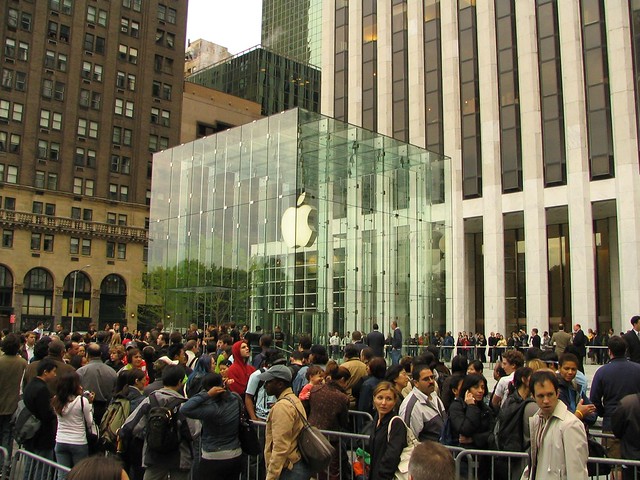
The grand opening for the Fifth Ave. Apple Store drew long lines in 2006. (Photo by flickr user workinpana)
As both transit ridership and great historical buildings grow in the public eye, at Grand Central Terminal, the times they are a-changing’. Once a threatened building that nearly underwent the same fate as our dearly departed Beaux-Arts original at Penn Station, Grand Central was saved from the wrecking ball after a prolonged fight by Jackie Kennedy Onassis. By the early 1990s though, the station was in sorry shape as commuters just tried to get out of it. After 20 years, it has been restored to grandeur.
These days, Grand Central isn’t just for commuters. It’s a destination for tourists, foodies and folks looking to catch a glimpse of harried life in New York. It’s featured in everything from animated movies to annoying TV commercials, and it is the place to be. With the East Side Access project with a half a decade from completion, the area will only grow more crowded and more traveled as time goes by.
Nothing quite shows just how hot Grand Central is than the rumors we heard earlier this year of an Grand Central-bound Apple Store. The rumors started in February, dissipated in March and came roaring back in May. Today, they are here to stay as the MTA may vote on an Apple Store for the Metrazur space as soon as next week.
With the Apple Store on tap, The Timesreflected on the changes at Grand Central. The story is one we’ve heard all throughout the city. As the building has become a more popular destination for shopping and eating, old tenants have been pushed out in favor of bigger names with more money. Magnolia Bakery, with its world renowned cupcakes, replaced the Little Pie Company, for instances, and more changes are afoot as the MTA continues to upscale Grand Central. Christine Haughney reports:
More than a decade after the restoration of its public areas, including its shops and restaurants, Grand Central has realized its goal of becoming a retail destination, appealing to a wider audience than the train and subway riders rushing between platform and street.
This month, Grand Central’s landlord, the Metropolitan Transportation Authority, notified 300 applicants that most of them had been rejected for the 74 available slots at its December holiday fair. By late fall, the terminal expects to have a dozen new shops and restaurants, including Beer Table, which has a restaurant in Brooklyn; bread and vegetable stands run by Eli’s; and an outpost of the popular downtown store Kidding Around Toys.
When Apple proposed opening a store on the balcony overlooking the main hall, it submitted its bid in linen-lined boxes, as if it were a wedding present to transit officials, a source familiar with the application process said. The board is expected to approve the deal as early as next week, at its monthly board meeting.
But changes popular with shoppers and the transportation authority, which handles the real estate for the station’s operator, Metro-North Railroad, have angered some of the shop owners who helped drive the transformation. While shop owners appreciate the traffic and improved surroundings of the new Grand Central, they say the authority can be a very demanding landlord that displays little loyalty once leases expire.
The stories are the same citywide. Some business owners willing to gamble are getting priced out after years of loyalty, and they aren’t happy. “Twelve years ago, I didn’t want to come there; there was nothing there,” Sushil Malhotra, a restauranteur who owns Cafe Spice, said. “But now, because I’m successful there, anybody can outbid me.”
Ultimately, though, the successes of the Apple Store are a true testament to the power of preservation. The MTA turned a rundown relic into a shining example of a modern train station. In the fall, I’ll be working two blocks away from the terminal, and I couldn’t be happier about it. It’s a modern attraction that’s getting better. It’s too bad we can’t say the same about the rest of the transit system quite yet.
As we try to figure out where in Grand Central the rumored Apple Store may land, today’s Post sheds some light on the topic. According to Garrett Sloane, the computer giant is targeting the Terminal’s main hall and will take over the balcony area currently inhabited by Charlie Palmer’s Metrazur restaurant. Reportedly, Metrazur’s backers are “scouting new locations,” and the MTA could open some closed balcony space to make room for the vast store. On the record, Metrazur called this a “rumor” while Apple and the MTA declined to comment on the speculation.