Tag: Long Island Bus

  • NICE BUS, $7.3 million in the red, already threatening service cuts

    When Veolia took over operations of Long Island Bus from the MTA, the company never made explicit promises to maintain service levels or the fare structure. Now, just a few months into their tenure, the company has announced proposed service cuts totaling $7.2 million set for April. “A budget shortfall makes service changes necessary, although the changes are significantly less than those proposed by the MTA last year, involve no route cancellations, and are designed to impact the fewest possible passengers,” the company said in a statement.

    Clearly, Veolia is a bit touchy about these service cuts. In the statement, they claim that they have realized $35 million in operating efficiencies and that the cuts are only a portion of the $26 million in eliminations proposed by the MTA. Of course, that MTA proposal was designed as a ploy to call Nassau County Executive Ed Mangano’s bluff. The MTA simply wanted Nassau County to be upholding its end of the funding agreement.

    So how is Veolia planning on these “reductions and reconfigurations”? They offered up this take: “Our proposed system re-design is the result of a very careful analysis of how riders use the system. We rode every route and every stop, seven days a week, recording actual passenger usage and travel patterns. After a rigorous analysis, we focused on making the smartest changes that would impact the fewest passengers. Naturally, we focused on the routes that are least used by customers and are thus the most expensive to operate.”

    Essentially, then, Veolia is doing what the MTA threatened to do. Since Mangano cut county contributions to the bus system from $9 to $2.5 million, NICE BUS is essentially placing that funding cut on the backs of its riders. Perhaps the are operating at greater efficiencies than the MTA. Perhaps the MTA was bluffing about a $26 million cut to force Mangano’s hand. Either way, Long Islanders are no better off now as their county leadership continues to withdraw funding for transit.

  • From LI Bus, a case study in the purpose of transit

    Here’s an interesting question for you: Should public transit systems and the public authorities that run them be trying to turn a profit? In other words, at what point should authority heads such as Jay Walder cease running a transportation network as a public good and start running it as a business?

    The answer to this question isn’t an easy one in an age of austerity. By and large, public transportation networks are inherently not operated as a business as the service level. In New York, for instance, the MTA runs mostly empty trains at 3 a.m. and allows buses to run routes with a cost-per-passenger high enough to make any private CFO cry. That’s how New York City exists as a huge economic hub and tourist destination today, and that’s how mass transit is operated as a public good.

    On the other hand, though, are a few competing demands. First, the MTA must operate these services efficiently through a streamlined bureaucracy and a procurement process that isn’t beset with red tape. Second, it cannot become an organization beholden to pension costs and lifetime benefits. Third, it will require public subsidies from a government whose constituents depend on public transit for their daily lives, and politicians will have to recognize that the MTA or a similarly situated organization may not operate as efficiently as a corporation that answers to stock-holders. The demands are different, and the expected benefits are different.

    Recently, a few good minds in the transit realm have been debating the way transit authorities operate. David Levinson has called for financially sustainable mass transit systems while Jarrett Walker has called upon those funding transit systems to better outline their goals. The competing demands of ridership vs. coverage are at odds with financially self-sustaining transit systems. I’ve simplified their arguments, and it’s worth reading their pieces at length because we’re seeing this debate play itself out in real life on Long Island.

    The Long Island Bus saga has been a debacle. In its original agreement with Nassau County, the MTA agreed to operate the service as long as the county paid for it. Over the years, the county’s contributions had decreased while the MTA’s had increased, and the authority threatened to pull out of Nassau if County Executive Edward Mangano didn’t agree to upping the county’s contributions from $9 million to $26 million. Mangano called the MTA’s bluff and decided he could run the bus system for less by farming it out to a private company. He claimed no service cuts or fare hikes would follow.

    From the start, the privatization process has been a mess. The county used a non-transparent process to pick Veolia, a company with close ties to Mangano’s campaign, and they failed to meet a July deadline for an agreement. The MTA will operate the buses until December 31, and at that point, Nassau County will reduce its contributions to just $2.5 million — $6 million less than the cost of fuel alone. Veolia will then be expected to cover the difference. Without subsidies, no one, including the company’s CEO, knows how.

    Earlier this week, Michael Setzer spoke about how the company would save the millions it stands to lose from the MTA and state when it takes over the LI Bus network. “You can’t save $35 million by turning off the lights,” Setzer said. In other words, there’s virtually no way Veolia can operate the bus system with its current route structure and fare system while breaking even or turning a profit.

    On their website, if you read closely enough, Veolia has said as much. They are threatening “adjustments” of bus timetables that will reduce frequency, and while they say there is no plan in place to raise fares next year, they also say that “it’s possible that modest service redesigns and fare increases will be recommended.” You can’t just save $35 million by turning off the lights.

    Veolia is a private company long used to operate bus systems with large public subsidies. If they can’t turn a profit in Nassau County with a meager subsidy and the current route plan or fare structure, something will have to go. Relatively empty buses that provide a transit lifeline for people who can’t afford anything else will be cut, and fares will go up. A public good won’t be so public any longer.

    As this grand experiment rushes toward a launch, we’ll watch Nassau County closely. It could be a model for how transit agencies can operate, but it sounds as though it’s going to be an example in government failure and the decline of a once-proud bus system. Perhaps Nassau County will come to its senses and recognize the purpose of its bus system before it’s too late, but I’m not counting on it.
  • Veolia chosen for LI Bus contract

    Veolia Transportation will take control of operations for Long Island Bus beginning in 2012, Nassau County Executive Edward Mangano announced today. The Illinois-based subsidiary of a French company bested MV Transit and First Transit in the bidding, and they have promised to “keep existing fares and levels of service through the end of 2012,” Newsday reports. After 2012, it’s anyone’s guess what Nassau County’s bus service and fare structure will look like.

    The decision, of course, is not without controversy. While transit advocates and local politicians do not believe that Veolia will be able to maintain service levels and fares, the company apparently has close ties to Nassau County’s politicians. As Newsday notes, “Veolia hired D’Amato’s firm, Park Strategies, as consultant during the county bidding process. Park Strategies vice president Robert McBride, a well-known GOP lobbyist who hosted a fundraiser for Mangano in McBride ‘s home in January, headed the effort locally.”

    Meanwhile, Veolia does not have a stellar safety record, and Nassau Country representatives do not believe that the company can provide the same service as the MTA without a greater subsidy from the county or higher fares. “This is going to end up costing us so much more money,” County Legislator Kevan Abrahams said. “One way or the other, we’re going to have to put money into this. And I hate to think that it’s going to come from the riders.” What a mess.

  • LI Bus fate to be determined tomorrow

    As the MTA has already voted to withdraw funding from Long Island Bus by the end of the year, Nassau County Executive Ed Mangano is moving forward with a plan no one thinks will succeed. According to Newsday, Mangano will unveil the private company picked to operate the popular Nassau County bus service. The winning bidder will be Veolia Transportation, MV Transit or First Transit and will have to be approved by the county legislature before it can begin to operate the buses next year.

    The MTA and Mangano have been at odds over Long Island Bus funding for a while. Despite funding agreements fund the transit network, Nassau County contributes just $9.1 million to the bus system’s operations, and the MTA has asked for upwards of $26 million more. Mangano has refused to do so and has insisted that a private company acting without increased subsidies and turning a profit will be able to offer the same service for the same fares.

    Transit advocates are rightly skeptical, but the county executive is moving forward with the plan anyway. “Financially, it doesn’t make sense,” Kate Slevin of the Tri-State Transportation Campaign said. “They’ll have to contribute a lot more money if they want it to function even remotely like it does now.” For more on this long-simmering dispute, check out my archives. I don’t think Nassau Country commuters are going to think too highly of the entity that emerges from this move.

  • MTA Board votes to terminate LI Bus contract

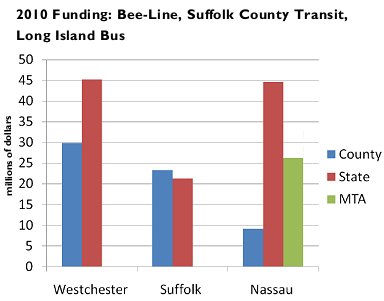
    Nassau County has not invested in its own bus system. (Graph via TSTC)

    Following months of political maneuvering between Nassau County Executive Edward Mangano and the MTA over Nassau County bus service, which included a last-minute reprieve earlier this month, the authority’s board has voted to terminate its agreement with the county at the end of the year. Barring any unforeseen circumstances, the MTA will, after 40 years, cease operating the county’s bus service following a bitter dispute over payments.

    Board members, according to numerous reports over the past few months, are incensed at the county — one of the richest in the state — for its failure to fund transit, and those who spoke with reporters did not mince their words. “To take care of the riders of Nassau County, the MTA has provided $140 million, which has not been provided to the riders of Suffolk County, Westchester County, Dutchess County, Rockland County, Orange County, Putnam County and the City of New York for the bus systems that we took over,” Mitchell Pally, an MTA board member and Suffolk County resident said. “I think it’s clear to say that the only people who have been protecting the riders for the last 10 years in Nassau County is this board, not Nassau County.”

    This vote comes after months of public wrangling between Mangano and the MTA, and it has not been a good experience for Long Island Bus riders. When the MTA first asked Nassau County to contribute to bus service, Mangano essentially called for Jay Walder’s resignation. The county, it seems, wanted its bus service without paying for it. After the MTA voted to terminate service this month, state representatives pushed through a plan in Albany to siphon some state capital funds to cover operating costs for the remainder of the year. Now the deal will be dead come December 31.

    Mangano, of course, tried his typical appeal to the “bloated bureaucracy.” It might ring true with partisan voters, but it’s an empty threat considering the state of Long Island Bus funding. “It’s a sad day in America when a government agency such as the MTA chooses to maintain its bloated bureaucracy over the services it is charged to provide its residents,” he said. “Because the MTA has failed taxpayers time and time again, Nassau County will move forward with a public-private partnership that maintains bus service without demanding an additional $26 million from taxpayers. The MTA’s monopoly over transportation in Nassau County ends now.”

    Of course, one might argue that it is a sad day in America with government officials want other county’s taxpayers to foot the bill for $26 million worth of bus service for someone else’s residents. One could say it is a sad day when zeroing out Nassau County’s financial reserves on the backs of bus riders becomes a political game. Nassau County, remember, contributed just $9.1 million toward the $140 million it costs to operate the county’s bus system, and the remainder has to come out of someone else’s pocket.

    With the vote today, the MTA is being more than generous with Nassau County. The contract requires just 60 days’ notice of termination, but the board is giving the county an extra eight months to finalize privatization plans. Nassau County has been working toward a private solution since early fall, but no concrete proposals have materialized. County officials still maintain they can find a carrier to provide the same comprehensive bus service at lower costs than the MTA does, but my gut feeling is that the private solution will lead to numerous cuts of unprofitable routes or more pressure on Nassau County to pony up for transit service.

    While I hate to draw too many sweeping conclusions from this saga, it’s hard not to see Nassau County’s maneuverings as indicative of transit policy throughout New York. Politicians want more and better service on the one hand, and they want to contribute fewer and fewer dollars to the operating costs on the other. The people who end up suffering the most are the riders who can least afford it.

  • Mangano eyeing LI Bus privatization

    Now that the MTA has announced plans to cut 25 Long Island Bus routes, Nassau County Executive Ed Mangano is again promoting the idea of privatization to save the service. Mangano, who tried to find companies interested in the fall, claims the MTA is not running the service effectively and that privatization will cure those ills. “The MTA just wants more and more money. Now they want more money and they’re giving us half the service,” he said to Newsday.

    As transit advocates and LI Bus workers were quick to point out, though, Mangano’s thinking is simply wrong. If the MTA can’t operate little-used bus routes at a break-even rate, a private company looking to turn a profit certainly won’t be able to offer the same service levels. Ryan Lynch from the Tri-State Transportation Campaign noted that Suffolk County’s system is a smaller one operated privately that requires three times the subsidies Nassau County has forked over to the MTA lately. “The county would be better served, and bus riders would be better served, if Nassau partnered with the MTA,” he said.

    Mangano, who foolishly called for Jay Walder’s resignation over this issue in September, took heat from the MTA and LI Bus drivers as well. The MTA, which has cut LI Bus administrative costs by 30 percent, claims Mangano is just playing politics. “Mr. Mangano is more interested in shifting blame than in providing the service Nassau bus riders need and deserve,” spokesman Kevin Ortiz said.

    Cindy Tropeano, a driver who heads Committee to Save Long Island Bus, expressed her skepticism as well. “It would be worse, if not the same,” Tropeano said of privatization. “We’re hoping that they wise up and that somebody put some money into it so that all of this can go away.”

    The MTA is hosting a hearing on the cuts in March, and the board will vote in April. Will Nassau County leave 16,000 of its residents out to dry or can a deal be reached? Stay tuned.

  • MTA planning steep cuts to Long Island Bus

    Nassau County has not invested in its own bus system. (Graph via TSTC)

    The game of chicken between the cash-strapped MTA and Nassau County Executive Ed Mangano is about to leave approximately 16,000 residents of Nassau County without bus service. As Newsday reported this morning, the authority has failed to reach a funding agreement with the delinquent county and will cut 25 of Long Island Bus’ 48 routes.

    According to Alfonso Castillo’s report, Bethpage, Elmont and Lindenhurst will be left without bus service and two other lines will enjoy weekday-only buses. “I can’t tell you that people will not be hurt by this. People will be hurt by this,” MTA CEO and Chair Jay Walder said to Newsday. “We can only provide the services that are being funded.”

    Castillo has more on the long-standing conflict between Mangano and the MTA:

    Walder said the bare-bones bus services are all the MTA can afford to run, given that Nassau County contributes only $9.1 million to the bus system’s $141-million annual budget. By comparison, Suffolk pays about $24 million toward its bus system’s $48.6 million budget.

    MTA officials say the service cuts will save $12.2 million a year, including salaries of more than 200 LI Bus employees who will be laid off. Walder said the cuts target lines with the fewest passengers. Service for about 85 percent of riders will be kept. Because Nassau ‘s paratransit bus service – Able-Ride – mirrors fixed bus routes, about 18 percent of disabled bus riders also face losing their transportation.

    Walder said the decision follows several failed attempts for more than a year to convince County Executive Edward Mangano that Nassau must give LI Bus the same support other counties give their bus services. “The reality is in this case the county has a mismatch. It has put in the funding for one level of service, but it expects a level of service that is much larger than that,” Walder said.

    Once upon a time, Nassau County vowed to cover the difference between fare revenue and operating costs for the LI Bus routes, but lately, the suburban county has scaled back its contributions. Mangano’s office claims it cannot find the $24 million necessary to support bus service, and it continues to look toward private operators as a potential way out of this problem. As of early November, three companies had submitted bids.

    Meanwhile, the MTA is defending this action and has highlighted how the county has failed to compromise. The agency has cut administrative costs by 33 percent and has been attempted to eke every last dollar out of the Long Island Bus holdings. “At the end of the day, even at the lowest possible costs, it’s costing more than the county is providing,” Walder said.

    The people who stand to lose the most also spoke out against the cuts. As one Nassau County resident spoke of her decision to move to Forest Hills for the sake of her commute, another expressed his dismay. “I think it’s the most ridiculous thing people have ever thought of,” a Levittown bus rider said. “This is like crippling you from getting to work.”

    The MTA will hold a hearing on the cuts on March 23. It’s still not too late for legislative action, but timing is slowly running short as the MTA plans to vote on the cuts in April. “It’s devastating,” Kate Slevin of the Tri-State Transprotation Campaign said. “These are people who are struggling as it is – a lot of the working poor, lots of students, lots of senior citizens who can no longer drive.”

  • Three private companies bid for LI Bus as future hazy

    Nassau County has not invested in its own bus system. (Graph via TSTC)

    The MTA’s showdown with Nassau County has continued into the fall as neither party has given up ground in the fight over Long Island Bus. The MTA is being forced to pick up millions in costs for Nassau County’s bus system while the county will throw in only $9.1 million. The MTA has, rightly so, threatened to pull the plug on this service without more operating subsidies.

    Ideally, as the Nassau County legislature recently discussed, the county would slowly up its contributions to the bus route while the MTA would continue to operate the transit system. The MTA would be receptive to this plan, but the Nassau County Executive has engaged in a classic misdirection. He’s called for Jay Walder’s resignation instead of taking responsibility for his county’s bus route.

    The solution from Nassau County’s side has been privatization, and as Newsday reported yesterday, three companies have submitted bids for an LI Bus takeover. MV Transit from Fairfield, California, First Transit from Cincinnati and Veolia Transportation from Lombard, Illinois, have all submitted bids. The county is amidst reviewing bids, but it seems to want a deal that will, as Mobilizing the Region notes, allow it to capture fare revenue without contributing any direct subsidies.

    Unfortunately for Nassau County, even in areas of the country where these private operators run bus routes, they do so with heavy subsidies. Veolia, for instance, receives $36 million in subsides from Tuscan, Arizona, where ridership is half that of Nassau County’s Long Island Bus. Nassau County wants to have its cake and eat it too.

    The MTA and Nassau County will continue to work toward a solution, and the authority has to give the county 60 days’ notice before withdrawing service. Still, Nassau County is playing chicken with a service that its residents can ill afford to lose. It is a dangerous game indeed. “I can’t get around Long Island without the bus,” one 40-year rider said. “There are a million of us who can’t.”