Tag: Select Bus Service

  • SBS Woes: A summons for a broken machine

    As New York city and the MTA continue the painfully slow rollout of Select Bus Service offerings and pre-boarding fare payment systems, recurring problems are popping up. New York 1’s Tina Redwine yesterday produced a story on SBS riders getting summonses through no faults of their own. It’s a familiar tale: A rider holding a 30-day MetroCard finds that both SBS ticket machines are broken, boards the bus and receives a summons. “I am upset, because as a paying MTA customer, I should not be subjected to a $100 summons when I have proof I didn’t steal services that I’m being accused of stealing,” Aaron Goldberg, one of the riders highlighted, said.

    The MTA isn’t too sympathetic to these plights. While authority officials said the summonses would likely be dropped and admitted that the machines were out of order, the folks who were ticketed on the Upper East Side still have to appear before the Transit Adjudication Board in Brooklyn. But that strikes me as an unfair result. The MTA’s proof-of-payment system is an antiquated one that relies on paper confirmation. If the authority isn’t going to stock the paper machines in a timely fashion so that people can board without risking a summons, something has to give. Goldberg and others are getting ticketing for being victims of the MTA’s own shortcomings.

  • On SBS successes and meddling community boards

    Now that the MTA and DOT have been offering Select Bus Service for nearly nine months, the agencies have a better picture of how it’s shaping up, and the early returns have been quite positive. This week, DOT presented its findings on SBS to Community Board 3, and DNA Info was there. According to DOT, trips have increased along the M15 by 30 percent since Select Bus Service debuted, and travel times by 15-18 percent.

    Meanwhile, enforcement remains a key concern for the city. Enforcement officials had issued nearly 4700 fare-evasion summonses to riders through April, and lane enforcement cameras had resulted in 5800 ticketed drivers who were parked in the bus-only lanes. People too are safer as injury-causing crashes have dropped by 14 percent on both avenues between 34th and Houston Sts.

    Yet, CB3 didn’t seem satisfied, and here we see the dangers of community boards in the transportation planning process. Community Board members say that gaps between local and express stops and the frequency of Select Bus Service stops “make it difficult for riders to choose between the two buses.” Their solution? More Select Bus Service stops. CB3 wants to see “regular and SBS bus stops be placed closer together or combined at locations to provide riders with more options,” and one rider asked for a stop at Allen and Delancey Sts.

    If Community Boards had their ways, Select Bus Service stops would be just as frequent as local service, and that’s the problem. SBS works because the stops are far apart, and that sometimes means skipping busy locations. Already, there’s a stop at Houston and Allen and Grand and Allen. That’s only a distance of 0.4 miles. Adding yet another stop in there — two blocks away from Grand St. — is entirely unnecessary.

    I’m happy to see Community Board consulted in the planning process. Neighbors should have a say on changes that will impact their lives. But at a certain point, the experts have to be allowed to run the service. Local and express stations aren’t closer together so that SBS buses aren’t stuck behind local routes. Station distances on the SBS route are far apart to allow buses to build up speed. That’s what makes the system work, and it shouldn’t be changed.

  • BRT Battlegrounds: Hylan Boulevard

    From the MTA press office:

    MTA New York City Transit and the New York City Department of Transportation invite the public to discuss transit service, traffic conditions and pedestrian safety on Staten Island’s Hylan Boulevard during an Open House that will be held on Wednesday, June 8, at The Renaissance Conference Center in the Grant City section of Staten Island beginning at 7 p.m.

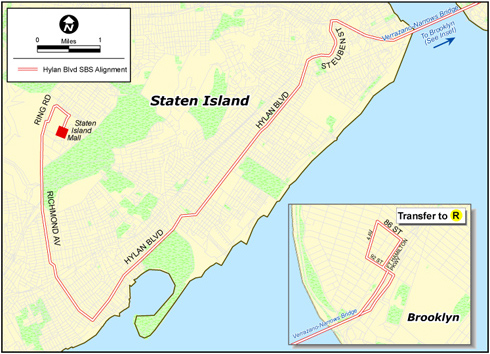
    The study will examine ways to improve safety, traffic flow and ease congestion along this major thoroughfare. The scope of the study will extend from the Staten Island Mall on Richmond Avenue to the 86th Street (R) subway station in Bay Ridge, Brooklyn. It carries several express bus routes and is served by the S78 and S79 with a combined average weekday bus ridership of more than 30,000.

    The MTA and NYC DOT have already started to work on bringing Select Bus Service to Hylan Boulevard following its successful introduction in the Bronx (Bx12) and Manhattan (M15). In addition to concepts for Select Bus Service, the Hylan Boulevard Transportation study team will develop two or three different proposals for transportation improvements to be evaluated and discussed with the community.

    The public is invited to learn more about the objectives of the study, examine display boards, and offer comments regarding transit, traffic and curb use on Hylan Boulevard with project team members. The event begins with a formal presentation at 7:15 p.m. but the general public may stop by any time between 7 p.m. and 8:30 p.m. at the Regency Room of The Renaissance at 2131 Hylan Boulevard (at Bedford Avenue) in Staten Island.

    For more on the Hylan Boulevard proposal, check out NYC DOT’s project page.

    So why does Hylan Boulevard matter? Well, lately, the MTA and DOT’s joint Select Bus Service efforts have not been met with arms wide open. The plan to turn 34th Street into a Transitway that would have benefited commuters, pedestrians and businesses alike was shot down by a small but stridently vocal group of NIMBYs. Hylan Boulevard, though, is the perfect place for a bus lane.

    Staten Island is a tricky area for transit improvements. Because it has so long been disconnected from the subway map and enjoys some express bus service, it is by far the most car-dependent area of the city, and its residents are skeptical of anything that takes road space away from autos. Yet, this SBS proposal — which connects to the R train in Bay Ridge but should continue deeper into Brooklyn if not Manhattan — could be the first step in speeding up bus service and improving transit in and out of Staten Island.

    I won’t be able to make the meeting tomorrow, but hopefully, Staten Islanders will take this chance to voice their support for better bus service and more transit options in an underserved borough.

  • Recommended Reading: What future NYC BRT?

    This great idea remains alive only on paper. (Image via NYC DOT)

    In the wake of the death of the 34th St. Transitway, transit advocates have been down on the state of citywide bus improvements. Everyone in New York admits that buses are too slow, but an ambitious plan to bring physically separated bus lanes with dedicated rights-of-way to Midtown has been replaced by another half-hearted proposal to paint some stripes on the street and call it a bus lane.

    With the demise of the Transitway, none of the Mayor’s plans to slowly bring bus improvements to the five boroughs will include a “best practices” approach to BRT. While pre-boarding fare payment plans will speed up bus dwell times, the vehicles won’t enjoy the benefits of a dedicate ROW. To improve bus service then will require stringent bus lane enforcement efforts and true signal prioritization efforts.

    Over at Streetsblog, Noah Kazis took a few minutes to wonder about the future of BRT. He writes, in part:

    It seems likely that without physical separation on 34th Street, there won’t be physical separation on any bus lanes implemented before the end of the Bloomberg Administration. The remaining routes in the city’s first phase of BRT rollout — on the Nostrand Avenue corridor in Brooklyn and Hylan Boulevard in Staten Island — are scheduled to debut in the next two years and do not include physically separated lanes…

    “A number of the environmental and transportation groups are starting to recognize that the next administration after Bloomberg is going to have to answer to us on where they stand on these issues that have been wildly popular for New Yorkers,” said Kate Slevin of the Tri-State Transportation Campaign.

    Though a new physically separated busway is unlikely to be constructed in the next three years, said Joan Byron of the Pratt Center for Community Development, “Planning can happen and dialogue with stakeholders can happen that make it a lot more likely that the next phase is gets built and has those features.” Byron said she hopes that the BRT team at DOT can assemble a coalition along its next routes that can politically lock in full-featured bus improvements. “There are workers and residents and employers in the outer boroughs who would love to have this problem of a Select Bus route running by their door,” she said.

    To get dedicated busways, the city will have to change its outreach approach. It’s going to have engage folks like Joan Byron of the Pratt Center and work with Community Boards to explain why dedicated lanes are necessary. It’s not enough to propose these improvements by fiat, but rather, DOT must educate New Yorkers who aren’t familiar with the rationale behind transitway improvements.

    For now, the 34th St. changes are a set-back, but their ramifications echo into the future. It’s not too late to bring dedicated bus lanes to the city, but it will require stronger and more inclusive leadership than what we have seen so far. To improve the buses, we’ll need it.

  • Lappin: M15 Select Bus Service garners a B-

    Over the last few years, the MTA and New York City Department of Transportation have worked to make our city streets more bus-friendly. Left twisting in the winds of surface traffic, the current fleet is known more for the shleppiness of rides and for cross-Manhattan trips, being slower than walking. Select Bus Service — the city’s cross between bus rapid transit and glorified express service — has been designed to combat that stigma, and just five months after its first Manhattan implementation along 1st and 2nd Aves., Select Bus Service garnering both praise and criticism from the city’s politicians.

    From the get-go, forces lined up against Select Bus Service in Manhattan. Due to the demands of drivers as well as construction work around the Second Ave. Subway area, DOT opted against the gold standard of bus rapid transit: There are no physically separated lanes. Instead, the city can enforce bus lanes through camera-based ticketing systems, and for parts of the route, buses do not even enjoy those bus-only lanes. Meanwhile, pre-board fare payment has come to the city as well, but as machines are often out of paper and enforcement has been cumbersome, paying before boarding hasn’t delivered the promised panacea of speedy buses. Things are faster, but they’re not yet fast.

    Yesterday, City Council member Jessica Lappin, who represent’s Manhattan’s 5th District, unveiled a Select Bus Service report card, and she gave the new, speedier a B- after just four months of service. Lappin has been one of the more vocal proponents of faster bus service, but she also must balance that support with a community loath to surrender any parking spaces or curbside vehicle access. It shows in her assessment.

    Lappin, who said there was “no excuse” for the service to receive anything less than an A, thankfully hasn’t given up hope after four months. “I am proud to have worked with activists and other elected officials to bring this service to the East Side and I still believe it can be a great thing for our community. but we aren’t there yet,” she said on Monday. “In some ways, the new service is working well, but other areas still need improvement.”

    So what’s working well? Lappin, who solicited reactions from her constituents that ran the full gamut of “miserable” to “disgraceful” to “appalling,” highlighted speed as the main benefit. The buses have improved travel times by nearly 20 percent, and for that, everyone along 1st and 2nd Aves. is thrilled.

    But Lappin dwelled on the negative as politicians are wont to do. The buses, she claims, are not accessible enough and earned a meager C- here. By her count, 56 percent of seats are not accessible for the elderly or handicapped because they are up a set of steps on the bus, and stations that are half a mile apart are not easily reached by those who cannot walk. To me, this is a strange thing to nitpick. Nearly all new buses have sections that aren’t accessible, and the SBS vehicles have low floors for easier boarding. As the MTA said, these buses are no less accessible than any others, and those who find the station spacing too great can still take local M15s.

    The Council member also highlighted problems with fare collection. As I’ve detailed before, passengers left without proof-of-payment receipts have been ticketed aggressively and, shockingly, do not find the fine a welcome one. Some have complained that the MetroCard readers run out of paper, and although the MTA claims those machines are empty only 2-5 percent of the time, Lappin found that 10 percent of machines in her district were out of service. Thus, she gave this component a C. Meanwhile, enforcement efforts, which earned a B, cause buses to idle while cops check tickets, and thus, it slows down the service.

    I’m honestly having a tough time wrapping my head around the East Side assessment of the Select Bus Service simply because Lappin readily admits that its significantly faster than the M15 local service. The point of SBS isn’t to stop every two blocks; it’s to offer speedier trips for those in a position to take advantage of it. Right now, politicians should be focusing on securing dedicated lanes, signal priority for buses and better bus lane enforcement. That is how a city can build a better bus service.
  • Four months in, SBS service earns its praise

    When Select Bus Service debuted along 1st and 2nd Avenues in early October, it had a rocky beginning especially in the press. East Siders couldn’t come to terms with the changes to their painfully slow local bus routes, and the media found faults with the new service from Day One.

    Now that the East Side SBS has been on the road for four months, both East Siders and the city’s transit reporters are coming around to the new service. I’ve received numerous emails from riders who love the increased speeds and want to see this service elsewhere around the city, and in today’s Daily News, Pete Donohue praises the service. Although he references the “bumpy start,” which might be more a creation of the media than a reality on the ground, he notes that bus travel times have improved by 12-16 minutes or nearly 20 percent. Only Second Ave. Subway construction work (and the lack of truly dedicated lanes) is an impediment to even faster travel.

    The MTA and NYC Department of Transportation offered up some statistics. Northbound travel from South Ferry to 126th st. now takes 62 minutes instead of 75 while southbound trips during rush hour can last 76 minutes instead of 88. The NYPD, meanwhile, has handed out 15,200 summonses to bus-lane violators, and 156 cars have been towed. When signal prioritization goes online this year, the trips should be even smoother. “The success of these first corridors in reducing travel times shows the enormous potential that exists if we can put ideas into play across the city,” Transit head Thomas Prendergast said.

  • Ironing out the SBS wrinkles

    In amNew York today, Theresa Juva speaks to some East Side bus riders who are frustrated with the Select Bus Service glitches. Riders at popular stops have found that the machines run out of paper too frequently, and the MTA’s technicians aren’t notified until the paper is out. Furthermore, the machines have been installed too close to the curb and facing the street, thus creating a safety hazard for those purchasing a trip. I’ve also received emails from riders who have found their cards demagnetized by the SBS fare dispensers. It is, in other words, a work in progress.

    For its part, Transit officials say they’re troubleshooting the machines. The authority is working to upgrade software to clear paper jams and alert technicians as the paper for the receipts dwindles down. “A lot of times with new equipment you have to do improvements,” spokesman Charles Seaton said. Of course, this could all be avoided if SBS didn’t require something as clunky and 1900s as a paper receipt, but I digress. Ultimately, though, it’s worth remember that the East Side Select Bus Service is still a relatively new service that’s working as a high-volume model for the MTA’s and DOT’s future Select Bus Service plans. If the machines don’t work now, the authority can better plan for future SBS iterations. Some aspects of the improved bus service work better than other, but as the guinea pigs along 1st and 2nd Ave. have found, you can’t beat faster bus service.

  • The wrong way to enforce SBS proof-of-payment

    Over the weekend, I wrote a not-so-sympathetic post on a woman who jumped the fare and bemoaned getting caught. I compared her actions to jumping the turnstile in the subway, and I don’t feel bad for her plight. This story, on the other hand, irks me.

    To set the stage: Yvette Stokes uses her 30-day MetroCard to procure a Select Bus Service receipt at 106th St. and 2nd Ave. Upon boarding, enforcement agents ask her for her proof of payment, and she obliges. Then, 72 blocks and 15-20 minutes later, another group of officers board the bus and again ask riders to procure the POP receipts. Ms. Stokes rummages around in her bag and pulls out a two-day-old receipt instead. “The officer was very agitated with this and started shouting at me,” she told The Post. “The very next thing he said was that I couldn’t hold up the bus — and then he ordered me off the bus.”

    After exiting the bus, Stokes shows the officer the proper receipt, but he writes her up a $100 ticket anyway, ignoring her proffered receipt. The summons has since been dismissed, and the MTA claims the officer did nothing wrong. Yet, this response is unnecessarily hostile. By checking POP receipts multiple times one one bus route, police are making normal bus riders seem like criminals, and the office in this instance showed an utter lack of common sense. If the point of SBS is to convince riders to take the bus over subway-like distances, Transit and its agents must toe the fine line between proper enforcement and overbearing ticketing.

  • Fare-jumper bemoans getting caught

    Try this one for size: Upper East Side marketing director is late for a meeting. She sees a Select Bus pull up to her stop at E. 79th St. and Second Ave., and without paying, she hops on the bus. The driver tells her she will need proof-of-payment, but she can’t get off because the doors are closed. The driver, Daryn Mayer claims, allegedly says, “OK. Don’t pay. Ride for free.” He later denies saying that.

    At the next stop, enforcement officers board while Mayer does not get out to pay. She can’t produce the receipt and gets slapped with a $100 ticket. She’s challenging the fine, but the MTA has little sympathy for her. “When asked by the inspector, the bus operator denied he had let her on the bus, and said he explicitly told her she needed to pay her fare. At that point, she was removed from the bus and received a summons,” authority spokesman Kevin Ortiz said. She also, Ortiz said, “became combative, responding with an expletive.”

    The story in The Post, linked above, seems designed to elicit sympathy in Mayer, but I can’t find much in her story. Boarding a Select Bus without pre-paying is akin to hopping the turnstile. You aren’t excused from paying the fare because the train might leave, and the same applies to the bus. Select Bus Service has been up and running since early October now, and ignorance of the law is no defense.

  • Building a better bus system: The need for lane enforcement

    Yesterday marked a big day for the MTA’s and City’s joints efforts aimed at improving the bus lane for bus-lane camera enforcement went live. Today, two articles highlight the various approaches and attitudes to lane enforcement techniques.

    At Transportation Nation, Alex Goldmark reports on the NYPD’s recent ticketing blitz. As of Nov. 17, police officers have written 13,833 summonses to those blocking bus lanes — and that, Goldmark notes, is without the aid of cameras. In essence, officers have written 350 tickets per day since the 1st and 2nd Ave. Select Bus Service lanes went live and have generated $1.6 million in revenue. I’m happy to see such institutional support for a key transportation initiative, but I wonder why a similar ticketing blitz wasn’t as publicized along Fordham Road as it has been along the East Side.

    The second article worthy of attention comes from C.J. Hughes of The Times, and it focuses on drivers annoyed by the bus-only lanes. For years, the city has had “bus lane” stenciled on its avenues, and for years, few have bothered to obey the law. The money quote comes from a limo driver from Staten Island who said, “This is crazy. Bloomberg needs to go to a psychologist. He closed the whole city.”

    Officials have promised that drivers will be allowed to unload but stopping for errands will not be tolerated. “It’s important that people understand that these are rules and they need to be followed, but they will not be enforced in an arbitrary way,” East Side Assembly representative Brian Kavanagh said.