The Second Ave. Sagas’ podcast “The Next Stop Is…” returns this week with a short episode for your listening enjoyment. Eric Brasure and I discuss New Jersey Transit’s post-Sandy woes, the increase in PATH fares that slipped under the radar and BusTime’s Manhattan debut.
This week’s recording runs a shade over 20 minutes, just short enough for your subway commute, and I’m posting it now to give you a chance to grab the link for your morning ride if you check the site early enough. You can grab the podcast right here on iTunes or pull the raw MP3 file. If you enjoy what you hear, subscribe to updates on iTunes as well.
We’ll be back with a new episode in two weeks, and we’d love to take more reader questions. So if you have a topic you’d like me to cover, leave a comment or drop me a note.
With just a few weeks to go before the rules implementing the Taxi of Tomorrow were to take effect, one of Mayor Bloomberg’s signature plans may be dead as a New York State judge ruled today that the city does not have the authority to implement such a plan. In siding with the taxi industry over the city in the battle over the Nissan NV200, Judge Shlomo Hagler summed up his view, “Simply stated, the power to contract and compel medallion owners to purchase the Nissan NV200 from Nissan for ten years does not exist in the City Charter.” Rather, Hagler opined, the City Council should set these standards.
Bloomberg, no friend of the taxi industry, had first announced the Taxi of Tomorrow competition as a way to leverage the city’s purchasing power while selecting cars that were safe and spacious. The move has come under fire in recent months though as the Nissan NV200s are not as fuel-efficient as the options available for the current fleet and aren’t handicap-accessible either. His administration will appeal, but it is unclear if our next mayor would continue the site as both Joe Lhota and Bill de Blasio have not embraced the Taxi of Tomorrow.
Meanwhile, as Ted Mann notes in The Journal, this ruling could leave the city liable to Nissan for some costs as well. As Mann writes, “The carmaker’s contract with the TLC would permit it to recoup design and production costs in the event the taxi project is cancelled by the city. Nissan estimated those costs, in a document previously filed with the court, at roughly $50 million, though some familiar with the matter have said the costs could be higher.”
A shot of the 7 line extension from June. It’s beginning to look a lot like a real subway tunnel. (Photo: Metropolitan Transportation Authority / Patrick Cashin)
As Mayor Bloomberg’s time in office nears an end, his tenure is racing against the clock for the 7 line extension. For better or worse, this project, less one key station, is his baby, and earlier this year, he vowed to push trains through the tunnel before his term ends if it means an opportunity for a ribbon-cutting. It may not be ready for revenue service until mid-June of 2014, but some sort of ceremony will take place before the end of the year just to Bloomberg can pat himself on the back for delivering the dollars.
At a certain point, the conversation surrounding the 7 line changed. I used to call it the Line To Nowhere, and while it’s sort of the line to nowhere, in a few years, it’ll be the Line That Turned Nowhere Into Somewhere. It shouldn’t surprise us because most of New York City developed on the backs of the various subway lines, but development of Manhattan’s last frontier is following the subway and at a very rapid pace.
In a big piece in this week’s Crain’s New York, Dan Geiger explores that development. The dollars are starting to roll in, and soon the buildings will start to rise. Geiger reports:
With the long-talked-about transit link almost ready, the area’s real estate interests are betting vast sums that more tenants will follow in the footsteps of the major companies that have already booked huge blocks of space, including Coach, Time Warner and L’Oréal. Indeed, as Crain’s first reported last week, Citigroup is considering relocating its global corporate headquarters from Park Avenue to Hudson Yards.
In response to those bullish signals from tenants, developers are snapping up major development sites at a prodigious pace, making the area the most active in the city this year for such deals, according to real estate experts. The 7 train’s looming arrival has only hastened that frenzy. Bob Knakal, chairman of sales brokerage Massey Knakal, said small fortunes are being created, as the activity has pushed up land prices by double or more.
“A lot of the development sites that only a short time ago were considered speculative are now tangible,” Mr. Knakal said. “You’ll see a lot more happen in the neighborhood coming up. There are at least four very significant sites that I know of that will be in play within the next month or two right smack in the Hudson Yards.”
The Related Cos., already in the process of developing the 26-acre, $15 billion Hudson Yards complex, has been the most voracious buyer of adjacent sites in a doubling down of its holdings in the area. The company has entered into a contract to acquire a parcel between West 35th and 36th streets—for $75 million or more—that will border a new “Hudson Boulevard” being constructed by the city to run between 10th and 11th avenues.
The actual arrival of the train to the area was a key moment psychologically for developers. As Geiger notes, those investing in the area believe that 70 percent of residents will use the 7 train on a daily basis, and the level of interest has increased as it’s become clear that the subway is a reality and not just a promise. Meanwhile, Related, the company with the largest stake in the area, plans to start work on the platform that will cover the Hudson Yards early next year.
“If there were no No. 7 subway, I’m not sure we would be starting the platform then,” Jay Cross, the head of the Hudson Yards project for Related, said to Crain’s. “But knowing that it is going to be there means we have to get going and that we will also have enough tenant interest for the space there.”
Is there a lesson here — besides, that is, the one Dan Doctoroff was espousing a few weeks ago when he praised the 7 line at the expense of the Second Ave. Subway? We see that subway construction can still feed development and can still dictate where people want to live, work and build in New York City. The same doesn’t happen around Select Bus Service lines, and our politicians would be wise to pay attention the Hudson Yards. There are other areas of the city that could use subway lines and the subway lines can lead to more density and a better use of scarce space.
Amidst much anticipation, Manhattan now has real-time bus tracking as the MTA unveiled BusTime for the County of New York. At around midnight this morning, BusTime — the MTA’s in-house-built, distance-based system — went live on nearly all Manhattan bus routes. The system is available on the web right here, and already, bus bunching is on display for all to see.
In announcing the new technology, a variety of MTA officials made their perfunctory statements. “MTA Bus Time is a game changer and a service that greatly enhances our customers’ experience with bus travel,” MTA Chairman and CEO Thomas F. Prendergast said. “MTA Bus Time has turned your phone into a tool that tells you when to start walking to the bus stop so you can get there right when the bus does. Meet your bus, don’t wait for it.”
Those riders who can now meet their buses — or opt to walk — instead of waiting include those who use the following routes: M1, M2, M3, M4, M5, M7, M8, M9, M10, M11, M14A, M14D, M15, M15 SBS, M20, M21, M22, M23, M31, M35, M42, M50, M57, M60, M66, M72, M79, M86, M101, M102, M103, M104, M106, and M116. The M34 and M34A were already a part of BusTime, and Brooklyn- and Queens-based routes that enter Manhattan will be added as BusTime comes to those boroughs and depots within in the next six months. The MTA estimates that 93 percent of all Manhattan bus riders can now track their routes.
To bring this borough’s iteration of BusTime online, the agency’s small in-house staff had to code in 1800 bus stops while adding GPS hardware to the buses that operate in the city. Since 2012, the MTA has installed this technology on 2852 buses. Conveniently, the MTA also provided a list of apps already accessing the BusTime API. Those include, for iOS All Aboard NYC; All Schedules Free; Bing Mobile; Bus New York City; Google Maps for Mobile; In Time Staten Island; Ride On Time NYC; Roadify; and Transit Times. For Android, Bus Tracker Pro – MTA NY and Sched NYC feature real-time bus information.
As with the previous boroughs, Manhattan’s BusTime is based on distance rather than time. Since travel times are variable and far more costly to get right, the MTA has gone with a distance-based approach that allows riders to estimate potential wait times. It’s not perfect, but any regular rider should pick up on the idiosyncrasies within a handful of uses.
Meanwhile, through the web interface, you can see bus bunching in action. Earlier today, a variety of north-south lines had two, three or even four buses all within 10 blocks of each other with big gaps in service. Jason Rabinowitz at NYC Aviation noted the problem with the M60 and service across 125th St., a particular sore spot after a vocal minority temporarily squashed bus improvements for the congested corridor.
With a wealth of location data now available, hopefully, the MTA can begin to attack the problem of bunching head on. For everyone else, now you know where your bus is and that hopeless stare down an avenue can become a thing of the past.
New Jersey Transit’s response to Sandy is the story that just won’t die. It’s not quite a scandal, even though perhaps it should be, but the developments continue to trickle out thanks to reporting by Karen Rouse from The Record and Andrea Bernstein from WNYC. This should be a bigger black eye on the face of the Garden State and its governor, but so far, the scandal just won’t stick.
Late last week, a story emerged that Chris Christie had absolved NJ Transit head Jim Weinstein of blame for the agency’s failures. These failures, as you’ll recall, cost the agency a few hundred million dollars in rolling stock and involved moving trains into locations identified as vulnerable to flooding. These failures also involved ignoring weather forecasts and generally assuming everything would be fine even as sister agencies in New York City prepared for the worst. Even Christie’s story rang a little strange, though, as Rouse reported:
[Gov.] Christie said that in the chaos of Sandy’s approach, a low-level manager who was in charge of securing hundreds of pieces of equipment at the last minute ditched a plan that was in place to protect the equipment, all without the knowledge of Executive Director Jim Weinstein. Christie claimed that the unnamed employee was a civil servant and because of civil service rules, could only be demoted.
“It was a lower-level manager that made the decision on the cars … where they were placed,” the governor told The Record’s editorial board on Thursday. “It was not vetted up the chain as it was supposed to be vetted up the chain. Mr. Weinstein handled it internally because he’s a civil service employee, and you can’t just fire the person. He was demoted as a result of that decision, and that’s what we could do…There’s certain people, when you’re governor, that you can fire, and there’s certain people that the law does not permit you to do that to.”
However, several officials close to NJ Transit said none of the agency’s employees fall under civil service rules, and that the law that created NJ Transit in 1979 excludes the agency from the civil service system.
The day before Superstorm Sandy made landfall in New Jersey, more than a dozen NJ Transit workers — from yardmasters to the top executive — shared emails describing where and how the agency’s rail fleet was being moved to shelter it from the storm. In one of the most questionable decisions made during the storm, many locomotives and passenger cars were parked in low-lying areas in Hoboken and Kearny — a key move that caused more than $120 million in damage after the storm surge flooded the rail yards with brackish water. How this occurred remains a mystery, particularly as damage was minimal to the operations of the Metropolitan Transportation Authority across the Hudson River in New York State, which faced the same devastating storm but managed to move its fleet to higher ground.
This week, at a meeting with The Record’s editorial board, Governor Christie said the decision at NJ Transit was made by one employee who didn’t follow the agency’s plan and didn’t inform his supervisors about his actions. NJ Transit officials declined to elaborate on that remark Friday, leaving open the question of how a single low-level manager could be responsible for a decision that led to so much destruction.
But a review of emails obtained through a public records request shows that in contrast to Christie’s remarks, at least 15 agency executives and managers, were aware of fleet movements into low-lying areas in the days leading up to Sandy. Included in at least one email, was NJ Transit Executive Director James Weinstein — whom Christie has held blameless for the damage and whom the governor praised enthusiastically during the editorial board meeting.
Unknown is whether other directives went out that were not recorded in emails and that contributed to the decision to park the rail stock in Hoboken and Kearny. But the email chains establish that information on rail fleet movements was shared widely by top decision makers at the agency.
The Record identified William Lawson, a former superintendent of equipment management, as the scapegoat for the response to Sandy. He lost about $10,000 in salary and received a titular demotion. Christie, meanwhile, continued to defend Weinstein even as the email thread suggested that the New Jersey Transit head had plenty of information concerning the agency’s response. “Jim Weinstein didn’t know about it until after it happened,” the governor said. “Everyone else at NJ Transit executed that plan except for one guy.”
Based on Rouse’s reporting, Christie’s comments don’t pass the smell test. Lawson’s emails made their ways to Weinstein with time left to change the plan, and yet, the rail cars were left to flood. Even a minor demotion is hardly an adequate response to the magnitude of the miscalculation, and a dismissal — which could have happened — didn’t.
But all of this is proverbial water under the bridge. Someone should be held responsible, but as the one-year anniversary of the storm approaches, it’s likely that no one will be called to answer for the damage. Rather, New Jersey Transit should be working to ensure every single one of its riders that these mistakes will not happen again. Instead of issuing a mea culpa and moving forward, as the MTA did after Irene, New Jersey Transit has played defense. I can’t imagine they’ll leave rail cars to flood again, but month after month of ducking and dodging has done little to instill much confidence in me.
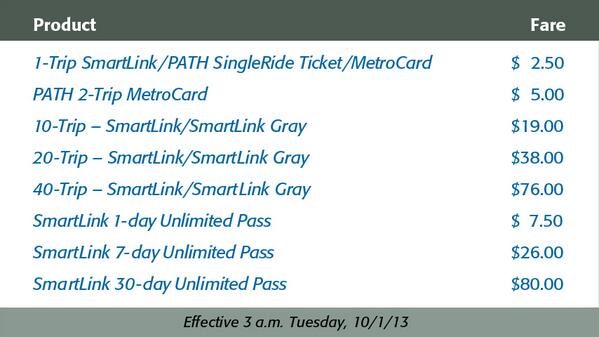
If PATH raises fares and no one covers it, does it count?
You wouldn’t know from the utter lack of press coverage, but PATH fares went up this week. Port Authority issued no press release, and only an errant PATH Tweet made note of the fact. It’s mystifying really how little coverage PATH gets. It has an average weekday ridership of over 260,000 and is a key connector underneath the Hudson River.
So that’s that. Here are the weekend changes.
From 11:30 p.m. Friday, October 4 to 5 a.m. Monday, October 7, there are no 1 trains between 137th Street and 242nd Street due to brick arch repair at 168th and 181st Streets. 1 trains operate between South Ferry and 137th Street. Customers may take A trains, the M3 and free shuttle buses as alternates.
Free shuttle buses operate between 137th Street and 168th Street
M3 and free shuttle buses operate between 168th Street and 191st Street
Free shuttle buses operate between 207th Street and 242nd Street
Customers may transfer between buses and trains at 137th Street (1), 168th Street (A) and 207th Street (A) stations. For Dyckman Street and 207th Street, use nearby A stations; transfer between the 1 and A trains at 59th Street-Columbus Circle.
From 11:45 p.m. Friday, October 4 to 6 a.m. Saturday, October 5, from 11:45 p.m. Saturday, October 5 to 6 a.m. Sunday, October 6 and from 11:45 p.m. Sunday, October 6 to 5 a.m. Monday, October 7, uptown 4 trains run express from Grand Central-42nd Street to 125th Street due to electrical work at 51st Street.
From 5:45 a.m. to 7 p.m., Saturday, October 5 and from 7:45 a.m. to 7 p.m., Sunday, October 6, Dyre Avenue-bound 5 trains run express from East 180th Street to Dyre Avenue due to track tie block and surface replacement north of Morris Park and cable work north of Baychester Avenue.
From 6 a.m. to 11:30 p.m., Saturday, October 5 and from 8 a.m. to 11:30 p.m., Sunday, October 6, 5 trains run every 20 minutes between Dyre Avenue and Bowling Green due to electrical work at 51st Street.
From 11:45 p.m. Friday, October 4 to 5 a.m. Monday, October 7, Pelham Bay Park-bound 6 trains run express from Grand Central-42nd Street to 125th Street due to electrical work at 51st Street.
Beginning 12:01 a.m. Saturday, October 5 until May 2014, 6 trains skip Middletown Road and Castle Hill Avenue in both directions due to station renewal work.
From 12:01 a.m. Saturday, October 5 to 5 a.m. Monday, October 7, Brooklyn-bound A trains run local from 125th Street to 59th Street-Columbus Circle due to track tie renewal north of 59th Street-Columbus Circle.
From 12:01 a.m. Saturday, October 5 to 5 a.m. Monday, October 7, there is no A train service between Euclid Avenue and Lefferts Blvd or Howard Beach-JFK Airport due to track panel work at Lefferts Blvd. and Rockaway Blvd. and track tie renewal and maintenance at Grant Avenue. A trains operate in two sections:
Between Inwood-207th Street and Euclid Avenue
Between Howard Beach-JFK Airport and Far Rockaway
Free shuttle buses operate in two segments:
Between Euclid Avenue and Howard Beach-JFK Airport, making station stops at Grant Avenue, 80th Street, 88th Street, Rockaway Blvd., 104th Street, 111th Street, Lefferts Blvd., Aqueduct Racetrack and Aqueduct-North Conduit Avenue.
Between Euclid Avenue and Howard Beach-JFK Airport, nonstop
Transfer between trains and free shuttle buses at Euclid Avenue and/or at Howard Beach-JFK airport. Note: Rockaway Park train shuttle is unaffected.
From 12:01 a.m. Saturday, October 5 to 5 a.m. Monday, October 7, Coney Island-bound D trains run local from 145th Street to 59th Street-Columbus Circle due to track tie renewal north of 59th Street-Columbus Circle.
(FASTRACK)
From 5:30 a.m. to 8 p.m., Saturday, October 5 and Sunday, October 6, there is no D service between Stillwell Avenue and Bay Parkway and no N service between Stillwell Avenue and 86th Street due to FASTRACK shutdown for maintenance, testing and inspection of signal equipment. Customers may take F or Q trains and the B1, B4, B64 and B82 buses instead.
From 8 p.m. Saturday, October 5 to 5:30 a.m. Sunday, October 6, the last stop for some trains headed toward Coney Island is Bay Parkway due to FASTRACK shutdown for maintenance, testing and inspection of signal equipment.
From 12:01 a.m. Saturday, October 5 to 5 a.m. Monday, October 7, Jamaica Center-bound E trains run local from Roosevelt Avenue to Forest Hills-71st Avenue due to track maintenance north of Elmhurst Avenue.
From 11:45 p.m. Friday, October 4 to 5 a.m. Monday, October 7, Jamaica-bound F trains run express from Church Avenue to Smith-9th Streets due to work on the Church Avenue Interlocking.
From 12:01 a.m. Saturday, October 5 to 5 a.m. Monday, October 7, Jamaica-bound F trains run local from Roosevelt Avenue to Forest Hills-71st Avenue due to track maintenance north of Elmhurst Avenue.
From 11:15 p.m. Friday, October 4 to 5 a.m. Monday, October 7, Coney Island-bound F trains are rerouted via the M line from Roosevelt Avenue to 47th-50th Sts due to station work at Lexington Avenue-63rd Street for the Second Avenue Subway project.
From 11:45 p.m. Friday, October 4 to 5 a.m. Monday, October 7, Nassau Avenue-bound G trains run express from Church Avenue to Smith-9th Sts due to work on the Church Avenue Interlocking.
From 11:45 p.m. Friday, October 4 to 5 a.m. Monday, October 7, there is no G train service between Court Square and Nassau Avenue. G trains operate between Nassau Avenue and Church Avenue. There is no G service at Greenpoint Avenue, 21st Street and Court Square.
Free shuttle buses operate on two routes:
Via Manhattan Avenue between Nassau Avenue G and Court Square
Via McGuinness Blvd between Lorimer Street L and Court Square
Customers may transfer between:
G trains and shuttle buses at Nassau Avenue
L trains and shuttle buses at Lorimer Street
E or 7 trains and shuttle buses at Court Square
From 11:45 p.m. Friday, October 4 to 5 a.m. Monday, October 7, there is no L train service between Lorimer Street and Myrtle-Wyckoff Avs due to track tie renewal at Graham Avenue. L service operates in two sections:
Between 8th Avenue and Lorimer Street
Between Myrtle-Wyckoff Avs and Rockaway Parkway
Free shuttle buses operate between Lorimer Street and Myrtle-Wyckoff Avs.
“Full service to the MTA Metro-North Railroad New Haven Line will be restored Monday morning, assuming the new substation which received Con Edison power today is found reliable during our testing over the weekend.”
Meanwhile, Metro-North released additional information concerning the credit process today. Although the amounts have not yet been determined, New Haven Line riders will weekly or monthly passes that were valid during the outage can begin to apply for credit beginning October 9 or October 20, respectively. Customers may apply for this credit until March 31, 2014, and the agency will waive the customary $10 processing fee. The credit will be available at select New Haven Line stations and in Grand Central. Mail & Ride customers will receive the credit automatically.
The open gangway of an articulated train in Paris.
I haven’t been to Paris in a while. My one and only trip to the City of Light came in 2001, and even then, I remember riding articulated train sets on the Metro. To a city rat who hadn’t experienced too many other subway systems, these seemingly endless trains were a revelation. They seemed — and were — more spacious than New York’s limited cars and allowed for better passenger flow and more people to ride with a little bit of extra comfort. Why didn’t New York have these, I’ve often wondered.
Over the years, we’ve heard a variety of excuses emanating from any number of U.S. transit agencies. While we have articulated buses, trains with open gangways haven’t yet arrived in the states. Some say that articulated trains can’t handle New York’s curves; others say that it’s a new thing requiring extensive testing. Whatever the reason, we sacrifice capacity and flexibility for the rolling stock we have.
But the MTA seems to be considering articulated trains as they look to the future. In the 20 Year Needs Assessment released this week, articulated make an appearance. Buried in the back as part of the effort to develop a 21st Century system was the following:
As the MTA continues to purchase new buses and subway and commuter rail fleets, it must incorporate state-of-the-art design concepts and technologies to minimize energy consumption, maximize carrying capacity, reduce loading times, and meet the expectation of a tech-savvy generation of new travelers. In particular, consideration should be given to trainsets with open gangways between cars, similar to the design of articulated buses. This will both maximize carrying capacity, and allow passenger to move to less-crowded areas of the train, balancing loading and unloading times at all doors.
The articulated trainsets aren’t arriving with any of the current rolling stock orders. The R179s and R211s won’t feature open gangways. So it’ll likely be until the mid-2020s that we see any such cars hit the rails in New York. By then, the R62 cars currently in use on the 1 and 3 lines will be nearing retirement age, and the 1 in particular would be a prime line for articulated cars as, outside of the old South Ferry station, the curves are essentially non-existent.
So why then don’t we have these open gangways already? Back in 2009, Yonah Freemark tackled the question and received the following response from an MTA spokesman: “MTA New York City Transit had considered an articulated train which was proposed by Kawasaki under the R110A contract. The proposal was, however, rejected by us due to the impact it would have had on the project’s budget and schedule…We may take another look at articulated trains in the future if and when we have a budget for Research and Design for an entirely new subway car.”
Basically, as with anything new, it cost too much. But now the MTA has a twenty-year plan and a vision for future train sets. If the tunnels can handle them, the next-gen rolling stock should have open gangways. It’s a minor improvement that can make a dent in reducing overcrowding and improving ease of movement in crowded subway cars.
While exiting the Times Square station near the Shuttle platform’s Track 4 exit today, I noticed the sign you see at the top of the post. For Manhattan bus riders, a big day is coming soon as the MTA has promised that BusTime, it’s real-time bus tracking system, will be available on all of the borough’s buses some time this month. I reached out to the MTA for more details and was told that the announcement will come next week.
BusTime is the MTA’s distance-based bus location system that was developed in-house. While the system does not include countdown clocks, it comes with a text message-based system and smartphone enabled apps as well. For Manhattan bus riders, the arrival of BusTime will take the guess work out of waiting for some of the city’s least reliable and slowest bus routes around. It’s a solid first step.
In bits and pieces this past summer, the MTA set forth its vision for New York City’s next twenty years. As the city continues to grow and modernize, the MTA and its subways, buses, commuter rail lines and bridges will continue to drive the city’s economy in more ways than one, and as part of an effort to meet demand and continue to provide reliable service, the agency has been arguing since July for twenty years of investment. We know it’s going to cost over $100 billion, and today, those costs and the plan crystallized as the MTA published the 140-page 20 Year Needs Assessment.
The document itself is an impressive feat of planning and an impressive feat of chutzpah too. The MTA is asking for $105 billion over the next twenty years — or approximately the same amount it has spent over the past 30 — without including any funding estimates for expansion projects. (Stephen Smith, now writing for Next City, has more on the cost comparisons.) So the $64,000 question is: What do you get for $105 billion?
What I find most interesting about the document is the way it divides MTA needs from the MTA wants. From the start, the agency is very forthcoming in its needs. It needs $105 billion to maintain current service levels, continue toward a state of good repair and prepare the system for more usage and 21st Century technology. It wants an unstated amount for future expansion which should include a 7 line station at 10th Ave. and 41st St., the rest of the Second Ave. Subway, capacity upgrades for the West Side IRT and the Queens Boulevard line, the reactivation of the Rockaway Beach Branch (page 127!), and even articulated train sets. The price tags for these expansion efforts — the wants — haven’t been included because the MTA, I’ve been told, doesn’t consider them part of the necessary needs for maintenance of and upgrades to the existing system.
One line in particular struck a chord. After presenting a table that shows how the MTA will spend $105 billion with the bulk of that going toward New York City Transit projects, the MTA notes how they restrained themselves. “On a fully unconstrained basis,” the report reads, “the agencies’ needs are even greater than what is included in this assessment since more backlogged state of good repair needs exist than can be implemented.”
Mull that one over a bit. The MTA wants to spend $105 billion on repairs over the next twenty years after spending $100 billion since 1982 and could spend more due to a backlog of work. That is the legacy of neglect and a tell-tale sign that a system which still employs signal components from the 1930s. To defend the ask, the report explains, “The significant investments identified in this assessment, constrained as noted above, are prioritized according to such factors as age, condition, performance, safety and reliability in order to provide the greatest service benefits and maintenance savings to the operating budget.”
In no particular order, then, the MTA has identified a variety of areas for its needs. It needs to upgrade the signal system to implement communications-based train control while bringing online B Division countdown clocks and generally making more real-time information available to the public. It needs to upgrade the city’s bus network. It needs to bring more stations into compliance with the ADA. It needs to add more transfers to streamline operations. It needs to add system resiliency in the face of changing weather patterns.
As the money adds up, though, the MTA argues that many of these needs will result in operational savings. CBTC, for instance, can allow the MTA to run more trains at lower costs. Another need — the Metrocard replacement — can improve interagency relations and reduce fare collection costs. “The future promises the ability to use a single smart card or a cell phone with a smart chip — cell phones being nearly ubiquitous in the New York region — to ride any and all of the MTA region’s transportation systems, from NYC Transit’s subways and buses to the commuter railroads,” the assessment says. This new approach could offer many benefits to the MTA, including increasing bus speeds by shortening the boarding process, reducing labor and cash handling expenses, supporting inter-modal fare payments options and improving customer service through simplified and expanded fare payment options.”
Outside of these operational needs and system upgrades, though, the MTA has capital needs as well. Combining these expenditures results in $68 billion in projected New York City Transit investments. This total includes over $15 billion for signals, $9.4 billion for stations and $8.4 billion for cars. The rolling stock replacement plans for the next 20 years include retiring cars purchased in the early days of the capital plan in the 1980s. The MTA wants to stick with a 40-year replacement cycle, and as it struggles to maintain something resembling a state of good repair, components replaced seemingly recently will near the end of their life cycles.
But what of the fun stuff? We like to dream big, and the MTA here is dreaming practically (albeit expensively). One project set for the 2015-2019 capital plan involves rehabbing the 42nd St. shuttle terminal in Times Square, the only part of that station complex that hasn’t seen work in recent years. “Work will include renewal and reconfiguration of the Shuttle station, both to improve passenger circulation and to make the station ADA-accessible,” the MTA promises. “The existing Shuttle station has various deficiencies, including circuitous customer paths, platform edge gap fillers and other components that are not in good repair, and a general station appearance that does not match the standard achieved through the rest of the Times Square complex.” The Rockaway Line will have to be rebuilt before 2034 as well.
So now what about those wants? The wants are what I like. The wants are what will continue to make the city more accessible and less dependent on cars while permitting growth in areas that are underserved by transit. Those wants are up in the air. The Second Ave. Subway should wrap at least 100 years after it was first proposed, and articulated train sets would do wonders for crowding during peak-hour subway trips. But these are projects that need more dollars and more champions. The MTA has a $100 billion need; how can it find the money for the wants as well?
 The Second Ave. Sagas’ podcast “The Next Stop Is…” returns this week with a short episode for your listening enjoyment. Eric Brasure and I discuss New Jersey Transit’s post-Sandy woes, the increase in PATH fares that slipped under the radar and BusTime’s Manhattan debut.

 Amidst much anticipation, Manhattan now has real-time bus tracking as the MTA unveiled BusTime for the County of New York. At around midnight this morning, BusTime — the MTA’s in-house-built, distance-based system — went live on nearly all Manhattan bus routes. The system is available on the web
 New Jersey Transit’s response to Sandy is the story that just won’t die. It’s not quite a scandal, even though perhaps it should be, but the developments continue to trickle out thanks to reporting by Karen Rouse from The Record and Andrea Bernstein from WNYC. This should be a bigger black eye on the face of the Garden State and its governor, but so far, the scandal just won’t stick.


 (FASTRACK)


