Author: Benjamin Kabak

  • Severely truncated service for the New Haven Line ‘until further notice’

    With Con Ed warning that repairs to the New Haven Line’s power system could take two to three weeks, the MTA has put in a place a stop-gap measure for Metro-North commuters. The agency promises to deliver approximately one-third of the busy commuter line’s normal service and is warning riders that this plan will be in place “until further notice.”

    Beginning with the morning rush on Thursday, morning rush hour trains will run from New Haven to Stamford every 20-30 minutes with connections to diesel express service from Stamford to 125th St. and Grand Central; and diesel local service through Rye with bus service to White Plains and the Harlem Line. From Harrison, local trains will run every 20-30 minutes through New Rochelle and then direct to Fordham, 125th St. and Grand Central. Buses will run from Pelham and Mount Vernon East to Mount Vernon West and the Harlem Line. Diesel trains will leave every 30-40 minutes from Grand Central, making all local stops to Stamford with hourly connections to New Haven.

    For off-peak service, trains will run very infrequently. Trains will run between New Haven and Stamford leaving every after at 45 past, and local service will run from Stamford to Grand Central every half hour. Heading north, trains will leave Grand Central four and 34 minutes after the hour making all local stops to Stamford.

    For the evening rush out of Grand Central, trains will run direct to Stmford with connections to New Haven provided every 20-30 minutes. An express bus will operate from the Harlem Line in White Plains to Rye to provide connections to local trains. Finally, Metor-North will provide limited train service from Grand Central to New Rochelle, Larchmont, Mamaroneck and Harrison Stations, and Harlem Line train service to Mount Vernon West for a bus to Pelham and Mount Vernon East Stations. Sounds fun, doesn’t it?

    The MTA is trying to prepare customers for worst. Riders are urged to stay home if possible, and the Harlem Line will cross-honor New Haven Line tickets. Crews, meanwhile, are working “to try to establish alternative power sources to serve the New Haven Line.” It just so happens that the redundancy — a second feeder cable further up the line — is out for maintenance as Metro-North had required some repairs.

    Wednesday’s disruption was another in a string of bad luck moments for the New Haven Line. Derailments and rail damage led to delays earlier this year, and each time a problem has arisen, the built-in redundancies were offline due to repairs. At a certain point, you can’t overbuild the guard against every foreseeable problem, but this is some string of ill-timed incidents. Is it a sign of decaying and aging infrastructure? Hard to say as Con Ed and the MTA were prepping for the future by refitting the other feeder cable. But with one offline, when the other goes down, operations go south in a hurry.
  • Con Ed: New Haven Line power repairs could take ‘2-3 weeks’

    While passing through Grand Central this morning shortly before 7 a.m., I noticed crowds larger than usual idling throughout the main hall, and when I glanced up at the video boards, I — or at least anyone who needed the New Haven Line — was in for a rude awakening. All New Haven Line Metro-North service had been suspended to do the failure of a 138kV power feeder that began at approximately 5:22 a.m., and full power could take a few weeks to return.

    Twelve hours in, and the news is not looking good. Con Ed issued only a terse statement seemingly taking a passive aggressive swipe at the MTA: “Con Edison is working with Metro-North to try to establish alternative power sources to serve the New Haven line. Company crews are working around the clock to make repairs to a feeder cable that failed earlier today, but repairs of this nature typically take 2-3 weeks. Another feeder normally providing service to the New Haven line was out on scheduled repairs to accommodate Metro-North upgrades on their equipment.”

    The MTA, meanwhile, is scrambling. The agency can run only one train per hour in each direction, which amounts to only 10 percent of the regular service on the nation’s busiest commuter rail line. Amtrak is reporting significant delays as well. Thursday’s commute will involve some sort of train/bus shuttle combination, and the MTA will have the plans for this service ready later today. I’ll update as more information comes in.

  • The Times tears down Santiago Calatrava

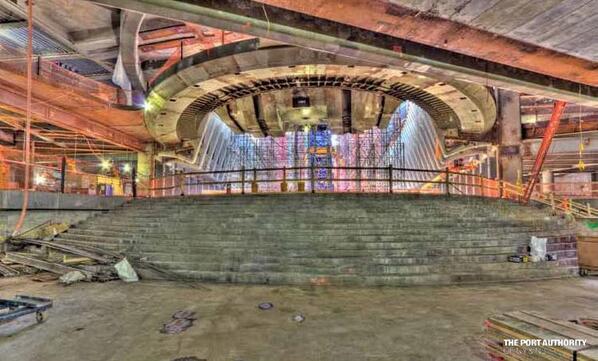
    A glimpse inside Calatrava’s costly subway station. (Photo via @WTCProgress)

    When The New York Times puts a target in its sights, the Grey Lady goes hard:

    In numerous interviews, other architects, academics and builders say that [Santiago] Calatrava is amassing an unusually long list of projects marred by cost overruns, delays and litigation. It is hard to find a Calatrava project that has not been significantly over budget. And complaints abound that he is indifferent to the needs of his clients…

    Mr. Calatrava is likely to come under renewed scrutiny in New York as building continues on one of his latest projects, the new PATH train station at ground zero. It is expected to open in 2015 but is six years behind schedule and will cost $4 billion, twice the original budget.

    Critics of the project, commissioned by the Port Authority of New York and New Jersey, find the final price tag hard to believe. (In January 2012 an independent audit of the Port Authority concluded that the agency was “a challenged and dysfunctional organization.”) But several executives who have been involved in construction at the World Trade Center site, who did not want to speak on the record because of their relationship with the project, said Mr. Calatrava’s designs were problematic, too, calling for hugely difficult construction, including a vast underground chamber. In addition, they said, he demanded that surrounding buildings house all the station’s mechanical elements, like ventilation, which complicated construction and called for time-consuming coordination.

    The Port Authority declined to discuss the cost overruns and issued a one-sentence statement: “Early estimates for the transportation hub were based on conceptual designs and were therefore unrealistic.”

    In Calatrava’s Spanish hometown, politicians aren’t as quick to lay the blame for cost overruns on the shoulders of so-called conceptual designs. Ignacio Blanco, a member of the Valencia parliament which has had its fair share of disputes with its native son, says that Calatrava’s designs — upon which cost estimates and funding requests are based — are devoid of necessary detail. “Other architects, they know exactly the door handles they want, and where to buy and at what cost,” he said. “But Calatrava is the opposite. His projects do not have this degree of precision. If you look at the files on the aquarium, which was built by someone else, they are fat. But there are just a couple of pages on the Calatrava projects.”

    I’ve been highly critical of the PATH WTC station for years now. It’s a glorified subway station that will cost taxpayers $4 billion. It’s a vanity project developed by a starchitect who has made it about him and his contributions to the New York scene rather than about a cost-controlled transit improvement. The mistakes of PATH and the mistakes of Calatrava should be a lesson to the various New York stakeholders at plans to expand or rebuild Penn Station move forward. This is a mess that didn’t have to be a mess.

  • Map tool wins MTA’s 2013 App Quest contest

    Citymapper, a iOS app that uses real-time transit information and up-to-date service advisories to provide its users with a wealth of travel information within the five boroughs, won a $20,000 prize in the MTA and AT&T’s 2013 App Quest contest, the agency announced today. The app comes with a web component and can even tell users how many calories they’ve burned on a trip throughout the city. It’s not quite transformational or quirky, but it works.

    This year’s App Quest launched in May and featured 49 submissions. My personal favorite in terms of creativity was an Android app called MetroNap that uses motion sensors to wake up the user when he or she reaches a destination. It did not walk away with a prize though from the panel of nine members of the city’s burgeoning tech and V.C. industry.

    In addition to Citymapper, five other apps walked away with cash prizes. Subculture.FM allows uses to get more information on the artists who participate in the Music Under New York program; Transit App, my current go-to for train arrival times and trip instructions, took home $5000. Accessway, an accessibility app for visually impaired riders, and Bus NYC, which taps into the BusTime API, garnered honorable mentions, and Moovit, yet another mapping app, was the winner of the popular vote.

    “The app developers who competed in this challenge have shown that they have the know-how, the enthusiasm, and the energy to do great things with the open data we and others provide,” Thomas Prendergast, MTA Chairman and CEO, said. “And we are glad that so many in the tech community have put their efforts into helping the MTA, and, more importantly, our customers. That’s why we are going to continue to expand the amount of open data we provide.”

    Once again, the MTA, with a fiscal assist from AT&T, decided to outsource app programming to the benefit of the riders, and we have a new series of apps to use, enjoy and, sometimes, delete. Check out all of the submissions right here.

    Apologies for the short post tonight. I have an early morning meeting on Wednesday, but I’ll be back with a new edition of the podcast, among others, later on this morning.

  • Amtrak breaks ground on possible future Gateway path

    With an infusion of billions, this concrete box will one day host Amtrak's Gateway Tunnel.
    With an infusion of billions, this concrete box will one day host Amtrak’s Gateway Tunnel.

    With Sandy money flowing New York City’s way, Senator Chuck Schumer was able to wrangle enough dollars earlier this year to launch part of the Gateway Tunnel. Specifically, the state’s senior senator secured the $185 million needed to preserve Gateway’s right-of-way under the Hudson Yards development under the rubric of flood prevention. Yesterday, officials gathered to celebrate the ground-breaking of this monumental concrete box that may, years and billions of dollars in the future, host a new trans-Hudson train tunnel for Amtrak.

    “The value of the work on this concrete casing cannot be underestimated as it preserves a possible pathway for new tunnels designed to increase the reliability and capacity for Amtrak and New Jersey Transit’s operations and will step up the resiliency of the rail system against severe weather events like Super Storm Sandy,” Amtrak Chairman Tony Coscia said.

    This current construction effort is a two-year project to build a casing between 10th and 11th Avenues in order to save what Amtrak called a “possible right-of-way” for two new tunnels into Penn Station. It is slated to be completed in October of 2015. When or if Gateway and the corresponding Moynihan Station plan will ever see the light of day remains to be seen.

    Interestingly, the Sandy part of this picture could spur Amtrak and the feds to action though. As the rail agency detailed in its press release, the storm surge from Sandy flooded four of the six tunnels under the Hudson and East Rivers. This is the first time in their 103-year history that the tunnels were inundated, and nearly 600,000 daily riders on Amtrak and New Jersey Transit saw their commutes disrupted. The casing, wide enough for a two-track train tunnel, will be flood-proof, though Amtrak’s materials do not explain how.

    Before Gateway can become a reality, Amtrak will have to replace the Portal Bridge and extend the concrete casing to the west to 12th Avenue, but the region’s politicians remain ever hopeful. “Today’s groundbreaking is about so much more than making way for the Amtrak Gateway tunnels,” New Jersey Senator Bob Menendez said. “It’s about celebrating a $185 million investment in our future, in keeping our competitive edge in the New Jersey-New York area, in our preparedness against severe weather events like Super Storm Sandy. We can’t be satisfied with a 19th century infrastructure in a 21st century world and expect to stay competitive in a high-tech, fast-paced, global economy. For the growth of the entire region, it’s critical that we invest in new rail tunnels across the Hudson.”

  • Is light rail right for Red Hook?

    A glimpse at the Red Hook streetcar alignment DOT rejected in 2011.

    I took a long walk from Park Slope to Red Hook and back a few weekends ago. It’s a great stroll through a diverse group of Brooklyn neighborhoods and includes a some sights and some food. Along with the obligatory stops at El Olomega for papusas, Steve’s for key lime pie and Fairway for groceries, a number of restaurants, craft distilleries and unique shops line some of the route. It is not particularly transit accessible.

    Red Hook residents know full well that the nearest subways aren’t particularly near. The F/G stop at Smith/9th Sts. is back open, but it’s a trek from all but the closest parts of the neighborhood. The B61 runs through the area, but residents have a love-hate relationship with the bus. It also, I noticed, stops more frequently than every other block along certain stretches of Van Brunt Street.

    For decades, Red Hook residents have argued for, well, something. A streetcar has been the goal of certain advocates, but the fight for better options has been an uphill battle. The area isn’t zoned for much more residential development, and it now clearly suffers from the fear of a future storm. It’s next to impossible to get flood insurance, and many believe it’s just a matter of when and not if the next flood will arrive. There are pockets of gentrification, but the neighborhood may be reaching something of a peak.

    Still, the fight goes on. At a recent City Planning forum, Red Hook residents gathered to discuss resiliency, and, as DNA Info’s Nikhita Venugopal reported, light rail was on the agenda. She writes:

    A dedicated light-rail system through Red Hook would ease the neighborhood’s transportation hassles, locals said at a community meeting Tuesday night. About 30 residents, business owners and people who work in Red Hook discussed ways to improve the neighborhood’s network and bolster its resiliency to future storms, at a community meeting organized by the Department of City Planning.

    Split into groups of five, people studied large-scale maps of the neighborhood, marking suggested bus routes, potential Citi Bike terminals and spots vulnerable to flooding. A streetcar system, which advocates have been fighting for since 1989, would give locals an easier way to travel through Red Hook and avoid the B61 bus, they said.

    Streetcars are “efficient,” “cleaner” and “would increase business in Red Hook,” said Bill Appel, director of the Gowanus Canal Community Development Corporation. The light-rail line, which would run down Van Brunt Street, should accommodate the corridor’s two-lane car traffic and have a travel time of about eight minutes, locals said.

    This isn’t the first time in post-Sandy New York that a potential light rail system for Red Hook has come up. Former deputy mayor Dan Doctoroff discussed the idea a few months ago at a city forum as a potential economic driver for the area, but such a move would have to come with a corresponding change in zoning to spur development. Various commercial entities in the area are keen to see better transportation options, and Bob Diamond, of course, hasn’t given up the fight. If anywhere is primed for an experiment in surface transit, it would be Red Hook.

    Or would it? In a contested move two years ago, DOT already torpedoed a streetcar over costs. At the time, the agency estimated that building out the route, along with the infrastructure needed to support and maintain a new-to-New York transit option, would cost $176 million in capital funding and approximately $7 million a year in annual operating costs. Ridership projections anticipated under 2000 new riders per day. Outside of a few new bars and restaurants and one devastating hurricane, nothing has changed that would have a material impact on that analysis.

    To realize a dream of light rail will require substantial buy-in from private developers and some changes to the condition on the ground. It’s not impossible, but in today’s transit investment climate, it isn’t — and probably shouldn’t be — a priority. That said, Red Hook needs better transit, and why not dream of a space for New York’s first experiment in light rail?

  • A Tale of Two Lhotas from the TWU

    As the last sprint of the mayoral race kicks into gear in the coming weeks, New Yorkers will continue to hear about Joe Lhota’s brief tenure atop the MTA. Notable for the agency’s competent and speedy response to restore service in the aftermath of Sandy, Lhota’s reign also coincided with a fare hike and toll increase. While the economic plan predated him and was an absolute must for a cash-shy agency, he was the face of the authority as prices increased, and that’s a tough problem to overcome for a candidate running, in part, on his successes after the storm.

    Meanwhile, labor relations played a small role during his time as CEO and Chairman, and John Samuelsen, president of the TWU, commands a decent sized vocal bloc. Recently, though, various public statements have led me to wonder what, exactly, Samuelsen thinks of Lhota. In a Daily News piece designed more as an insult to Jay Walder than as praise of Joe Lhota, Samuelsen issued some faint praise and an incomplete assessment. Despite some gripes with Lhota over the MTA’s smart decision to shutter the subways in advance of Sandy, Samuelsen called Lhota “a quick study” who “simply did not stick around long enough to leave any permanent imprints on our transit system.”

    Is that the TWU head’s final word on the matter? Of course not. In a piece issued earlier this summer in the pro-labor Chief-Leader and reprinted on the TWU’s website, Samuelsen had harsh words for Lhota over the ongoing union contract dispute. “Lhota doesn’t know a damn thing about how to run a subway or bus system,” Samuelsen said. “Prendergast knows what Track Workers go through when they’re swinging a hammer all day in the tunnel in 110-degree heat. Lhota has no idea; he’s just a two-bit bean-counter from the financial industry.”

    So was Lhota just a two-bit bean counter or was he also a quick study? Is this more of a sign of TWU leadership speaking to the diverse audiences of the Daily News and Chief-Leader? Either way, Lhota’s MTA legacy remains up for grabs before Election Day.

  • Rethinking station design to encourage passenger flow

    On a daily basis, I get to experience the sheer joy of the Times Square subway station at the heights of both the morning and evening rush hours. This isn’t something I’d ever recommend to anyone else as it is truly a mass of disorganized humanity. People are angling to get from the Shuttle to another train and from the 1, 2 or 3 trains to the Shuttle while others just want to get out of the station and still others want in. Combine that with the tourists who have no idea where they’re going, and it is amazing more fights don’t break out amidst the brushed elbows and shoved shoulders.

    One of the problems with the space — and Times Square isn’t alone in this regard — is that it’s cramped and from an age before passenger flow was a thing studied at graduate schools and in engineering classes. It’s also a mish-mash of various systems with the Shuttle track system fairly inefficient and the integration between the BMT and IRT awkward at best.

    History, though, doesn’t excuse the elements that have always been within the MTA’s control. Take, for instance, the way people enter and exit train stations. If you happen to have the misfortune of trying to get into a station — Times Square, Grand Army Plaza, 7th Ave. on the Brighton Line near me in Brooklyn — as a rush-hour train empties, good luck to you. All incoming turnstiles are temporarily flooded with people exiting, and those entering can either shove through the maddening crowd or wait. Even turnstiles that say “no exit” are useless as the bar spins with no resistance (or corresponding check to the gut).

    Fixing these problems could go a long way toward solving the rat race feel of the subway system, and a few weeks ago, the Daily News published a short but intriguing article on an upcoming effort to streamline passenger flow. Today, The Times issues its follow-up, and although the specific details are still a bit vague, the MTA seems to be serious about experimenting with moving people through congested choke points.

    Matt Flegenheimer writes about the MTA’s decision to “shuffle station furniture”:

    The changes, part of a roughly $900,000 project, have drawn on observations of riders’ entering and exiting behaviors, bolstered by data on which specific turnstiles are used most at particular stations…

    The authority has responded with a series of proposed tweaks culled from the Disneyland playbook of pedestrian funneling, using the location of turnstiles as cues to create a desired traffic flow. At a No. 1 train entrance at Rector Street in Manhattan — where a turnstile and emergency gate previously appeared at platform level, occasionally stranding riders on board as lines backed up into the first car — equipment was moved upstairs. The emergency gate has been exiled out of the typical walking path, perched diagonally from the top of the steps.

    …So far, fare areas in three stations have been adjusted: at Rector Street, and at Marcy Avenue and Nassau Avenue in Brooklyn. Ten more hubs have been flagged for the next round of renovations. After that, the authority plans to continue modifying fare areas at an average of 10 stations each year. Jackie Kuhls, the authority’s chief budget officer for subways, said that much of the work involved tweaking past station layout plans that placed major entrances and exits near token booths, which receive far less traffic than they once did.

    Without accompanying diagrams or overarching plans, it’s still tough to get a sense of what the MTA is doing on the whole. Are they solving choke-point problems or moving them upstairs? What Flegenheimer does reveal though is that some of those HEETs — the iron maiden-like high entrance-exit turnstiles — are on the decline while low turnstiles are on the raise. Even at unstaffed entry points where fare evasion are a concern, the MTA may decide that smooth entry trumps the limited revenue lost to those who hop the turnstile. (The ease of slipping through an emergency exit negates the benefits of the HEETs anyway.)

    It sounds like a start though. Solving the mess at Times Square would be the gold standard in station redesign, and easy fixes such as truly dedicated exit and entry turnstiles at peak hours would be a big help. But should we expect anything revolutionary or are we stuck with the chaos that makes the subway system so uniquely New York?

  • Weekend work impacting 11 train lines

    I’ve seen worse weekends. I’ve seen better.


    From 12:01 a.m. Saturday, September 21 to 5 a.m. Monday, September 23, Utica Avenue and New Lots Avenue-bound 4 trains run local from Grand Central-42nd Street to Brooklyn Bridge due to signal work between 14th Street-Union Square and 42nd Street-Grand Central.


    From 5:45 a.m. to 7 p.m., Saturday, September 21 and from 7:45 a.m. to 7 p.m., Sunday, September 22, Bowling Green-bound 5 trains run express from Dyre Avenue to East 180th Street due to signal work between 14th Street-Union Square and 42nd Street-Grand Central.


    From 6 a.m. to 11:30 p.m., Saturday, September 21 and from 8 a.m. to 11:30 p.m., Sunday, September 22, 5 trains run every 20 minutes between Dyre Avenue and Bowling Green. Bowling Green-bound 5 trains run local from Grand Central-42nd Street to Brooklyn Bridge due to signal work between 14th Street-Union Square and 42nd Street-Grand Central.


    From 11:45 p.m. Friday, September 20 to 4 a.m. Monday, September 23, Brooklyn Bridge-bound 6 trains run express from Pelham Bay Park to Parkchester due to station work at Castle Hall Avenue and Middletown Road.


    From 12:01 a.m. Saturday, September 21 to 5 a.m. Monday, September 23, there is no A train service between Euclid Avenue and Lefferts Blvd/Howard Beach-JFK Airport due to track panel work at Lefferts Blvd. and Rockaway Blvd. and track tie renewal and maintenance at Grant Avenue. A trains operate in two sections:

    • Between Inwood-207th Street and Euclid Avenue
    • Between Howard Beach-JFK Airport and Far Rockaway

    Free Shuttle buses operate in two segments:

    1. Between Euclid Avenue and Howard Beach-JFK Airport, making station stops at Grant Avenue, 80th Street, 88th Street, Rockaway Blvd., 104th Street, 111th Street, Lefferts Blvd., Aqueduct Racetrack and Aqueduct-North Conduit Avenue.
    2. Between Euclid Avenue and Howard Beach-JFK Airport, nonstop
      Transfer between trains and free shuttle buses at Euclid Avenue and/or at Howard Beach-JFK airport. Note: Rockaway Park Shuttle service is unaffected.


    From 12:01 a.m. Saturday, September 21 to 5 a.m. Monday, September 23, Brooklyn-bound A trains run local from 125th Street to 59th Street-Columbus Circle due to track tie renewal south of 125th Street.


    From 12:01 a.m. Saturday, September 21 to 5 a.m. Monday, September 23, Coney Island-bound D trains run local from 145th Street to 59th Street-Columbus Circle due to track tie renewal south of 125th Street.


    From 11:15 p.m. Friday, September 20 to 5 a.m. Monday, September 23, Coney Island-bound F trains are rerouted via the M line after 36th Street, Queens to 47th-50th Sts due to station work at Lexington Avenue-63rd Street for Second Avenue Subway Project.


    From 11:30 p.m. Friday, September 20 to 5 a.m. Monday, September 23, Coney Island-bound F trains run express from Jay Street-MetroTech to Church Avenue due to work on the Church Avenue Interlocking.


    From 11:30 p.m. Friday, September 20 to 5 a.m. Monday, September 23, there is no G train service between Church Avenue and Hoyt-Schermerhorn Sts due to work on the Church Avenue Interlocking. Customers should take the F instead. To connect between F and G service, customers should take the A or C between Hoyt-Schermerhorn Sts and Jay Street-MetroTech.

    G service operates in two sections:

    • Between Court Square and Bedford-Nostrand Avs.
    • Between Bedford-Nostrand Avs and Hoyt-Schermerhorn Sts, every 20 minutes.


    From 11:45 p.m. Friday, September 20 to 5 a.m. Monday, September 23, M service is suspended due to station renewal at Fresh Pond Road, Forest, Seneca, Knickerbocker and Central Avenues. Free shuttle buses operate between Metropolitan Avenue and Myrtle Avenue, making all station stops.


    From 11:45 p.m. Friday, September 20 to 5 a.m. Monday, September 23, Ditmars Blvd-bound N trains are rerouted via the D line from Stillwell Avenue to 36th Street due to track panel removal at 86th Street.


    From 11:45 p.m. Friday, September 20 to 5 a.m. Monday, September 23, Coney Island-bound N trains skip 49th Street in Queens due to drain pipe installation at Times Square-42nd Street.


    From 4:45 a.m. to 9 a.m., Sunday, September 22, Coney Island-bound N trains skip 30th Avenue, Broadway, 36th Avenue and 39th Avenue due to emergency replacement of damaged rail and other rail repairs north of Queensboro Plaza.


    From 6 a.m. to 11 p.m., Saturday, September 21 and Sunday, September 22, Bay Ridge-bound R trains skip 49th Street due to drain pipe installation at Times Square-42nd Street.

  • MTA, TWU set to meet again

    It’s been a long time since we’ve heard any sort of update on the status of the contract negotiations between the MTA and TWU — a very long time in fact. With the MTA presenting numerous budget projections with the net-zero labor increase baked in and the TWU agitating against it at everyone opportunity, the two sides haven’t sat down with each other in over a year, and discussions before that were hardly fruitful. Jay Walder and the TWU didn’t get along, and Joe Lhota hardly made solving the contract conundrum a priority during his short time with the agency.

    Now, though, as Pete Donohue reports, the two sides will resume meeting to work toward a deal. The TWU has been without a valid contract for 19 months, and they want to see a change. Donohue reports:

    Transport Workers Union Local 100 will bolster its case for modest wage increases with a campaign stressing the hard work and sacrifices bus and subway workers made during and after the deluge. “Hurricane Sandy changed everything,” Local 100 President John Samuelsen said. “It’s only appropriate to review and rehash the incredible work New York City transit workers did in getting New York City back on its feet.”

    … The stakes are high when the two sides sit down Sept. 30 — and not just for the approximately 36,000 transit workers. An MTA-TWU contract could set the pattern for talks between City Hall and other municipal unions if accompanied by two conditions: The pact is deemed favorable by organized labor, and Democrat Bill de Blasio, the mayoral candidate unions largely support, wins in November, said Lee Adler, senior associate at Cornell University’s Industrial Labor Relations School.

    … The MTA insists it can’t afford raises without work-rule changes and efficiency measures to pay for them. The implication is that the authority, which already plans to raise fares again in 2015 by approximately 7.5%, might have to boost its prices even higher without a “net-zero” agreement. The MTA also wants to loosen contract language prohibiting it from eliminating conductor positions on the vast majority of subway trains, a move that would leave riders with just the motorman during emergencies until additional help arrives.

    I’m not sure I see the logic in the TWU’s position with regards to the Sandy response. It’s true that workers were asked to go above and beyond for it, but it’s also true that overtime pay was part of the equation. Meanwhile, one telling statement from Tom Prendergast earlier this week provides some insight into management’s thinking. “The farepayers have done a lot, if not more than their fair share,” he said of the MTA’s ongoing struggles with their budget. “Management has done a lot; labor hasn’t.”

    Tie wage increases into productivity gains. Allow for OPTO. Don’t allow for another three years of wage increases without something in return. That’s the current stalemate, and it’s not likely to break any time soon.