With costs seemingly skyrocketing, will Phases 2 and 3 of the Second Ave. Subway see the light of day?
With the fallout from the MTA’s decision to cut $1 billion in Second Ave. Subway funding from the current five-year capital plan stretching into this week, the agency engaged in an all-hands-on-deck approach to making nice. Years too late, politicians finally started asking the right questions about the cost and timeline for this project, and MTA officials engaged in some backtracking on the cuts.
“We have,” MTA CEO and Chairman Tom Prendergast said, “committed that if we can speed up the schedule to begin tunneling the East Harlem phase sooner, we will pursue a Capital Program amendment to do so. Governor Cuomo has made clear that he would like us to accelerate work on the Second Avenue Subway, and we are actively looking for ways to deliver the project faster.”
In speaking with reporters during Wednesday’s tour of the East Side Access caverns, MTA Capital Construction President Michael Horodniceanu repeated this promise. “We’ll do what needs to be done to speed up the second phase,” he said. But a vague promise to do something the agency was already going to do isn’t really the story. Rather, Horodniceanu opened the door to a question the agency hasn’t been willing to answer yet. When the MTA initially requested $1.5 billion for Phase 2, the agency refused to say how much the full phase would cost, raising eyebrows among those who have watched NYC’s transit construction costs skyrocket. On Wednesday, Horodniceanu kinda sorta spilled the beans.
While responding to questions about why everything cost so much, Horodniceanu said he expects Phase 2 to cost between $5.5-$6 billion and believes tunneling to south to Houston St. — Phase 3 of the project — will cost $10-$12 billion. It’s not clear if the latter eyepopping figure is the combined costs of completing Phases 2 and 3 or if Phase 3 separately will cost that much. Either way, these dollar figures are astounding and would shatter records for most expensive subway projects, on a per-mile basis, anywhere.
Horodniceanu had no real answer for the expenses. As I mentioned yesterday, he pointed to unionized labor as a cause of East Side Access cost increases, but unionized labor bills transit projects throughout the world. At one point, he tautologically stated everything cost so much “because New York is expensive” and mentioned as well the costs of building “massive underground transit connection in densely populated areas.” Tell that to London or Paris though.
For the Second Avenue Subway, Phase 2 involves old tunnels and a new dig that must cut underneath Metro-North at 125th St. and the Lexington Ave. IRT. The Final Environmental Impact Statement [pdf] claimed that Phase 1 would cost $3.8 billion while Phase 2 would cost $3.4 billion and Phase 3 would cost $4.8 billion. Even accounting for inflation, the new estimates, off the cuff as they may be, blow these 11-year-old projections out of the water. And that’s a big problem for future transit expansion in New York City.
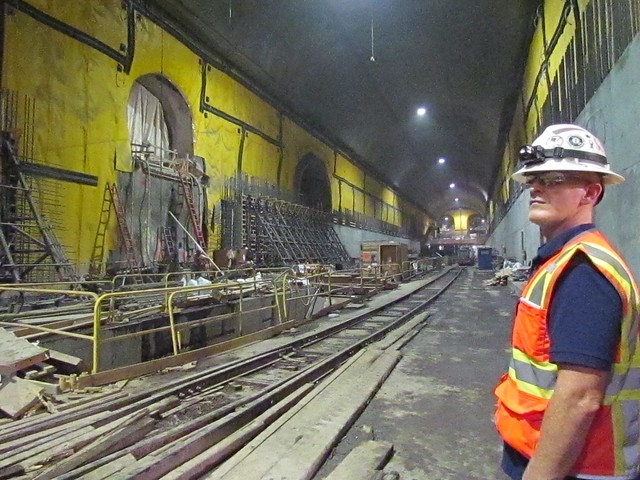
A glimpse inside the future home of the East Side Access terminal. (Photo by Benjamin Kabak)
While walking with New York City’s transit reporters through the future home of the East Side Access terminal underneath Grand Central yesterday, the same question came up over and over again: Is this thing worth it? Buried at its lowest point 140 feet below Park Ave., the East Side Access project will bring under 200,000 daily LIRR to Grand Central, shaving up to 30 minutes per day in commuter times. It will also cost over $10 billion and likely won’t open before December 2022, a few months shy of my 40th birthday and 18 years after the MTA and FTA signed a full funding grant agreement for the project.
At this point, you should know the details of East Side Access. It will be an eight-track LIRR terminal that allows for a better distribution of Long Island commuters. It has little effect on the problems plaguing the subways, and its cost per ride — $10.2 billion for 162,000 riders — makes it the least efficient transit construction project in the world. Anyone starting to examine it now would tell you not to bother.
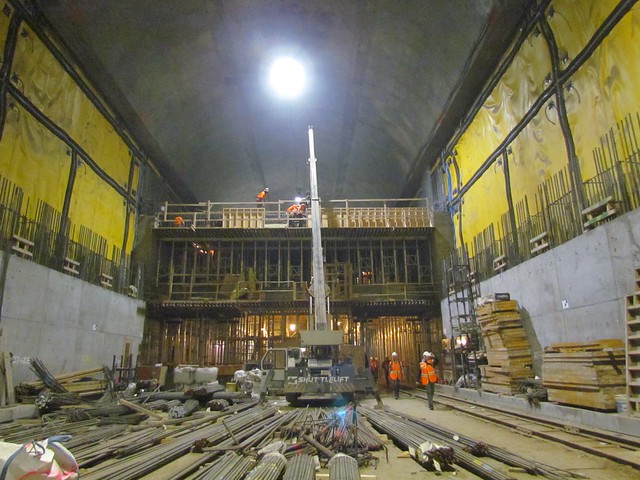
This cavern will one day host four tracks on two levels for LIRR trains. (Photo by Benjamin Kabak)
But there I was yesterday, in a dark, dank, loud cavern with reporters who are wise to the MTA’s cost problems and Michael Horodniceanu, the president of MTA Capital Construction who seemed exhausted by the pestering that needs to happen over and over again. When asked by Dana Rubinstein of Capital New York about the escalating costs, Horodniceanu blew off the question. It would, he would say, take “a dissertation” to assess why everything costs so much.
His full answer was even less satisfying. “Why does it cost $10 billion?” he said. “Because New York is expensive.” As if the tautology proves the rule. He added that similar projects the world over cost less because they are built “without using unionized labor.” That’s a political hot potato, but it’s one that contains an element of the truth. Labor costs are driving up New York City’s transit construction costs, but so are FTA impositions, environmental standards and plain old corruption.
Meanwhile, Horodniceanu kept saying “it’s needed.” And why? “The only way you’ll remain competitive on a world map, to be like London, Shanghai, like Paris,” he said, “you need to have public transport. This piece of public transport is extremely important because it brings additional flexibility to be able to bring people from Long Island to the East Side of Manhattan and vice versa.”
There’s so much ex post rationalization going on here that it’s hard to know where to being. London’s construction costs are probably the closest to New York’s, but they’re getting two Crossrail build-outs for far more riders. Plus, they believe in cooperation amongst commuter rail lines and sharing space in underutilized terminals. The LIRR is being sent to a new sub-basement 100 feet below Grand Central’s lower level all for an improvement that will benefit the same number of people as 2% of our daily subway ridership.
Waterproofing efforts loom over the massive East Side Access tunnel. (Photo by Benjamin Kabak)
It’s hard when you’re underground to look past the grandiose nature of the work. The concourses and platforms will stretch to 50th St., and the space is enormous. Plus, as the MTA has completed 60% of the work and is set to issue contracts by the end of January to cover up to 80%, there is no going back. The agency would have to pay the feds nearly as much in refunds as it would cost to simply finish this seemingly never-ending project. And yet, it’s throwing good money after bad.
Maybe in ten years we’ll look back on the East Side Access project and its Penn Station Access partner and wonder how we lived without the ability to send the LIRR to the East Side and Metro-North to the west. But today, it’s hard to see this as the MTA’s answer to London, Shanghai or Paris, and it’s much, much easier to see this as the MTA’s answer to a lack of inter-agency cooperation, costs run amok and planning in bad need in reform. This is a project that New York City ultimately needs but not at this cost.
I’ll be posting photos throughout the day to my Instagram account. Click through for a slideshow of other shots from underground.(more…)
Phase 1 of the Second Ave. Subway project may open by the end of 2016. How much longer will we have to wait for the rest?
When the MTA first published its 2015-2019 Capital Program toward the end of last year, it seemed that Phase 2 of the Second Ave. Subway would soon see the light of day. Without pinpointing the total funding need for the stretch of the line that will run from 96th St. and 2nd Ave. to 125th St. and Lexington, the MTA had proposed a $1.5 billion line item that included project management and design, real estate acquisition and initial tunneling. The best laid plans would have seen initial tunneling being in 2019 with the remainder of Phase 2 funded in the 2020-2024 capital plan.
And then nothing happened. Governor Andrew Cuomo, the ultimate arbiter of all things MTA in New York State, didn’t make an effort to ensure the capital plan would be funded until mid-summer, and even then, he used the MTA to wage a petty political battle against the city and Mayor Bill de Blasio. By the time the two leaders set aside their childish fighting, nearly a year had elapsed between the MTA’s initial proposal and ultimate approval of the capital plan. For the MTA, this year meant uncertainty over funding and an inability to move forward on projects for which dollars were not guaranteed. Phase 2 of the Second Ave. Subway was one of those casualties.
When the MTA unveiled its revised 2015-2019 Capital Program last week, funding for the Second Ave. Subway had taken a big hit. Instead of a $1.5 billion request, the agency now included just over $530 million — still a lofty sum and one that would cover the full costs for Phase 2 were we in, say, Paris or Madrid — but the $1 billion cut was the single biggest reduction in the revised plan. The $535 million would fund “environmental, design, and real estate and project support to undertake preliminary construction work, such as utility relocation.” The MTA still plans to build Phase 2, but after a 13-month delay in capital funding approval, they claim to no longer have the time or resources available to spend $1.5 billion on the project before the end of 2019. With fewer dollars available, the MTA could make the decision to ask for more in four years.
And then everything hit the fan. Fallout was loud and angry with politicians accusing the agency of further delaying a massively delayed project, and the optics of withholding money for the Harlem-based sections after building the route through the Upper East Side looked even worse. If you take the MTA at its word, the agency still plans to build Phase 2 when it can, but the when looks a little more distant today than it did a year ago. Plus, New Yorkers aren’t keen on trusting the MTA. Can you blame them?
On Tuesday, local politicians struck back, and they were loud. Urging the MTA to just build the damn thing already, they condemned the agency for cutting the budget now. This was positive activism from politicians who were turning to a familiar whipping boy. In a letter to the MTA, Reps. Carolyn Maloney and Charles Rangel expressed their displeasure with the situation. “We understand that the MTA will be moving forward with preliminary engineering and design, but it is disappointing to know that this project is once again being short-changed,” they wrote. “As you know, the long history of the Second Avenue Subway has involved repeated incidents of funding allocated and withdrawn, plans made and cancelled, ground-breakings celebrated and construction halted. We hope that this substantial funding cut does not signal the MTA’s lack of commitment to building phase 2 of the project.”
The two members of Congress posed a series of questions that need to be asked. They questioned the timetable for Phase 2 — something that is currently a real mystery. Noting that the MTA hasn’t yet requested federal dollars, a move that would commit the agency to build all of Phase 2 or refund a billion dollars to the feds, they asked when the agency plans to apply for New Starts money and enter into a full funding agreement. And importantly, they asked about the total expected cost, another mystery.
Yet, I couldn’t help but think that it was long overdue and years too late. Politicians tasked with oversight duties should have been asking these questions years ago to ensure that Phase 2 started once (or even before, as the Final Environmental Impact Statement contemplated) Phase 1 was completed. These questions need to be answered, but based on the MTA’s speed and competence (or potentially lack thereof), the MTA cannot start Phase 2 work much before 2020. As MTA CEO and Chair Tom Prendergast said in a statement in response to Tuesday’s happenings, “[The $535 million] reflects the work we can realistically accomplish in the next four years given the regulatory and engineering constraints on heavy construction in a densely populated section of Manhattan.”
Meanwhile, the city too put some pressure on the MTA, and this too seemed oddly timed. Just last week, Polly Trottenberg, who is, thanks to Albany inaction on other potential appointees, Mayor Bill de Blasio’s only true representative on the MTA Board, praised the MTA’s capital plan with nary a peep about funding for the Second Ave. Subway. Yesterday, de Blasio’s words seemed to indicate that this cut was unexpected. “I do think it came as a surprise to many people that there was a change in the funding,” he said, “and I think that has to be reconsidered to make sure that everything is being done to move phase two as quickly as it can be done.”
The mayor, as you may recall, recently promised to contribute over $2.5 billion to the MTA’s capital program. Apparently, he wasn’t concerned enough with the details to follow up on how the city’s money will be spent and whether the MTA should be focusing on certain priorities. It is another move that shows the mayor’s lack of attention to transit matters, and it gave Cuomo, via Prendergast, the opportunity to ding de Blasio. In his statement, Prendergast highlighted how Trottenberg a week ago had called the new capital program a “very terrific capital plan.” What a mess.
At this controversy continues to boil, I hope New York City’s political representatives can learn a thing or two. First, paying attention to what the MTA is doing before it gets too late to do anything to change it is important. Imagine if Maloney and Rangel used their influence years ago to find out why Phase 2 planning hadn’t yet begun. Imagine if politicians were willing to hold the MTA’s feet to the fire on the outrageous costs associated with these capital projects. Imagine if de Blasio were to pay attention to transit spending priorities before they become news and not after. Imagine if the MTA were engaged in an aggressive effort to build out the Second Ave. Subway as fast as possible rather than as slow as possible.
The MTA knows it’s facing an uproar. As Prendergast said, “We have committed that if we can speed up the schedule to begin tunneling the East Harlem phase sooner, we will pursue a Capital Program amendment to do so. Governor Cuomo has made clear that he would like us to accelerate work on the Second Avenue Subway, and we are actively looking for ways to deliver the project faster.”
It is also not too late to right this wrong, but it will take considerable political effort and a lot of money. Phase 2 may now not finish until 2025 or beyond, and Phase 3 — the southern part — was originally supposed to take another nine years to complete. Maloney and Rangel should question that work as well. How much longer can we wait?
The new transfer between the 3 and L in Brownsville shows that transit matters.
In the MTA’s original 2015-2019 Capital Plan, New York City seemed oddly underrepresented. The Second Ave. Subway had a big pot of money coming its way, but while the investment in Transit was steep, the benefits were behind the scenes. Such is the nature of a system in need of modernization, but in the revised 2015-2019 Capital Plan, certain improvements are more obvious.
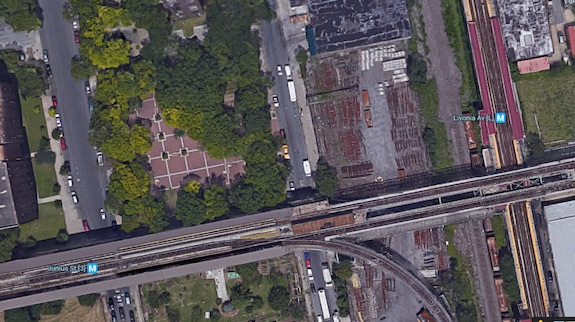
One of those upgrades comes to us on the border of East New York and Brownsville, where the 3 train and the L train cross. As a remnant of history, the L train at Livonia Ave. and the 3 train at Junius St. cross, but there’s no transfer. You can thank early-to-mid 1900s New York City politics for that quirk of the subway system, and this spot has long been one of the most obviously lacking transfer points. For years, East New York and Brownsville residents have clamored for the transfer, and early this year, politicians renewed their calls for the MTA to correct this oversight.
According to the capital plan documents, the transfer will be built out in 2018 and is part of the MTA’s accessibility efforts. The agency will spend $15 million on ADA upgrades and $30 million on an in-system transfer between the two stations. Perhaps a free out-of-system transfer would be cheaper, but $30 million is a rounding error in a $28 billion capital plan. It’s well worth the psychological impact of the work.
In another sense, though, even this minor move is an important one for the MTA and for the city. When was the last transit improvement geared toward East New York or Brownsville? As the city struggles to deal with the fallout from the decision to remove $1 billion from the funding request for Phase 2 of the Second Ave. Subway, the MTA is spending some money to upgrade transportation options in an area that often doesn’t see much attention. As Stephen Smith noted on Twitter, people are noticing:
Random people on the B38 are bonding with each other over the upcoming 3/L transfer.
By investing in areas that don’t often see transit improvements, the MTA can send a message that transit matters. This move can get New Yorkers out of their cars and onto the subway. It can lead to an embrace of transit as something responsive to people’s needs and as something that can improve lives. These aren’t the busiest of stations, but it’s a need that has long been obvious. It’s also something that city residents shouldn’t have to fight this hard to see become a reality.
Across New York, there are a few other obvious transfer points that could yield benefits in the form of conveniences for riders without a significant corresponding drop in revenue. I’m sure those who wish for a similarly obvious connection between the G and the J/M/Z in South Williamsburg are awfully jealous, and they have every reason to be. These minor but important upgrades simply shouldn’t take years to realize.
The Train of Many Colors will celebrate both Games 4 and 5 of the World Series this weekend.
Nearly two weeks ago, I took a look at some light rail initiatives out of Queens. While I’m skeptical of Council Member Elizabeth Crowley’s plan for light rail, I find it encouraging that people are talking about it. The good folks over at LTV Squad took both arguments further as Ray Cevoli wrote two thoroughly excellent posts on the topic. He took apart Crowley’s proposal and then put forward one of his own. I’d recommend you read them both to see how Queens could use preexisting ROWs to improve transit and interconnectedness in a borough screaming out for both.
Additionally, with the Mets forcing the issue tonight, the MTA’s Train of Many Colors will depart from 34th St.-Hudson Yards at 6:30 p.m. on both Saturday and Sunday. The train will make express stops along the 7 to Citi Field. It’s a fun chance for a photo op. Here are the rest of the service advisories. You’re probably better off walking than waiting for the Franklin Ave. Shuttle this weekend.
From 11:30 p.m. Friday, October 30 to 5:00 a.m. Monday, November 2, 1 trains are suspended in both directions between 14 St and South Ferry. Take the 45ACR trains and free shuttle buses instead. Free shuttle buses provide alternate service between Chambers St and South Ferry.
From 11:30 p.m. Friday, October 30 to 5:00 a.m. Monday, November 2, 2 trains run local in both directions between Chambers St and 34 St-Penn Station.
From 6:30 a.m. to 12 Midnight Saturday, October 31 and Sunday, November 1, 3 trains run local in both directions between Chambers St and 34 St-Penn Station.
From 11:45 p.m. Friday, October 30 to 5:00 a.m. Monday, November 2, Brooklyn Bridge-City Hall bound 6 trains run express from Parkchester to 3 Av-138 St.
From 11:45 p.m. Saturday, October 31 to 5:00 a.m. Monday, November 2, A trains are rerouted via the F line in both directions between W 4 St-Wash Sq and Jay St-MetroTech.
From 12:01 a.m. Sunday, November 1 to 5:00 a.m. Monday, November 2, A trains run local in both directions between W 4 St-Wash Sq and 59 St-Columbus Circle.
From 11:45 p.m. Saturday, October 31 to 5:00 a.m. Monday, November 2, Brooklyn-bound A trains run express from 168 St to 125 St.
From 11:45 p.m. Friday, October 30 to 5:00 a.m. Monday, November 2, Lefferts Blvd-bound A trains skip 104 St.
From 6:30 a.m. to 11:00 p.m. Sunday, November 1, C trains are rerouted via the F line in both directions between Jay St-MetroTech and W 4 St-Wash Sq.
From 6:30 a.m. to 11:00 p.m. Sunday, November 1, Brooklyn-bound C trains run express from 168 St to 125 St.
From 5:30 a.m. to 12 Midnight, Sunday, November 1, E trains run local in both directions in Queens.
From 11:30 p.m. Saturday, October 31 to 5:00 a.m. Monday, November 2, F trains are suspended in both directions between Coney Island-Stillwell Av and Kings Hwy. Free shuttle buses operate between Kings Hwy and Coney Island-Stillwell Av, stopping at Avenue U, Avenue X, Neptune Av, and West 8 St. Transfer between F trains and free shuttle buses at Kings Hwy. Consider using the DNQ between Coney Island-Stillwell Av and Downtown Brooklyn or Manhattan.
From 12:01 a.m. Sunday, November 1 to 5:00 a.m. Monday, November 2, F trains run local in both directions in Queens.
From 11:30 p.m. Friday, October 30 to 5:00 a.m. Monday, November 2, L trains are suspended in both directions between Canarsie-Rockaway Pkwy and Myrtle-Wyckoff Avs. Take free express and local shuttle buses and AC or J trains.
Free local shuttle buses provide alternate service between Rockaway Pkwy and Myrtle-Wyckoff Avs, stopping at East 105 St, New Lots Av, Livonia Av, Sutter Av, Atlantic Av, Broadway Junction, Bushwick Av, Wilson Av, and Halsey St.
Transfer between free shuttle buses and L trains at Myrtle-Wyckoff Avs. To/from Manhattan, consider the AC or J via transfers between trains and shuttle buses at Broadway Junction.
Rockaway Park
From 11:45 p.m. Friday, October 30 to 5:00 a.m. Monday, November 2, the Rockaway Park Shuttle is suspended. Free shuttle buses provide alternate service between Rockaway Park and Beach 67 St A station, stopping at Beach 105 St, Beach 98 St, and Beach 90 St. Transfer between free shuttle buses and A trains at Beach 67 St.
Franlkin Ave.
From 12:01 a.m. Saturday, October 31 to 5:00 a.m. Monday, November 2, the Franklin Avenue Shuttle will run every 24 minutes.
The 72nd Street station underneath 2nd Ave., as shown here in September. Will the city see future phases of the long-awaiting subway line? (Photo: Metropolitan Transportation Authority / Patrick Cashin)
The MTA has a penchant for angering everyone. Whether it’s rush hour delays or crowded trains or fare increases, the agency is not high on New Yorkers’ lists of favorite things. But rare are the days when a line item in a budget draws as much ire as the MTA’s move to cut $1 billion in funding for Phase 2 of the Second Ave. Subway did on Thursday. Even though the agency still plans to spend half a billion dollars on design prep and real estate acquisition before 2020, lingering doubts over the project’s future have pushed this move onto front pages around the city.
In a certain sense, the MTA is trying to be practical. That there is a gap of at least three years between the expected revenue service date for Phase 1 and the date they can start construction work on Phase 2 is an indictment of other issues with the MTA’s ability to execute on large problems and plan appropriately. The MTA should have ensured that design work for Phase 2 was wrapped by the time Phase 1 opens so that the transition to work on the next section would be seamless. But the opportunity has passed. Instead, the MTA will prep everything necessary to start work during the 2020-2024 Capital Program.
That is, if you take the agency’s word at face value, and few do. As the implication of the $1 billion reduction in spending sunk in on Thursday, no one was happy. Some noted that the MTA would no longer be applying for federal grants that may or may not be available in five years. Others worry that this is the beginning of the end of the Second Ave. Subway. After 100 years, we’ll get three stations and nothing else.
But a funny thing happened on the way to 125th Street: New Yorkers grew aware of the fact that the Second Ave. Subway was actually under construction and would actually open soon, and they want more. The statements on Thursday came fast and furious. House representatives Carolyn Maloney and Charles Rangel issued a joint statement bashing the decision, calling the MTA’s painfully slow construction timeline a “huge mistake.” The two said:
“While we are delighted that the state and city were able to reach an agreement to move the MTA’s Capital Plan forward, we are deeply concerned that roughly one-half of the reduction in the cost of plan is coming from the Second Avenue Subway. The current plan includes only $535 million for the Second Avenue Subway, most of which will be spent for preliminary engineering and design, as opposed to the $1.5 billion originally proposed. The MTA has also dropped its assumption that it would receive New Starts federal funding for the subway during this capital plan. New Yorkers have been promised a full build Second Avenue Subway since the 1920s. Based on the current schedule, one hundred years will have passed and we will still be waiting. This ‘go slow’ approach to the Second Avenue Subway is a huge mistake. ”
Meanwhile, other local politicians hopped on board. Robert Rodriguez, an Assembly representative from Harlem, condemned the move. “The MTA’s vote to drastically cut the 2nd Avenue Subway budget is shocking and indefensible,” he said. “For over a century, New Yorkers from the Lower East Side to Harlem have patiently waited for transit equality to become a reality.Yet, the MTA’s approved plan has dashed those hopes and told New Yorkers north of 96th Street that they don’t matter. This cannot stand. I call on the MTA to correct this mistake, demonstrate fairness and leadership and include funding in the capital plan to complete the Second Avenue Subway up to 125th Street.”
In comments to WNYC’s Kate Hinds, he called the move an “economic injustice.” Relying on Rodriguez’s statements and words from others, Hinds wrote a fantastic and comprehensive rundown of the move which included a look back at how the MTA used the Second Ave. Subway to court money from the mayor and then cut the planned funding once the mayor ponied up the money. It is a must-read on this subject.
In other coverage, The Times wrote about the near-universal condemnation of the funding move, and even the New York Post editorial board, hardly a bastion of bleeding-heart liberals, noted the class issue inherent in the MTA’s decision, even if they used to bash de Blasio again. How do you build a subway line through the Upper East Side while delaying the one through, as Rodriguez put it, “a lower-income community that certainly needs the access as much as the first phase”?
So what exactly can the MTA do here? They don’t have time to restructure the capital program again. In fact, the funding battle between the Mayor and the Governor which led to a delay in approval of the capital plan is a major reason why Phase 2 is being shifted from the 2015-2019 plan to the 2020-2024 plan. The MTA simply couldn’t execute because the agency didn’t know how much money it would have. What they can do is stress a firm commitment to building Phase 2, secure the promise of federal dollars and look to put shovels in the ground as soon as possible. It’s not a perfect solution, and it raises the question of why Phase 2 isn’t ready to start the day after Phase 1 wraps. But it may be the best they can do. Either way, this has become a major flashpoint issue, and there’s no easy way out.
Phase 2 of the Second Ave. Subway project will eventually extend the route north to 125th St. and west to Lexington Ave., but due to MTA capital funding disputes, construction won’t begin until the early 2020s.
Nobody ever likes to grovel. It’s that antiestablishment aversion to brown-nosers we all develop in middle school, but yet, there comes a time in every person’s career when, if one is not the ultimate, one must grovel. Thus, when the MTA sent out a press release on the MTA Board’s approval Wednesday of the revised and pared-down $29 billion five-year capital plan, agency head Tom Prendergast had to grovel.
“Thanks to the leadership of Governor Andrew M. Cuomo and the hard work of our dedicated MTA staff, this revised Capital Program will reduce costs and deliver projects more efficiently without cutting any projects or the benefits they will bring to our customers,” Prendergast said. You can almost hear him gritting his teeth via press release.
Cuomo played the part. Calling Wednesday a “great day,” Cuomo easily dismissed the months of childish fighting. “I challenged the MTA to revise its Capital Program in a way that reduced costs and delivered results more efficiently, without cutting any major projects or the benefits they will bring to commuters – and that is exactly what this new Program does,” he said. “Along with the State’s historic $8.3 billion investment and significant funding from the City to pay its fair share, this will mean a stronger, safer and more reliable MTA well into the future.”
Take that for what you will (and keep in mind that Cuomo’s funding solution likely just means more MTA debt). Now that the capital plan approval is on its way toward full approval, the reality is that the MTA isn’t exactly underfunded. It can tap into a massive amount of money to keep up current projects and implement future ones. Whether the agency spends well and gets bang for the buck is certainly in doubt, but the money, in some form or another, is there.
So with the capital plan approved — and one that relies more on city input — what’s changed? When the MTA first unveiled the 2015-2019 Capital Program during the summer of 2014, we delved into the request for funds for Phase 2 of the Second Ave. Subway and a variety of other measures, from signal work to Penn Station Access to the MetroCard replacement and beyond. The new plan shows how even a contribution of just a few billion dollars, as Mayor Bill de Blasio eventually ponied up, can skew things.
Notably and most importantly, the idea that Phase 2 of the Second Ave. Subway will see shovels enter the ground before the end of the decade has gone up in smoke. Instead of proposing $1.5 billion for the northern section of the long-awaiting subway line, the MTA has pared down its request to slightly over $500 million, and nearly all of this money is expected to come from federal sources. Here’s MTA-speak on the project:
The proposed 2015-2019 Capital Program provides $535 million to commence SAS Phase 2. This is a reduction of $1.0 billion compared to the previous 2015-2019 capital plan proposal that was submitted in September 2014, reflecting funding availability and the ability to implement scope within the plan period. Included are environmental, design, and real estate and project support to undertake preliminary construction work, such as utility relocation. The balance of the work necessary for operation will be funded in future capital programs.
In plain English, this means that the MTA no longer expects to start the actual construction work on Harlem-bound part of the Second Ave. Subway until the 2020-2024 capital plan comes due. Previously, the MTA had expected some contracts for tunneling to be issued by 2019, but in the capital plan and subsequent comments on Wednesday, officials indicated that this was no longer a realistic timeline, considering the MTA’s ability to undertake the work and available funding. For what it’s worth, the billion-dollar reduction for Phase 2 of the Second Ave. Subway is the single biggest line-item cut in the new capital plan.
Now, this move doesn’t mean that the Second Ave. Subway extension to 125th St. and Lexington Ave. is dead. In fact, it commits the MTA to spend half a billion dollars on this vital part of the line. Rather, it means New Yorkers will have to wait longer for those stations at 106th, 116th and 125th, and, as time leads to more dollars spent, it’s likely to cost more as well. This is a symptom of the phased approach indicative of the funding constraints placed upon the MTA. It’s also a result of the ballooning East Side Access costs as the MTA needs to secure the dollars to finish that project. So we’ll wait until the mid-to-late 2020s instead. What a crazy thought.
Meanwhile, the new capital plan has more projects worth considering over the next few days. As a laundry list, the MTA, under pressure for some reason from de Blasio, will spend a whopping $5 million on the initial studies for a Utica Ave. extension (something I’ll revisit shortly) and will spend the same amount on studying converting Staten Island’s North Shore rail right-of-way to a bus rapid transit route. Investments in the new fare payment system have jumped from $250 million to $419 million, an indication that the MTA actually wants to see this project through, and the agency has yet again vowed to deliver countdown clocks throughout the subways by 2020 as well.
The agency has also signed up for a few more long-awaited subway-related projects. After years of requests, the agency will finally offer a connection between Livonia Ave. on the L and Junius St. on the 3 for a cost of $30 million, and the 42nd St. shuttle may see a big overhaul. (Look for more on that project soon too.) The MTA will also spend $740 million — up from $561 million — on ADA-related projects, including new entrances for the L train at Avenue A.
So that’s a lot to digest, and it barely scratches the surface. You can read through the revised booklet if you wish; the MTA has published it as a pdf. I’m not thrilled about the elongation of the Second Ave. Subway timeline, and I feel it’s indicative of the way the MTA operates (or doesn’t) these days. That’s the cost though of a 10 percent reduction in budget. If that’s the “bloat” Cuomo referred to when he bashed the initial capital plan, I don’t have high hopes for subway expansion until a more transit-friendly governor takes over in Albany. Either way, though, $29 billion is nothing to scoff at.
As something of a follow-up to Monday’s post on the status of the trans-Hudson tunnels, take a gander at this video the Regional Plan Associate has produced. As part of its effort to drive the conversation regarding both rail capacity and a new Penn Station, the RPA has created an easy-to-understand video highlighting why they think we need to invest sooner rather than later in the infrastructure necessary to overcome capacity constraints and stability issues regarding Amtrak’s tunnel. We can debate what should happen to Penn Station (and how much it should cost) for hours, but the video helps put into image the countless words that have been written on the tunnels.
An update in the MTA Board materials shows how the MetroCard replacement has been delayed six months.
When the Mayor and the Governor magnanimously set aside their unnecessary differences to come to an agreement on the MTA’s capital funding gap, it seemed as though a victimless dance had ended. The MTA had its money; the governor had his political victory over the mayor; and most New Yorkers wouldn’t notice any difference. But everything comes with a cost.
For the MTA, the capital funding crisis could have been worse. Though we still don’t know exactly where the money will come from, by reaching an agreement in October, Andrew Cuomo and Bill de Blasio avoided a slowdown of work. Had the political bickering over the money stretched into December, the MTA’s authority to pay for ongoing capital work would have run dry, and the agency would have had to shutdown some projects. As it stands, the MTA had to curtail some impending work, and one of those victims was the MetroCard replacement effort.
When last we visited this topic, the MTA had issued plans to institute a new fare payment system by the beginning of 2020 and phase out the MetroCards by the end of 2022. Now, though, thanks to Cuomo’s and de Blasio’s delays, the MTA had to hold back the RFP for the new fare payment system. Thus, the MetroCard replacement now won’t be ready for customer use until mid-2020, and the MTA expects to complete deployment of whatever the next gen fare payment technology will be until the middle of 2023. Six months may not sound like a lot, but it could potentially be a costly half a year for the MTA and its riders.
It’s not clear how much this will cost the MTA, but there’s certainly a cost involved. When the MTA began the latest push to implement a new fare payment technology, they originally targeted late 2019 as the date for deployment date. After 2019, the cost to maintain the current MetroCard system will skyrocket, as the MTA’s original contracts expire. With what will be a 30-year-old technology still in use, the cost to keep everything up and running will be high, and a six-month delay adds to these expenses. One way or another, riders will be footing the bill, and all of that political bickering will have a real consequence long after Cuomo and de Blasio are no longer holding their respective offices. Don’t let anyone tell you these funding fights don’t matter.
For the MTA, the problem is still one of execution. Ideally, in eight (!) years, the new fare payment system will be ready, but the MTA is still struggling with what this system will be and how it will be implemented. The agency wants to implement a system that relies on a contactless bankcard, smartphone or MTA-issued card, and it must include a new back-end system supporting payment and other financial functions along with a web-based interface for users to refill cards. Certain board members — such as Fernando Ferrar — have begun to question why the MTA is reinventing the wheel when contactless fare payment systems have become the norm throughout the world, but the agency is intent on finding that gem.
If all goes according to the new plan, the MetroCard replacement contract will be awarded in January of 2017 with design, development, testing and installation set to last around 42 months. The MTA’s best laid plans gang aft agley, and they aren’t being helped by recalcitrant politicians using budgetary debates to further petty political disputes. But here we are, and another six months we must wait. That is a real, tangible consequence with real, tangible costs which all will fall on transit riders’ wallets come 2023.
It’s not entirely clear what problem Amtrak is trying to solve with its Gateway Tunnel or how urgent the problem may be.
Amtrak was briefly in the news over the weekend when Chris Christie made a stir in the Quiet Car. Rushing for an Acela from D.C. to the Garden State, the New Jersey Governor either didn’t realize he was in the Quiet Car or didn’t care. One story has him huffing his way out of the Quiet Car after complaints of loud phone calls while another has him apologetically leaving once he realized his mistake. He’s no stranger to Amtrak, and I’m inclined to believe he simply didn’t notice at first that he was in the Quiet Car. The way the story went viral on Sunday though is indicative of the way the Quiet Car has been a success story. If only the rest of Amtrak were this successful.
Meanwhile, the long-range plans for Amtrak’s Hudson River tubes were in the news last week as Crain’s New York took a look at ways the region can increase trans-Hudson capacity before Gateway comes to fruition. Noting that the current condition of the North River Tunnels is “a daily threat to transport and commerce,” Veronica Vanterpool, head of the Tri-State Transportation Campaign, argued that we could and should act now. Generally, she argued for ferries (…) and prioritizing buses through current crossings. I’ll come back to her ideas later this week as they’re worth revisiting on their own.
Let’s look though at the argument surrounding the condition of the North River Tunnels. As now, it’s not exactly clear what the risks are to Amtrak’s tunnels. Seemingly in order to spur political action, the company has warned of potential defects and urged timely action. They’ve been pursuing this line of argument since Hurricane Sandy swept through the 100-year-old North River Tunnels, and in doing so, they’ve obscured the debate to their benefit.
There are essentially three different but intertwined arguments. The first is that trans-Hudson capacity is a problem because it limits the number of people who can enter into and pass through Manhattan in a timely fashion. This is a hinderance to rail expansion and a high-speed rail network running along the Northeast Corridor. The second is that a lack of redundancy makes the Hudson River chokepoint particularly vulnerable to disruptions both now and in the future. The third is that the aging infrastructure needs to be updated but can’t if there isn’t enough redundancy to weather the traffic. By conflating the three, Amtrak can argue that it needs more tunnels because the old ones are in danger of damage, and the system doesn’t have the redundancy required to pick up the load.
That’s all well and good (and perhaps, in a sense, true), but if Amtrak is truly worried that its tunnel is going to collapse, why is it running trains through it on a daily basis? Is this some sort of Russian roulette with rail passengers or a ploy? If the tunnels are going to fail in the future, the argument for investment can focus on needs; if the tunnels are at risk of failing tomorrow, then the time to act was yesterday. One way or another, Amtrak should be clear on these risks. Support for a multi-billion-dollar tunnel hinges on it.





 Rockaway Park


