Category: Brooklyn

  • Culver Viaduct work begins with G extension

    9132521

    A construction fence marks the start of the lengthy Culver Viaduct rehab. (Photo for Second Ave. Sagas by Twitter user JeffreyNYC.)

    The Culver Viaduct work and the extension of the G train deeper into Brooklyn are two stories near and dear to my heart. I first reported on the potential for increased G service in one of the very first posts on Second Ave. Sagas, and when it looked as though the Culver Viaduct rehab would start in 2007, I examined how the G train extension could just be a temporary service upgrade.

    In November 2007, after months of agitating for F express service partly on the basis of the extended G service, I delved into the viaduct plans. At that point, the project had been delayed considerably and was scheduled to start in the fall of 2008.

    As budget woes have plagued the MTA and the project has since been pared down, its fate seemed up in the air. Up in the air until this week, that is. As one of my readers noted late last week, a construction fence has gone up on the Viaduct, and starting in July, the G train will finally be extended along the Culver line to a new terminus at Church Ave.

    Both The Post and Urbanite reported on this change earlier this week. According to the amNew York blog, the MTA Board has to approve this $2.5 million service extension in advance of the viaduct rehab project.

    For now, this move is still billed as a temporary one. The G will gain stops at 4th Ave.-9th St., 7th Ave., 15th St.-Prospect Park, Fort Hamilton Parkway and Church Ave. as well as a transfer to the M and R at 4th Ave.-9th St. The extension will allow for a one-seat ride from Williamsburg and Greenpoint to Park Slope and Windsor Terrace, and if successful, the MTA will consider making it a permanent service extension. Sign me up for that one.

  • Future Travel: A desire named streetcar

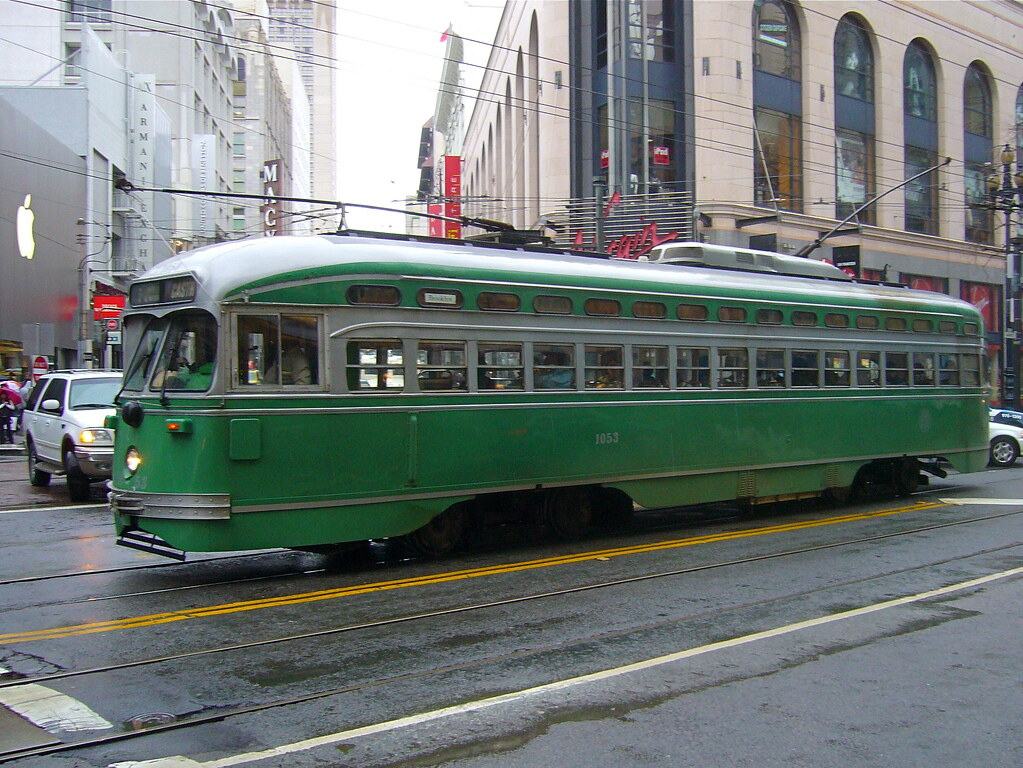
    A Brooklyn streetcar roams the streets of San Francisco. (Photo by flickr user phrenologist)

    Once upon a time, Brooklyn was the borough of streetcars. Powered by catenary wires, this ubiquitous green cars would take Brooklynites from one end of the borough to another. With the advent of the automobile and the rise of buses, streetcars become obsolete. The tracks were ripped up and the wires torn down.

    Now, though, New York officials are making sounds about a streetcar revival in Brooklyn. A few weeks ago while speaking in Toronto, NYC Department of Transportation head Janette Sadik-Khan praised the streetcar revival currently sweeping the nation. Streetcars, says, Sadik-Khan could streamline intra-borough transit while encouraging people to take advantage of their neighborhoods. “In Portland they just started a new streetcar and were able to leverage $3-billion in investment,” she notes. “We need to rebalance the transportation network and make it as efficient and effective as possible.”

    Last week, Yonah Freemark of The Transport Politic unveiled a very comprehensive study of potential streetcar routes in Brooklyn. Freemark analyzed current transportation patterns in the borough and proposed the following as a potential streetcar route. (Click the map to enlarge.)

    It is a very appealing vision, and it’s easy to see how Freemark’s network fits in with my proposed Select Bus Service qualifications. These streetcar lines connect various subway routes at points deep in the borough, and they bring transit to underserved areas. This scheme offers up the option to connect into Queens, and the line terminating at Starrett City could easily extended out to JFK Airport.

    There are of course very real objections to streetscars and very persuasive arguments in their favor. This came last summer when we discussed America’s streetcar renaissance. I’ll rehash them from this comment thread.

    First, streetcars are clean technology. They rely on electrical power and do not emit exhaust. Buses on the other hand are only at their environmental best when full. Otherwise, they are historically inefficient automobiles. Streetcars encourage development along their routes; they run faster; and they eliminate some congestion by discouraging short-distance driving.

    On the other hand, unless a city builds a dedicated right-of-way, these streetcars are beholden to surface traffic patterns. They can’t maneuver around accidents or traffic the way a bus can, and the catenary wires are rather unsightly in an urban environment. With the right-of-way, they aren’t appreciably more cost-efficient than bus rapid transit systems.

    As Freemark notes, a streetcar system would require a serious transit investment. It would require infrastructure and rolling stock as well as a drastic overhaul of the Brooklyn streetscape. While we might want to toy with the idea, for now, it just might be a pipe dream

  • New bus shelters installed on doomed routes

    A Cemusa bus shelter on Manhattan’s East Side. Similar bus shelters have recently gone up along soon-to-be-axed routes in Brooklyn. (Photo by flickr user animalvegetable)

    The bureaucracy in New York City is famed for its lack of interagency coordination. The MTA and Department of Transportation may cover similar ground, but prior to the last few years, the two agencies were rarely in tune with each other. Since Mayor Bloomberg has put forward his desire to make the city more pedestrian- and environmentally-friendly, NYCDOT and the MTA have been more cooperative. The recent Select Bus Service/Bus Rapid Transit plans are indicative of this effort, but now and then, the old bureaucratic mess reasserts itself.

    Such was the case recently when Cemusa, the company that has contracted with the city to install bus shelters and newstands across the five boroughs, replaced some old bus stops along the B23 route on Courtelyou Road in Brooklyn. While the neighborhood appreciated the new shelters, there was one not-so-minor problem: In less than six months, the B23 will cease to exist as a bus. It is one of the lines slated for the impending service cuts. Oops.

    James Barron of The Times covered this amusing story of bureaucratic snafus and transit woes recently. He writes:

    Two bus shelters on Cortelyou Road in Brooklyn — one at Ocean Parkway, the other at East Fifth Street — were replaced this week with shiny new steel-and-glass structures that can keep passengers on the B23 bus line dry on rainy days and unmussed on windy ones.

    But the B23 is one of six bus lines in Brooklyn that the Metropolitan Transportation Authority says it will eliminate unless it gets a financial lifeline from the State Legislature.

    Asked why new shelters were being installed along a line that could soon disappear, Seth Solomonow, a spokesman for the Transportation Department, noted that the proposed service changes were not definite. “But we will postpone any further installations on affected routes until the situation is clarified,” he said.

    Amusingly enough, the area’s residents had a better idea of what was going on than the Cemusa workers did — that is, until the new shelters popped up. “I figured they were just beginning to prepare for the service shutdown,” Antonio Rosario said to The Times. “This makes no sense.”

    Of course, Cemusa has since halted shelter replacement along the doomed line, but I wonder what will become of the new shiny stops. They’ll sit there, bright and unused, until the MTA has the money and political capital to restore the cut services. They’ll sit there as a monument to services we have lost and a reminder of our State Senate’s unwillingness to support transit. How fitting.

  • An MTA problem grows in Brooklyn

    Brooklyn pols are looking for more than just this quick fix to some prominent Brooklyn subway problems. (Photo by flickr user Gatto Arancione)

    Once upon a time, Jay St./Borough Hall and the 4th Ave./9th St. stops were two of the nicer destinations in the subway system. The former served as the headquarters for New York City Transit while the later once featured windows overlooking 4th Ave. with Brooklyn beyond.

    Today, these stations are among the worst in the system. The Jay St. stop is forever in a state of disrepair, and as numerous photos show, the station appears to be a permanent work zone. Further down the F line, a long-overdue rehab for the 4th Ave./9th St. stop got the axe when the MTA’s finances went south.

    Now, Brooklyn politicians and residents are demanding solutions to these blighted stations. On the Jay St., side, Brooklyn Borough President Marty Markowitz wants the MTA to address both the state of the station and its former headquarters, no empty, at Jay St. Reports a trio of Daily News staff writers:

    Despite promises to spruce it up, the Metropolitan Transportation Authority has let 370 Jay St. and its subway hub become a “blight on the face of downtown Brooklyn,” said…Markowitz. “This section of Jay St. is an embarrassment – and our commuters, residents and local businesses deserve better…”

    Most of the 14-story building, which the MTA leases from the city, is vacant. The facade is wrapped in scaffolding and black mesh, giving it the look of a haunted house.The subway station is even worse, with columns that are missing tiles, lots of chipping paint and large sections of the platform sealed off with plywood.

    MTA officials insist they are going to invest $106 million to rehabilitate the station and that funds to fix the building above it are in the next capital improvement plan.

    Famous last words from the MTA.

    Meanwhile, the Park Slope Civic Council has called upon the MTA to prioritize the mess at 4th Ave./9th St. The council wanted the MTA to open a long-shuttered second entrance to the busy station, improve the dim lighting underneath the Gowanus Viaduct and court retail for the deserted stretch of 4th Ave. under the station. The MTA will not be adopting any of these proposals at the current time.

    While this is always a matter of money that the MTA doesn’t have right now and probably won’t have in the future, it’s a shame that these Brooklyn stations continue to get the shaft. Brooklyn, after all, features some of the more beatific rides in the city. If only its stations matched the scenery.

  • The city across the river

    For New Yorkers living outside of Manhattan, “the City” has long been shorthand for the island around which the rest of the world revolves. For others, well, Brooklyn, Queens, the Bronx and Staten Island are all a part of New York City, and in some cases, with more residents than Manhattan, these other boroughs deserve their urban recognition as well. It seems that the MTA is getting on the debate. As Bed-Stuy Banana pointed out, the Nostrand Ave. subway stop along the IND Fulton St. line now tells riders which way to go if they want to head into “The City.” Casual nomenclature knows no bounds. [Bed-Stuy Banana]

  • Tempering the BMT Brighton Line enthusiasm

    For a crowded subway line with infrequent off-peak, the BMT Brighton Line — more commonly known as line serving the Q and the B trains — sure has been feeling the love this week.

    Nicole Brydson, a freelance writer and self-proclaimed gentrifier, penned a paean to this subway line for The Observer. She is sincere, if a little naive, in her treatment of central and southern Brooklyn, and the piece reads as a warning for people fearing gentrification.

    Brydson, as I am, is a 20-something Manhattan native who’s settling down in Brooklyn. Her Observer column details her life out here in the wilds of Prospect Heights. She is a gentrifier, always searching for the Next Big Neighborhood, and proud of it too.

    In her piece on the Brighton Line, Brydson bases her analysis around the 7th Ave. stop. She writes about how “biggest factor in finding an apartment was its proximity to this train line and especially to the 7th Avenue station.” Southern Brooklyn, she says, “seems to be getting a makeover.”

    As she praises the Q and B, she calls these trains more reliable versions of the L, that great symbol of gentrification. We don’t suffer through endless years of construction, inexplicable delays and sluggish rides into and out of Manhattan. Plus, the Q and B, as the L did years ago, are taking people into uncharted territories.

    But for all this pomp and circumstance, the Q and the B just aren’t another L train. The Brighton Line travels through some of Brooklyn’s oldest neighborhoods. The train once served Ebbets Field and the countless families who grew up in central Brooklyn, children of immigrants. It stretches into some of the more Orthodox religious communities in the city and extends its tentacles into strong ethnic enclaves in Brighton Beach. It even features some of the city’s best pizza just steps away from the Ave. J stop. While Williamsburg and Bushwick were ripe for development, the neighborhoods along the Q and the B have far deeper roots and much stronger communities than did the stops along the L train.

    Now, I love the Q and the B as much as the next person. I ride the B everyday, and the Brighton Line trains, when they show up, offers the fastest ride to and from Manhattan. The trip across the Manhattan Bridge certainly makes for a serene five minutes as well. But perhaps we’re taking this love of the Q and the B a little bit too far.

    Outside of the quaint neighborhoods and slice-of-life glimpses the Brighton Line offers, the trains — especially around rush hour — don’t make for a very pleasant commute. Try cramming yourself onto a stuffed Q train at 8:45 a.m. or a Brooklyn-bound B at 6:15 p.m. You can’t without pushing, shoving, cursing under your breath, sucking in your gut and stepping on someone’s toes. The trains don’t score high on the Straphanger Campaign’s cleanliness metrics; and as Flatbush Vegan pointed out, the new trains make for less seating capacity than ever. (The new R160s have more standing room but 120 fewer seats per train than the old R68s.)

    When it’s not rush hour and one can actually find a seat, the wait times, particularly when the B isn’t running, often seem interminable. Trains run every 8-20 minutes at nights and on the weekends. When the B is running, the 7th Ave. wait lines shouldn’t be longer than five minutes. But further down the line at the local stops and during off-peak hours, those 20 minutes just drag by.

    Like every subway line in the city, the BMT Brighton Line has its special charms. It has a zoetrope in an abandoned station, an earthen embankment section that runs near the site of the worst accident in New York subway history and a great view of the Brooklyn Bridge and New York skyline as it crosses the Manhattan Bridge.

    But the line is not some train mecca, and its neighborhoods are more worthy than to be considered the next great frontier in the endless gentrification of New York City’s outer boroughs. Let’s love it — along with its the southern Brooklyn neighborhoods — for what it is and not what Manhattanites priced out of their home borough would like it to be.

  • Southern Brooklyn stations may be too far gone to paint

    I love it when the MTA’s efforts at painting make the news. Last July, we saw the MTA paralyzed by indecision because they couldn’t figure out which stations to paint. Seven months later, in February, the MTA finally announce plans for an absurdly slow plan to paint every station. Today’s news is just as entertaining but fairly alarming as well.

    According to a report in The Brooklyn Paper, three stations in Bay Ridge may be getting skipped over for paint jobs because they are in such a bad state of repair that a paint job wouldn’t do anything for them. Some of this report seems to be conjecture by Gersh Kuntzman’s paper, but I think they may be on to something.

    Ben Muessig reports:

    While the peeling and flaking 77th Street R train station is about to get a new paint job, The Brooklyn Paper has learned that Bay Ridge’s other grimy stations may not get one because they suffer from such serious infrastructure problems that a paint job would offer only an inconsequential uplift.

    The MTA says it’s including 77th Street in a $52-million project that will put a fresh coat of paint on stairways, platforms and mezzanines throughout the city — but the gritty Bay Ridge Avenue, 86th Street and 95th Street stations will not be included in the job.

    In choosing which stations to repaint, the MTA did not consider stops that suffered from larger problems — like water leaks, transit spokeswoman Deidre Parker said. “It depends on when they were last painted, or if they were rehabbed recently,” she said. “If they need other extensive work, they’re not going to paint over existing problems.”

    While Parker had, according to The Brooklyn Paper, no further information about the decision to omit the Bay Ridge stations from the painting plans, it seems as though deeper questions surrounding the infrastructure and state of the stations may be in play.

    The story in The Brooklyn Paper comes out one day after Thomas Friedman urged the nation to invest in transportation infrastructure, and the timing couldn’t have been better. For the MTA and for this city, this news is one more alarming sign that we need some serious levels of investment in the subway system. It’s state is precarious, and as more stations fall into disrepair, the system will suffer.

    The trains may be new; the tracks may be in good shape; but the stations are starting to fall apart. How far this will go is up to the politicians holding the purse strings. Sadly, they don’t seem to be in a rush to do much of anything about it.

  • G train advocates dismayed by MTA’s ‘grave injustice’

    At the end of last week, when New York City Transit announced that some service increases were heading our way in July, one line was noticeably absent from the list. That line was, of course, the IND Crosstown train, better known as the G train.

    In fact, in writing about the service changes, Times transit reporter William Neuman explicitly mentioned the G train:

    One line that had been scheduled for more service in the original proposal last December but was not included in this round of improvements was the G. Riders on the G often complain of long waits between trains. Officials said the G did not exceed the loading guidelines.

    In English, that means that, based on metrics set by NYC Transit, G train capacity and wait times were within acceptable margins. In other words, tough.

    G train activists — some of the more vocal in the system — were outraged. “The M.T.A. has done a grave injustice to G train riders and commuters in Brooklyn if it fails to enact service enhancements,” Hakeem Jeffries, Assembly representative from Brooklyn said late last week.

    What Mr. Jeffries conveniently left was his anti-congestion pricing stance. While bemoaning the fate of service along a train important to his constituents, Jeffries didn’t offer up a mea culpa on his stance surrounding a plan that would have brought in money for the MTA to fund service upgrades.

    This is, of course, nothing new for beleaguered proponents of the G train. While not the most devoted blogger, Teresa Toro’s Save the G organization has long fought for more service on the only major subway line to eschew the borough of Manhattan. And in this case I have to side with Toro, Jeffries and G train riders.

    The MT’s loading guidelines view service overall. It’s true that the G train on weekends and off-peak times is mostly empty, and the ten-minute intervals between trains is manageable. But during rush hour, as residents from Gowanus to Greenpoint to and from Forest Hills to Long Island City scramble to make their G train connections, the four-car and six-car trains are packed to the gills. While the MTA needs to balance G train service with the demands of the Queens Boulevard trains, the G — particularly in the norther stretches of Brooklyn — needs more rush hour service. How and when it will happen is anyone’s guess.

  • Wrong time, right idea for G train activists

    The G train activists are so sincere. They have a website and blog devoted to their cause, and they’re working really hard to push the G train connection to Atlantic Ave. The only problem is that their efforts are coming at what is probably the worst time for rider activism in the city.

    Yesterday, one day after the MTA learned it wouldn’t have congestion pricing revenues for their coffers, G train activists took their case before the sympathetic City Council. Good ol’ John Liu and the transportation committee were more than willing to take the MTA to task for neglecting the only subway that connects Brooklyn to Queens without traveling into Manhattan. Raanan Geberer from the Brooklyn Daily Eagle tells us more, but it’s nothing all that new:

    Brooklyn officials and activists told horror stories and demanded better service on the much-maligned “G” train, while the MTA, in effect, pleaded poverty based on today’s economic situation…

    Current MTA plans for the line, which has suffered serious cutbacks since late 2001, involve what could be interpreted as “giving with one hand and taking from the other.” This would involve extending the line from the awkward Smith-9th Street southern terminal in Red Hook down to Church Avenue, adding five well-used stops.

    But in return, the permanent northern terminal would become Court Square, near Long Island City. Cutbacks from a Forest Hills terminal to Court Square were what started the G protest rolling back in late 2001 – nowadays, the G only goes to Forest Hills on the weekends and late at night, and when track work ensues, it doesn’t even run then.

    There’s nothing like City Council members grandstanding on an obvious issue either. “Many people call the G train the stepchild of the transit system, but I call it the abused child, the abandoned child,” Councilmember Letitia James said. “When I was a girl, when I got a `G’ on a paper, it meant “good.” But in the case of the G train, `G’ means God-awful, and it means the train is running like it’s in a ghetto.”

    Said Joanne Simon, “Rider consensus is that the route serves too few stations, that the stations have suffered significant neglect, and the service is inadequate.”

    Of course, none of these charges are new, but what’s the MTA to do? They have to balance the demands of the service with the volume in the Queens Boulevard tunnel, the track work on the Culver Viaduct and their currently bleak financial situation. The MTA has already withdrawn plans to add cars and more service to the G line, and they still don’t know if the Church Ave. extension will be permanent or temporary.

    Meanwhile, while it’s reasonable for G train advocates to ask for better service, some of their demands — like an underground connection to Atlantic Ave. — are just flat-out absurd. An above-ground free transit would be appropriate, but sinking hundreds of millions of dollars into a 600-foot tunnel will never be the best use of MTA funds.

    The G train activists have their point: The G line has become a vital subway line for communities along its path and an important connector for folks wishing to avoid the long trip from Queens to Brooklyn via Manhattan. When the money is there, G train upgrades are seemingly on the top of the MTA’s list. But right now, with congestion price hopes dashed and a nation on the brink of a recession, the G train activists are simply fighting for the right causes but at a very wrong time.

  • Brooklyn pols push G tunnel at Atlantic Ave.

    The G train, running through Brooklyn and Queens, is almost a good train. You can almost get from Park Slope to Williamsburg and beyond. You can almost transfer to the other lines.

    But the G train is also a big tease. For the next few months, until the Church Ave. extension is in place, the G doesn’t quite make it to Park Slope. And it stops tantalizingly close to the Atlantic Ave. hub, just four blocks away. There is, however, no transfer available.

    A Brooklyn politician would like to fix that problem. Fresh off successful efforts to connect the A/C/F stop at Jay Street with the M/R stop at Lawrence St. via an underground tunnel, Brooklyn pols and business lobbyists are urging the MTA to study a connection between the G at Fulton St. and the Atlantic Ave.-Pacific St. complex. Separated by only 660 underground feet, a free transfer could give life to the oft-derided G train.

    Sarah Ryley, reporting for the Brooklyn Daily Eagle, has more:

    Councilwoman Letitia James is asking the MTA to study whether the G Train at Fulton Street could be connected to the Atlantic Avenue transportation hub via an underground tunnel, she told the Eagle…

    “I understand that the MTA is cutting back on all their capital projects, but I want them to at least look at it and get a feasibility study,” said James, who represents Fort Greene and Clinton Hill. She said she’s working with Assemblyman Hakeem Jeffries on the matter and would suggest the project to help ease traffic as part of the mayor’s congestion pricing plan.

    “It would definitely increase ridership,” she said.

    According to an MTA spokesperson, the agency has yet to study this issue but will respond to James’ request shortly. Cost, however, will be a major red flag. The 50-foot tunnel at Jay St. will cost $130 million; a 660-foot tunnel would be significantly more costly, and in the end, its benefits would be limited in comparison to other capital campaign projects that could use the funds. I would probably study a connection between the G at Fulton St. and the C at Lafayette Ave. first. (Editor’s Note: Just use the connection at Hoyt-Schermerhorn.)

    In the meantime, G riders could see a free above-ground transfer between Fulton St. and Atlantic Ave. similar to the one at 63rd St. in Manhattan between the F and the trains that stop at 59th St. and Lexington Ave. Even that small gesture would be a step in the right direction.