Today is the final part of a four-part series on the Future of the MetroCard and smart card technologies. Part 1 outlined the benefits of smart card technology; Part 2 outlined the deficiencies of the MetroCard; Part 3 summarized the current plans for a smart card in NYC; and Part 4, below, proposes a new smart card for NYC.
The NY Times this morning had additional coverage on Bloomberg’s free cross-town bus proposal, as well as his push for a NYC smart card. According to the article, Mr. Soffin, an MTA spokesman, insisted that the MTA’s pay-pass pilot (on the Lexington Avenue Line) would be expanded to some buses by the end of the year. No word on a potential link with the Port Authority or New Jersey Transit, as the Philadelphia Daily News reported in July.
Part 4 – Get Smart
Although the specifics remain unclear, there are enough whispers from Elliot Sander, Jay Walder, Bloomberg, and the Port Authority to glean that an inter-agency smart card (in some form) is on its way. Outlined below is a proposal for what I believe such a smart card should look like in NYC.

A fantasy smart-card for NYC. Could this be our future?
1. Contactless RFID-Chips
I admit that I do not understand all of the technology behind fare cards, but I can say with certainty that the magnetic strip technology of the current MetroCard is not capable of performing all of the functions of a full-fledged smart card. Smart cards use an RFID chip, which enables a greater amount of information to be stored on a card than on a magnetic strip. Many credit card companies have supplemented magnetic strips with RFID chips on their own credit cards, because the capacity of RFID offers space for security features that permit users to use the card without a PIN. These same security features enable transit agencies to create smart card management systems for riders online. Additionally, the capacity of RFID allows one card to carry multiple pieces of transit information: an unlimited pass, a user’s transit status (student, handicapped, senior, etc.), transit balance, etc..
In addition to holding a greater capacity, RFID chips are also incredibly durable and adaptable. Even if a magnetic strip could implement all of the technological benefits of an RFID chip, it would have to be replaced at least as often as the average, well-used debit card. And unlike magnetic strips, an RFID chip can be embedded into virtually anything: cell phones, key chains, and even bizarre, carbon-tracking gloves. In Hong Kong and Britain, transit RFID chips are embedded into bank debit cards, streamlining wallets with one fewer card and enabling users to re-fill their transit accounts at bank ATMs.
Yet let’s take this a step further. Imagine a day when you can buy your transit tickets and passes on your smart phone. When you arrive at a fair gate or enter a train, instead of waving your smart card over a sensor – you’ll wave your RFID-embedded phone. In other words, your phone has become both the ticket vending machine AND the ticket. No MetroCard will ever be able to do that.
Finally and most importantly, RFID chips enable Contact-Less payment. While the MetroCard seems relatively fast, anyone who has used a contact-less smart card will tell you that it’s slow and prone to error. Currently the NYC subway system is bursting at the seams with over 5M riders on a weekday, and that number will continue to grow. A fast fare payment system will reduce congestion at subway turnstiles and dramatically speed payment on buses.
2. Inter-modal Compatibility
Like the Oyster and the Octopus, NYC’s smart card must be inter-modal. As outlined on Monday, the smart card has the power to remove psychological and logistical barriers between transit systems and modes. Once those barriers are removed, transit systems see greater flow between complementary, connecting modes.

As readers mentioned in their comments, implementation on each respective mode will require coordination and planning. While subways have logical entry and exit points, commuter rail lines do not. International systems, however, offer many examples of successful implementation on different modes of transportation. On the National Railway in London, conductors carry digital readers that scan the smart cards. Each rider’s card has a monthly pass, a digital one-way ticket purchased on the platform, or a fund to debit the ticket purchase. The flexibility of the technology ensures successful, inter-modal implementation.
3. MTA, Lead the Way! Sort of. . .
The politics of creating a regional smart card for NYC will undoubtedly be complicated. On the one hand, the Port Authority has traditionally played the role of inter-state transit leader. In order for the smart card to be a success, however, the MTA will play the most important role.
As outlined yesterday, the Port Authority has already implemented SmartLink, a smart card that has many of the features of modern smart card technology. Not only is it contact-less, like the Oyster or the Octopus, but its value can be controlled through the SmartLink website. The PA’s pilot for an expanded smart card system presumably will utilize the SmartLink.
A smart card in NYC, however, must be implemented first on the NYC Subway and NYC buses, because it the most efficient way to achieve a critical mass of smart card users. Unlike on commuter rail systems, smart card implementation on the subways/buses will be straightforward both for the MTA and most riders. Furthermore, since subway and bus ridership are so large relative to all other systems, smart card success on these modes would encourage its success on other modes/systems. Riders will gravitate to the fare card they use most frequently or is most popular.
As a result, implementation of a NYC smart card should follow a pattern that first establishes mass acceptance and then builds upon that foundation to link other systems that do not traditionally share the same fare collection system:
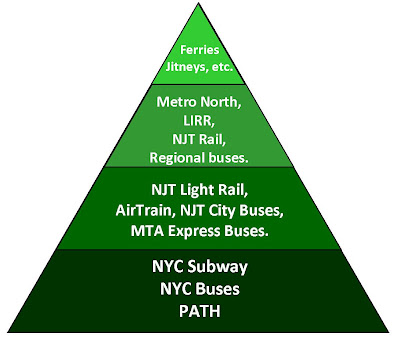
A. Start with systems where implementation is straightforward, ridership is greatest, and services are already linked: NYC Subway & Buses.
B. Extend implementation to popular connecting services that are intuitive extensions of the existing implementation: PATH, Hudson-Bergen Light Rail, Newark Light Rail, NJT Local Buses, AirTrain, etc
C. Extend to connecting systems that require more complex implementation and potentially contradict users’ traditional payment methods: LIRR, Metro North, NJT, Regional Buses, etc.
D. Extend to systems with lower ridership: Ferries, private jitneys, etc.
Although this project must rely on the MTA’s participation in order to achieve success, it should not be, nor can be, the sole agency leading its design. In my opinion, the Port Authority is unique in NYC for its role in bridging different governments and transit systems. Furthermore, the SmartLink card has already been successfully developed and piloted on the PATH. As a result, the MTA should not build their own smart card. Instead, they should take advantage of the Port Authority’s already completed R&D work by adopting the SmartLink and then working with the Port Authority to spread it to other systems.

4. Super-Regional Compatibility
Several readers expressed concerns about the boundaries of a NYC smart card. Reader Avi remarks:
“But once you add NJ Transit you open up a whole new can of worms. NJ Transit shares a station (Trenton) with Septa. Do you add Septa to the system? What about the NJ Riverlines? PATCO? It’s easy to keep saying yes, yes, yes, but before you know it you’re trying to coordinate an agreement between 10+ different agencies in 5+ states. Good luck getting everyone to agree on that.”
First, thank you, Avi, for your comment – it’s a very important point. Before I address it, I would like to remind everyone that we shouldn’t limit our plans simply because they seem complicated or overly ambitious. If planners had felt the same way 100 years ago, we never would have built NY’s current subway system.
Second, don’t underestimate the power of the smart card. If the Philadelphia area issued its own smart card for SEPTA, PATCO, and NJT services in the Philly area, there is no reason why this system could not be compatible with New York’s system. On Massachusetts highways, for example, the toll collection system is Fast Lane, but is fully compatible with EZ-Pass. The technology of RFID chips and their linkage to credit cards and bank accounts could easily allow for cross-system compatibility. In fact, planners in Philly are already planning to ensure potential cross-compatibility, by creating an “open-loop system” that will allow any RFID-enabled device to pay for the services.
Even if we presume that cities – DC, Philly, New York, Boston – remain the epicenters of respective smart card systems, we can presume that each card can be designed or adapted to ensure cross-compatibility. As a result, services that exist on the border of two transit eco-systems, like the RiverLine (NY and Philly), can accept more than one smart card. Regardless of which card you use, the appropriate agency will still receive the fare.
 When an eleventh-hour Albany bailout package earlier this year ensured that the MTA would not need to institute its original Doomsday budget proposal, I ran something of a postmortem on the transit advocates’ roles in the debate. In a rather scathing piece that generated strong feelings on both sides of the divide, I questioned the Straphangers’ approach toward their advocacy campaign and wondered if they were truly taking advantage of their position as the city’s leading — and sometimes only — transit advocacy group.
 Faced with a budget gap of a few hundred million dollars, the MTA may be targeting a politically sensitive giveaway that is bound to get New Yorkers riled up over the looming service cuts. According to a report in the Daily News, the authority is considering
 When the MTA raised fares earlier this year and continued the 15 percent pay-per-ride bonuses, the agency inadvertently created a crisis of mathematics among New York City’s straphangers. With a base fare of $2.25 and a volume discount, a rider has to buy 20 rides for $45 to earn a bonus of $6.75 that results in 23 rides for the price of the original 20. Yikes.

 By 1997, when the MetroCards turned from blue to gold, the technology was already obsolete. That year, Hong Kong launched the Octopus Card and became the first municipality to use a contactless smart card for its public transit fare payment system. While the MTA’s MetroCard has become ubiquitous in New York, cities around the globe from London to Washington, DC, have all embraced a smart card-type payment program.

