Category: MTA Absurdity

  • Murder at the Canal Street station

    Kill or be killed as you wait endlessly for the Q at Canal Street. (Photo courtesy of 31 Down Radio Theater)

    Well, that caught your attention, eh? Someone’s been killed at the crowded Canal Street stop? Well, not quite. I’m sad — or happy — to report that no one was murdered at the underground entrance to Chinatown.

    The murder is part of an interactive performance by the public artwork troupe 31 Down Radio Theater called Canal Street. The action takes place in labyrinthian tunnels of the Canal Street Station, and you, the detective-cum-straphanger, are supposed to solve the mystery. For $2 — or less — you too can be a New York detective. Time Out New York wrote about this intriguing work last week:

    For all the improvements over the past decade or so, the transit system is still kind of creepy, which makes a new interactive public artwork by the group 31 Down Radio Theater all the more diabolical. With just a swipe of your MetroCard, it puts you in the middle of a murder mystery unfolding in the Canal Street subway.

    According to creator Ryan Holsopple, the piece, titled Canal Street Station, consists of a toll-free number you can dial from any of the pay phones there. The voice of one Niki, an archetypally breathy French girl, comes on to say that she’s just committed a murder, and that you need to find her somewhere in the labyrinth of platforms and tunnels connecting the J, M, Z, N, Q, R, W and 6 trains. “Basically, it’s a big game,” says Holsopple, who adds that depending on where you are, you’ll be asked a specific question about that location—maybe for a detail from a nearby mosaic or which train goes to Fresh Pond Road in Queens. You hang up, snoop, then call back with your answer. If correct, you’ll be told where to go for your next call.

    I love this idea; I can’t wait to do it, and a few things leap out at me. First, this game relies on the payphones in the New York City subways. Wait a minute, you might be thinking, do those payphones actually work? Well, about a quarter of them don’t work. So part of the game is finding a working payphone at Canal Street. (The other part involves finding one you want to touch. Good luck with that.)

    Next, I think this game is best played at rush hour. That Canal Street station is a zoo during the day; why not really go for the “confusing masses of harried commuters” theme that would so enliven the game? You can push against the tide of humanity as you dash from the Brooklyn-bound N/Q platform to the uptown J/M/Z tracks.

    So there you have it. You can spend an hour, as the theater troupe suggests, running around Canal Street trying to find out minutiae about the subways in an effort to solve a murder. Test the payphones; test your patience. And have fun. It’s the best $2 or Unlimted Ride swipe you’ll spend this month.

    And who knows: Maybe she would have gotten away with it if it weren’t for you meddling kids and your dog too.

    To get started, head to the Canal Street station; pay the fare; find a payphone and dial 1-877-OR-WHAT-31 (1-877-679-4283). Canal Street will be in the Canal Street station until October.

  • If you see something, blog about it

    ifyouseesomethingbark.jpg

    Don’t worry about terrorists; K9 Emily is on the prowl.

    As I rode the uptown local from 66th St. to 96th St. this afternoon after catching a movie at the Lincoln Square Cinemas, my eye alit upon the ad above. Except it was in Spanish. So for four stops, I got a huge kick out of the ad that read, “Usted usa sus ojos. Ella usará su hocico.”

    I’ll use my eyes; she can use her snout. I felt safer already.

    Unbeknownst to me, I wasn’t the only one noticing the MTA’s ubiquitous yellow anti-terrorism ads urging individual attention to suspicious things in the subway. (And, no, we’re not talking about the guy selling pirated DVDs as suspicious as that may be.) Since I didn’t get a chance to read the Friday business section in The Times, I missed this brilliant article on the successes of the “If you see something, say something” advertising campaign.

    The short version: In the post-9/11 climate, the MTA hired Korey Kay and Partners to come up with a catchy slogan. They’ve certainly succeed as more than 30 organizations worldwide now use some variation on the theme.

    They include the Alexandria Transit Company in Virginia; the Australian states of New South Wales, Queensland, Victoria and Western Australia; Bay Area Rapid Transit; the Chicago Transit Authority; the Massachusetts Bay Transportation Authority; and TriMet in Portland, Ore.

    “We wanted something that was punchy and catchy enough to not fade in the background,” said Christopher P. Boylan, a deputy executive director at the M.T.A., “and makes a connection with every one of our passengers.”

    At the same time, said Allen Kay, chairman and chief executive at Korey Kay, “there was concern there could be backlash, concern we were using fear tactics,” so consumer research was used to determine perceptions of the theme.

    While Kay may have been concerned about the negative backlash, I’m a bigger fan of all of the parodies that seem to find there ways around the Internet and the city. My all-time favorite I spotted a few months ago on a downtown E train. It said, “Bush is still President, say something.” Sadly, I couldn’t capture it for posterity, but others have. Let’s take a look. (All links pop to show the pictures.)

    Some folks have taken to using pink pig stickers to lively up the posters. That’s just as good as drawing mustaches on news anchor’s faces. It never fails to amuse.

    Then, there are those who edit the slogan a la the President Bush one. I’ve seen many. One of my favorites is “If you see something, run like hell.” That one is poignantly sad in its veracity.

    But beyond humor, people have taken to using this slogan as a political statement. Here and here are political diatribes against the current administration.

    And even the Spanish signs have provoked the ire of vandals and xenophobes everywhere. When The Post ran an op-ed piece against the Spanish signs during the height of the anti-immigration debate last year, some straphangers decided to cut out the column and stick them behind the plastic ad coverings in the subway. If you see something, say something indeed.

    So then is this ad campaign a success? Well, it’s used the world over, and everyone in the city immediately knows what you’re talking about when you mention it. But it seems more humorous than anything else. Everyday, I see weird sh*t in the subway. If I said anything all the time, well, then I would just have to start a blog about it.

    Hey, wait a second….

  • NYCT to Shuttle Riders: Keep on minding the gap, buddy

    The 42nd Street shuttle awaits passengers while sitting on the Track 3 curve at Times Square. (Courtesy of flickr user gsdali)

    In certain stations in the London Underground, a soothing voice with a slight British accent repeats ad nausea to passengers, “Mind the gap.” These stations sit on steep curves in the tracks that lead to a separation of more than a few centimetres between the platform and car edge, and the phrase has taken on a cultural significance that sees it printed on t-shirts and mugs all over London.

    In New York, the MTA ignores the gap problem and pushes off necessary repairs for years in order to prioritize other capital projects. As part of the never-ending Times Square rehabilitation project, the MTA planned to fix the gap problem that led to a whopping 12 personal injury claims over the course of five years ending in 2005. But now, the MTA, already searching for solutions to the LIRR gap problem, won’t mind this gap until at least 2010, amNew York reports.

    while the MTA worked to renovate much of the Times Square station during the same [five-year] period it quietly decided last year to postpone work on the Shuttle platform until the 2010-14 capital plan is implemented.

    “It’s a shame that they pushed it back. It’s like renovating your house and leaving the entrance the same,” said MTA board member Andrew Albert.

    The gaps in question — those on Shuttle Track 3 measure up to 14 inches or eight inches more than the accepted six-inch MTA gap — came about because the 42nd Street Shuttle runs on the original IRT route. At 42nd St., the route curved from an east-west track along the Avenue I’m Taking You To to head up north on 7th Ave. The stop at what was never Longacre Square — that name went out of fashion in April of 1904, six months before the first IRT train pulled in to Times Squares — ended up on that curve that brought the train north. And thus there is a gap that must be minded.

    While platform extenders make it somewhat less dangerous, the ones in Times Square are underneath the platform unlike the giant noisy sliding things at South Ferry and Union Square. So people still trip, fall and tumble out of wheelchairs. The MTA has taken steps to solve this problem.

    Those steps? Said NYCT spokesman Paul Fleuranges to amNY: “We just ask our customers to use the gap fillers and where not possible, take their time and be mindful of the gap.” So, uh, pretty please, don’t trip.

  • Brooklyn riders, citing Queens service, defend their trains

    Two weeks ago, the F train came under attack from riders in Brooklyn who noticed fewer, more crowded trains. These riders, rightly so, were upset with the MTA for cutting back service in an area of the city suffering from gentrification and a population boom.

    This week, the F train riders responded to the original article in The Brooklyn Paper with a reply that, at the risk pissing off my fellow denizens of Brooklyn, is nearly as short-sighted as the MTA’s attempts to cut F train service without really acknowledging this service cut.

    Jasmine Melzer of Park Slope wrote to Gersh Kuntzman’s paper. (Scroll down for her letter.)

    I date the beginning of these problems to the introduction of the V train. Ever since the V came into existence, I have wondered whether Brooklyn was ever represented at the table that gave this service to Queens.

    Elementary math tells you that two won’t go into one. For Brooklynites standing on Manhattan subway platforms, watching useless, empty V trains heading for Second Avenue is a constant source of frustration…

    For the MTA spokeswoman to simply negate the possibility of either extending V service or utilizing the existing express tracks is to ignore the urgent need of a Brooklyn population that is nearing its historical peak.

    Melzer, citing the popularity of the MetroCard as the reason for the subway’s new-found popularity (uh, what?), also calls for express service on the F out to Coney Island. Now, on the surface, Melzer’s ideas seem fairly straightforward. They may even make sense in the grand scheme of the MTA. But it doesn’t hold up.

    (more…)

  • FDNY, following PD lead, vetoes $140-million radio system

    The Fire Department doesn’t like that radio system either. (Image from The Times)

    First, the Police didn’t find the MTA’s $140 million investment supposed ground-penetrating system workable. And now, unsurprisingly, the Fire Department has realized that, hey, radio waves don’t really penetrate the ground either.

    Citing “dead spots” where the radio signal cannot penetrate, the Fire Department said yesterday that the system is a failure. The MTA is now looking at a mighty expensive failure at a time when money is tight. “It’s only been through the sort of exhaustive testing that’s gone on that we’ve found these areas that are of concern to us, and we don’t want to rely on the system until it’s as close to 100 percent as we can make it,” said Francis X. Gribbon, a Fire Department spokesman, to The Times.

    New York’s paper of record had more:

    The Fire Department has also given the system a failing grade, saying it is permeated with “dead spots” where radio signals do not reach. It is a setback for the authority, which built the system and had defended its work by saying that despite the rejection of police officials, the Fire Department was using the system and was pleased with its performance.

    That is no longer the case. The Fire Department is preparing to circulate a memo to fire units this week which, in a draft provided by the department, says that “after many months of testing” it has concluded that the subway radio system does not “uphold the communications and safety standards of the F.D.N.Y.”

    There’s a lot of techno mumbo-jumbo in the article about radio frequencies and transmission signals. It delves into the differences between the police signals, which didn’t work too well off the bat, and the fire department’s signals which at least made it through some tests.

    But the bottom line is stark and straightforward. The MTA will have to spend an additional $20 million to fix these transmission problems which one New York City Transit official called “not an unanticipated result.” The total cost of the project is now set at $210 million, and this radio wave problem is just another example of unforeseen costs plaguing the MTA. It’s nothing new for the MTA which has faced these cost overruns for, oh, the last 103 years. What’s another $70 million anyway?

  • If you see something, take it!

    So apparently, the New York Police Department is bored. Cops assigned to the transit beat, you see, have been planting bags in the subway and then, uh, leaving them there until some unsuspecting subway rider takes them. At that point, the cops swoop in.

    Nope, no entrapment there. Just walk away.

    As you could imagine, the editorial pages of The Times were none too thrilled about this practice. While a Brooklyn judge, the Grey Lady notes, ruled that the police “do not need to manipulate a situation where temptation may overcome even people who would normally never think of committing a crime,” The Times’ complaint went beyond entrapment.

    There is also the question of whether the sting does actual harm. In an era of terrorism, where the police have to rely on the help of average people to notice anything suspicious — including apparently abandoned bags — the last thing New York needs are cynical operations that encourage mistrust between the police and subway riders.

    And of course, there is the effect on neighborliness. It is remarkable how many people in this city are willing to track down the owners of lost cellphones, wallets or bags. Arresting good Samaritans is bad enough, but encouraging them not to help in the future through this kind of overly aggressive policing is a downright shame. The best thing to do with this misbegotten program would be to end it.

    Well, that’s the understatement of the year. The Times was just saving the snark for me.

    By using these questionable methods, the police are clearly putting their “See something, say something” program at risk. If seeing something, saying something and doing something result in a ticket because you took an unattended bag, most straphangers will just become typical New Yorkers. “It’s not my problem” will become the familiar refrain. Gone will be the days of phoning in suspicious packages. And we’ll all just go back to our self-centered ways.

    You can blame the NYPD and their Operation Lucky Bag. That is one bad idea gone horribly wrong.

  • When you outlaw moving between subway cars, only outlaws move between subway cars

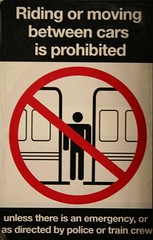
    Every day, thousands of straphangers are violating New York City Transit’s Rules of Conduct. I’ve done it; I’m sure you, dear reader, have done it too. Sometimes, you just have to get away from that un-air conditioned car with the stinky homeless guy in it. But by moving from one subway car to another, we are in clear violation of Rule 1050.9 (d).

    Oops. That’s all I have to say.

    For the most part, I believe riders don’t realize they’re breaking the law, and it’s an unlucky S.O.B. who gets tagged by a transit cop and handed a ticket. In 2006, according to The Daily News, transit cops handed out 3600 tickets or fewer than 10 a day. The cops must be catching, oh, 0.1 percent of all of New York City’s hardened criminals who move between subway cars.

    Interestingly, though, as the The News reported, about 60 percent of those given tickets had outstanding warrants. What did the MTA have to say about this?

    Of the 88 straphangers who got summonses in Brooklyn so far this year, 51 had outstanding warrants, Deputy Police Commissioner Paul Browne said.

    Two had loaded handguns, and two others were found to have knives. Ten had committed crimes or offenses in the subways before, and 26 refused to identify themselves, Browne said…

    Paul Fleuranges, a spokesman for the MTA’s rail and bus division, said he wasn’t surprised that “among those who would move from car to car there are individuals who had more than an empty seat in mind.”

    And that, folks, might just be the best quotation from an MTA official ever. Fleuranges seems to think that those shifty-eyed folks moving from car to car just might be trying to evade someone or something in their criminal past.

    Of course, that just ignores the idea that maybe, just maybe, police will be a little discriminating in their enforcement of Rule 1050.9 (d). Maybe a transit cop won’t give out tickets to 15 people who are trying to hide from a bad odor. Maybe the transit cop will give out a summons to those folks who already look suspicious. And nevermind the racial aspects to these findings (and Fleuranges’ statement).

    Just remember, every time you move between cars of the subway, you are breaking the law. Criminals, all of us. Guilty as charged.

    Image of the oh-so-effective sign warning against moving in between cars comes courtesy of flickr user Paula Ramírez.

  • Bay Ridge councilman wants full rush hour service

    A Manhattan-bound N train departs the 59th St. station in Brooklyn. (Courtes of flickr user TimSPC)

    Rush Hour is never a good time to take a train out of service. The subways are at their peak ridership levels as tired commuters simply want to be home after a long day’s work. No one wants to deal with a train going out of service five stops before theirs, and the pleasures of taking a packed shuttle bus along surface streets for another 25 minutes.

    Well, maybe someone should tell the MTA that because it seems that some Bay Ridge-bound R trains have been going out of service at rush hour leaving passengers at 59th Street to wait for the next train or take a shuttle bush to reach the last four stops. Councilman Vince Gentile has taken the task of informing the MTA of their absurdity on his shoulders. The Brooklyn Papers reports:

    “The MTA has designated 59th Street as the final stop for a significant portion of Brooklyn-bound trains during peak hours,” Gentile said. “This is a major concern.

    “The MTA is effectively telling riders that there is no rush hour in Bay Ridge,” added Gentile, who admitted that he did not know the exact percentage of trains that get taken out of service, but said he considered one to be one too many.

    The councilman fired a letter to MTA President Lawrence Reuter on Feb. 7 demanding better service for Ridge residents, and has yet to receive a response.

    For its part, the MTA is claiming that there’s always another train directly behind the ones that go out of service ready to take passengers beyond 59th Street. But we’ve all heard that announcement before, and it’s simply not reliable.

    By now, the R train is used to this wonderful publicity. The Straphangers Campaign rated it 14th out of the city’s 22 subway lines in its annual subway report card. And I wouldn’t expect an angry from Councilman Gentile to change the situation. After all, the MTA must adhere to its schedule, and sending rush hour trains past 59th Street to where people live in Brooklyn just isn’t part of that time frame.

  • No, really. Stand clear of the doors, jerk.

    Let the passengers out first, folks. (Courtesy of flickr user Infinite Jeff)

    For the MTA, a “late” subway is all relative. When you have no set schedule, how can a train really be late?

    But the trains are supposed to run on time. They’re supposed to enter the station and leave the station in a timely fashion, and when passengers hold up the train, bad things happen. Ever wonder why you have to sit on the Manhattan Bridge for what seems like hours at a time? Blame the train delays ahead of you. And now, you can blame unruly passengers too, the latest reports say.

    According to The New York Sun, trains delayed by unruly passengers in December jumped to 313 from a 2006 monthly average of 195. That’s a whopping 45 percent. With ridership nearing record numbers due to an increase in tourist visits to New York, tensions ran high on the trains at the end of last year.

    The Daily News had more on the causes behind those pesky delays:

    More than 4,270 trains were thrown off their schedules last year because riders blocked subway car doors from closing in stations, according to Transit Authority statistics. It’s now the fifth-leading cause of delays, up from 20th place just five years earlier…

    Ridership has continued to rise in the past several years, resulting in more crowded trains. But TA spokesman Charles Seaton said he couldn’t say whether there was a connection to the number of door blocks.

    Classifying delays is not always an exact science. Transit officials say that the “holding doors” category includes instances where riders try to squeeze onto crowded trains as opposed to intentionally trying to prevent a train from departing.

    Well, come on. More passengers and more crowded trains might probably maybe just possibly result in more delays. And just like SUBWAYblogger, the MTA is trying to blame Mr. Last Minute Arrival Guy.

    The top ten leading causes of delays from December 2006 after the jump.

    (more…)

  • Gross diseases as subway poster graffiti

    coldsores.jpg

    Graffiti in the subways is bad. It’s illegal; it’s an eye-sore. Just don’t do that.

    Now that we have my disclaimer out of the way, via Gothamist (and as I was writing this, SUBWAYblogger) comes a new take on the old reliable mustache-on-the-newsman subway ad graffiti: Printable Cold Sores

    The instructions are easy:

    1. Download the cold sore PDF file.
    2. Buy some clear labels.
    3. Print.
    4. And enjoy.

    Mike and Juliet would look much better with a few well-placed cold sores, and I’m sure a certain Midwesterner in NYC would agree with me.