Category: MTA Economics

  • Congestion fee to go to Second Ave. subway instead of JFK Raillink

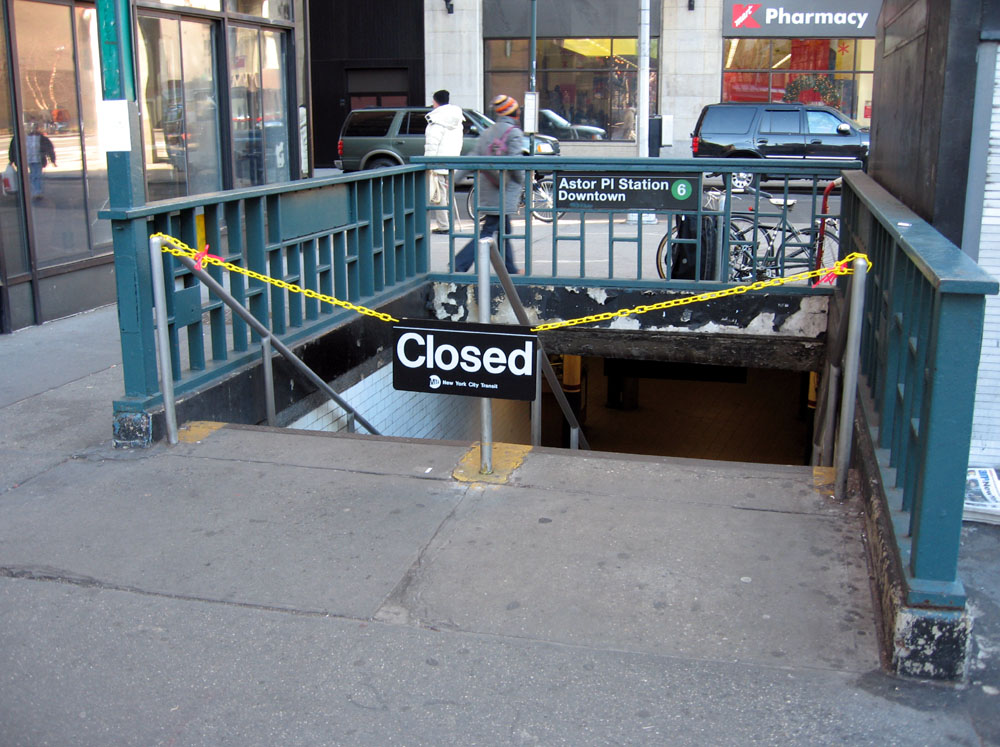
    The Train to the Plane has long gone the way of the Dodo. (Photo by Doug Grotjahn. Courtesy of NYCSubway.org)

    Oh, the tortured history of the JFK Raillink. When last we saw this ill-fated raillink in April, the plan seemed to be hanging on precariously to life support. Now, any high-speed train to the plane is all but dead, according to the latest reports.

    The New York Sun notes today that Mayor Bloomberg, long a proponent of the Lower Manhattan-JFK Raillink, has decided to compromise on this project in order to gain support for his congestion pricing plan. Elliot Sander, the MTA CEO, and Sheldon Silver, influential New York State Assembly speaker, have said they will warm up to the congestion pricing plan if more of the money goes toward financing the Second Ave. subway instead of a raillink that most transit advocates feel would be a waste of $6 billion.

    In direct negotiations between Messrs. Bloomberg and Spitzer, as well as a series of discussions between city and state officials over the past week intended to hammer out a bill on congestion pricing before Memorial Day, talk has turned to omitting some transit improvements that were included in the city’s original 2030 plan, according to multiple sources close to the negotiations.

    The $3.75 billion that was earmarked in the city’s sustainability plan for a rail link that would provide a direct connection between Lower Manhattan and John F. Kennedy International Airport, instead could help pay for the completion of the Second Avenue Subway, currently under construction but not yet fully funded … The East Side subway line, which would serve Mr. Silver’s district in Lower Manhattan if completed, has long been one of the speaker’s favored projects, as well as a priority for Mr. Spitzer.

    According to The Sun, support from Silver and Sander would go a long way toward legitimizing Bloomberg’s plans in the eyes of the federal government. And with the approval of the federal government comes more money for transportation in New York City.

    The money itself was be funneled to the Second Ave. subway through the proposed SMART authority, a topic I will touch upon later this week. Meanwhile, transit advocates are pleased to hear that the City is narrowing its focus to a few major construction projects that have a higher chance of being completed instead of many minor projected that never seem to move forward.

    This plan, in my idea, is the missing piece of the NYC2030 plan. It ensures that the Second Ave. subway has a dedicated source of funding and allays concerns that The Line That Almost Never Was will still be just a figment of our imagination. Furthermore, it all but kills the JFK Raillink, a rapid transit line that would affect far fewer people than the Second Ave. subway will. It’s good to see some common-sense economics emerging from the cooperation between the City, State and MTA.
  • Transit strike, sketchy book-keeping mar Kalikow tenure

    The 2005 transit strike will forever mar Peter Kalikow’s MTA tenure. (Photo courtesy of flickr user NYC Comets)

    On Monday, we came to celebrate Peter Kalikow (with a little urging from the MTA’s press department). On Tuesday, we come to bury him.

    As Kalikow prepares to leave his post as chairman of the Metropolitan Transportation Authority, the papers are aglow with critical examinations of his tenure.

    While we may remember Kalikow for his push to extend the subway system along 2nd Ave. and his unwavering dedication to the 2005 Transportation Bond Act, we won’t soon be forgetting the 2005 transit strike or the sketchy ways in which the MTA went about raising the fare in 2003. The Times has more about the transit strike and the bitter animosity that have since arisen between the MTA and the Transit Workers Union:

    Gene Russianoff, the staff lawyer for the Straphangers Campaign, a transit rider advocacy group, said Mr. Kalikow sometimes hewed too closely to Mr. Pataki’s interests, allowing Albany politics to dictate policy. As an example, he cited the poor labor relations that characterized Mr. Kalikow’s years at the authority, especially after the strike that halted city bus and subway service for 60 hours in December 2005.

    “That was one of the black marks,” Mr. Russianoff said. “He ended up with probably what was the worst labor relations in the 25 years we’ve followed the system. It was, I think, purely Pataki politics that dictated what happened.”

    In my opinion, however, that transit strike pales in comparison with the economic circumstances surrounding the 2003 fare increase, a situation which the word “sketchy” defines perfectly. In 2003, the MTA raised the fares amidst cries from City Hall and Albany that the MTA has shifted around millions of dollars of surplus money to make it look like the fare hike was a necessity instead of a luxury.

    While the Straphangers Campaign and others bring the suit eventually lost on appeal, as Gene Russianoff notes in Metro, the end result has been favorable; the MTA now must maintain a higher level of transparency than ever before.

    So as Kalikow exits, sometimes, we’ll remember the way he spoke out against the lowball offer the Jets made for the Hudson Yards area and the way he’s tried to be more rider-friendly. At other times, as that $76 melts away every month, we’ll remember the fare hikes. It’s a tortured legacy for the man in charge of one of New York’s greatest assets, and his shoes will not be filled easily. But if the potential replacement took any lessons from the last six years, we’ll have an even better subway system come 2013.

  • Homeless in the subway on the rise, says anyone who rides a train

    The homeless in the subway aren’t funny, but this edited poster sure is. (Courtesy of flickr user bellerspace)

    Back in February, the homeless denizens of New York City came to our collective consciousness when reports revealed that the MTA spends $2000 per homeless person. At the time, the MTA noted that many of the homeless people escorted out of the subway simply return after a few days.

    Well, now, as anyone who rides the subway can attest to, the MTA has revealed that the homeless problem in the subway is on the rise. While the total homeless population has decreased about two percent in the last year, the number of homeless in the subways has risen 33 percent. The Post has more:

    “Subways are not a safe haven for the homeless,” MTA Executive Director Elliot Sander said. “They are not a safe place to be. It also has an impact on the environment for our commuters. It’s an issue we need to solve humanely.”

    Sander and DHS Commissioner Robert Hess identified three transit hubs that are homeless hot spots: Penn Station, the Parsons-Archer station in Jamaica, and Stillwell Avenue in Coney Island.

    None of this comes as news to straphangers. Anecdotally, as a frequent rider, I’ve seen more homeless on the subways recently than I have in years. Late at night, it’s now hard to find a train car without a sleeping resident. And forget about Penn Station, as the article notes; that hub has long been a haven for the homeless. It’s hard to find a usable bathroom in Amtrak’s home, and the homeless pervade the station, often right under the noses of the transit cops patrolling the area.

    But what can the city do here? That’s the tough question. Overall, the homeless in New York are a much smaller percentage of the population than they are in other U.S. cities, but their presence in the subway leaves many feeling unsafe. The cops could wake up sleeping riders who seem to have settled in for the night, but that’s hardly a long-term solution. Anyone got any better ideas?

  • ’08 fare hike could target Unlimited Ride Metrocards

    To hike the fares or not to hike the fares? That is the question, and MTA CEO Elliot “Lee” Sander is coming down on the side of hiking the fares.

    Last week, I speculated that the MTA’s unexpected tax windfalls could stave off an announced 2008 fare hike. But not so fast, said Sander. Metro, on of the city’s free dailies, has more:

    Sander said this year’s surplus wouldn’t ward off a fare hike.

    “Nothing on that has changed,” he said.

    That’s because the MTA has to pay back massive debts incurred to pay for capital projects, to fix infrastructure and to buy new trains and buses. Ballooning deficits have been predicted to reach $1.9 billion by 2010.

    In other efforts to reduce this debt, Mayor Bloomberg announced that the city would contribute $200 million a year to the MTA. The last time the City gave so much to the MTA was during the Koch Administration.

    “There is a direct connection between the withdrawal of that support by the city and the large operating deficits that we face in ’08, ’09 and ’10, so we really appreciate [Bloomberg’s] focus,” Sander said. “The contribution to the capital program significantly diminished after 1994, and that certainly had a role in the amount of borrowing that the MTA had to do.”

    Interestingly enough, the Unlimited Ride Metrocards could be the biggest victims of the fare hike. In fact, I believe the only hikes will affect those who use Unlimited Ride Metrocards. On Monday, SUBWAYblogger directed my attention to an article in The Post noting that we riders save close to $1 billion using Unlimited Ride Metrocards.

    Since the average cost of an Unlimited Ride averages out to about $1.31 per ride and only 12 percent of all subway riders pay the full $2 fare with no discount, the MTA will look to recoup some of the money it gives up by offering these discounted MetroCards. It’s bad for those of us who rely on the subways to commute, but the MTA needs the money. Hopefully, they’ll use the funds to offer us better service and more trains.

    We’ll know for sure in July when Sander makes his final announcement on the fare hike. So stay tuned until the dog days of summer when our wallets may get just a little thinner each night.

  • Tax revenue could stave off ‘08 fare hike

    Just the other day, I took the MTA’s new CFO to task for his gloom-and-doom scenario involving the MTA’s financial picture and tax revenue. Well, today, I have better news: Because of the increase in taxes collected by the MTA, the planned 2008 fare increase may be off the table.

    With the MTA collecting over $184 million more than planned, The Daily News speculates that this surplus could cover the gap that the fare increase was supposed to meet. Pete Donohue has more:

    Since January, key real estate taxes have generated nearly $600 million for the MTA – $184 million more than anticipated.

    If that pace continues, those taxes would fill the $800 million gap the Metropolitan Transportation Authority had projected for 2008.

    “God bless the housing market,” Gene Russianoff of the Straphangers Campaign said. “It helped generate a $1 billion surplus in 2006 and, hopefully, it will hold off a fare hike in 2008.”

    (By the way, I’m going to count up how many MTA articles appear in the New York press and in how many of those Gene Russianoff appears. My guess is upwards of 90 percent.)

    So that’s good news. The MTA, with some massive projects on tap, is facing a better-than-expected financial picture. Of course, the MTA officials aren’t quite as quick to celebrate, and I don’t blame them. The last thing they want to do is say the fare increase is off the table and then watch as the real estate market tanks in August. In fact, an MTA spokesman said exactly that.

    “Revenues from real estate taxes are extremely volatile and it’s too early in the year to know where revenues will end up,” MTA spokesman Jeremy Soffin said. “We will not consider a fare increase until we have exhausted all other options.”

    The final decision on a fare increase will come in December. Hopefully, the real estate market will stay healthy and robust until then. I wouldn’t mind sticking with my $76 monthly Metrocard. Enough of my hard-earned money goes to the monthly card as it is.

  • Yankees’ Metro-North station bid going nowhere fast

    newyankeestadium.jpg

    A new Yankee Stadium is slowly, and sadly, rising out of the remains of the Macombs Dam Park. (Photo by Benjamin Kabak)

    On a visit to Yankee Stadium this year, it’s impossible to miss the construction of the new stadium across the street from the old one. Crew members are on site during day games, and the new stadium, set for an April 2009 debut, is slowly taking shape. The same cannot be said for the plans for a state-of-the-art Metro-North hub in the South Bronx that is supposed to serve this new stadium.

    A month ago, I noted that this transportation hub was, like most MTA projects, already well over budget before construction even began. Now the news is worse. According to documents released earlier this week by the MTA, the first contract for this new station should have been awarded already, but as Metro New York’s transit beat writer Patrick Arden noted on Tuesday, no contract is in sight and plans for the station are in jeopardy.

    Progress has been delayed by the need to develop “an overall project budget,” wrote engineering consultant Carter Burgess. The $45 million cost is rumored to have nearly doubled over the last year. “In addition, an agreement with the City of New York regarding the project’s maintenance and shared construction cost is also being finalized.”

    “We’re still waiting for the city to acquire the land,” explained MTA spokesman Jeremy Soffin. “There hasn’t been any final budget put out, or an expected date for work to begin. When the land is acquired, we’ll have more to say.”

    Similar to the problems surrounding the 7 line extension, the City and the MTA are at odds over just who is supposed to be paying for all of this. What originally began as a gesture of good will to the City’s leading environmental and public transportation advocates who wanted a transportation hub instead of four parking lots with a capacity of a measly 5,000 cars has devolved into another political fight over money between two powerful bodies.

    Has anyone thought to ask the Yankees, recently valued as a franchise at $1.2 billion, to pitch in? Well, according to Straphanger Campaign guru, the omnipresent Gene Russianoff, the Yankees are mysteriously missing from this story. “The MTA is tapped out — its core program is in jeopardy,” Russianoff said to Arden. “So what’s more important? Paying to make the Yankees happy, or asking them to participate? I think it jeopardizes the project.”

    I hear ya, Gene, and I couldn’t agree more. In fact, why not ask A-Rod to pitch in? After all, he makes $40 million in a season and a half. I’m sure he could contribute something for the good of the project other than record-setting home runs. Share, Alex, share!

  • New MTA moneyman wonders ‘What if?’

    monopolymoney.jpg The MTA is notorious terrible with money. Maybe they don’t have enough and need to raise the fare. But, oh wait, an accounting error reveals the Authority had more than it thought. Maybe this project will come in under budget; maybe not.

    Yesterday, the MTA’s new CFO got in on the act, discussing finances and the dangers of relying on property tax. Gary Dellaverson, the former head of labor negotiations, spoke at length about the MTA and its tenuous (or not) funding situation. Metro’s Patrick Arden has more:

    The booming real estate market has resulted in large surpluses at the Metropolitan Transportation Authority, defying the agency’s attempts to make predictions. Yesterday the MTA announced real estate taxes brought in $185 million more than anticipated. But former labor negotiator Gary Dellaverson warned the good times can’t last forever, as he stepped into his new role of chief financial officer.

    In what he called “a pure ‘what if’ exercise,” Dellaverson showed a series of graphs charting the amounts the MTA has been raking in from real estate transactions. Taxes tripled from 1983 to ’87. “The sad part of that story is from ’87 to ’91 those taxes coming to the MTA lost 65 percent of their value,” Dellaverson said, noting a “pretty obvious bell curve” before wondering “what happens if that type of a phenomenon — that trough to peak, peak to trough — takes place again.”

    So we’ve got some typical MTA financial shenanigans at work here. Dellaverson, in his first role as CFO, announces that he will be presiding over an organization that just received an unexpected $185 million surplus. For that kind of money, they could sign Derek Jeter.

    But — and this is a big “but” — Dellaverson had to do something to make sure that the MTA, which has long pled poverty and is relying on large federal contributions for its pressing capital construction projects, didn’t look too financially solvent. So hey, maybe the property tax bubble will burst again, and the MTA will lose $500 million in projected revenues by 2011. Right, guys? Guys? You with me? Anyone?

    Mark Page, an MTA board member and head of the Office of Management and Budget, was not fooled by this worst-case scenario act. He noted that Dellaverson’s models, seemingly pulled out of thin air, are not too be considered reliable. “Almost without exception those forecasts turn out to be wrong,” he said. That is one resounding vote of confidence for the new Chief Financial Officer.

    And Gene Russianoff, whose presence in every subway-related article is actually written into the Charter, Administrative Code and Rules of the City of New York, questioned the reality of the projected $800 million budget deficit set forth by the MTA this year. I’m with you, Gene. I bet the MTA has more money than we’re led to believe here. But hey, real estate bubble? Tax breaks? Lower revenue? Godzilla? Anyone?

  • MTA doesn’t trust its system for ‘important’ trips

    The MTA doesn’t want its workers waiting and waiting and waiting for the train that never shows up. (Courtesy of flickr user Vincenzo F)

    Sometimes, the stories about the MTA are so ridiculous, they write themselves. This story — one in which the MTA doesn’t even trust its own service — is one of those.

    You see, the MTA doesn’t want its employees late for important events like random drug tests. So instead of having them use the subway for free, the Transit Authority sinks hundreds of thousands of dollars into, get this, taxi rides for its transit employees. Head, meet brick wall.

    The Post’s Jeremy Olshan, transit reporter extraordinaire, broke this story today. Olshan reports:

    When the MTA wants to guarantee its employees get to their destination, they skip the bus and subway and call a taxi. Rather than take a free ride on the largest public transportation network in the nation, the thousands of transit workers called for random drug tests are required to take a car service.

    This week, the MTA board is set to approve $285,000 in contracts with four city car services to provide the transportation.

    So there you go, folks, straight from the mouths of the MTA Board members: Take a cab if you want to get anywhere quickly. I bet Mayor Bloomberg isn’t too thrilled with this news coming out after his PLANYC2030 announcement that was designed to prop up public transportation in New York City.

    The MTA acted quickly to defend its policy. The Authority noted that some bus depots are so far away from the testing facility at 180 Livingston St. in Brooklyn that workers wouldn’t be able to get there within the mandatory two-hour reporting window. Meanwhile, as Google Maps shows, 180 Livingston St. is within walking distance of not just one or two subway lines but twelve different lines.

    Maybe — maybe — if someone were coming from the far reaches of the Bronx or Queens, I would buy the two-hour excuse. But does that mean every single worker has to take a cab? Not in an age of rampant budget deficits. Every little bit counts.

    Eric Giola, City Council member, summed it up best: “It seems like more Pataki-era waste and mismanagement that can be easily corrected by this new administration. While you want to ensure the accuracy of drug tests, $300,000 in taxi bills is over the top and unnecessary.”

    I can’t make this stuff up, folks.

  • Mayor Mike’s congestion tax plan sends more $$$ to mass transit

    congestion-pricing-plan-map-222.jpg

    The Mayor’s PLANYC2030 calls for an $8 congestion tax for cars enterting Manhattan’s Central Business District between 6 a.m. and 6 p.m. during the week.

    Woah, baby. If you think the Red Sox and Yankee fans have it out for each other, wait until the congestion fee foes start taking on the proponents of Mayor Bloomberg’s PLANYC2030. It’s going to get messy around here.

    (Side note to Yankee fans: Don’t despair. Despite the infuriating managerial style of Joe Torre, this weekend wasn’t terrible. There’s more at River Ave. Blues. So go there. Ok. Plug over.)

    On Sunday — Earth Day 2006 — Mayor Mike finally released the details of his plan to provide for a sustainable New York City by the year 2030. Heavy on the environmental aspects of creating a livable city and focusing on providing better public transportation for the Center of the Universe, Bloomberg’s plan will make or break Mayor Mike’s NYC legacy. And as with any comprehensive plan of this magnitude, it is rife with controversy.

    Over the next few weeks, I’ll explore the various aspects of Bloomberg’s plan as they relate to public transportation. With the Second Ave. Subway and dedicated bus express lanes key proponents of the transportation aspect to PLANYC2030, I’ll have a lot to say. Today, let’s look at the congestion fee. The New York Times reports on what will be a very controversial plan:

    The proposal that is sure to attract the most attention, and possibly objections, is one to impose the $8 fee on car drivers, and $21 for truck operators, to drive in Manhattan south of 86th Street. The mayor said congestion on the city’s streets is the source of many of the city’s health, environmental and economic problems. “We can’t talk about reducing air pollution without talking about congestion,” he said…

    The fee the mayor is proposing would only be imposed during the week, between 6 a.m. and 6 p.m.. And motorists driving the major highways along Manhattan’s east and west sides would not be fined, so it would be possible to go from Brooklyn to Harlem along Franklin D. Roosevelt Drive without entering the zone. The fee would be deducted from the tolls commuters already pay to come into Manhattan via the bridges or tunnels. There would be no toll booths, just a network of cameras that would capture license plate numbers and either charge a driver’s existing commuter account or generate a bill to be paid each time.

    According to Bloomberg’s estimates, this congestion plan would generate $400 million in revenue in its first year alone. This money would be invested into the transportation network that serves and surrounds the city. The MTA would receive money for additional lines and much-needed upgrades.

    Furthermore, as commuters are turned off from driving because of this high fee, more people will turn to the subways as alternate means of transportation, and the MTA should enjoy a financial benefit from the increased ridership as well.

    As an advocate of mass transit, I am, as I noted on Friday, fully in support of this plan. Fewer cars in Manhattan, fewer cars on the roads around New York, that all sounds perfect to me.

    But the debate will get nasty. Outer borough residents (wrongly) feel this will negatively impact their economies, and business owners won’t like the $21 truck charges which they will have to pick up. As part of the coverage of transportation in New York City, I’ll be following this debate as well. So stay tuned. It should be a good one.

  • Hey, where is the money?

    With apologies to Nelly for the pun-derful headline, money was on the mind last week at the Second Ave. subway groundbreaking. For starters, there isn’t enough of it yet for this new subway line, and officials with the Transit Chapter of the Civil Service Technical Guild don’t think the money the MTA has is being spent wisely. Who woulda thunk it?

    We start with the issue of funding, as reported by Reuters. According to the wire service’s reports, the MTA is still $800 million short, and Federal Transit Administration Administrator James Simpson called for some public-private partnerships. Not everyone was too thrilled with this idea, Joan Gralla reported.

    Spitzer reacted noncommittally to Simpson’s proposal. Asked if New York should use public-private partnerships like Texas, which has the biggest U.S. program, Spitzer said: “Nobody is talking about that for the New York City subway.”

    Chicago two years ago spurred states and cites to explore these partnerships — which are common overseas — when it got $1.83 billion by leasing its Skyway commuter toll bridge. But some fiscal monitors have bashed Chicago’s model, saying the city got too little for its 99-year lease, and gave up its right to share any extra tolls with the two companies — MIG, run by Australia’s investment bank, Macquarie Bank Ltd, and Cintra, part of Spanish construction giant Ferrovial.

    In the same article, Mysore Nagaraja, the head of MTA Captial Construction, noted that the project would be finished in 2021 if funding held up. Wait a second, Mysore. I thought the the original end date was set for 2020. So we’re already a year behind schedule and nothing has happened yet. Uh oh.

    Meanwhile, People’s Weekly World, a Union newspaper descended from the Daily Worker, questions the MTA’s decision to contract out some of the work for the construction of the Second Ave. subway.

    The Metropolitan Transit Authority-NYC Transit contract calls for the private firm to do engineering work on the planned Second Avenue subway line, work that the union contends could be done more efficiently by in-house engineers.

    It is estimated that some $384 million of the project’s anticipated $3.8 billion budget would be absorbed by this contract. This amounts to approximately $51 million for each year of the seven-year project. Union leaders report that their members could do the same work for only $8 million per year, resulting in a savings of more then $300 million over the life of the project.

    Right now, I’m in no position to comment on the validity of the arguments set forth by the Civil Service Technical Guild as reported by PWW. But if the claims are accurate, I think I just found some of that missing $800 million for Phase 1 of this four-tiered project.

    Sounds like we’re in for a fun ride over the next few years as the MTA gets to juggle a multi-billion-dollar public works program with a tortured history. Hold on, folks.