While waiting for a train at the Union Square station last month, Michael Dion suffered one of the most horrific accidents a straphanger can experience. He may or may not have been drinking when he fell in between a train and the gap extenders on the southbound IRT express platform, and he was pinned there for 30 minutes. Onlookers and MTA employers tried to help, but it took a half an hour before someone could come to release the fillers.
Now we learn that Dion is suing the MTA and the New York City Transit Authority for $15 million in damages. According to The Post, the suit will a negligence claim on two grounds: “Dion accuses the agencies of being negligent for failing to install safety barriers that could have prevented him from falling into the gap and for failing to have trained workers on site who could have quickly extricated him.” His lawyer Jay Dankner compared Union Square unfavorably to the old South Ferry stop. “Why would you put [barriers] at South Ferry but not 14th Street?” he asked.
For the MTA — and more importantly, for farepayers who wind up footing this legal bill — this lawsuit puts them in a bad spot. Anyone at Union Square can tell you about the frequent announcements that urge straphangers, over and over again, to “please stand clear of the moving platform as trains enter and leave this station.” The issue of Dion’s sobriety at the time will come up as well. Yet, the MTA can’t protect passengers at one station and not another, and it shouldn’t take 30 minutes to find someone who can release the hydraulics in order to retract the gap fillers. It’s a messy situation all around, and Dion will get his payday.
The MTA is still trying to dig itself out from under the metaphorical snow left in the wake of its failed blizzard response. (Photo courtesy of MTA)
No body of legislators and politicians has perfected outraged hindsight better than the New York City Council. Tasked with providing a check against the mayor and granted oversight powers over city agencies, the City Council can’t press too hard on the MTA, a state authority that derives its power from Albany, but it can make New York City Transit Authority leaders squirm. That’s just what the Council did on Friday.
For five hours on Friday, stretching past lunch and into the afternoon, City Council members used their lofty committee perches to rake Transit officials over the fire. Even though The Times and The Daily News had complete post mortems a few days after the snow, the City Council had to hear it from the horses’ mouths themselves, and the Council members had to make sure they looked appropriately outraged and disappointed for the cameras. All around, it was a giant mess.
For their part, Transit officials didn’t put on a show, but we already know how badly they messed up. We know that they opted to put the agency on a low-level Plan 1 footing on Thursday morning before Christmas Eve. We know, even as the forecast worsened, that they didn’t ramp up their staffing and procedures to Plan 4 until well after the forecast changed late Saturday afternoon and snow began to fall on Sunday. We know about trains that were stuck near Howard Beach and the deeper reaches of Brooklyn, about buses that were dispatched without chains and were stranded in the snow-covered streets. We know the MTA didn’t have a situation room or a centralized command structure in place for such a storm that weekend.
Yet, despite this knowledge, the Transit officials under the gun didn’t have answers. Transit president Thomas Prendergast said that his men “forgot” about the A train stuck at Howard Beach and had no evacuation plan once streets became impassable. The agency didn’t ready a situation room, and Prendersgast simply said, “The fact that it fell out of practice is a serious deficiency.” He didn’t know how much the storm cost the authority and said that no one had been fired or demoted yet as Transit is still conducting its own review. “We were lulled into a false sense of security on our own,” he said of the unexpected accumulation from the storm. “Nobody led us into that.”
Often, Prendergast said he didn’t have detailed answers for the Council members because his staff had been preparing for subsequent winter storms. He also reiterated what MTA sources have told me: Concerns over overtime costs played no role in the MTA’s decision to call in extra employees to respond to the storm. When deemed appropriate due to snow fall, Transit moved to a Plan 4 footing and paid no heed to the staffing costs. After all, weather contingencies are a part of the MTA budget.
Ultimately Prendergast issued his own mea culpa. “We failed during the blizzard and this is an apology on our part due to that failure,” he said.
The City Council, of course, didn’t take to Predergast, his team or his apology. The outrage ran the gamut from a call to the Governor to remove Prendergast from Transit to a clear attempt to blame Transit for the city’s own failures. It was hindsight at its finest. “Today was an abject failure,” Council Speaker Christine Quinn said of the hearings. “I was shocked by the performance of the transit leaders, the folks from the MTA at today’s oversight hearing. It really left me not feeling any greater level of confidence that the MTA can handle the next storm.”
Quinn, who called Transit’s responses “beyond shocking,” had more to say: “All you had to do was open up the blinds and see that the snow was falling. Blizzards don’t happen every week, but it’s not like a swarm of locusts came into New York or something we’ve never seen.”
She wasn’t alone in condemning Transit. David Greenfield, a councilman from Brooklyn’s District 44 who has been dubbed “Kvetch” by former Streetsblog editor Aaron Naparstek due to his ability to complain about literally everything, was live-blogging the hearing via his Twitter account. He comes across as simply a complainer looking to score easy political points and didn’t accept Transit’s words.
When union leaders testified that the MTA did indeed have overtime costs in mind when they didn’t call a Plan 4, Greenfield lapped it up like a good political puppy. It doesn’t matter if the TWU and ATU officials who spoke had first-hand knowledge of the response; if the MTA said it, Greenfield won’t accepted it. “Sadly, I am not surprised,” he said after the hearings. “The MTA is broken. I believe that in order to keep this city moving forward we have to stop accepting excuses and overhaul the structure of the MTA.”
Letitia James, who never met an MTA hearing she couldn’t exploit for personal gain, used her time in the sun to rail against the late December fare hikes. “You failed us and should not have raised your fares on December 29,” she said. Because of a poor response to the blizzard, the MTA should not have raised its fares to address a potential $400 million budget gap. In the world of the City Council that makes perfect sense.
Ultimately, everyone lost. New Yorkers lost when Transit was ill prepared for the biggest storm of the winter. Transit officials lost the little faith they had from the City Council and straphangers. Transit officials may also, as Nicole Gelinas wrote, lost a chit in their upcoming labor battle as well.
But the City Council came out looking petty and kvetchy. They have perfected the time-honored tradition of complaining about subway service but offered no solutions. Should Transit have dumped passengers off the A train in Howard Beach and let them fend for themselves? What should the proper blizzard response team look like? How would the City Council prefer to see the subways run? These are questions that have to be answered if New York is to move forward with better transit.
It will snow again this winter. We’ll get another big storm, and the MTA will be tested. It won’t be Christmas Eve, and Transit won’t be blindsided by mounting drifts. Will the Council accepted an improved response or still find reasons to complain?
As the scandal over falsified signal inspection reports gains steam, the MTA Inspector General has found multiple violations concerning inspection measures. As The Daily News reports today, the IG raided crew rooms at Times Square and found copies of signal bar codes in various lockers and desks. It is, as Pete Donohue reported, against MTA regulations for workers to possess these materials. “This is a serious infraction,” Transit head Thomas Prendergast said. “We’ve ratcheted up our effort to make sure people are complying with the rules and regulations.”
Donohue notes that these findings could lead to the first dismissals over the falsified signal reports, and with an ongoing criminal investigation, more current and former MTA workers could still find themselves in trouble. Whether the inquiries will reach to former Transit presidents remains to be seen, but the MTA and the IG’s office says they are taking these allegations very seriously. “It is outrageous and alarming that in the midst of an ongoing investigation, and given the recent close public scrutiny regarding falsification of signal inspections, our investigators and officials of NYC Transit found unauthorized bar codes in signal maintainers’ lockers and even in plain view just a few days ago,” Barry Kluger, the Inspector General, said.
In December, station platforms and subway tracks were buried by the snow. (Courtesy of New York City Transit)
It is snowing. Cue the plows! Pull out the shovels! Toss the salt! After last month’s snow debacle, the city is going to make sure we’re ready, and as of this writing, three plows have already passed by my window tonight. They might just be tearing up the asphalt roadbed instead of clearing up the one inch of snow on the ground, but they’re out there.
As New York works to keep its streets clear and sidewalks less slippery, the MTA has ramped up its snow preparedness as well. Already, express trains are running local and the authority expects them to do so well into Wednesday. The commuter rail lines are running reduced schedules, and the authority is urging passengers to check its website before venturing out in the morning. For up-to-the-minute reports on transit, the Daily News is running a live-blog.
Meanwhile, MTA officials spent part of Tuesday afternoon assuring reporters that the authority will be better prepared for the current storm. Hundreds of customers won’t get trapped near Howard Beach or on trains above-ground in the deeper reaches of Brooklyn, but potential commuters also must take care to travel only if it is necessary. “If you don’t need to travel tomorrow morning, please don’t,” MTA CEO and Chairman Jay Walder said on Tuesday.
Late last night, the authority elaborated on its approach to the snow in a statement: “Our goal in this and all storms is to continue providing service so long as it is safe for our customers, employees and equipment. We recognize the importance of public transportation especially when conditions are difficult. Doing this safely means service may be temporarily suspended or curtailed to avoid stuck trains and buses.”
But what of that next storm? What of the big one? The authority said today that it’s still conducting its own review of its snow procedures, and already, the agency has established a centralized snow command in charge of coordinating weather-related services. It’s also gearing up to have a response plan for major blizzards. Pete Donohue received advanced word of the MTA’s snow review and clued us in as to what to expect in the future. He writes:
The MTA may shut down at least some subway service during future blizzards rather than risk trains getting stuck, the Daily News has learned. “We may need to shut down the system,” an internal Metropolitan Transportation Authority document says. “We need to change the philosophy of how we operate, particularly in snowstorms. Keeping the service running regardless might not be the best option.”
The agency’s subway division kept running trains in last month’s blizzard. Three A trains with hundreds of passengers were stuck in eastern Queens – including one for about seven hours. Next time there’s such a severe blast, “We need to think about an organized shutdown of the system,” the document says.
The document is a draft summary of a meeting transit executives held last week to improve its storm response.
For years, the MTA has tried to power through the storm on the theory that trains can push snow out of the way, but when drifts pile up, as they did in December, the trains cannot pass. It happened in 1996 during the city’s big snow storm, and it always seems to knock out the subway system. Being willing to cancel service ahead of the storm may leave commuters struggling for other options, but it won’t leave them stuck at an unfamiliar train station and miles away from home.
Unfortunately, the city and the MTA cannot control the weather. They don’t dictate when it snows or how much accumulates. They can fight it as it falls, but as more arrives, it builds up with nowhere to go. To fight the snow, sometimes, we just have to accept it for what it is, and that is seemingly what the MTA’s new plan will try to do.
Back in May, at a talk with reporters, MTA CEO and Chairman Jay Walder talked, as he often does, about his experiences in London. To accomplish work efficiently, Transport for London often shuts down service across entire lines for much of a weekend, and the MTA has been debating doing that here. Walder mentioned it to me again during my interview with him, and at yesterday’s Transit Committee meeting, NYCT head Tom Prendergast broached the subject as well.
The MTA, it seems, may be revamping the way they approach weekend work. “Maybe for some of the more difficult tests, that take a long time to set up, pick one Saturday a month and do it at night, starting after five or six o’clock at night, look at things like that,” Prendergast said.
On the one hand, this will inconvenience thousands of subway riders, but on the other hand, weekend service changes already do that. If the MTA can minimize the frequency of the changes, blitzing a line could pay off in the long run. Meanwhile, in response to the findings that crews falsified signal inspections, Transit may need to increase the time and manpower required to conduct a thorough review of the system’s numerous signals. Weekend work and changes just make get worse before it gets better.
These new signs will begin appearing in subway cars everywhere this weekend.
On my way to the Jay St.-MetroTech ribbon-cutting yesterday, I hopped on a Manhattan-bound 3 train at Grand Army Plaza and found myself in a car surrounded by unfamiliar placards. Instead of the regular SubTalk signs discussing various goings-on at the MTA, I was face-to-face with this sign. Identical to the example atop this post, it said “Improving, Non-Stop” and was clearly a redesign of the MTA’s house ads.
When I arrived at Jay St., I had a chance to quiz Jay Walder and Paul Fleuranges, the MTA’s Senior Director of Corporate and Internal Communications, on the changes. The new signs have been designed to explain a mix of messages to riders with a focus on highlighting, as Walder said, “things we’ve done this year and improvements we’ve made.”
Graphically, the signs are meant to be simpler than the old SubTalk signs. The top is calmer, with more white space, while the MTA bullet, minimized on the old version, has been restored to a primary spot at the top. The website address is added subtly below the bullet. For the ribbon across the bottom, the new signs borrow the strip map stylings that are prominent on the cover of the new subway map.
Fleuranges and I spoke about what will be on the signs. Some of them — such as the one above which you can click to enlarge — feature general messages about the need to improve the system. Another thanks the MTA’s employees for their hard work. Others focus on bus lanes, the changes made to Select Bus Service and the arrival of the countdown clocks throughout the subway system. Fleuranges said that Transit is unveiling nine or ten new signs this weekend with more to come over the next couple of months.
The long-running SubTalk ads debuted in 1993 and were often in the news. For years, the rotating ads included a popular series called Poetry in Motion, but that was canceled and replaced with the Train of Thought ads in mid-2008. According to Fleuranges, SubTalk hasn’t been officially canceled; for now it’s “on haitus.” The Train of Thought ads though are “on the way out.”
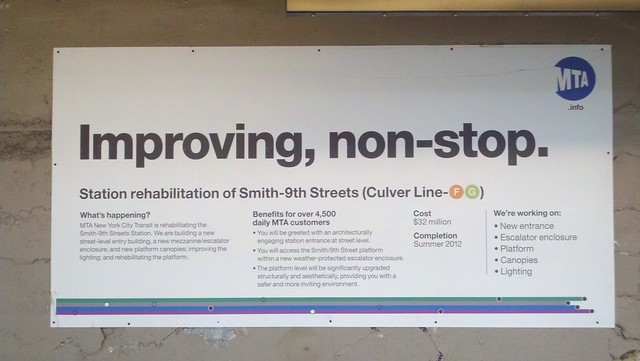
In addition to spots in subway cars, the “Improving Non-Stop” ads will pop up at construction sites as well. On the way back to Park Slope from Downtown Brooklyn, I spotted one at Smith-9th Sts. It looks a little something like this:
The Improving Non-Stop signs inform customers of big-ticket construction projects. (Photo by Benjamin Kabak. Click to enlarge)
The idea here is to present riders with the same look and same type of messaging as the in-car ads features. After nearly two decades, it was time for a rebranding.
You wouldn’t know it from the warm, rainy day that has descended upon New York, but the calendar flipped to December today. With the final month of the year comes the holiday shopping and tourism season. Tourism spikes, and as track work slows down, subway travel climbs as more people fill the city. To meet demand and make travel more pleasant for everyone, Transit announced today that it will be increasing weekend subway service this month.
The services increases start this weekend and will last for the next three weekend through December 19th. During this stretch, headways on the IRT local routes — the 1 and 6 trains — will see wait times drop from eight to six minutes. The 2 and 3 trains will operate every five minutes instead of six, and the 4 and 5 trains will arrive every four minutes instead of every five. On the lettered lines, E service will increase from every ten minutes on Saturday evening and Sunday to every 7.5 minutes throughout the weekend. F and Q train riders will see also see waits shortened from 10 minutes to 7.5 minutes.
The MTA says ridership increases in December are driven largely by those out for holiday shopping. “This is an extremely busy time of year for weekend travel and we are increasing our scheduled weekend service in areas of historically high ridership,” NYC Transit President Thomas Prendergast said. “By adding extra trains we are able to increase capacity and also shorten the wait time for riders.”
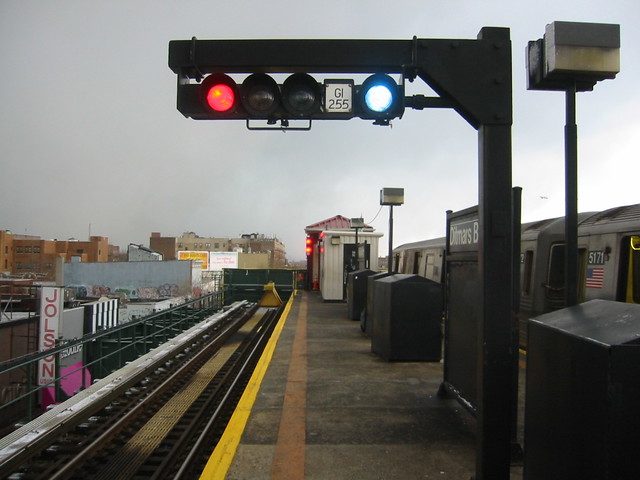
Signals at Ditmars Boulevard await an incoming train. (Photo by flickr user zin1966)
Thousands of subway signal inspection safety reports have been falsified over the last few years due to pressure from management, a report by the MTA Inspector General revealed on Friday. According to Barry Kluger’s ongoing investigation, inspections that should have been completed within 30 days were delayed for days or even weeks, and the safety of the subway’s complex signal system could have been compromised.
Due to the importance of his findings, Kluger has shared his initial report with Transit before releasing it to the public, and MTA officials have taken swift action. “Instead of waiting for results to come in and issue a report, we’ve been working with NYC Transit and supplying them with some of the results on an ongoing basis,” Kluger said in a statement. “They’ve moved quickly to try and get their arms around this and have been making a number of changes.”
NYC Transit supervisors falsified thousands of vital signal inspections across the subway system for years, leaving straphangers at risk for deadly collisions like the one that killed nine people in Washington, DC, The Post learned.
Across every line, a cabal of managers in the signal department forced maintainers to fib on the inspections by threatening them with punishments like loss of overtime, according to a sweeping six-month investigation by the inspector general of the MTA, which oversees NYC Transit. At least one high-level chief, Tracy Bowdwin — the MTA’s highest-earning Signal Department supervisor at $165,000 a year — was demoted last week in the fallout, and managers are still being questioned, transit sources said.
The dangerous practice was a response to ramped-up pressure from the MTA to meet federal standards that call for railway switches and signals to be inspected monthly, sources said. “Instead of five signals to inspect [in a shift], they would give you 15. There’s no way 15 could be done, but they would say you had to do it,” one signal maintainer said. “It’s like you think your car is fine after going to the mechanic, but they never looked at it.”
According to Haddon’s report, “workers who didn’t comply lost overtime privileges or got sent to the dirtiest, most leak-infested tunnels.” That’s revenge at its worst for practices that could land some Transit workers in legal trouble.
For its part, Transit spokespeople ensured reporters that the signals that were the subject of Kluger’s report have been reinspected and that the system is safe. “We also took swift action to ensure that none of these deficiencies undermined the signal system’s safe operation or its underlying components,” NYC Transit Spokesman Charles Seaton said. “The signal system is safe.”
I often pity the poor F train. It reaches from Coney Island to Jamaica, Queens, with an extended local stint in Manhattan, and touches the lives of so many people. Yet, these straphangers by and large can’t stand the F. It’s slow; it’s crowded; it doesn’t offer Brooklyn express service; and the waits can seem interminable.
Last year, under pressure from State Senator Daniel Squadron, the MTA conducted an internal review of F train operations, and the results were decidedly not pretty. With old rolling stock, poorly maintained infrastructure and decaying assets, the F line was literally falling apart. A year later, a follow-up reveals that Transit has greatly improved the F, but the line still lags far behind the average subway performance.
Michael Grynbaum of The Timessecured a copy of the follow-up report, and I’ve posted it in full after the jump below. It contains few surprises and perhaps a few twisted numbers as well. The F is doing better, Transit insists, but it’s still not there. “It feels like you get the diagnosis again, and it’s not specific about the solution,” Squadron said to The Times.
In general, the various metrics that tracked the F train’s performance showed marked improvement. The weekday on-time rate is now at 78.1 percent, up from 62.3 percent in 2009 but off the systemwide mark by over eight percent. The weekend and on-time assessments show similar improvements, but the MTA cautions that it has changed the way it calculates on-time performance to “improve transparency and to more closely align measures to customer experience and management priorities.” The trains aren’t necessarily more on time in an absolute sense, but they are on time if we consider only the MTA’s tracking methods.
Most notable is the vast improvement in the mean distance between car failures. Over the last year, the rolling stock options along the F declined from five — with some of the oldest cars running along this route — to two, and thus the MDBF shot up from 148,257 to 703,159 in July. “Improvements in F performance statistics over the past year can be attributed to the replacement of older R46 cars on the F train with newer R160 cars, as well as the completion of trackwork in Queens that had been underway for several months in 2009,” says the report. “The replacement of V with M service in Manhattan and Queens may also have positively affected performance of the F train.”
Ah, yes, the semi-controversial, semi-obvious M train rerouting. The report couldn’t assess the F train without contemplating the V, and it does so in depth. Transit believes the elimination of the V train and the replacement with the M between 47th-50th Sts. and Broadway/Lafayette St. can be a boon for the F. No longer with V trains interfere with F train operations at 2nd Ave. as the M bypasses that stop and trains no longer terminate there. Additionally, the reduction in the number of passengers transferring between the J/M/Z and the F at Delancey St./Essex St. has speeded up trains into and out of that station. As a result of the M train’s continuing along the 6th Ave. line, the F trains are also relatively emptier out of Delancey/Essex as well.
At some point in the near future, we’ll have enough data to assess fully the successes of the new M train, but so far, the results have been positive. Anecdotally, the northbound M trains leaving Broadway/Lafayette and West 4th St. have been more crowded than the V trains were, and with so many passengers from Middle Village and Brooklyn bound for Midtown, the one-seat ride has proven to be a welcome addition to the subway map. It’s a change that should have come sooner. But I digress.
F train load analysis results for the AM rush.
Finally, Transit is still working to assess load demands along the F at the AM and PM rushes. The tables above show that train car crowding levels are within acceptable parameters, but again, it’s worth noting that the MTA has changed its load guidelines since the initial F assessment. In 2009, a train was considered 100 percent full if every seat was taken. Today, a train is considered 100 percent full if every seat is take and around 15-18 passengers are standing. Thus, at times when the F cars are at 80 percent capacity, there are no seats to be had.
Ultimately, the F is still suffering from years of neglect and few adjustments to the operation schedule as the train’s popularity has peaked. Transit didn’t need to add more layers of management as they threatened to do last year, and key capital improvements and signal modernization programs are still awaiting funding. Concerns over the timetable and frequency of off-peak service haven’t been addressed, and the F is still very much a work in progress.
Postscript: For those of us still holding out hope for an F Express train in Brooklyn after the interminable Culver Viaduct project wraps in 2014, Transit has promised at least a feasibility study. “The review of express service in Brooklyn will be undertaken closer to the completion of the Culver Viaduct project,” the document says. There’s hope for it yet.
After the jump, read the F train review follow-up in full.(more…)
After coming under fire from civil rights groups, New York City Transit has voluntarily agreed to provide translation services for those facing Transit Adjudication Bureau hearings. According to a letter from New York City Transit lawyer Michael Schnabel and obtained by The Times, those defending themselves from charges of fare-beating, littering or quality-of-life offenses will soon be able to receive the assistance of translators via a phone service. “We do support the view that those individuals who appear for hearings should be afforded every reasonable opportunity to effectively present their defenses,” Schnabel wrote.
In late September, the NYCLU had challenged the MTA’s lack of translators, and one reporter sent to a TAB hearing watched as a defendant struggled to find someone who could provide an accounting of the proceedings. Transit has maintained though that is not “legally obligated” to provide these but rather is doing so ensure that the accused are able “to fully participate in the process to the greatest extent reasonably possible.” Still, the NYCLU called this a clear victory. “They recognize it’s an indefensible situation, even if they don’t agree it’s an illegal situation,” lawyer Christopher Dunn said. “I don’t have any doubt they are going to implement this.” The MTA says the translation services will be in place by the end of the year.


 I often pity the poor F train. It reaches from Coney Island to Jamaica, Queens, with an extended local stint in Manhattan, and touches the lives of so many people. Yet, these straphangers by and large can’t stand the F. It’s slow; it’s crowded; it doesn’t offer Brooklyn express service; and the waits can seem interminable.

