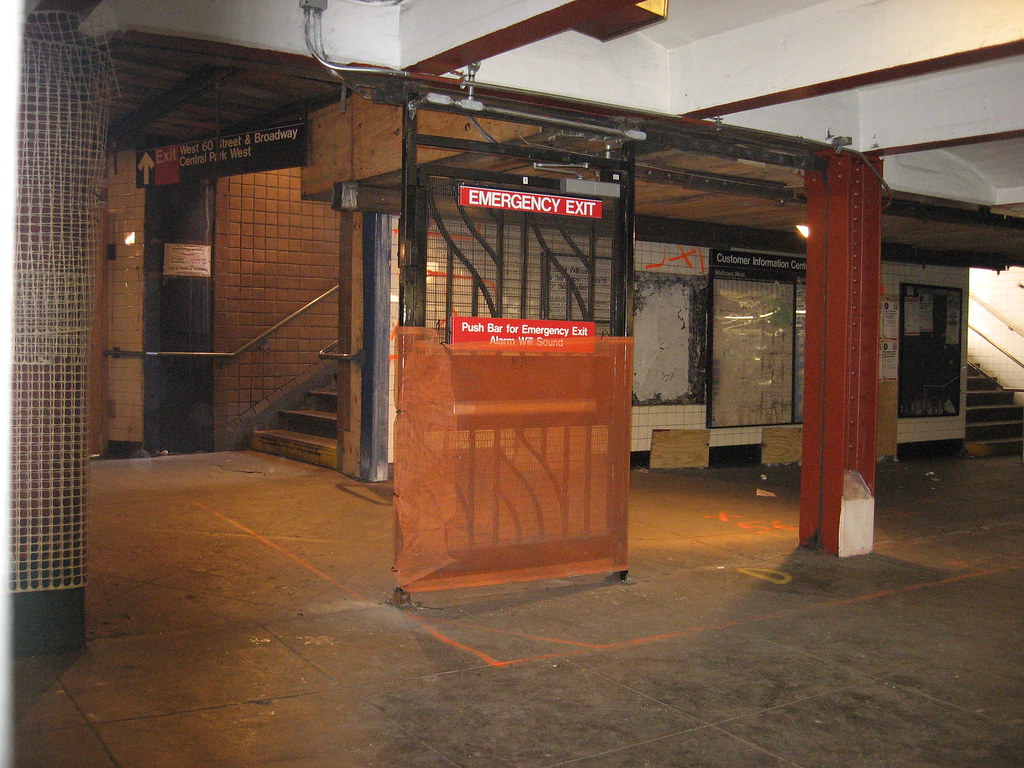
In case of emergency, go around. (Photo by flickr user rlboston)
The emergency exit doors in subway stations throughout the city are the scourge of the system. Installed in 2005 and 2006 to provide fast egress in the event of an underground emergency and equipped with an ear-splitting alarm, the doors are rarely used for their intended purpose. Instead, people who think rules don’t apply to them use the exits to escape crowds at turnstiles and generally get out of dodge faster than the person next to them.
Today, the New York City Transit Riders Council issued a call for better emergency exit policies. In a report released this morning (PDF here), the NYCTRC unveiled results of a study its members conducted of the emergency exits. These rider advocates found widespread emergency exit abuse and numerous instances of fare evasion. The group found examples of herd mentality and concluded, as anyone who spends enough time near the subway’s fare-control areas, that the alarms are completely ineffective.
The NYCTRC’s methodology is fairly straightforward. This summer, council members sat at 19 subway stations throughout the four boroughs and at various times of the day to monitor the emergency exit use. The findings are summarized succinctly:
In the course of sixteen hours of observations during peak hours and nineteen hours of observations in off-peak hours, our surveyors counted a total of 2,308 passengers using designated emergency gates for access to and egress from the paid area of subway stations. Most of this activity involved 2,115 individuals who exited the paid areas of the stations through the emergency gates. Our surveyors also observed 193 individuals entering the paid areas of stations through the emergency gates. In 109 cases, surveyors indicated that these entries into the paid areas appeared to be made in the course of evading fare payment.
So when do people use the emergency exits? According to the council’s observers, those brave souls willing to risk setting off the alarm do so to “relieve a backlog of riders waiting to exit the station.” However, as I witnessed this summer at the relatively empty north end of the City Hall/Chambers St. stop, some people use the emergency exit because it’s the door closest to the stairway. Convenience often trumps manners.
The council too noted that a herd mentality is in full effect with regards to the emergency exits. “At many locations where large numbers of riders improperly exited the station through emergency exit gates,” the report says, “it appeared that riders generally refrained from using the gates until one rider “broke the ice” by using the gate. Once the gate was opened and the alarm activated, a substantial percentage of exiting riders turned from using authorized points of egress and exited the station via the emergency gate.”
And what of fare evasion as well? Only around five percent of emergency exit use constituted examples of fare evasion, and the NYCTRC says the vast majority of those fare evasion uses came at one station — 125th St. and Nicholas Ave. — where the gate was unlocked and unalarmed. “Clearly an open gate without an operable alarm is an invitation to individuals wishing to enter the system improperly,” says the report.
Unfortunately, the report is low on recommendations. The Riders’ Council suggests that monitored exits deter improper emergency exit use, but that alarms are not the answer. “We believe that because the alarms sound very frequently, they have lost their ability to alert riders to a possible emergency,” the report says. “If anything, [the alarms] serve to distract a shrinking force of station personnel from other duties.” The alarms may also alert those looking to avoid paying that the gate is open.
Without station agents at every exit and with emergency gates so porous, the Riders’ Council suggests video monitoring, a silent alarm and a better locking mechanism for the gates. The best answer might just be targeted police sweeps aimed as those who are violating the emergency exit rules either to enter without paying or to exit improperly. The emergency exit debate has been raging for years and with no end in sight. The NYCTRC report confirms what we know: that emergency exits are far from perfect. If you build it, New Yorkers will abuse it.