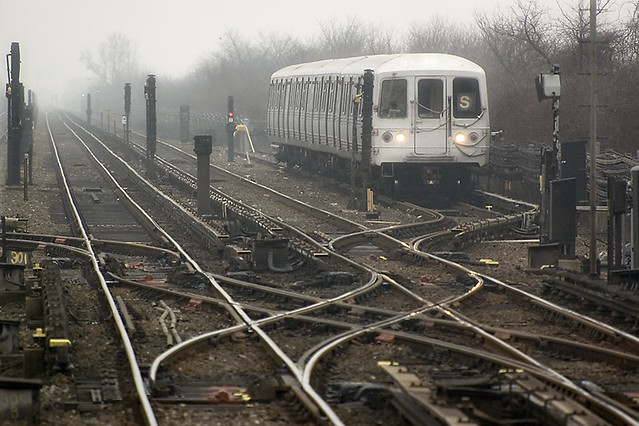
I often think that New Yorkers should care more about transit issues than they do. Whether people realize it or not, the subways are the hidden, underground force driving the New York City economy, and without them, the city will slow down. New York is the city that never sleeps because its subways never stop.
Still, most people are happy to remain in the dark on issues surrounding transit. They’re happy to repeat disproved tales of two sets of books and don’t understand the admittedly complicated financial structure that supports the MTA. They pay little attention to transit policy or the politics behind it. Most people do not have the time or energy to stay informs, and others will do it for them.
A recent Quinnipiac poll supports that belief. In a survey of New Yorkers’ political views and beliefs, the pollsters found that few people believe transit issues are that pressing. In fact, when asked what the most important problem facing New Yorkers are today, only five percent said mass transit issues were most important. Far more picked on education or the economy or even the overall budget as more pressing.
On an micro level, the numbers are even worse. Only three percent of respondents believe that quality mass transit/public transportation is a major problem while just one percent believe that highway or traffic congestion are of great concern. Of course, while those numbers are depressing, the poll is a binary one. Something either is the most important issue or isn’t, and respondents couldn’t grade issues on a sliding scale. Perhaps New Yorkers believe transit is a compelling problem but not the compelling problem of the day.
Over at Streetsblog, Noah Kazis found the silver lining in these poll numbers. Highlighting how more people picked public transit over congestion as a problem, Kazis wrote, “The voters most concerned with transportation — the ones who will be thinking about it at the ballot box — are far more interested in transit than traffic flow.”
That may very well be true, but it’s hard to find comfort in those figures. New Yorkers don’t mind public transit. They complain about it; they want trains to run more frequently, be less crowded and be nicer. But when push comes to shove, the economy and education will always remain of paramount importance.
What then can we do? I want to see a better transit system. I want to see smarter traffic and transit policies, a more robust investment in the system by our state politicians and realistic expansion plans that can happen in the next decade. I’d rather not see endless fare hikes and service cuts while the MTA races to cover its bottom line, but that’s where we are.
Until New Yorkers begin to pay more attention, transit will always just be a background issue. It’s easy to kick around the MTA because they mostly deserve it, and few people will bother to learn more about it. That’s just the nature of things right now. It might be an uphill battle, but I’ll keep fighting it. Transit should be a bigger issue amongst New York voters, but right now, it has a long way to go.
A Times graphic shows the proposed route for the city's new regular ferry service. (Via)
Pardon the hyperbole in the headline atop this post, and if anyone chuckled at the recycled idea of ferry service acting as the city’s transportation savior, I wouldn’t blame them. Politicians have been trying to bring regular, affordable ferry service to the city’s waterfront for decades, and now, the Mayor is at it again.
Michael Bloomberg will announce today that, beginning in June, BillyBey, a part of New York Waterway, will begin operating regular ferry service between Brooklyn, Queens and the East Side from 7 a.m. to 8 p.m. during the week and from 9 a.m. to 7 p.m. on weekdays. During peak hours, the ferries will operate every 20 minutes — a move the city hopes will help attract potential customers — and the boats will run every 30 minutes off-peak and once an hour during the winter. The ride, subsidized to the tune of $9 million a year by the Economic Development Corporation and with a three-year commitment, will cost $3 or $5.50 depending upon the departure point.
According to Michael Grynbaum’s coverage in The Times, the ferries will “travel along a seven-stop route that stretches from Long Island City, Queens, to the Fulton Ferry landing by the Brooklyn Bridge, and includes Manhattan terminals at Pier 11 in the financial district and East 34th Street.” New stops include India Street in Greenpoint and North Sixth Street in Williamsburg. On the Manhattan side, the operator will run a free bus down 34th St.
“If we want every part of Brooklyn, every part of Queens, to be as attractive to businesses and residents as Midtown Manhattan is,” City Council Speaker Christine C. Quinn said, “we have to make it as easy as possible to get to and from in an orderly, affordable fashion. That is what ferries can do.”
For the city, the key to this new service is the use of the word “regular.” In the past, efforts to bring ferry service to the East River have foundered due to, as Grynbaum puts it, “infrequent service, outsize operating costs and low ridership.” By enforcing a frequent schedule and subsidizing the route, the city hopes that residential growth along parts of the waterfront in northern Brooklyn will help make ferry service viable. “Consistent and dependable service will be a magnet for potential users,” Robert K. Steel, a deputy mayor, said. “Development has occurred along this corridor. You’ve got more people who would potentially find the service attractive.”
When the city first floated this idea back in June, I supported it, but the caveats about ferry service in the city remain. The biggest problem is one of access. New York’s waterfront — and Manhattan’s especially — is rather isolated from the city and not that close to the major job hubs. To make the ferries more dependable than, say, the subway, the trips will have to take less time, and it’s tough to see that happening especially when connecting bus rides are involved.
The other issue is one of demand. Does the demand exist to run ferries every 20 minutes? Do enough people live near the East River waterfront to fill up the boats? Pier 6 at the Brooklyn Bridge Park, for instance, is far from everywhere, and even though bikes will be allowed on board the boats, it’s probably faster just to ride over the bridges. Even in Williamsburg where waterfront development has been most pronounced, boats every 20 minutes seems aggressive.
Still, the city is trying, and that’s what counts. If the ferries lighten the load on the L train in the morning and take a few more cars off the road, perhaps they can work out after all.
As New York and New Jersey continue to hash out funding for the Tappan Zee replacement, New York State Comptroller Thomas DiNapoli has issued a report exploring public-private partnerships as a way to finance the state’s infrastructure deficit. According to DiNapoli’s calculations, New York is on the hook for nearly $250 billion in rail and road improvements, and the best way to find the dollars for these upgrades may involve these controversial P3 partnerships.
The report itself is fairly technical and breaks very little new ground. In it, DiNapoli lays out the oversight challenges and economic hurdles P3 plans face, and he urges the state to ensure that any such partnerships “achieve the correct balance between public and private interests.” It seems though all but inevitable that P3s will have to enter the picture to help bridge the infrastructure deficit. I’ve long believed that adopt-a-station plans would help improve the cleanliness of New York City subway stations, but it will be a challenge to realize agreements that please the private investors and the public interest when the pricetag is a $16 billion one for a new bridge. Still, the report is worth a read. [Office of the Comptroller]
A proper light rail network could redefine public transit in New York City.
Along Second Ave. right now, the MTA is slowly — very slowly — building part of a new subway line at an astronomical cost. By the time Phase 1 of the Second Ave. Subway opens in late 2016 or 2017 or 2018, the total budget for the four-stop extension of the BMT Broadway line will cost $5 billion. For its money, the MTA will alleviate overcrowding on the Lexington Ave. line, but $5 billion doesn’t go as far as it once did.
Around the country, city planners are looking for ways to build mass transit on top of a pre-existing network of roads. Once upon a time, when cars were not ascendant, cities had vibrant networks of streetcars, and public transportation didn’t carry with it lower class connotations. While DC and Los Angeles are both building new subway lines, most American cities are looking to expand public transit at lower costs. Enter the streetcar.
At Slate yesterday, Tom Vanderbilt explored the streetcar/monorail divide and noted how “the future of urban transportation looks a lot like the past.” In other words, although advocates on either side of the debate have their arguments, we’re seeing a decidedly old concept realized on our city’s streets. Dedicated lanes and grade separations dictate the speed and flow of technology, but the idea that to improve mobility, we must dig underground (and spend billions upon billions of dollars) is one no longer viewed as the Holy Grail of transit planning, if ever it was.
Vanderbilt talks about the monorails at Disneyland and discusses the once and former transportation of the future in the context of today’s urban planning:
Modern monorail partisans insist theirs is a viable, if misunderstood, transportation form.. The Web site of their leading organ, The Monorail Society…, extols successful monorails around the world (Tokyo-Haneda, the Shanghai Maglev, a monorail slated for the Philippines!) and argues their benefits: Safe (with some exceptions), popular, and cost-effective. The failure to spread in cities worldwide reflects, they argue, a sense that they are still “experimental.” It is as if they can’t shake the perception that their moment is not yet here. As Wayne Curtis wrote, “the monorail was twenty years ahead of its time, and it has been mired there ever since.”…
Streetcar supporters counter with a battery of well-practiced rejoinders. They say streetcars are cheaper than monorails. Sure, Japanese monorail systems make money, they argue, but so do Japanese trains. Light-rail—a term that has a somewhat slippery definition, but which I’m using here to refer to streetcars (whether modern or vintage in style) that run short routes with frequent stops at street level—has a proven track record in America and has carried infinitely more passengers. Supporters also claim that streetcars promote urban development—which seems possible if not proven….
In a conciliatory note, streetcar fans acknowledge that monorail is suitable “where nothing else fits and there is a need to connect at least two points of high activity”—situations in which you wouldn’t have to build lots of expensive elevated stations or worry about a lot of network “branching.” And if monorails are haunted by their forward-looking past, a rap on many streetcars is that they are simply vehicles for nostalgia rather than real transportation, “Disneyland toys,” as Randall O’Toole snorts. As a famous article, Don Pickrell’s “A Desire Named Streetcar,” noted, municipal officials have persistently underestimated light-rail construction costs and overestimated eventual ridership numbers. (A later study noted planners had gotten better on rider forecasts but no better on capital costs.)
Vanderbilt notes too a Jarrett Walker piece on monorails and why they’re aren’t widely accepted. “The current generation of urban designers is pretty passionate about the supreme importance of the pedestrian experience at the ground plane and resistant to putting any substantial structure directly over a street,” he wrote in 2009.
In New York City, our monorail is confined to the outskirts of Queens. It flies under highways and over parking lots en route from the subway to the airport. It serves its purpose, but it’s been marginalized. In a city once famous for its streetcars, our light rail network doesn’t exist. Vision42’s version of 42nd St. hasn’t gained serious traction, and the plan to bring streetcars to the Brooklyn waterfront is mired somewhere in the bureaucracy of the Department of Transportation.
It isn’t, though, for lack of trying. During the planning stages of the Second Ave. Subway, the MTA included various light rail iterations in the alternative studies. These proposals included a full-route light rail on 2nd Ave. and/or 1st Ave., a short subway line with a light rail connection to Lower Manhattan and a light rail spur from 14th St. via Avenue D and East Broadway to Canal St. But eventually, any light rail at all was discarded in the screening process because, as the analysis of the alternatives says, of “substantial potential traffic impacts.” The cars that pushed out the streetcars are still keeping them out.
Ultimately, that’s the problem with the way the MTA has approached its transit improvements. We’re paying through the nose to build a subway line because we can’t replace auto lanes with transit. We see extreme NIMBYism when the MTA proposes turning car or parking lanes into dedicated and physically separated bus lanes. We see uproars over bike lanes being installed in residential areas. The car reigns supreme, and no one in planning will challenge its hegemony.
It isn’t necessary to spend billions on an overpriced subway when cheaper alternatives that might require a surface-level sacrifice exist. These cheaper alternatives can bring service to areas of Brooklyn and Queens that aren’t due for any significant expansion of subway service, and they can complement our subway network with ease. But until we’re willing to give up lanes, light rail networks and streetcars will remain, at least for New Yorkers, something we see at the zoo, airports and, of course, Disneyland.
Just in case you worried that New York is alone when it comes to legislatures stealing money that should be dedicated to transit, think again. As Transportation Nation dismayingly reports today, the 112th Congress has adopted rules for the House that allow for transportation funds to be used for non-transportation purposes. A rule shielding those funds from such a misappropriation had been in place since 1998, and it seems clear that the G.O.P.-led House will try to cut transit and infrastructure spending over the next two years.
Local politicians and transit agencies aren’t happy. Earlier this week, Jay Walder penned a letter to Congressman Anthony Weiner. In it, he urged the New York State Democrat to speak out against this parliamentary maneuvering. “The proposed revision,” the MTA CEO and Chair said, “would allow highway user fees to be applied to other types of investments, reducing Congress’ ability to provide predictable levels of funding for transportation projects.” A significant portion of the MTA’s capital money comes from the federal government, and at a time when the agency must fill a $10 billion gap in its current five-year spending plan, this move could not come at a worse time.
Transit advocates expert this move to reduce federal infrastructure spending by approximately $7-$8 billion. For more on the ramifications of this decision, check out coverage on The Transport Politic.
A shuttle sits outside of the Broad Channel station. Commutes from the Rockaways are among the longest in the nation. (Photo via flickr user Pro-Zak)
New York is a funny city. It’s expensive to live here. It’s expensive to eat here. It’s expensive to buy apartment, go to school, pay taxes, the works. Now, it ends up that it also takes longer to commute to work than it does in just about any other part of the nation. Density and that harried pace of life in the City that Never Sleeps comes with considerable patience.
Earlier this week, the U.S. Census Bureau, in the biggest data dump in its released, released the results from the American Community Survey. Conducted between 2005-2009, this census takes sampling data to draw up a picture of the nation from every level imaginable. Some of the data is available to the city block. (Check out The Times for more on the top-level findings, what they mean for our region and a great interactive map.)
As I was browsing the data, I decided to pull up some numbers on commute times. Nationwide, the average commute time is just 25 minutes for those who do not work at home. In the Los Angeles metro area, where only seven percent of the people take public transit and over 80 percent drive, the mean commute is just 29 minutes.
Meanwhile, closer to home, the results make us out to be a city out of place. In the New York Metropolitan Area, only 41.5 percent of commuters drive while 43.9 percent take public transportation. The region’s mean travel time to work is 36.6 minutes, and within the city, that number spikes to 39 minutes. In fact, parts of the region — Staten Island in particular — feature the highest commute times in the nation at over 40 minutes, and in Queens, where over 50 percent take public transit, the mean commute time is 42 minuts. In Kings County, where 60 percent of commuters take public transit, commute times are a breezy 41 minutes, and only in New York County, colloquially known as Manhattan, does it take 30 minutes to commute to work.
This commute data is probably the single most telling part of the Census survey. From it, we understand why areas of the city come with rents that would make your eyes bulge and your wallet shrivel. From it, we understand why people grow so harried with their travel times and why no one is satisfied until trains run so frequently that wait times are essentially zero. From it, we see the flaws in the way New York’s business developed.
The city features such high commute times because the vast majority of workers are trying to get to Manhattan, and Manhattan, an island, doesn’t have very many access points or direct routes from outer boroughs. With few exceptions — hospitals and airports — the city’s job hubs are in Lower Manhattan and Midtown Manhattan. Because relatively few people live in these areas, we travel, and we travel from great distances for comparatively little money. What we don’t pay in gas, insurance and auto depreciation, we pay, at a lesser cost to the environment, in travel time.
As the crow flies, my commute from Park Slope to school in the morning is around 4.5 miles. On a freeway going 65, I could cover that in less than four minutes. At 2 a.m., it might take 15 or 20 if I drove. On the subway during rush hour, it takes around 25-30 minutes door-to-door.
Of course, public transit is vital to the city’s well being. Because Manhattan is an island, it can’t handle the traffic. It’s a commercial hub in a geographically isolated area that needs the subway — and requires people to travel for a while — to thrive. That our city’s forefathers had the foresight to build a vast public transit system is a minor miracle, and it’s sort of silly that we have such a love-hate relationship with the subway and the public transit system. Without it, New York City as we know it simply wouldn’t exist.
Throughout the world, countries are building or already enjoying high-speed rail networks, but America, once the home of the world’s first railroad barons, has been left in the dust. Now, the Obama Administration is trying to get regional high-speed rail networks off the ground, but poor state finances along with a skeptical public beholden to the auto industry and crushingly high price tags have left these proposals surrounding by question marks.
Not helping the matter is inherent skepticism in the press coverage of the high-speed rail initiative. Take, for instance, a Room for Debate feature from the opinion pages of The Times. Six commentators offered up their views on the future of rail in the U.S., and most of them were bearish on the idea. Robert Puentes from Brookings wants sensible investments that offer smart connections; Jan Brueckner, a U.C. Irvine economist, doubts that Americans will change their transportation patterns; and Sam Staley from the Reason Foundation calls a high-speed rail network “infeasible and not cost-effective.” It’s designed to fail before it even gets off the ground.
Only Bob Yaro, head of New York’s own Regional Plan Association, seems to understand the need for high-speed rail. At $500 billion, a comprehensive rail network “won’t come cheap,” he says, but “we can’t afford not to build a national high-speed system. It’s not the only infrastructure investment needed to secure our economic futures. But it’s one that will be essential to our future mobility and competitiveness.”
As a solid follow-up to my morning rant about the lack of subway expansion in New York City comes word that, as I posited, public transportation investment is the nation’s leading in job creation. AltTransport highlights a new (PDF) report by the Transportation Equity Network that shows how $1 billion in transit investment leads to 9000 more new jobs than $1 billion in road investments. Of course, New York City, with its extensive transit network, TEN finds, leads the nation in both transit investment and job creation through this spending. The city has spent 75 percent of its Transit Improvement Program funds on transit and has created 34,679 jobs per $1 billion spent. While New York politicians are clamoring for road improvements, investment in transit would lead to a stronger economy and a better city overall.
For a few pieces that I’m readying for next week, I’ve delved into the political history of numerous subway expansion efforts. Most resemble the failed Staten Island subway plans in that the Transit Authority proposes an extension, the Board of Estimates approves the program, the Mayor signs it into law and then, nothing. The money isn’t there; the cost estimates skyrocket. Something gets in the way, and that something is a failure of leadership.
In the late 19th and early 20th centuries, a few foolhardy men who believed they can change the city used their positions of power and influence to secure lucrative contracts that allowed them to build and operate the first subway systems. The Interborough Rapid Transit company gained its premiere spot through some officially-sanctioned monopolies and eventually accepted the Brooklyn-Manhattan Transit as a competitor. The men behind these private companies were out to turn a profit, and they did so by driving workers who built the subway hard and pushing the city for high payments for expansion plans.
In the 1920s, in response to both the financial successes of the IRT and BMT and the overcrowded subways, Mayor John Hylan proposed a city-owned and operated competitor. Thus, the Independent Subway System, one of the most overbuilt subway systems in the world, was born. As the city’s Board of Estimates artificially deflated the fare for political gain, the subway companies faltered financially, and the city eventually assumed control of all three in a grand unification scheme. The IND Crosstown line — today’s G train — opened in 1937, and after that, the pace of subway expansion in New York City slowed considerably.
After unification, parts of subway routes in the outer boroughs with some connections into Manhattan would open, and the Chrystie St. Connection in 1967 involved a massive undertaking. These snippets of subway routes were originally proposed as part of the ambitious Second System, but sapped of money by the Great Depression and political will by the bad guy in our tale, most of that system hasn’t seen the light of day.
Today, there are glaring holes in subway service. Some train lines end, built with expansions in mind, have been stuck at their terminals for 80 years. Other major landmarks — such as the city’s airports — remain frustratingly out of reach of a one-seat ride to Manhattan. Still other parts of the city once slated for subway access — the Sheephead Bays and Eastern Queens of the Big Apple — remain disconnected. It is for lack of trying.
As Robert Moses built out the city’s roads throughout the 1940s, 1950s and 1960s, subway construction took a back seat to the automobile. Moses didn’t allow space for a train connection to what was then Idlewild Airport as he built various highways out to the airport. He foreclosed the Verrazano Bridge to an eventual rail connection by engineering a grade too steep for the city’s subways. He pushed aside proposals to fund transit and would have nothing of expansion plans.
Today, the irony is that the subways need a Robert Moses. They need a big dreamer with the proper political clout to push through major projects. Nearly two and a half years ago, then-MTA head Elliot Sander proposed an ambitious 40-year plan that included the circumferential subway, cross-Bronx routings and an expansive Second Ave. Subway. It was a new Second System, and it remained a dream on paper.
Sander didn’t have the political influence to garner much support for his plan, and he was out at the MTA by the middle of 2009. His replacement Jay Walder is more focused on the technological innovation of transit and is trying to, amidst an ongoing budget crisis, bring a modern sense and sensibility to the MTA and New York City Transit. Beyond the projects already in progress, Walder hasn’t paid much lip service to a growth plan.
So we wait until a transit champion comes along. It won’t be any time soon, but an ambitious plan to invest in the subways and expand the tracks eastward, southward, westward could stimulate the construction economy and provide an opportunity for growth in a crowded city. Who will one day be that leader?
In a few weeks, the MTA will host a series of public hearings on a proposal to raise fares by approximately 7.5 percent, and then a few weeks after that, New Yorkers will go to the polls at Election Day to send a bunch of unqualified and largely inept legislators back to Albany. As the vote and the fare hike draw ever closer, one topic not on the lips of politicians this year is a funding solution to the MTA’s woes. While congestion pricing or bridge tolls remain untapped, the only solutions Albany can offer involve service cuts, fare hikes or more borrowing, quite destructive in the long-term. The MTA’s funding crisis so no signs of abating.
Today in the Albany Times Union, John Petro of the Drum Major Institute takes Albany to task for neglecting its duties to public transit in and around the New York City area. “State lawmakers,” he says, “must craft a long-term plan for taming the debt they let grow out of control and for maximizing new sources of transit funding without overburdening average taxpayers or the riding public.” The only problem with this seemingly simple mandate is that state lawmakers have buried their heads in the sand and have taken dedicated funds away from the MTA at the time of greatest need.
In his piece, Petro urges the media to push hard on Andrew Cuomo’s non-stance on the MTA. In his campaign literature so far, Cuomo has barely paid heed to the MTA’s problems and has instead hinted that he might rollback the payroll tax, a source of $1.4 billion in annual revenue for public transit. Petro also urges New York’s representatives in Washington to secure more funding for operations assistance. As he says, “Our public transit system is an irreplaceable asset and an invaluable part of the nation’s infrastructure that should be protected. Leaders in state government better start treating it that way.” I hope someone is listening.