Category: Public Transit Policy

  • Planning for the future before planning for tomorrow

    One of the great problems urban planners face today is a lack of foresight and connectivity. City leaders like to plan for two or three decades into the future, but they hate to figure out how best to keep their municipalities running next year, next month or even next week. New York and its public transit system are no exception. With separate capital and operating budgets, the MTA is planning for the long-term future while fare hikes and service cuts are our short-term destiny.

    This week, the great Windy City is taking the chance to glimpse three decades into the future. Chicago, as The Times detailed this windy, has issued the preliminary version of its “Go to 2040” plan. The report explores how Chicago is going to grow to become even more of a super-region in the American midwest while facing the challenges — congestion, transportation, environmental — that come with it.

    One of the main centerpieces of the plan concerns Chicago’s public transportion ambitious. Much as our MTA suffers from financial neglect, the Chicago Transit Authority has faced its own fiscal challenges, and at a high level, “Go to 2040” urges city leaders to do what you would expect. It calls for more investment in public transportation infrastructure, a push for making Chicago a high-speed rail hub and a clear commitment to maintenance and expansion of the current commuter rail and El systems. These projects, ideally, would be funded through revenue from congestion mitigation plans.

    If those broad strokes of a more nuanced plan than what I’m presenting sounds familiar, well, that’s because it is. Three years ago, Mayor Michael Bloomberg put forth his own three-decade plan, and when PlaNYC 2030 came out, most transit advocates rejoiced. Bloomberg had published his own 16-point plan that would make New York a more sustainable city by 2030. Unfortunately, the plan hasn’t gone as its proponents had wished, and the city had no fallback.

    In a PDF report card from April, the minds behind PlaNYC 2030 assessed their progress, and the results were dismaying to say the least. Of the 23 milestones to be achieved by the end, 11 fell into the “not yet achieved” category, and only four are fully achieved with a handful of others in progress. Of those initiatives not attained, the big ticket items stick out. The city hasn’t addressed its congestion problems; it has not improved freight movement or capacity; it has not increased capacity on commuter rail or key congested subway routes. While not a total failure, increased bike lane mileage and a few half-hearted bus-rapid transit routes are not the milestones the city had hoped to be celebrating this year.

    Meanwhile, on a day-to-day basis, the MTA is struggling to make ends meet. In 2008, then-MTA head Elliot Sander spoke of the authority’s own 40-year plan and the promises of the circumferential subway route. Just over two years later, current authority CEO and Chair Jay Walder has had to engage in a nearly unprecedented slashing of service and will soon announce some very steep fare hikes. The MTA might have the outlines of a plan for 2050, but it does it have one for 2011?

    That is the essence of city government right now. It’s far easier to write reports about the city decades from now when my theoretical children are my current age. It’s easy for politicians and bureaucrats in New York and Chicago who will be long gone from their jobs by 2030 and 2040 to look toward a better, more sustainable future. But they also have to look toward next year. They have to establish a fallback plan when congestion pricing proves inanely politically unpalatable. They need to answer the funding crises of today before setting forward the spending plans of tomorrow. It is a lesson though that often goes unlearned.

  • Federal money for construction but not operations

    The feds are funding Second Ave. Subway construction efforts, but money for operations remain out of reach. (Photo by Benjamin Kabak)

    As part of the continued federal support for the MTA’s megaprojects, Rep. Carolyn Maloney announced this week that the transportation appropriations bill for 2011 will contain $400 million for the Second Ave. Subway and the East Side Access project. Maloney has been touting her role in delivering this money for the better part of 2010, and the grants are a welcome addition to the MTA’s capital coffers. The ease with which this money was delivered, however, lays bare the inherent contradictions in the way Washington funds construction but not operations for the nation’s transit authorities.

    In announcing the grants, Maloney spoke of the economic impact of the construction efforts. “I’m proud to have helped to make sure that this year’s House transportation bill includes a $400 million boost for these two ‘megaprojects,’ which are creating thousands of jobs right here in New York,” she said. “On their first day in operation, the Second Avenue Subway and East Side Access will move more people than the entire transit systems of most other major American cities. I thank Chairmen John Olver and David Obey and their colleagues on the House Appropriations Committee for their ongoing commitment to funding the Second Avenue Subway and East Side Access, which are vitally important boosts for our region’s economy.”

    With this grant, the Second Ave. Subway will receive $197 million and the East Side Access $215 million. Maloney, who slammed the progress along Second Ave. in a report last fall, focused this time on the way the subway work creates jobs. For every dollar spent, she said, city GDP increases by $1.59, and the Second Ave. Subway will generate $4.347 billion in economic activity during construction. Afterward, East Side residents will enjoy quicker and more comfortable commutes as many residents are closer to a subway line, and overcrowding will be lessened along the East Side IRT.

    This is all well and good for New Yorkers. We need to make sure the MTA construction projects are fully funded, but what of the other transit budget? What of operations and the need to maintain consistent and frequent service? What of helping out cash-strapped agencies avoid budget cuts?

    Over the past few years, between Recovery stimulus grants, 9/11 grants and general transportation appropriations grants, Washington has sent billions of dollars to the MTA, and every single cent has gone to the capital budget. None of these billions can be used to close an $800 million operating budget. “The law is quite clear,” MTA spokesman Kevin Ortiz said. “The federal money cannot be used to cover operating expenses.”

    As Maloney appeals to the economic impact of construction, the deafening inaction from Washington on the transit rescue package speaks volumes about the stilted funding priorities. A federal rescue plan for transit operations would generate billions in economic activity as well. It would keep hundreds, if not thousands, of workers in their jobs and would ensure fast transit service into and out of the city’s business areas. It would keep cars off the roads and ensure productivity remains high.

    Of course, as we saw yesterday with the political support for Select Bus Service, politicians prefer to point to a concrete accomplishment. Representatives can say that they helped usher in Select Bus Service. Look how much better the commutes are. They can’t say that their millions staved off service cuts that would have been a huge headache because constituents have a tough time conceptualizing that as a true political accomplishment. That money, however, is just as important.

    So we can celebrate the $197 million for the Second Ave. Subway, but at the same time, we should be wary of it. If the MTA could earn that much from Washington for operations, it wouldn’t have to cut service twice over. After all, last month’s cuts save the agency just $93 million while impacting the rides of hundreds of thousands daily. But that’s the way Washington works. Until it changes, we’re left with expansion plans that go forward while service declines.

  • A Ferry good idea for New York City travel

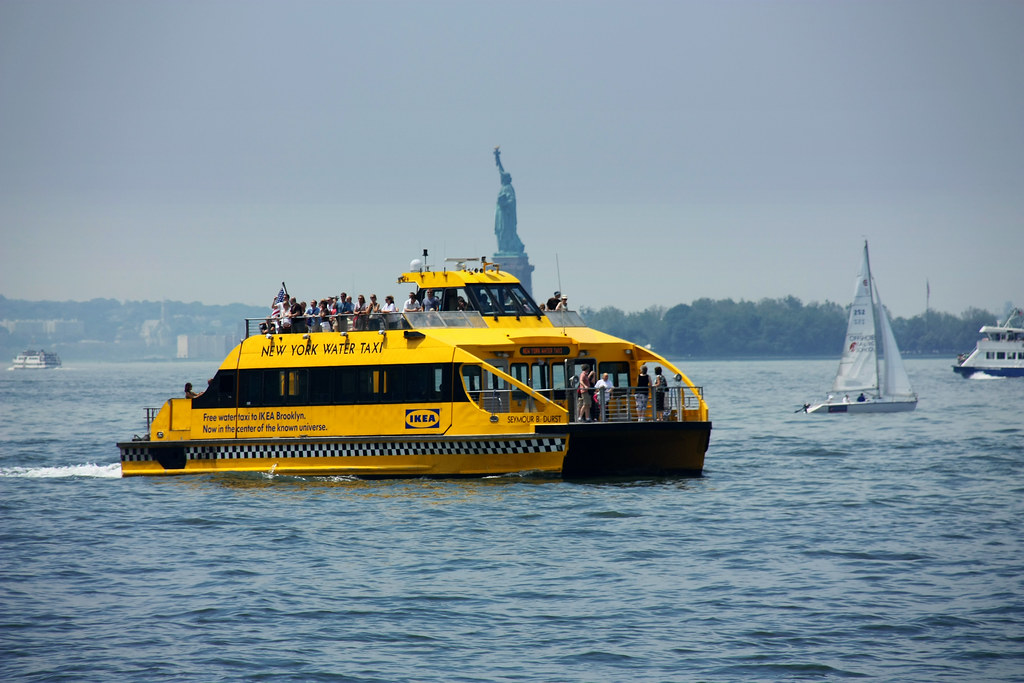
    A New York Water Taxi en route to Battery Park. (Photo via flickr user Tomas Fano)

    For a city whose central business area is an island, New York City is surprisingly cut off from its waterways. With a road network ringing the island, numerous bridges and tunnels connecting Manhattan to the outside world and an extensive subway system that makes interborough travel an afterthought, the city can feel like just another landlocked metropolitan urban area.

    Last week, though, I challenged that paradigm en route to a Yankee game. After more than two and a half decades of taking the 4, the D or the B (and once the C) to Yankee Stadium, my sister and I headed down to Pier 11 on Wednesday night, and at 5:30, we boarded the game-day special water taxi. The boat leaves 90 minutes before game time and drops its 150 passengers off on the far side of the new Metro-North stop at 153rd St. From there, it is about a ten-minute walk through a parking lot, over a train station and past the old stadium to the new ballpark.

    As a means of travel to the stadium, the water taxi is more gimmick than practical mode of transit. Our door-to-door trip from Wall St. took over an hour while the 4 train takes approximately 35 minutes to make the same trip and leaves you closer to the stadium than the boat does. Yet, as we traveled, I marveled at the route. We motored past parts of the city most New Yorkers never see from the water, and my sister and discussed just how far some of those East Side dwellers are from the nearest subway stop. With a ferry stop only at 34th St. along the East Side, those who live far east either walk, take the bus or drive.

    But what of the waterways? Ferry service in New York is never taken seriously, but a Times article published yesterday suggests that may change. Currently, approximately 100,000 people per day take ferries in New York, and according to Ariel Kaminer, most of those who aren’t taking the Staten Island ferry travel between New Jersey and Lower Manhattan. Some use the Ikea shuttle, and the once-a-day shuttle to and from the Rockaways has its followers.

    Kaminer reports though that the city is looking to expand its use of the water ways. She writes:

    Three public entities have been considering it from different angles. The Economic Development Corporation is soon to release its “Comprehensive Citywide Ferry Study.” The Department of City Planning is interested in how ferries could revitalize the waterfront. And the Office of Emergency Management is looking around for mass-evacuation plans. (In a crisis, you wouldn’t want to be left hailing a taxicab.) Put all that together, and there’s a chance that a decade from now, ferries could be mentioned along with buses and subways as main-course options on New Yorkers’ transportation menu…

    Ferries are a growth opportunity. To add new routes, you don’t need to dig a tunnel or lay a track. You don’t need to reroute traffic, build bridges or add lanes. And in many parts of New York, unlike almost every other city, you wouldn’t need to build big parking lots where riders could leave their cars. What cars?

    What you need is a viable pier and a boat. You need a convenient way to get from water’s edge to people’s ultimate destinations. And you need someone to be in charge of it all…

    It’s hard to imagine ferry service expanding very far unless it becomes a public initiative, an integrated system with coordinated schedules and MetroCard access. But who would lead such an initiative? The Metropolitan Transportation Authority? The Port Authority of New York and New Jersey? The Department of Transportation? No one seems to know.

    Whatever value these public agencies ultimately assign to reducing car traffic, easing interborough transit, supporting waterfront development or other such civic goals, New Yorkers have a personal reason to care. Ferries are fun. They tend to cost a few dollars more than other forms of mass transit, but you can think of the difference as an inexpensive form of mental health care.

    In a sense, Kaminer treats ferries like a gimmick. They’re fun, she says, because to landlocked New Yorkers, they are. But ferries could do a lot for the city’s transit pathways as long as planners recognize something about ferries: They aren’t very fast, and they should be used to connect areas of the city that aren’t near or accessible to other transit options.

    Because New York City opted to ring its waterfronts with roads, the bulk of development has occurred near the middle of the island. While people do live along the waterfront, far more people work, live and play in the center of the island, and for millions, ferries are inconvenient, impractical and slow. But if the city can figure out a way to run cost-neutral or even profitable ferry service from areas that don’t enjoy easy access to subways or regular bus routes, the only thing in the way, as Kaminer notes, would be a lack of a pier.

    For most, ferries won’t become a way of travel. We live far from the shorelines and work far from the shorelines. Plus, as my meandering trip up the East River last week demonstrated, ferry travel can take twice as long as a subway covering the same ground can. Yet, it makes sense to invest in the waterways. If even enough people for a few boat rides a day find the taxis cheaper and more convenient than their current commutes, the ferries will have paid off.

  • LaHood not yet on board with Senate transit measure

    As a group of U.S. Senators prepare to fight for a $2-billion transit rescue package that could help the MTA avert sweeping service cuts next month, one potential ally hasn’t yet embraced the bill. As Andrea Bernstein at Transportation Nation reports, Ray LaHood, President Obama’s Transportation Secretary, has not yet endorsed the bill. While speaking with WNYC’s Brian Lehrer yesterday, LaHood expressed concerns over finding the $2 billion without pushing the country further into the red.

    “We haven’t endorsed it,” he said, “because we really need to look at how we pay for that or how the Congress is going to pay for it. But we’re in discussion with Congress on a regular basis about these kinds of transit problems — lower ridership and lower resources. It’s an issue. We’ve talked to Congress a lot about it, these things have to be paid for too, it’s one thing to say you’re going to appropriate x amount of dollars but we’ll continue to keep a watchful eye on it.”

    LaHood’s press secretary later explained that the secretary’s use of present tense simply means that, as of now, the administration is not endorsing the bill. Implicit in that statement is a belief that the administration would consider supporting the transit operations rescue package if an appropriate source of funding could be found. As it is, New York, for example, would still have to face the reality of an inadequate funding scheme for transit, but if federal money can close the gap until the end of 2011, perhaps by then, real estate taxes will increase enough to cover the MTA’s budget gap.

  • With time tight, northeast Senators eye transit rescue package

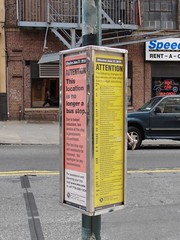
    A bus stop no longer With June 28, the day on which New York City Transit will eliminate bus and subway service in order to save $93 million, coming ever closer, time for any rescue packages is running out. Yet, the United States Senate might just come through with the dollars the MTA — and other transit authorities across the nation — needs to avoid crippling service cuts or fare hikes.

    With support from the Amalgamated Transit Union and the Transport Workers Union, Senators Chuck Schumer, Kirsten Gillibrand and six other Democrats announced a federal bill that would provide $2 billion in operations aid for transit authorities that are currently exploring service cuts or fare hikes to close budget gaps. The MTA would be eligible for $275 million in assistance that would be good through September 2011.

    “Commuters in New York are outraged by the fare hikes and service cuts that are being considered right now,” Gillibrand said. “This emergency funding is badly needed to maintain strong and affordable transit systems that get workers to work, students to school, and keep our economy moving.”

    Streetsblog, its DC counterpart and the Tri-State Transportation Campaign all hailed the introduction of the bill as a major step toward a transit rescue. Yet, time remains as short. Writes Ben Fried at Streetsblog:

    Before the MTA can decide how to allocate the funding, the bill has to pass Congress. The legislation could be attached as a rider to a war spending bill the Senate is expected to pass this week, said Liu. Or it could be attached to a small business tax credit bill the week of June 8. (The transit aid measures would also have to clear negotiations in conference committee.) Either option would presumably allow the MTA to avoid enacting service cuts scheduled to take effect at the end of June.

    “It comes down to our region’s senators being the champions for this on the Senate floor,” said [TSTC’s Ya-Ting[ Liu, who praised [Connecticut Senator Christopher] Dodd and the Senate delegations from New York and New Jersey for sponsoring the bill. “We just know we have to keep up the public pressure.”

    In New York City, this bill could not come soon enough, and I worry that its Eleventh Hour introduction may in fact be too late. The MTA has already implemented new schedules for its commuter rail lines and has phased out G train service to Forest Hills. Construction crews are working now to ready the Chrystie St. Cut for revenue service as the M will replace the V train along Sixth Ave., and signs mark bus stops across the city announcing service changes or outright suspensions. If the MTA is to reverse these cuts, the money must start flowing soon.

    Of course, the other element of this rescue package we must consider is the way it absolves New York State of its responsibilities toward transit. If this important piece of legislation can pass the Senate quickly, it will be good only for the next 16 months. It isn’t designed to replace state funding schemes, and states shouldn’t begin to rely on the feds to bail out transit agencies every time a funding crisis arises. Perhaps the economy will rebound enough to provide the MTA with increased real estate taxes to avoid future armageddons, but a toll or congestion pricing scheme will have to be put in place sooner or later to help shore up the authority’s revenue streams.

    Realistically, the MTA is planning to move forward with its cuts until the bill is ultimately approved. The authority, never one to waste words as it seemingly does with dollars, had only a brief statement to issue. “We support the bill,” spokesman Kevin Ortiz said, “and we hope it passes.”

  • A funding failure on a national level

    A bus stop warns of impending service cuts. Photo by Benjamin Kabak

    Throughout the country, signs such as the ones currently adorning New York City’s bus stops are popping up all over. While infrastructure investment may be up, transit authorities can’t meet their bottom line, and to avoid fiscal ruin, those who run transit systems are cutting service and employees. As transit use hits record highs for the auto era, a depressing map from Transportation For America shows just how widespread the service cuts are.

    Why transportation authorities are in the red cuts to the heart of mass transit as a public good. To ensure relatively equal access to all, fares for buses, subways and light rail lines must be kept artificially low. While the demographics of New York City’s transit users do not line up well with the rest of the nation’s, throughout the country, people who are less well off are generally transit riders, and to keep the economy moving, transit fares cannot be prohibitively expenses. In an ideal world, the state would subsidize the difference between revenue and a $0 balance sheet.

    But over the last few decades, transit authorities have come face-to-face with financial difficulties. Some of it can be blamed on a conservative government movement hesitant to invest in public goods. Some of it can be blamed on bad debt funding practices; some on rising pension obligations and management salary totals; and some on unfunded federal mandates. The bottom line is that, no matter the cost, transit authorities are broke, and the American people are suffering for it.

    A recent editorial by Dan Grabauskas, a former GM at Boston’s MBTA, and Paul Regan, current executive director of the MBTA Advisory Board bring this national problem to light. In Boston, the MBTA faces a “$230 million structural deficit and $543 million in unfunded safety-critical projects.” In other words, despite the city’s willingness to spend billions on the Big Dig, it can’t find the money to ensure the T can run properly, efficiently and safely.

    The two summarize the national crisis:

    According to a 2010 survey by the American Public Transportation Association, 84 percent of all transit agencies have cut service or raised fares in the last year, or plan to do so in the near future. New York City faces a $800 million shortfall, and has implemented a plan to delay maintenance, and cut entire subway lines and bus routes; Chicago, facing a $300 million shortfall, has significantly reduced service on dozens of bus routes, and rail lines; Philadelphia has announced a 6 percent fare increase to help close a $110 million operating deficit; and Washington has a $189 million operating deficit for next year, with plans to balance it by using capital funds to pay for operating costs (thus deferring maintenance), as well as reducing some bus and rail service.

    These “legacy’’ transit systems are starved by budgets in which escalating and intractable fixed costs outpace combined fare revenues and government subsidies. They are pressured by safety and reliability concerns resulting from deferred maintenance, and they face continuing calls for expansion without regard for how to pay to build, operate, or maintain the extensions, let alone the existing system.

    Overall, the two urge transit authorities to invest in repairs and system maintenance — the so-called State of Good Repair — before eying ambitious expansion projects. One, though, should not come at the expense of another. The country’s transit networks must expand to meet environmental demands and the needs of growing urban population centers.

    The two also urge public/private partnerships to encourage creative solutions to maintenance and construction challenges, and they call for an expansion of the funding available for public transit systems under the Intermodal Surface Transportation Efficiency Act. It might be too late for New York to avoid the upcoming service cuts, but as a nation’s transit systems suffer, it’s time for the federal government to act. Token stimulus dollars that can be used for operating expenses won’t cut it, but a true commitment to mass transit will.

  • The MTA’s own green dividend

    As New York settles in to celebrate Earth Week, the buzzword of the week is, of course, “green,” and New York City’s transit options are taking center stage. We heard yesterday how the fact that New Yorkers drive much less than other Americans makes the citymore livable, environmentally friendly and economical and has lead to over $19 billion in auto-related savings. (The full report — called New York City’s Green Dividend — is available here as a PDF.) Today, the MTA gets in on the act.

    According the MTA in conjunction with the Climate Registry and the American Public Transportation Authority, the city’s network of subways, buses and commuter rails helps New Yorkers to reduce greenhouse gas emissions by 17.4 million metric tons. “We now know how much carbon MTA operations emit each day,” Ernest Tollerson, the authority’s director of policy and media relations, said. “But more importantly, we also know how much carbon is prevented from entering the atmosphere when 8.5 million people per day choose to ride the train or the bus instead of drive their cars.”

    Based upon a report issued by the Climate Registry and methodology developed by the American Public Transportation Association, the MTA used a three-part test to evaluate the its carbon savings. The non-profit collaboration of states, provinces and territories takes into account, according to the MTA’s release “1) car trips avoided each time someone leaves his or her car at home and chooses to ride a train or bus; 2) congestion relief and therefore increased fuel efficiency of those cars that remain on the road; and 3) public transportation’s role in fostering compact land-use patterns that encourage walking and bicycling for some trips and shorter trips overall.”

    Based upon these calculations, the MTA allows New Yorkers to avoid 8.24 units of carbon emissions for every unit the MTA emits via its operations. The numbers say New Yorkers avoid emitting 19.8 million metric tons of Carbon a year, and the MTA knows, via a study from the Climate Registry, it released 2.4 million metric tons of carbon annually for a net savings of 17.4 million metric tons.

    “This is proof positive that New Yorkers are avoiding the release of a very large volume of greenhouse gas emissions by riding the region’s trains and buses,” APTA’s President William Millar said. “It demonstrates how important public transportation is in combating climate change and reducing carbon emissions. Clearly, it is one more important reason for everyone to support the expansion of public transportation services throughout the country.”

    The MTA used these findings to argue for a share of carbon revenues in an emissions cap-and-trade system, — a goal of the authority since 2008 — and this report goes hand-in-hand with the city’s Green Dividend release. Without a vibrant and comprehensive public transit system, New York City would be a pollution-choked parking lot with congestion and unbreathable air (or, as I like to call it, Los Angeles). With the MTA, the city is greener, cheaper and less congested than nearly any other urban area in the country. If only Albany would recognize this reality.

    Above: Emissions diagram courtesy of the MTA.

  • Paving New York and putting up a parking lot

    Without the subway, traffic, seen here along Houston St., would be crippling to New York City. (Photo by flickr user vauvau)

    One of my more prominent themes here on Second Ave. Sagas over the last few years has focused around the role the New York City subways play in driving the city’s — and the region’s — economy. Although cars are the focus of politicians hellbent on keeping bridges unnecessarily free and congestion pricing away from the streets of Manhattan, without a subway system that takes seven million New Yorkers to and from work, school and play every day, the city would simply cease to function on the scale that it does today.

    Those of us who fight for better transportation solutions and more public transit investment are well aware of the importance of the subway system, but for reasons relating to interest group politics, wealth and access, our representatives prioritize auto drivers to the detriment of the rest of us. Maybe a new report issued by the city can start to turn that tide.

    The study is called New York City’s Green Dividend, and the Daily News offers up a short preview. The report, writes Pete Donohue, “says there would be 4.5 million more cars on the road if New Yorkers racked up the same average mileage as residents of other big metropolitan areas. Parking that many cars would require a lot about the size of Manhattan.”

    He continues:

    The city-commissioned study argues that improved transit and pedestrian-friendly changes to the city’s landscape benefit not just the environment but the economy. The findings

    • The average number of miles driven per person daily in New York City is 9, while the average per person in other large metropolitan areas is 25 miles a day.
    • Residents of the five boroughs save $19 billion a year because they buy fewer cars and avoid many auto-related expenses such as gasoline and car insurance…
    • Nearly 57% of New York City workers commute by mass transit; 32% drive or take cabs; 10% walk, and 1.2% take their bicycles or use some other mode.

    As previous studies have shown, the numbers of those commuting into the Manhattan Central Business District by mass transit are even greater, and auto trips plummet accordingly. As presented by Donohue, the study doesn’t appear to quantify how New Yorkers ride to school, but when it’s officially released, I’ll try to update these figures.

    I’m not surprised by these findings at all. Without a cheap, reliable and relatively efficient subway system, people wouldn’t be able to live in Flatbush and work in Midtown. They wouldn’t be able to go from the north Bronx to Lower Manhattan for the cost of a subway swipe. On the other hand, a worse transit system — say one crippled by service cuts — would lead to more cars, more pollution, more time spent in traffic, more frustrating attempts at finding parking spots that just don’t exist. The city cannot afford that future.

    Although I began this post hoping that politicians who control the purse strings would respond positively to this survey, the truth is that they probably won’t. New York’s elected representatives seem blind to the fact that public transit plays such a vital role in the region. Only when transit fails will they be forced to act. In the meantime, we’ll continue to argue that more investment transit and not more giveaways to drivers is the way to economic health and growth in New York City.

  • A nation in support of public transportation

    For much of the last two years, New Yorkers have witnessed a battle of mass transit funding and public transportation policy. While New York City, the state’s economic driver and only area of New York experiencing a population growth, needs and relies on its mass transit system to function efficiently and productivity, the state legislators holding the purse strings have not readily embraced making tough choices over public transportation funding.
    We don’t have congestion pricing or bridge tolls, and we don’t have a commuter tax with proceeds funneled to the network that brings commuters to work. Instead, we have an MTA teetering on the edge of financial ruin that is preparing to slash services and may need to raise fares for the third year in a row. It is a political mess and one most New Yorkers do not support. If we had our druthers, the state would be investing heavily in city-based and city-oriented transit networks.

    Across the country, as transit ridership increases but the costs of running a public transportation network do as well, municipalities are, by and large, facing cuts to their transit options. A new survey by the American Public Transportation Association released yesterday revealed that 84 percent of transit agencies have had to raise fares, cut service or consider both options since the start of 2009 in order to meet budget. Another 69 percent of those surveyed are trying to close budget deficits this year, and 11 percent of all transit agencies have a budget gap of 20 percent or more for the current fiscal year. Needless to say, this is dismaying news.

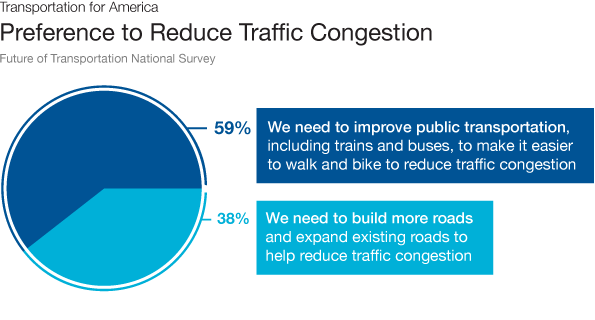
    It shouldn’t, according to the American people, be like this though. In fact, most Americans want to see more transit investment and more federal support for local public transit networks. In a new poll released this week, Transportation for America found overwhelming support for public transportation. In fact, 82 percent of those polled said that “the United States would benefit from an expanded and improved transportation system, such as rail and buses.” More comforting too were people’s traffic-mitigation preferences. Take a look:

    On an economic level, though, the true preferences were encouraging. Currently, the federal government spends approximately 17 cents out of every transportation dollar on public transit. Fifty-eight percent of poll respondents said that the feds should spend more, and most people thought that the government should be willing to more than double that amount to 37 cents per transportation dollar. The full poll and all of the results are available here.

    Right now, it’s tough to find much joy in these numbers because it often seems as though no one is listening. We as New Yorkers, we as Americans, want a greater investment and a stronger commitment to the railroads, subways and buses that transport us. Yet, politicians are hesitant or unwilling to make that commitment, and even more are just downright hostile toward public transportation.

    As the MTA, the nation’s largest transit agency, struggles to stay afloat, these dramas I write about every day are repeating themselves on a smaller scale across the country. As public transit networks fail, Americans want more rail and bus options. They want to have cheaper, reliable and efficient transportation options, and they want the government to spend money on it. Maybe one day, those we elect to represent us will wake up to that truth. For now, we just have to hope the MTA and its brethren can weather this bad economic storm.

  • APTA speaks out against the use of stimulus funds for operating deficits

    Over the last few months, a growing divide has emerged amongst those of us in the transit advocacy community. Some fighting for transit dollars — such as Gene Russianoff of the Straphangers Campaign — have called upon agencies to use federal stimulus dollars earmarked for capital improvements to cover operating deficits while others — such as the Regional Plan Association and I — have come out against the use of capital funds as an operating band aid. In my view, it simply sets a bad precedent and allows state legislatures to further shirk responsibility for funding transit.

    Today, the divide has spread to the federal level as the American Public Transportation Association, a federal transit lobbying organization, announced its opposition to the use of stimulus funds for operating expenses. Elana Schor at Streetsblog DC covered the story today, and APTA’s statement jibes with my position. “A lot of folks look at it as a zero-sum game,” Paul Dean, the group’s government relations director, said, “that if you add a federal subsidy, that’s going to lead to state and local governments decreasing their contribution, and you’re going to be back in the same place you were — with less money available to meet your capital needs.”

    In New York, MTA CEO and Chairman Jay Walder has continually voiced his opposition to the so-called Russianoff Plan as well. Since the use of stimulus dollars wouldn’t come close to covering the MTA’s gap, the authority is still trying to find the $750 million it needs via service cuts, internal belt-tightening and better state-based funding mechanisms. The need for capital money and expansion, even at a time when operating revenues are low, remains a paramount concern for an agency all too well aware about the dangers of capital neglect.