Category: Second Avenue Subway

  • Delays, overruns again plaguing Second Ave. Subway

    A 2009 MTA slide still tells a story of delays and high costs for the Second Ave. Subway.

    Nearly a year ago, the Federal Transit Authority disputed the MTA’s claims that the Second Ave. Subway would open by the end of 2016. While the FTA’s estimates had Phase 1 costs at nearly $5 billion and the opening in mid-2018 at the latest. Officially, the MTA had disputed these figured and continued to proclaim a 2016 date for the project. Now, it seems, the tide is turning for the worse.

    According to a report in The Observer, the MTA is officially acknowledging the risks of delays and overruns for both the East Side Access and Second Ave. Subway projects. The details are not pretty:

    By these estimates, the Second Avenue Subway is now estimated to cost $4.98 billion, another $307 million beyond the numbers the M.T.A. had been working off, with completion in February 2018, up from December 2016. East Side Access is now at $8.1 billion, up $328 million, with completion in April 2018, up from September 2016. (At the same time, the M.T.A. still says that it believes it can bring the projects in below these numbers and on its schedule.) …

    All told, the situation involving East Side Access and the Second Avenue Subway tells a story that is all too frequent with giant public sector projects. The projects were approved and sold to the public with one price tag, only to see the budget prove far too insignificant (very rarely, if ever, do projects come in well below their initial projections). And once a project has started—once the foot is in the door—it becomes really difficult to pull the plug, even if the public would never have signed onto the initial price tag.

    In this case, the Second Avenue Subway was initially supposed to be $4.1 billion, with completion slated for June 2014; East Side Access was budgeted at $6.3 billion, to be finished in December 2013.

    With regard to these projects, M.T.A. spokesman Jeremy Soffin said the agency would work toward the existing budget, which it views as attainable. “We have a budget and a time line that we’re working toward and we plan to meet,” he said. “Both we and the F.T.A. acknowledge that here’s risk inherent in these projects.”

    According to Eliot Brown, the FTA has blamed rising construction costs and poor oversight as sources for both the delays and cost increases along Second Ave. As the MTA has capital funds secured only through 2011 but significant federal contributions to this project, Phase 1 will open eventually this decade, but I have my doubts about Phase 2 and beyond. Simply put, for the MTA to earn more support for capital investment of this magnitude, these projects need to meet their deadlines and budgets. So far, these goals have been elusive ones indeed.

  • A slow start to the TBM’s journey down 2nd Ave.

    Over six weeks, the MTA brought politicians and reporters underneath Second Ave. for the ceremonial launch of the Second Ave. Subway tunnel boring machine. The MTA’s plans called for the TBM to dig out two 7800-foot long tunnels from 96th St. to the northern stub of the BMT Broadway tracks at 63rd St. and Lexington Ave. Digging at a pace of 40-60 feet per day, the TBM should complete the first tunnel by January, but the early going has been rough.

    As Dan Rivoli reported last week, the TBM had been digging at a pace of just 10 feet a day due to some highly fractured rock underneath the avenue. Because so much is unknown about the geology of Manhattan, the MTA had to proceed cautiously through this stretch of rock. Otherwise, the TBM’s digging could have created complications and the threat of a cave-in in the eastern starter tunnel. As of Thursday, the MTA’s Aaron Donovan informed me, the TBM had broken through the area of highly fractured rock and had reached the 300-foot mark. Although it is still in the start-up phase, the TBM should now begin to pick up speed. 2016, here we come.

  • Stores suffer while 2 Ave. residents earn a break

    Displaced Second Ave. residents can leave all of their construction woes behind.

    With construction continuing apace underneath Second Ave. and the MTA maintaining its intention to finish Phase 1 of the Second Ave. Subway by 2016, attention has turned to the impact construction has on both residents and businesses. For years, businesses have bemoaned the disruption as sidewalk space is lost, and the general disarray of a construction zone has taken over. The MTA has been unable to find money to help out businesses, and although the Upper East Side will enjoy extreme growth when the subway opens, for now, business owners are finding progress rough.

    Those who live near the construction zone are suffering as well. Many of the buildings along Second Ave. date from the early 20th Century, and decades of less-than-perfect maintenance have left many unstable. Although landlords are ultimately responsible for shoring up their buildings and keeping them up to code, the MTA has decided that its cheaper to pay for the engineering work than it is to fight building owners in court and risk delaying the subway.

    But now the story emerges: As the MTA works to reinforce these buildings, the residents of Second Ave. must relocate, and the MTA is going to pay handsomely for it. According to a report in The Times, the authority is set to dole out payments well above market rate to appease displaced residents. Here’s how Michael Grynbaum puts it:

    Say the Metropolitan Transportation Authority has decided to eject you from your Upper East Side walk-up for a month, maybe two, to help make way for the Second Avenue subway. You will be offered a choice. Stay in a nearby hotel, free, or skip the hotel and accept a rent stipend from the authority. A stipend that pays $5,000 a month.

    That sum is for renters who live in a studio. For those in one-bedrooms, the authority will offer $6,000 a month. A two-bedroom renter gets $9,000. The authority will also pay $40 per person, per day, for meals. Moving and furniture storage costs are covered too, along with rent and utilities for the apartment you are leaving. Maybe giving your home to the transportation authority would not be so bad after all.

    According to a recent report, these figures are well above market rate. In non-doorman apartment buildings, an Upper East Side studio goes for approximately $1700; a one-bedroom for $2200; and a two-bedroom for $2800. It is no coincidence that MTA is an anagram for ATM.

    It gets better, though. Those who choose to eschew the stipend can instead take up the MTA on its hotel offer. The stipend prices correspond to hotel rates for the Marmara Manhattan, a high-end residential hotel on 94th St. Those who don’t want the trouble of finding their own places can stay at the hotel courtesy of the MTA. The authority stresses that these seemingly exorbitant prices are well worth the cost of avoiding delays as residents litigate their ways through the construction morass. Despite the gaudy prices, I’m inclined to agree.

    Still, Second Ave. business owners cannot be too happy with this news. As Crains New York detailed yesterday, businesses are sufferingly greatly along the avenue. Some stores are reporting revenues down by nearly 50 percent, and restaurants that rely on outdoor seating are finding less available sidewalk space, fewer people willing to dine al fresco inside a construction zone or both. A new website at 2ndAvenueShopper .com is the latest effort from the Second Ave. Business Association, but the shop owners are fighting a losing battle. “There’s a stigma with Second Avenue now,” Cafe Greco owner Frank Sofroniou said.

    The dueling headlines this week show the troubles of construction. The MTA must pay to relocate residents and finds it economically expedient to do so even with stipends well above market rate, but the MTA is under to obligation to offer financial support for struggling businesses. When the subway is open in six years, the entire neighborhood will be revitalized, but for now, it must adjust to the trials and tribulations of a semi-permanent state of flux.

  • As 2nd Ave. businesses suffer, MTA toes the 2016 line

    The first phase of the Second Ave. Subway will be open for business by the end of 2016, Michael Horodniceanu, president of MTA Capital Construction, promised at a City Council hearing yesterday afternoon. Even as tunnel boring has faced some difficulties, even as the federal government doubts the MTA’s own projections, the authority has continued to assert that these $5 billion subway extension will open in 78 months.

    Pledging that this projected date is “set, as far as I’m concerned, in stone,” Horodniceanu hedged his bets. “You should understand one thing: We have a variety of factors that many times are unanticipated.”

    Despite this seemingly firm timeline, the MTA currently has no idea when future phases of this not-so-ambitious and long-awaited subway line will see the light of day. Originally, the MTA had anticipated a full line by 2020, but now, Horodniceanu does not know when or if the authority will begin to make plans for Phase 2. For what it’s worth, Phase 2 will rely on some preexisting tunnels north of 96th St., but construction, according to MTA documents from the early 2000s, will rely largely on disruptive cut-and-cover techniques. The price tag should be lower, though, than the fully-funded $4.45 billion figure for Phase 1.

    While some of Horodniceanu’s testimony can read as good news from an agency notorious for finishing projects years late, the main purpose of the Council’s hearing concerned Second Ave. businesses, and on that front, the MTA has taken an approach worthy of Mr. Spock. The long-term needs of the subway-riding many outweigh the temporary needs of the few.

    As Heather Haddon and Gabriela Resto-Montero note not for the first time, construction along the East Side has been catastrophic for businesses. Eighteen restaurants and shops along the avenue have gone out of business, and others further south are without their sidewalk cafes this year due to construction.

    What will the MTA do about this economic issue, the City Council wanted to know. The answer: nothing. “We have no way of determining which businesses have closed as a result of construction. Businesses close and open for a variety of reasons,” Horodniceanu said. “We are not in a position to provide any financial help. We are not going to look at claims unless there is a claim related to something we have done.”

    When asked if the cash-starved MTA could set aside money in the project’s very lean budget for reimbursement expenses for suffering businesses, Horodniceanu replied simply, “Absolutely not, sir.” What more is there to say? During massive street construction, businesses will suffer, and neighborhoods will carry the weight of a megaproject. In six years, if all goes according to plan, Upper East Siders living on Second Ave. will enjoy a quality of life better than they’ve known in the decades since the Els came tumbling down. For now, the temporary loss of business is but the price of progress.

    “We are acknowledging that construction impacts the businesses and the residents’ quality of life,” Horodniceanu said. “But at the end of day, this area will be better off because we are providing transportation to their front door.”

  • Rachel Maddow explores the SAS launch box


    The tunnel boring machine head and much of the trailing equipment have progressed through the launch box and south down Second Ave. since its launch two weeks ago. (Photo via The Rachel Maddow Show on flickr)

    In mid-May, I took a trip into the Second Ave. Subway launch box as part of the MTA’s ceremonial launch of the tunnel boring machine. On Friday, MSNBC’s Rachel Maddow did the same, with a video camera in tow.

    She ended her Geek Week special with a look at some impressive infrastructure projects. Although I’ve questioned whether or not Phase 1 of the SAS is a megaproject, the work going on underground is certainly impressive in scope, and Maddow brought it to light in an 11-minute segment, embedded below.

    What I like most about Maddow’s coverage is the accompanying flickr photo set. By comparing her pictures with mine, we can see how far the 500-foot-long tunnel boring machine has dug out since it started work two weeks ago. For now, progress will be slow and steady, and the TBM should complete the two tunnels by next November.

    Visit msnbc.com for breaking news, world news, and news about the economy

  • CB 8 rejects Second Ave. advertising proposal

    For the past three years, businesses along Second Ave. have struggled to draw in customers as the MTA digs out its new subway line. Many shops and restaurants have closed while others are barely hanging on. Meanwhile, the state rejected monetary grants for businesses, and a Shop 2nd Ave. initiative hasn’t been as successful as many would hope.

    In an effort to attract more customers, earlier this week, a group of business owners and Co-Op residents proposed a modification of the neighborhood’s billboard restrictions. The proposal would have allowed store owners to hang billboards on buildings that are up to 100 feet away from the business entrances. Thus, proprietors could advertise above the construction site.

    Community Board 8, however, rejected the measure. “We’ll look like 42nd Street,” Kathy Watts-Grossman, an Upper East Sider, said. “If you cheapen the neighborhood by putting up signage, you can’t take it back.” With few Community Board members willing to trade off some temporary advertising space in an effort to keep businesses alive, Second Ave. store owners will have to keep struggling along. As Richard Bass, a consultant who helped put forward this proposal said, “It’s a trade-off of evils. No one likes to advertise in a residential neighborhood, but no one likes shutting down businesses.”

  • Down the rabbit hole, a tunnel boring machine comes alive

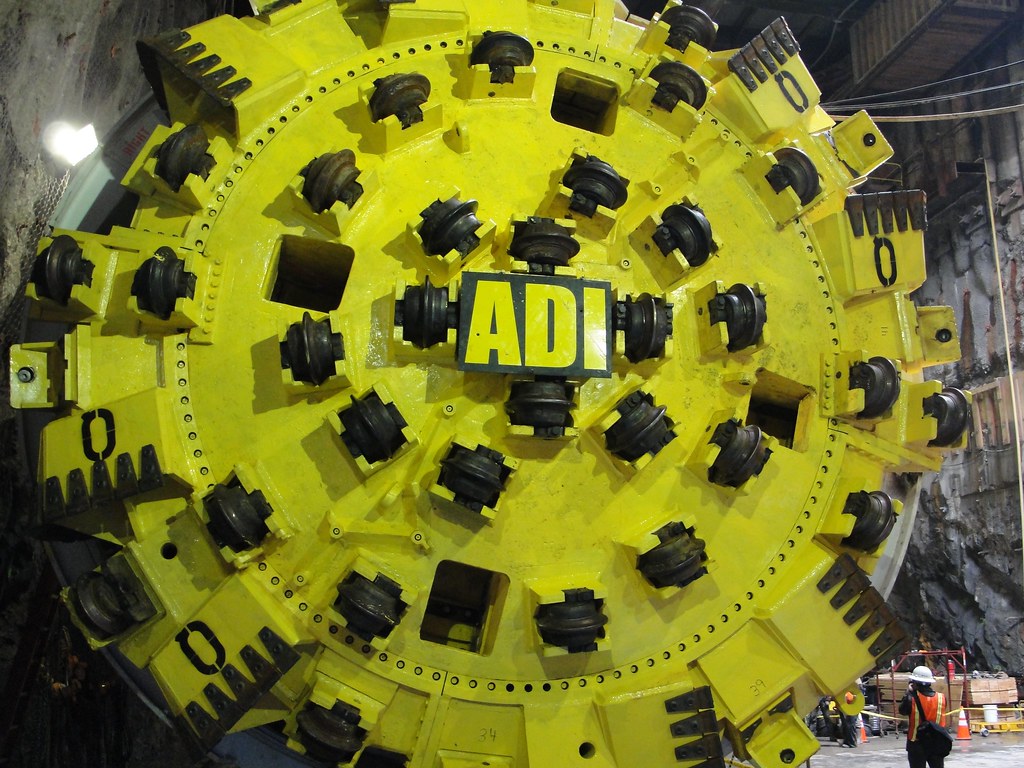
    Cutterhead

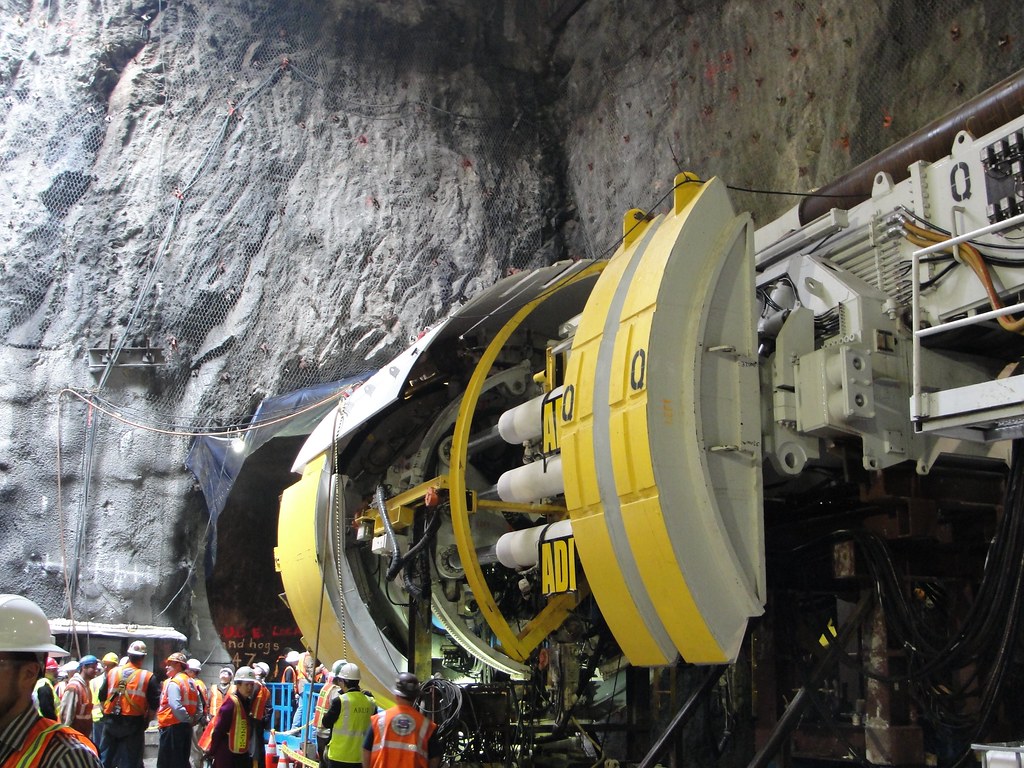
    The front of the tunnel boring machine that will soon to be digging out the Second Ave. Subway tunnels. (All photos by Benjamin Kabak. Click to enlarge.)

    As I ventured this morning into the Second Ave. Subway launch box beneath the area from 92nd to 95th Sts. along the Upper East Side, I was struck by how utterly massive the underground cavern is. It spans more than three city blocks and bottoms out at a depth approximately 60-70 feet below street level. Apartment buildings loom over the hole in the ground, and the scope of this project — an undertaking of massive proportions — is staggering.

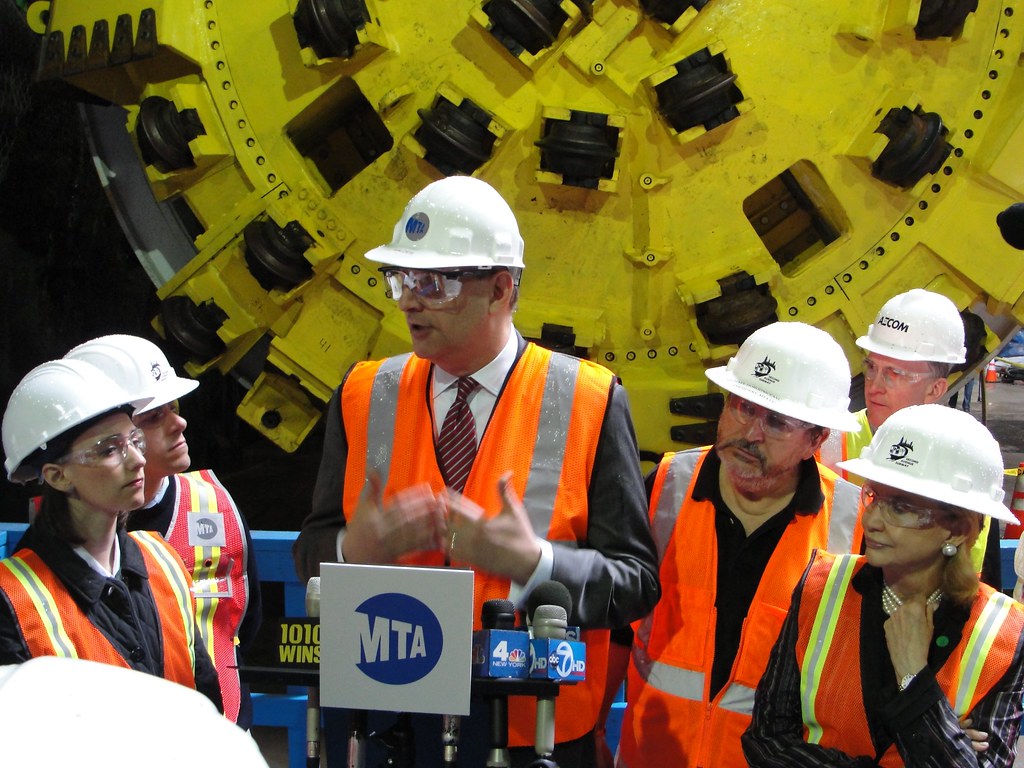
    For the first time since the April 2007 groundbreaking, the MTA invited reporters and city officials underground to mark another Second Ave. Subway milestone. Today, at shortly after 10:30 a.m., MTA CEO and Chairman Jay Walder blasted an air horn that marked the start of the tunnel boring machine’s journey from 92nd St. to 63rd St. With two City Council members and a House representative along for the photo op, the MTA reaffirmed its commitment to Phase 1 of the Second Ave. Subway and stressed the December 2016 completion date.

    Walder and Co.

    “There have been skeptics who saw construction start and stop in the 1970s and said the Second Avenue Subway would never be built,” Walder said. “But today, we are turning on the machine that will dig the Phase 1 Second Avenue Subway tunnels, and we won’t turn it off until the tunnels are done.”

    “Every day,” Carolyn Maloney, House representative from the Upper East Side, said, “the tunnel boring machine will be moving the new subway dozens of yards closer to the finish line. That’s real progress, and it means that it’s no longer a matter of ‘if’ the Second Avenue Subway will get done — it’s now a matter of ‘when.’”

    A close-up of a cutterhead blade.

    Prior to the ceremonial launch of the tunnel boring machine, Michael Horodniceanu, president of MTA Capital Construction, took reporters and photographers on a tour of the launch box. He spoke at length about the progress they plan to make now that the 500-foot-long, 450-ton TBM is ready to go. The machine is going to dig out approximately 40-60 feet of dirt a day and will be operating nearly non-stop until next November. The first tunnel — the downtown tube on the west side of the street — will reach the existing tracks at 63rd St. by January 2011, and the MTA will then pull the TBM back through the tunnel to start working on the uptown tube. When all is said and done, the TBM will have dug out two tunnels 7800 feet long.

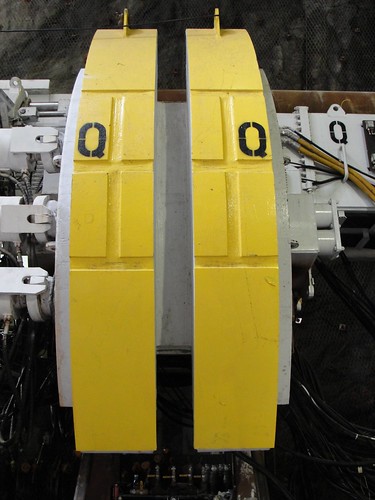
    QQQ

    Currently, the TBM is decked out in the familiar yellow of the BMT Broadway trains with Q markings throughout the surface. The Q, running north from 57th St. and Broadway to 96th St. and 2nd Ave., will be the original Second Ave. Subway, followed eventually by the T train when and if Phases 3 and 4 reach south of 63rd.

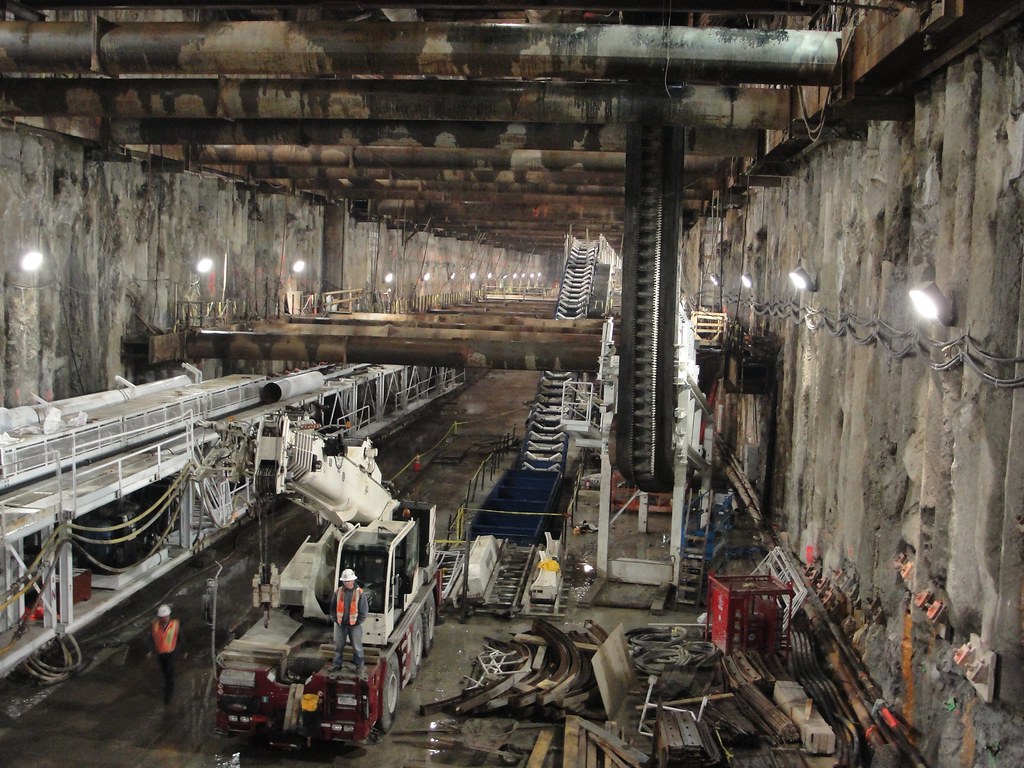
    DSC00554

    This is the view from approximately halfway up the staircase that feeds to the street level, and it shows just how massive this project is. The machinery on the left is a part of the TBM tail, and the conveyor belt will bring debris and rock out from the two tunnels. The concrete and support beams are bracing the tunnel walls. In this picture, the concrete supports are visible, and two Second Ave. buildings loom over the open hole in the ground. These buildings, some 120 years old, are literally atop the subway tunnel, but MTA officials say residents won’t know when the TBM is passing underneath.

    Interestingly, the utilities are still exposed for all to see. The Second Ave. water main is wrapped in insulation, and the MTA will eventually bury all of the pipes as they begin to fill in the tunnels and construct the station caverns. Despite this concrete beginning, there’s a reason why this project still has at least 6.5 years to go.

    TBM

    Before the launch, I couldn’t resist posing in front of the TBM, and after, Carolyn Maloney spoke about the money and the timing. “It’s our job to keep it on target” for 2016, she said.

    With $1.3 billion in federal funds behind it as well, the pressure from DC is squarely on the MTA. “If they decided not to build,” she said, “we lose the money.” And so the TBM will start its journey inching slowly south as a subway line eight years in the making moves another step closer to reality.

    Below is a slideshow of all of the photos I took underground. As the lighting conditions varied, some shots are better than others, and after the jump, check out a 45-second video of the TBM cutterhead spinning as Jay Walder celebrates the moment with an air horn.

    (more…)

  • UESers blame rat infestation on Second Ave. Subway

    When the MTA started work at Second Ave., I had figured the rat infestation articles would come. Yet, in the three years since the groundbreaking for Phase I of the current SAS projects, rats have been noticeably missing from the picture, until, that is, today. As part of their new New York City-focused metro coverage, the Wall Street Journal reports on an increase in the number of rats on the Upper East Side. “It looks like the street’s moving,” Walter Johnson, a 35-year UES resident, said to Andrew Grossman. “It’s just wild. You can’t imagine how infested this place became.”

    Recently, UES residents have taken their complaints to the MTA, but the authority and its contractors say an abandoned building on Second Ave. and not the subway construction is the root of the rat problem. There are, says the MTA, no rat problems within the work zone, and the contractors have, according to Grossman, a ” rodent-control program in place that includes bait and traps within the construction zone.” Public health experts dispute the connection between construction and rats in the first place. “The public has the perception that if there’s construction, there’s going to be rats,” Bobby Corrigan, a city consultant, said. “There’s never any scientific evidence to show those two things are correlated.”

    Still, even with the MTA implementing rodent-control measures and a likely cause of the infestation pinpointed, Upper East Siders prefer to blame the Second Ave. Subway for their quality-of-life problems. It’s become a familiar trope and one that is bound to last until the first Q train rolls up Second Ave., if not beyond. As Tara Reddi said, ignoring all evidence to the contrary, “We are, until 2018, in a living hell.”

  • The MTA takes us inside the launch box

    Last night, the cutterhead for the Second Ave. Subway tunnel boring machine arrived on site, and thanks to Ben Heckscher from The Launch Box, I was able to post a series of photos from the big moment. Just a few minutes ago, the MTA posted its official release on the symbolic arrival of the cutterhead, published the video, above, to its YouTube page and posted the images — many of which I’ve embedded in this post — to its Facebook page.

    “The arrival this week of the TBM at Second Avenue is a clear indicator that the MTA is delivering on a major expansion project that will have a dramatic impact on Manhattan’s East Side easing overcrowding within our transit system and serving as an economic driver for the region as a whole,” MTA Capital Construction President Dr. Michael Horodniceanu said via the release.

    When fully assembled, the TBM will 450 feet long, and the cutterhead will feature 44 rotation disks designed to cut through the Manhattan Schist. In May, the TBM will make its first of two trips through the rock, and when the boring is completed, two 7700 foot-long tunnels will be ready for further work.

    In its release this afternoon, the MTA offered up some vital information about the Second Ave. Subway. When Phase I is completed, it will serve at least 213,000 riders per day who currently use other subway lines, buses taxis or private cars to get around down. Transit believes it will decrease crowding on the Lexington Ave. subways by as much as 13 percent or 23,500 fewer passengers per weekday. Those who live along the far East side will see travel times reduced by up to 10 minutes. The western-most of the two SAS tubes, says the MTA, will be the first mined by the TBM.

    As this shot shows, the cutterhead is truly immense. It measures 22 feet across and is painted yellow in honor of the fact that these new tunnels will extend the Q train northward from 57th St. And now we wait the 6.5 years until the first phase of the Second Ave. Subway is ready for revenue service.

    All images courtesy of the MTA. For more, check out this gallery.

  • SAS Update: The TBM cutterhead arrives

    Work crews prep the TBM cutterhead. (All photos via Ben Heckscher/The Launch Box)

    Throughout the week, various parts of the tunnel boring machine that will soon start to dig out the Second Ave. Subway tunnel from 96th St. to 63rd St. have arrived at Second Ave. Last night, at approximately 9:30 p.m., the centerpiece arrived as the cutterhead, the part of the machine that will do the heavy lifting arrived.

    For the project, this arrival was largely a symbolic one. After all, digging out the tunnels is relatively easy and inexpensive. Building out the stations and the infrastructure that supports the subway are the two expensive and time-consuming aspects of the project. Still, for a subway route with a such a long and tortured history, just the arrival of the TBM cutterhead is enough for a celebration.

    A few weeks ago, I profiled the TBM the MTA will use underneath Second Ave. This particular machine is a 30-year-old veteran that most recently dug out the Fall River CSO in Massachusetts. It last churned beneath the streets of New York when it burrowed its way through the 63rd St. tunnel and has been reconditioned to be “like new.”

    I couldn’t make it up to the Upper East Side last night for the drop, but Ben Heckscher from The Launch Box was on hand for the big moment. He published a comprehensive photo timeline with commentary. He notes that, as you can see in the photo at right, the cutterhead is missing the cutter disks. Those will be installed in the launch box. The cutterhead too has been painted yellow and marked with giant black Qs to demarcate how the TBM will be extending the Q train north from 57th St. underneath Second Ave. Despite the upcoming service changes, the MTA still intends for the Q to service Phases I and II of the Second Ave. Subway.

    By 10 p.m., the cutterhead had been dropped below street level, and the crowds with their cameras dispersed for the night. The ceremony was over, and the hard work — assembling the TBM and starting the digging — will beg in earnest. One day, our subway line will arrive.

    * * *
    In other Second Ave. Subway news, the MTA this week released its latest quarterly update on the project. The full report — available as a PDF by clicking on the image at right — covers the last quarter of 2009, and as expected, the MTA still believes the Second Ave. Subway will be in revenue service by December 2016.

    The most interesting slide from the report is the timeline on page 16. While some of the execution dates for the contracts have been pushed back, the authority doesn’t believe these delays will impact the overall completion of the project. In general, construction on the actual station structures at 96th, 86th and 72nd Sts. won’t commence until late 2011 at the earliest, and utility relocation and demolition continues apace.

    The 63rd St. station, however, is due for more immediate upgrades. According to the MTA’s timeline, the design process wrapped up last week, and work on the station will begin this December. This will include the destruction of a temporary wall that seals off the now-unused tunnel that will one day provide a stop for the northbound Q trains and a transfer to the F. The unused portions of this station are visible on this track map.

    Service on the Second Ave. Subway may still be over five years away, but it’s seemingly going to happen this time around. Can the fourth time be the charm?