Category: Second Avenue Subway

  • Cutterhead Support arrives at the SAS launch box

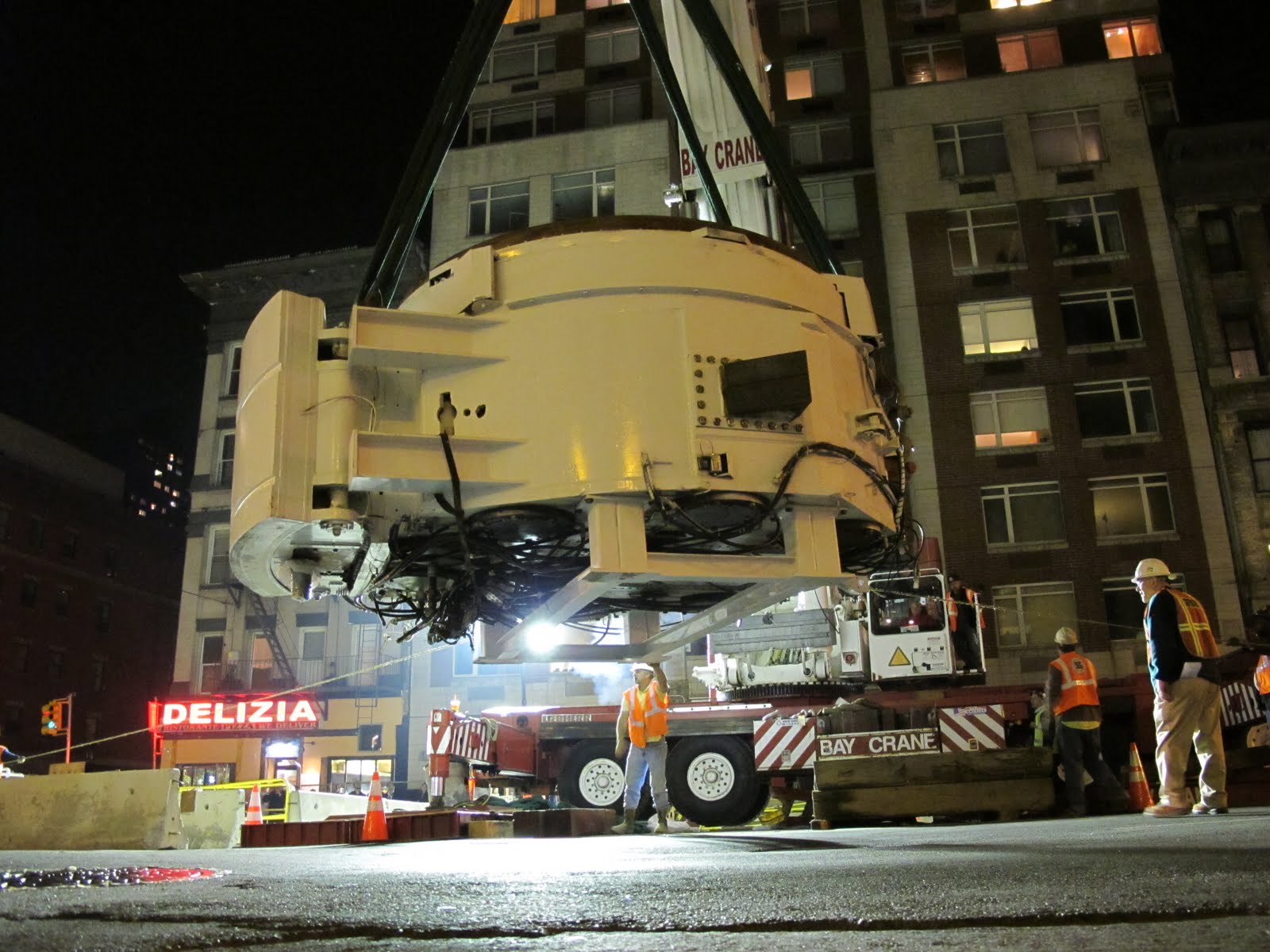
    As the Second Ave. Subway tunnel boring machine is slowly being assembled in the project’s launch box, today’s photo — again courtesy of Ben Heckscher and The Launch Box — is of the Cutterhead Support. This piece will go in between the Main Beam and the Cutterhead. It arrived on site last night after crossing the George Washington Bridge at 8 p.m. and was lowered underground shortly before 11:30 p.m. According to my sources, the Cutterhead itself will be arriving tonight at around the same time, and although the weather isn’t the greatest, I’m sure the shutterbugs will be lining up for a chance to capture the moment on film.

    For more from the delivery of the support piece, be sure to check out The Launch Box. I’ve embedded another great shot after the jump. (more…)

  • SAS eminent domain may torpedo an UES Fairway

    Bad things happen when the government gets between Manhattanites and their gourmet grocery stores, and the MTA is about to see, first hand, what happens during those battles. Last night, during a hearing on the MTA’s request to use eminent domain to take some properties it needs for Second Ave. Subway infrastructure, the news came out that a planned Fairway for 86th St. may be in jeopardy. According to Gabriela Resto-Montero of the news site DNAinfo, the MTA has requested some property that would “cut into a loading zone at the 240 East 86th Street location,” a spot Fairway has been eying for an Upper East Side store.

    As Resto-Montero recounts, the MTA has proposed taking some of Fairway’s planned loading space and allocating it to other Second Ave. businesses that have suffered a loss in curbside access due to subway construction. Fairway, on the other hand, has requested an expanded loading zone and an exemption to delivery hours to compensate for their losses. “They don’t want to get into a situation where they can’t operate properly,” Richard Levin, the grocery store’s lawyer, said of Fairway last night. The grocery chain’s planned UES expansion may yet be another business casualty of the ongoing Second Ave. Subway construction.

  • The TBM Main Beam arrives at Second Ave.

    Last night, at approximately 9 p.m., the Main Beam of the tunnel boring machine arrived at the Second Ave. Subway launch box. Ben Heckscher from The Launch Box was on hand to snap some photos. He captured the above shot at 10:33 p.m as the beam — the part of the TBM that sits behind the cutterhead — was lowered underground. Rumor has it that the cutterhead itself will be arriving later this week, and I’ll try to get some pictures of it. For more photos and information about last night’s Main Beam drop, check out the latest from The Launch Box.

    To accommodate delivery and installation of the TBM, Second Ave. will be largely closed to traffic. Up to three lanes will be shuttered at various times over night between now and the end of the month, and for more on those closures, check out Dan Rivoli’s coverage in Our Town.

  • SAS Planning Snapshot: The RPA’s MetroLink

    The MetroLink plan put for by the RPA in 1999 was far more extensive than the MTA’s SAS proposal.

    In the recent history of the Second Ave. Subway, 1999 was a pivotal year for the long-aborning subway line. With New York’s economy on the upswing and subway ridership along Lexington Ave. creating cattle car-like conditions, New York politicians and transit activists were pressuring the authority to include a funding request for the Second Ave. line as it got ready to propose the 2000-2004 capital plan. How ambitious the MTA would be in its plans for Second Ave. though was an open question.

    As the debate over Second Avenue’s subway future wore on that summer, three contending proposal emerged. The first was a very modest one put forward by their MTA that featured four potential solutions to the Lexington Ave. subway crunch. The first was a no-build plan that would look to improve current service through signal upgrades and increases in train capacity. The second focused on creating priority bus lanes on First and Second Aves. from 96th St. to Houston St. The third involved building a subway line from 125th St. to 63rd St. with a connection to the Broadway line via the unused tunnel at 63rd St. — also known today as Phases 1 and 2 of the SAS. The fourth involved that new subway line but with a streetcar that go from 14th St. and Union Square to Broad St. via the Lower East Side.

    Reaction to these proposals was intense and immediate: No one liked them. ”The M.T.A. has proposed mere tokens,” then-Public Advocate Mark Green, head of a group of politicians pushing a full Second Ave. line, said. This group later called upon the MTA to ask for funding for the full line. ”We expect the M.T.A. to offer bold solutions to big problems,” they said.

    The Permanent Citizens Advisory Committee to the MTA echoed those politicians. ”We do support the north subway, but only as a step toward a full-length subway,” Michael T. Doyle, the committee’s transportation planner, said. ”It’s a good first step but they can’t just stop with that.”

    As city politicians spent the summer urging the MTA to plan for a full-length Second Ave. Subway, a third proposal from the Regional Plan Association remained on the table. Released in early January 1999, this call for transit expansion on a grander scale — 19 miles of new subway tunnel, 31 new stations and five new subway lines with the Second Ave. subway as the trunk line. The plan had a price tag of $13 billion, a figure we scoff at today, but RPA analysts defended their work 11 years ago. ”This plan makes it possible for almost everyone in the city to benefit,” the association’s Jeffrey Zupan said. ”Despite the price tag, people will say it’s worth it, if it does enough for enough people.”

    As for the details, the plan — still available here on the RPA’s website — would have been the most extensive subway expansion project since the IND Second System, and it all relied on the Second Ave. Subway. The blue line on the map above would have served Co-Op City and Lower Manhattan. The green route would run as a super-express from Grand Central Terminal to Water Street and then onto Kennedy Airport via a new line over the Van Wyck. The brown line would have traveled from Grand Central to the Financial District and into Brooklyn via Second Ave. and the Nassau St. line. The black route would run via Second Ave. to Jamaica. The red line would go from Laurelton to Gravesend via LIRR tracks, head down Second Ave. and spur off at 14th St. to Ave. C as original SAS planners had hoped. This line would then enter Brooklyn on the F and run express via the IND Culver line to Ave. X.

    Over a decade later, we still argue for these transit expansions, but MetroLink never came to be. One day, we hope for F express service in Brooklyn and a high-speed rail link from Lower Manhattan to JFK Airport. We want to see the Second Ave. Subway extended into the Bronx and to Co-Op City, and Alphabet City too yearns for closer subway access. The planners who don’t have to write the checks can afford to dream big.

    Meanwhile, we know how the story ended. The MTA earned approval for a four-phase plan to build the Second Ave. Subway from 125th St. to Hanover Square, and I can’t shake the feeling that the authority’s original goal to build a subway only from 125th St. to 63rd St. may be all that we get. The agency has money for Phase 1, and Phase 2 relies on a good portion of preexisting track. Beyond that, Phases 3 and 4 await money, a political ally and time. The politicians may have won on paper in 1999, but an Upper East Side Second Ave. subway stub remains a very distinct possibility. It’s better than nothing even as the RPA’s MetroLink remains alluring and oh-so-far out of reach.

  • An SAS date with the tunnel boring machine

    At the end of last week, I profiled the tunnel boring machine that the MTA said would soon be lowered into the launch box below Second Ave. Yesterday, we learned that the big date is sooner than we think.

    The SAS TBM – whose 22-foot cutterhead is shown above – is heading for Second Ave. Over the next three weeks, according to a notice posted on the CB8 website, the TBM will be lowered into the launch box and reassembled. It will then start drilling out the Second Ave. Subway tunnels. The notice reads:

    Tunnel Boring Machine delivery notice

    Over the next three weeks, between April 12 – 30, 2010, we plan to deliver to the work site and start assembly of the 22-foot diameter Tunnel Boring Machine (TBM), all its associated back-up equipment, as well as the excavation material haulage system and removal equipment.

    The TBM and associated back-up equipment are over 300 feet long, and consists of the TBM itself and eighteen double-deck rail cars on which the actual back-up equipment is carried. In addition, locomotives to haul material into the tunnel and rail cars for removal of excavated material will also be delivered. The total weight of the TBM itself is of the order of 485 tons, and will therefore be delivered in smaller pieces and assembled on site. Some of the individual heavier components of the TBM weigh between 60 to 125 tons. Similarly, the rail cars and back-up equipment will be delivered as individual components and installed/assembled in the Launch Box. All lowering of the TBM and back-up components will take place at the deck opening between 92nd and 91st Streets. A large crane will be located south of this deck opening to perform the lowering operations.

    Due to the size of the machinery and DOT oversize load restrictions, the delivery of this equipment will need to occur at night between the hours of 11:00 pm and 6:00 am, on weekdays only. Lifting the equipment off the trucks and lowering into the launch Box will require up to three lanes of Second Avenue to be closed to traffic for two weeks (April 12 through April 23) and one lane for one week (April 26 through April 30) between the hours of 11:00 pm and 6:00 am. In addition, all lanes will be shut down during the actual pick of the equipment for safety reasons. Second Avenue will remain open to traffic during other times. Staging of the delivery trucks will be alongside the Launch Box and possibly at discrete locations north of 95th Street.

    Please be advised that a safe work plan for this operation is in place. Due to the nature of this extended operation and safety precautions to be taken, the area will be lighted and some noise during its performance is unavoidable. MTACC will make every effort to minimize any impact to the community during these night-time hours.

    As I mentioned on Friday, this TBM was made 30 years and was reconditioned to be “like new.” It has been put to use on four other projects, including the 63rd St. subway tunnel, and it was tested just a few weeks ago in Newark, NJ. Watch below a video of the testing, and for more on this TBM, check out coverage on The Launch Box and Upper Green Side.

    Image above courtesy of MTA Capital Construction. Click it to enlarge.

  • A Second Ave. Subway once bound for Avenue A

    Even as Phase 1 of the Second Ave. Subway moves forward, the Holy Grail of New York City subway expansion plans is still inspiring those who dream of a better mass transit system for the city. Over at his excellent site vanshnookenraggen, Andrew Lynch recently unveiled his incredibly fascinating and thorough examination of the Second Ave. Subway future. I’m working with Andrew to bring parts of his series to Second Ave. Sagas, but in the meantime, his post has me taking a trip back through New York City subway planning history.

    The date in 1969, two years after the Chrystie St. Cut opened, and New York City is eying another round of subway expansion. The Board of Estimate and the New York City Transit Authority are working, often at odds with each other, to develop plans for the Second Ave. Subway, forty years after the initial IND Second System fell victim to the Great Depression. The debate over the route would expose the demands of a Board trying to respond to constituent demands and a Transit Authority attempting to make the most out of its service offerings.

    The newly-formed MTA’s plan for Second Ave. was a simply one. As the current plans propose, the new subway line would have headed straight down Second Ave. and south of Houston St., would have followed, in the words of Emanuel Perlmutter, “Chrystie Street, the Bowery, St. James Place, Pearl and Water Streets to a Broad Street terminus.” This route would have maximized connections with out lines as well because plans called for transfers between the SAS and the F at 2nd Ave. and the D at Grand St. The MTA alleged that 25,000 riders from the Bronx and 30,000 from Brooklyn would have taken advantage of these transfers, and from a planning perspective, the MTA would have achieved its goal of offering comprehensive service.

    The politicians though did not like it one bit. Manhattan Borough President Percy Sutton called it a “snobway thruway.” This train, he alleged, skirted the city’s poorer neighborhoods – called slums by reporters and politicians – and it did not provide ready transit access to those who lived in Alphabet City. Instead, in the days before the MetroCard, thousands of less well-off New Yorkers would have to continue paying double fares to take the bus from the far reaches of the East Village to the subway on Second Ave.

    And so throwing money to the wind, the Board of Estimate pushed what they thought to be a better solution. Will Lisner of The Times described the change as thus: “The amended route would leave Second Avenue at 17th Street and bend east to Stuyvesant Square (near Stuyvesant Town), under 15th, 14th and 13th Streets to Avenue A, south to Essex Street along East Broadway and across Chatham Square.” This Ave. A would cost an additional $57 million, and although the Board of Estimate believed it would service 20,000 additional passengers, the MTA claimed just 3000 more riders would enter at Ave. A than if the subway were to stay on Second Ave. Furthermore, the IND transfers would be lost as well.

    Eventually, after much political wrangling, the Board of Estimate and the MTA agreed to a proposal so expansive it could never see the light of the day. At a cost of $55 million more, the Second Ave. Subway would have the best of both worlds: The train would head south via Second Ave. and also include a loop to Ave. C between 14th and Houston Sts. As some transit planners called the loop a “gimmick” to save “a few blocks walk,” others hailed it as a compromise that would placate both the Board and the MTA.

    Yet, by the 1974, it was not to be. Spiraling costs shelved the Second Ave. Subway to at least 1986, and today, as I wrote in September, that tea-cup shaped Alphabet City loop, while the darling of subway dreamers, just isn’t meant to be.

  • The shape of Tunnel Boring Machines to come

    Early last week, the MTA took us all for a visual trip inside the Second Ave. Subway launch box. With the starter tunnels nearly complete, the Capital Construction crews will soon lower the tunnel boring machine 60 feet under the ground to start the trip from 96th St. to the existing tunnels at 63rd St.

    Yesterday, via its NYCTSubwayScoop Twitter account, Transit unveiled some information about the tunnel boring machine that will soon dig the city its long-awaited Second Ave. Subway. The picture above – courtesy of MTA Capital Construction – shows the tunnel boring machine currently at work digging out the 7 line extension. The one for Second Avenue is quite similar.

    Per Transit, the TBM for the East Side dates from the late 1970s. It has been reconditioned and is now “like new.” Now on the way from Newark, the TBM was tested in New Jersey and will be reassembled in front of the starter tunnels underground. A new era in the New York City subway will soon be upon us.

    For this particular tunnel boring machine, a trip underground in New York City is nothing new. This is the same TBM that dug out the 63rd St. tunnel a few decades ago. Now, it will reunite with that tunnel and activate currently unused tracks that connect to the BMT Broadway line. Most recently, this machine dug out the Fall River CSO in Massachusetts.

    Over the next few weeks, I’ll have more on the tunnel boring machine and its launch date approaches. For now, I’ll leave you after the jump with two final images – again via Capital Construction – of the TBM underneath 11th Ave. The first shows the TBM getting pulled through the station cavern at 34th St., and the second shows the TBM’s trailing gear. Soon, we’ll have pictures similar to these but under Second Ave. as the phantom subway inches closer to reality. (more…)

  • Second Ave. Subway spared from state-wide construction shutdown

    When Gov. David Paterson earlier this week announced a construction freeze on all state projects if the New York legislature did not pass the budget on time, I feared for the future of the Second Ave. Subway. I knew Albany would not pass the budget before midnight on March 31, the legislatively-imposed deadline, and when April 1 dawned last night with no budget in place, it seemed as though Paterson’s shutdown would come to pass. So with New York heading toward financial difficulties and no firm budget plan in place, would this be the economic move that killed the Second Ave. Subway?

    I posed this question to the MTA yesterday, and although construction in the 1970s halted due to a crushing economic crisis, this year, Phase 1 of the Second Ave. Subway will move ahead as planned. With the MTA relying heavily on federal funds, stimulus grants and money secured through bonds for this project, the state construction shutdown will have no impact on construction underneath Second Ave. With federal money as the engine driving this project forward, its looking more and more likely that, at the very least, Phase 1 of the SAS will open this decade, New York City history be damned.

  • A launch box and art for a subway in progress

    A glimpse inside the Second Ave. subway tunnel-boring machine launch box. (All photos by Patrick J. Cashin/MTA)

    Over the last few years, as MTA construction crews have slowly turned Second Ave. into a battle zone, many New Yorkers have looked upon the decades-long Second Ave. Subway as a fantasy. It is the city’s Moby Dick, and even as Captain Ahab approaches his target, nothing, many argue, is going on. Buildings rumbling from the blasting, but progress, at least above-ground, can sometimes appear nearly non-existent.

    This Friday, the MTA unveiled a series of photos from underground. In a few weeks, the Second Ave. subway tunnel-boring machine will be lowered into its launch box, and drilling from 92nd St. south to 63rd St. will begin. The city will be one step closer to a badly-needed subway line when that TBM begins its own trek downtown.

    The photos are all available on the MTA’s facebook page, and they’re fairly stunning. Besides the one above of the starter tunnel, the authority has posted numerous glimpses inside the construction shaft, approximately 60 feet below ground. Take a peek:

    Here, we can see why work above ground has been slow. The MTA had to shore up support walls in the launch box and relocate numerous unmapped utility lines that have connected the Upper East Side to the city’s water, sewer, gas and electricity systems. This is delicate and important work. Eventually, these utility tunnels will be enclosed after the MTA fills in the launch box area.

    In this photo, as Ben from The Launch Box noted, the norther end of the launch box at 95th St. is visible in the distance. One day, this will be a part of the 96th St. station along the Second Ave. Subway.

    As workers underground prepare for the TBM, other MTA officials are trying to prepare for a new subway system as well. Just last week, in fact, Arts for Transit put out a Call for Artists for the new areas of the 63rd St. station at Lexington Ave. that will be open to the public in 2016. The Call is available here as a PDF, and the document highlights how the MTA plans to use parts of the current station to integrate SAS service and provide a transfer to the F train.

    This station originally opened in 1989, and while two platforms are accessible today to the public, two more are hiding behind temporary walls. Says Arts for Transit, “The new work related to the Second Avenue Project will involve removing the existing platform dividing walls and opening up both upper and lower platforms to create a four-track-station. To serve this enlarged station, the existing upper mezzanine on the east end (which has been left unfinished since construction) will be opened with new finishes. New station entrances will be constructed at the intersection of Third Ave and 63rd Street in Manhattan.”

    As the new stations come online, Arts for Transit will leave its mark. The agency says that they will have 3000 feet of wall space in the new mezzanines, and artists may turn in their portfolios this week. Arts for Transit will select some artists later this year, and construction will start 12-18 months later.

    One day, it seems, a part of the Second Ave. Subway will open, and New Yorkers will realize a dream deferred for over eight decades. Who knows if Phase II will see the light of day? Who can say if the T will eventually travel from Chatham Square to 125th St. and back? For now, though, progress continues whether we see it or not.
  • Living in the Upper East Side’s blast zone

    Residents of 1873 Second Ave., shown here at left next to the now-vacant Century Lumber lot, will have to be relocated for a month to accommodate subway construction. (Photo courtesy of Ben Heckscher/The Launch Box)

    Building a subway through densely-populated neighborhoods replete with old buildings and infrastructure is no small feat. Construction involves digging and blasting, detours and street closures, and New Yorkers will still be waiting at least six and a half more years before just Phase I of the Second Ave. Subway is open for revenue service.

    Over the last few months, as crews have nearly finished readying the tunnel boring machine’s launch box, we’ve heard a lot about life in the blasting zone. Just last week, Upper East Siders started to bemoan the late, loud blasts, and while the MTA maintained that all blasting was to wrap before 8 p.m., subsequent trips to the launch box site by Ben Heckscher of The Launch Box revealed otherwise. It’s loud; it’s dirty; it’s disruptive; it’s the slow march of transit progress as it tears up and then repairs a neighborhood.

    Yet, for millions of New Yorkers, Second Ave. Subway constructive remains just an idea. We live and work far from the construction zones and do not see businesses struggling to compete with construction. Two recent bits of writing — one a news story and the other a narrative — help to shed some light on life in the blast zone.

    We start with a report from The Real Deal. The MTA has informed the residents of 1873 Second Ave., a property on the west side of the avenue between 96th and 97th Sts., that they will have to be temporarily relocated for one month as the agency works to shore up the building. Next door, at the former site of the Century Lumber Co. building, the MTA will soon start work on a ventilation shaft.

    The MTA in a letter says that it will pay the full cost of relocation and will attempt to do so with “as little disruption as possible.” Still, for Upper East Side residents, this is no small move. “This is devastating,” one anonymous tenant said to The Real Deal. “I don’t want to move. If I move it would have to be for good and I can’t afford that. I have been in this apartment for 10 years and have always paid my rent and I just can’t believe something like this could happen. I heard about things like this happening in Brooklyn, but never thought it could happen to me.” Not everyone, it seems, understands the costs of living on a subway construction site or the fact that the MTA will foot the entire bill.

    For those who aren’t moving, though, the blasting — loud, disruptive, scary — has altered life along Second Ave. In a narrative about raising a family in a construction zone set to last for 10 years, Lisa Lawrence of the Upper East Side Moms blog writes about her young son’s reaction to the blasting. On a night of particularly loud blasting as the MTA started horizontal blasting that readies the launch box for the TBM, she writes, “my little guy came running out of his bed into our bed, scared out of his mind! My older two were very nervous and uneasy. After-all, we had begun to get used to the blasting and now this extraordinary boom?!?! My poor little ones. I am almost 31 years old, and I was scared out of my noodle! Imagine what they felt like!”

    Buildings shake; businesses close; dust rises and settles; life goes on, stranger than it did for this out-of-the-way corner of the Upper East Side five years ago. One person summed it up best to Heather Haddon. Said Mike Borak, “The neighborhood would be great if it wasn’t for this.”

    After the jump, video of a recent blast, recorded at 8:45 p.m. on Friday, March 19. It too comes to us via The Launch Box. (more…)