Category: View from Underground

  • Subway etiquette in three easy parts

    A 2010 stunt from Jason Shellowitz failed to bring courteous behavior underground. (Courtesy of Animal New York)

    On a multiple occasions at random times of the day in recent weeks, I’ve found myself on a few different trains with bench seating. When I ride those lines, I try to be mindful of the space between me and others next to me. I prefer not to sit on top of my neighbors when train cars are half empty, but I also like to make sure I’m not hogging more than my fair share of the space. If there’s room, someone should be able to sit next to me.

    What really grinds my gears, though, is when the person sitting down doesn’t take the same precaution. Recently, I’ve had people stumble over me, bumping into me and then sitting on top of me as they’ve attempted to take a seat on the train. Only after I glance, glare or raise an eyebrow at them do they mutter a half-hearted apology or finally utter excuse me. In any other setting — a movie theater, a sports stadium, an airplane — this behavior would be considered rude, but on the subways, it seems to be de rigueur as straphangers do everything humanly possible to avoid interacting with their fellow subway riders.

    In the grand scheme of the way we ride, these seat-bumpers are but a minor inconvenience. They pale in comparison with the pole-huggers, door-blockers and iPod headphone abusers, but they’re still a part of the great dance of the subway system. They set the tone for the way we view people sitting next to us and for the way we all interact during our short or not-so-short subway rides.

    Before the long weekend, Jen Doll at The Village Voice’s website offered up a primer on subway etiquette. Over the years, I’ve covered various approaches to politeness underground. Some have come in the form of a laundry list of dos and don’ts. Other pieces have examined single-issues topics (including the ever-controversial pregnant lady conundrum). Doll’s list though is short, sweet and to the point.

    Picking up from a video of people doing something in the subway that isn’t normally done in the subway — for instance, yoga — Doll distills subway etiquette into three simple points: 1. Pay attention to yourself, and to other people; 2. The subway is for getting you to where you want to go; and point three, which I’ll quote at length:

    ?3. Get on the subway train of your choice. Sit down or stand up in an area that seems convenient, and is not massively in the way of or on top of other people. Stay there until you reach your stop, reading, listening to music, staring into the ether, counting the minutes until you’ve arrived. Get off the subway. Carry on.

    In other words, be a good person and don’t use the subway for things that would annoy you if someone else did it or aren’t appropriate for the subway. Don’t eat; don’t fight; don’t host dinner parties; don’t take up more than your own seat. It’s all common sense to me, but when I watch the way we ride, I’m always shocked by how many New Yorkers can’t seem to grasp these simple concepts. The Golden Rule doesn’t always exist underground, but if it did, the subways would be a far more pleasant place for a commute.

  • Thoughts on a weekend without any travel at all

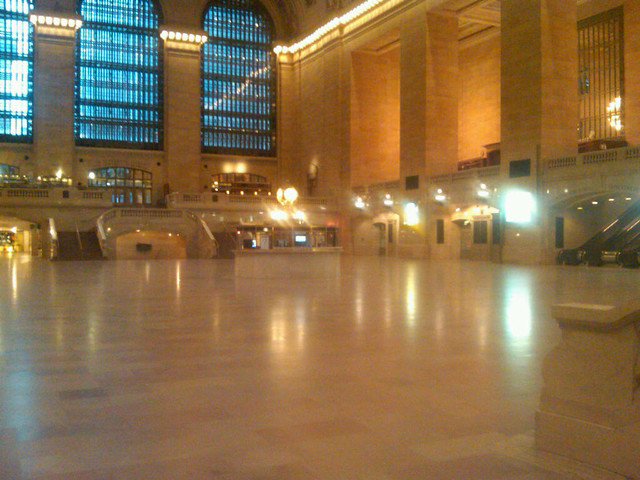
    Grand Central sat empty on Friday night as Hurricane Irene approached. (Photo courtesy of MTA, Aaron Donovan)

    I had some errands to run on Friday evening before Hurricane Irene arrived, and as walked down Broadway in Soho, business owners were hard at work boarding up their windows. After a dinner in Chinatown, I hopped on the 4 train for what would be my last subway ride until Monday afternoon. When I went to check on the trains on Saturday at around 2 p.m., stations were already boarded up, and the city has come to a standstill.

    When Gov. Andrew Cuomo and the MTA announced the system-wide closure, I didn’t know what to make of it. For my entire life, New Yorkers have scoffed at weather-related warnings. Until recently, blizzard watches never developed; big snowstorms failed to dump much on the city; and even previous hurricanes had petered out before arriving in the northeast. Maybe it’s the unique geography of New York City and the landmass of Long Island, but something seems to slow down big storms before they dump much on us.

    This time, though, the state wasn’t going to take any chances. After stranding passengers in the December blizzard, the MTA had to act, and the new governor wasn’t going to sit idly by. Cuomo ordered a system shutdown, and some of the starker images from the New York area emerged from our quiet transit system. Grand Central was entirely perfectly empty by Saturday afternoon. The bustling hub for transit and commerce had nary a soul inside. It was as though Cameron Crowe’s Vanilla Sky had come to pass.

    Over the next 42 hours, we sat and waited for life to resume. The storm came and went with parts north bearing the brunt of it, and the city could not spring to life. At first, I thought the roads would be more choked with cars as New Yorkers tried to drive into Manhattan and throughout the Bronx, Queens, Brooklyn and Staten Island to go on with their lives. Yet, as the MTA shut down, so too did most businesses. Employees couldn’t get to work without their trains, and it made no sense to open if the city was at a transportation standstill.

    With the MTA’s network out, though, we had an opportunity to see just how dependent the city is on the subways, buses and railroads the service us. In Park Slope, the businesses that were open on Sunday were staffed by locals. These folks live in the neighborhood or close enough to hoof it when the trains aren’t running, but many others were shuttered. People couldn’t get to work, and so work didn’t happen.

    By and large, New Yorkers regard the transit system as a necessary evil. We think nothing of taking a 20-minute train ride, as I did last night, from the West Village to Brownstone Brooklyn. It just happens. Sometimes, it’s slow; sometimes, it’s crowded; sometimes, we wait out for service interruptions. Usually, thought it just is.

    So I’m left with a question: Why can’t politicians see the importance of the system? Without the subways and the buses, New York becomes a city of neighborhoods, and no one can go anywhere. With the transit system, we have a vibrant economy that powers the nation and sometimes the world. The subways are the prime people-movers in that economy. Without political support, the system will slowly wither and die. Every day cannot be as quite as it was with Irene looming, but unless attitudes toward transit change, that’s where we’re heading. It’s not a pleasant future to contemplate.

  • ‘GUYS, there are rats in the subway, and the Daily News is ON IT’

    With apologies to The Times Is On It, the Daily News offers up a breath-taking expose on rats in the subway: There are lots of rats in the subway, they live in garbage storage rooms, and the MTA has done very little to combat the problems despite assurances a few years ago that they would. It’s a story we’ve heard over and over and over and over again. Rats, it seems, just come with the territory.

    In his piece on rats this week, Pete Donohue tries to offer up a new twist. He notes that Howard Roberts in 2009 pledged to “do something better” about the subway’s rat problems. Of course, two years and another Transit president later, nothing much has happened. The MTA says it’s going to try to seal up garbage collection rooms and place more rat poison there, but then, we’ll just be left with dead rats instead. The authority also says it’s going to have this program in place at 25 stations by the spring, but I have to wonder what takes so long.

    I’m not going to hold my breath on any of this. While waiting for a train earlier this week, I spied a rat poison warning sign that was dated July 2002. The MTA will haphazardly bait the system and then leave up the signs for a decade. It’s always been the way of things, and we’ll just continue to coexist with the multitude of rodents that inhabit the system.

  • In the face of Irene, making the right call

    Metro North's Port Jervis line will be closed indefinitely as the MTA addresses what it called catastrophic damage. (Photo by Metropolitan Transportation Authority)

    By the time I ventured out of Brooklyn on Monday afternoon for the first time since arriving home on Friday night, Irene’s impact within the five boroughs of New York City had largely dissipated. A few neighborhoods are dealing with flood waters and downed trees while others are still waiting for power to be restored. But as dramatic images of flooding in upstate New York and Vermont pour in, New York City remained unscathed.

    Of course, since the city emerged from the storm with only a death or two and little long-term damage, many pundits have begun to question our preparedness. Did we have to shutdown the city so completely on Saturday? Was it an overreaction to cut off subway service and shut down mass transit? Why couldn’t meteorologists better predict the weather? It’s typical Monday-morning quarterbacking but this for a natural disaster.

    Outside of the city, the storm has been devastating. So far, 40 people have died from it, and that total is expected to rise. The property loss is estimated to be well over $10 billion, and even locally, the MTA announced last night that Port Jervis line will not enjoy Metro-North service for months due to “catastrophic damage” to track beds, bridges and signal system. The railroad will run shuttle buses for now, but they do not anticipate service any time soon. More details are available in a press release, and the photos are breathtaking in their starkness.

    Now, even before we knew the full extent of the damage to Metro-North’s westernmost reaches, straphangers were wondering if the MTA overreacted. Why didn’t they run less frequent shorter trains during the storm? Why didn’t they wait to shut down the system until later in the day on Saturday? Why wasn’t it back up and running before yesterday morning? Eventually, these are questions that someone — the MTA, the governor’s office — will likely answer with a report in a few months, but for now, the answer is a simple one.

    As the storm bore down on New York City, meteorologists simply couldn’t know that it was going to largely skip over New York City. They couldn’t know that the worst would hit to the north of us. They couldn’t know that the bands of rain would spin out for a bit at 2 a.m. on Sunday morning and that the winds would be worst to the east of us. Even as it appeared as though New York would largely be spared the worst of it, forecasters continue to warn of uncertainty, and as people from the south who are in the regular paths of hurricanes know, it’s better to prepare for the worst than be left unprepared for a big storm.

    For the safety of New Yorkers, for the safety of MTA employees and for the safety and security of the subway equipment, shutting down the system was the right decision. Less than a day after the storm passed, the system was up and running with few hiccups, and we could breath easy. We dodged a bullet this time, but it won’t be the last one we face.

  • Photo of the Day: A quiet Monday commute

    The Mayor greets riders on the 6 train this morning. (via)

    When Mayor Michael Bloomberg and various city and state officials gathered yesterday afternoon to speak about the transit situation, hizzoner warned the assembled crowd about Monday in, well, less than sympathetic terms. “Tough commute tomorrow,” the Mayor said, “but we have tough commutes all the time.”

    For those of us in the five boroughs, though, it wasn’t a particularly tough commute. The Mayor’s 6 train from 77th Street wasn’t too crowded, and although the MTA warned that trains wouldn’t run as frequently, many offices in Manhattan remained closed today as employees from New Jersey and Westchester were left without transit options. Thus, trains were empty, and few people were in a rush to get anywhere.

    As the recovery continues, subway service will increase throughout the day, but the commuter rail situation looks a little bit dicier. I’ve heard that Metro-North has a “tentative plan” to restart service tomorrow at 2 p.m., but trains would run on a modified Sunday schedule. Many parts of the system remain submerged under flood waters, covered by downed trees or buried under mudslides. Normalcy may take a few more days.

  • Photo of the Day: Closing a 24-hour system

    The 7th Ave. subway stop along the BMT Brighton Line has been roped off. (Photo by Benjamin Kabak)

    Around 30 minutes ago in between bursts of rain, I ventured out to the 7th Ave. subway stop along the B/Q at Flatbush Ave., and it’s shut. Since the MTA’s system wasn’t built with doors — why would you want to block stations that are never supposed to close? — the low-tech pink warning tape is all that’s stopping anyone from getting into the subway system. It’s quiet out there as people are gearing up to stay home for the storm.

    The MTA this afternoon has posted a bunch of great photos from their storm prep. Earlier this morning, Jay Walder greeted Rockaway residents as they evacuated the area. Crews installed AquaDams to prevent flooding in the LIRR tubes into Penn Station, and Grand Central is a ghost town. The MTA doesn’t yet know when full service will be restored, but I’ll update the site as news develops. Stay safe.

    After the jump, a look into Grand Central with no one in it. This isn’t a still from Vanilla Sky. (more…)

  • Recommended Reading: On the link between autism and trains

    I’ve always believed that the Transit Museum is one of the city’s hidden gems. An unassuming spot in the abandoned Court St. station in Downtown Brooklyn, it houses a fantastic collection of old New York City subway artifacts, including turnstiles through the years and the finest display of rolling stock around. It’s a popular destination for school kids and a big draw for those with autism.

    In an article in The Times this weekend, new transit beat writer Christine Haughney explored the link between children with autism and trains. The Transit Museum has focused more on reaching out to schools for children with autism because the children connect with trains. Doctors aren’t entirely sure why trains are such a draw, but the museum seems to have hit upon a great combination. “Kids with autism treat moving trains, especially ones that have limited motion like just going along the tracks, as a natural reward,” Simon Baron Cohen, a Cambridge professor, said. “It catches their attention. Once you’ve got the child’s attention, you can do many types of teaching.”

  • Vacation Linkdump: Hugh Carey, Apple and more

    I’m off for a four-day vacation this weekend and won’t be here on Thursday, Friday or Monday to provide regular content. In the meantime, I have a variety of smaller stories that have been open in my browser tabs for a few days, and I wanted to share. For the weekend service advisories, check out the MTA’s site on Friday.

    Workers replace part of the LIRR viaduct at Nostrand Avenue. (Photo courtesy of MTA, Patrick Cashin)

    We start with this photo. It’s from a great photoset the MTA published to Flickr yesterday, and it highlights the replacement of the LIRR viaduct at Nostrand and Atlantic Aves. MTA photographer Patrick Cashin was on hand two weeks ago as workers completed the project, and he snapped some great shots of some welding and the trackbed coming in. Check out the full set right here.

    Next up comes a rather hilarious juxtaposition. Over the weekend, The New York Times complained that they could not get images of the Grand Central Apple Store from either the computer company or the MTA. In an editorial, the Grey Lady feared that the store would somehow ruin the landmarked building and its grand hallway. Strangely though, the pictures had already appeared in The Wall Street Journal. It’s a rather peculiar story, and I too would like to see more detailed renderings. But they certainly exist.

    The Tri-State Transportation Campaign is worried that the new Tappan Zee Bridge will have no space for transit. Clearly, that concern is not a positive development. It would be a shame to mess up this once-in-a-generation bridge replacement project. For more on that, check out my past coverage.

    Tom Acitelli from The Observer summarizes the qualifications for the next MTA head.

    Finally, former Gov. Hugh Carey passed away earlier this week. Carey has an interesting legacy with the MTA. He was in charge of the state as the MTA tried to escape for the economic doldrums of the mid-1970s, and as Noah Kazis wrote on Streetsblog, Carey is largely credited with saving the city’s transit system. It’s insightful, however, to read the contemporaneous coverage from the late 1970s. The city’s press wasn’t so sure of Carey’s success then. New York Magazine was critical of Carey in a piece in October of 1979 and looked skeptically at Harold Fisher, Carey’s MTA head, in an April 1979 article. If I have some time next week, I’ll delve deeper into those pieces, but Carey’s legacy isn’t as cut-and-dry as it seems.

  • Jay Walder: Escape from New York

    For two years, Jay Walder was literally and figuratively the center of attention at the MTA. (Photo by Benjamin Kabak)

    When Jay Walder made his return to New York, everyone wanted to talk about money. The State Senate, in a fit of legislative revenge, had just ousted Lee Sander and Dale Hemmerdinger as the heads of the MTA, and then-Gov. David Paterson wanted to ensure that his guy stuck around. So Walder and Paterson negotiated a Golden Parachute provision that would have given Walder a nice severance package had New York legislators decided to again remove the MTA head before his term expired.

    As the confirmation hearings dragged on, everyone had a say about Walder’s compensation. He would be overseeing an organization that spans 12 counties and hundreds of millions and employs tens of thousands of workers. Still, the $350,000 he would earn annually as well as a housing subsidy drew raised eyebrows, and even billionaire Mayor Bloomberg spoke out against it. In the end though, it was all for naught.

    Yesterday afternoon, Walder announced his resignation, effective Oct. 21, 2011, and all of a sudden, the Golden Parachute disappeared. Walder is leaving on his own accord, and the money — a pittance compared to his future earnings — doesn’t matter. While I don’t know the finer points of the decisions Walder had to make, I do know that his salary will enjoy a nice bump in Hong Kong, and as I’ve thought more about his departure, I realized it all boils down to a few key themes.

    To me, Walder was an effective leader willing to take hard steps to cut staffing levels and reorganize the MTA. He wasn’t perfect, and he has his critics both in and outside the authority. I believe he’s going to be very, very tough to replace both in his willingness to make those hard decisions and in his knowledge of and love of New York City and its transit system. That said, it’s worth analyzing a few of the driving forces behind his departure.

    Money, Money, Money

    As the MTA had to come to grips with its own finances, Walder’s money often took center stage. The TWU constantly protested against his salary while its members were let go. They protested with post cards; they stood in front of his house. It was one barrage after another, and he wasn’t, in the grand scheme of things, making all that much. A CEO of a private company the size of the MTA would make significantly more than $350,000 a year, and that’s exactly what’s happening.

    As Bloomberg News reported tonight, Walder is going to make $924,000 with “an undisclosed discretionary bonus and interest in shares.” If the United States’ great infrastructure minds can be lured to Asia by the promise of significantly more money, how will America’s cash-strapped transit agencies attract top talent and leadership? New York can’t pay the MTA head $1 million a year for reasons of politics and economics, but Hong Kong’s MTR, of which 76 percent is owned by the government, can.

    Investing in Infrastructure or Shunning It

    As the fallout from Walder’s departure lands, one sentiment runs through it all: Walder’s job in Hong Kong will be much better than his job in New York. Kathryn Wylde of the Partnership for New York summed it up perfectly for Transportation Nation. “He told me he regrets he has to choose between the job he loves here, and a much better job,” she said.

    So outside of the salary, what makes the job in Asia so much better? For one, MTR is a leader in transit expansion. It is currently working on a line that will connect Hong Kong to China’s high-speed rail network while the U.S. is currently canceling commuter rail tunnels and running into obstructionist road blocks when it comes to high-speed rail. While environmental and labor standards are deep concerns in China, a significant number of projects are ongoing. New York’s two subway expansion projects seem positively wimpy in comparison, and even now, the state is hesitant about investing $10 billion into a capital project that would, by and large, maintain our current decrepit system.

    So with MTR, Walder doesn’t have to read about his own money in the press, and he doesn’t have to deal with a broken down state apparatus. Who wouldn’t take that deal? It could very well signal the start of a brain drain to Asia, and that’s a problem politicians must address.

    A Resistant and Rambunctious Albany

    Finally, Walder’s relationship with the state could be another factor. In an interview with The Times, former Assemblyman Richard Brodsky — who is already using Micah Kellner to promote his own MTA candidacy — said Walder may have grown tired of the politicking. “I don’t think Jay has ever been comfortable in a highly political environment,” he said, “and with the budget scarcity that’s coming down the road, it’s likely to get more so.”

    Basically, Walder — and the next MTA head and the next one after that — has to go to Albany and sit there while politicians who never ride the subways and often are from areas of the state a good six hours away from New York City, berate him for what they perceive as the shortcomings of the MTA. They don’t offer solutions, funding or help; they just sit there and yell. It’s tiring for me writing a blog to listen to Albany respond to it all, but when the guy they entrusted to lead gets it every day, I’m sure greener pastures of a cooperative government sound great.

    * * *

    By the time Second Ave. Sagas turns five in November, the MTA will have had at least four different leaders — and perhaps five or six if you count Helena Williams’ stint as interim MTA CEO and the eventual interim will-in for Walder. That turnover at the top isn’t good for an organizational strategy, bureaucratic efficiency or an overall growth strategy, and the reasons for that turnover aren’t going away any time soon. I certainly don’t envy the person who will be chosen to replace Jay Walder.

  • As Apple deal nears, Grand Central evolves

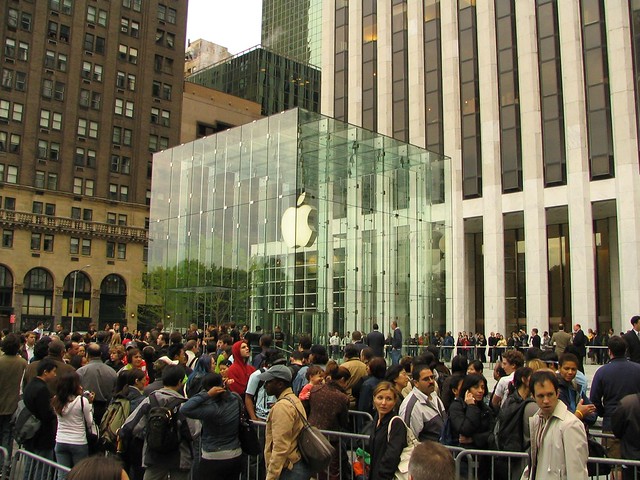
    The grand opening for the Fifth Ave. Apple Store drew long lines in 2006. (Photo by flickr user workinpana)

    As both transit ridership and great historical buildings grow in the public eye, at Grand Central Terminal, the times they are a-changing’. Once a threatened building that nearly underwent the same fate as our dearly departed Beaux-Arts original at Penn Station, Grand Central was saved from the wrecking ball after a prolonged fight by Jackie Kennedy Onassis. By the early 1990s though, the station was in sorry shape as commuters just tried to get out of it. After 20 years, it has been restored to grandeur.

    These days, Grand Central isn’t just for commuters. It’s a destination for tourists, foodies and folks looking to catch a glimpse of harried life in New York. It’s featured in everything from animated movies to annoying TV commercials, and it is the place to be. With the East Side Access project with a half a decade from completion, the area will only grow more crowded and more traveled as time goes by.

    Nothing quite shows just how hot Grand Central is than the rumors we heard earlier this year of an Grand Central-bound Apple Store. The rumors started in February, dissipated in March and came roaring back in May. Today, they are here to stay as the MTA may vote on an Apple Store for the Metrazur space as soon as next week.

    With the Apple Store on tap, The Times reflected on the changes at Grand Central. The story is one we’ve heard all throughout the city. As the building has become a more popular destination for shopping and eating, old tenants have been pushed out in favor of bigger names with more money. Magnolia Bakery, with its world renowned cupcakes, replaced the Little Pie Company, for instances, and more changes are afoot as the MTA continues to upscale Grand Central. Christine Haughney reports:

    More than a decade after the restoration of its public areas, including its shops and restaurants, Grand Central has realized its goal of becoming a retail destination, appealing to a wider audience than the train and subway riders rushing between platform and street.

    This month, Grand Central’s landlord, the Metropolitan Transportation Authority, notified 300 applicants that most of them had been rejected for the 74 available slots at its December holiday fair. By late fall, the terminal expects to have a dozen new shops and restaurants, including Beer Table, which has a restaurant in Brooklyn; bread and vegetable stands run by Eli’s; and an outpost of the popular downtown store Kidding Around Toys.

    When Apple proposed opening a store on the balcony overlooking the main hall, it submitted its bid in linen-lined boxes, as if it were a wedding present to transit officials, a source familiar with the application process said. The board is expected to approve the deal as early as next week, at its monthly board meeting.

    But changes popular with shoppers and the transportation authority, which handles the real estate for the station’s operator, Metro-North Railroad, have angered some of the shop owners who helped drive the transformation. While shop owners appreciate the traffic and improved surroundings of the new Grand Central, they say the authority can be a very demanding landlord that displays little loyalty once leases expire.

    The stories are the same citywide. Some business owners willing to gamble are getting priced out after years of loyalty, and they aren’t happy. “Twelve years ago, I didn’t want to come there; there was nothing there,” Sushil Malhotra, a restauranteur who owns Cafe Spice, said. “But now, because I’m successful there, anybody can outbid me.”

    Ultimately, though, the successes of the Apple Store are a true testament to the power of preservation. The MTA turned a rundown relic into a shining example of a modern train station. In the fall, I’ll be working two blocks away from the terminal, and I couldn’t be happier about it. It’s a modern attraction that’s getting better. It’s too bad we can’t say the same about the rest of the transit system quite yet.