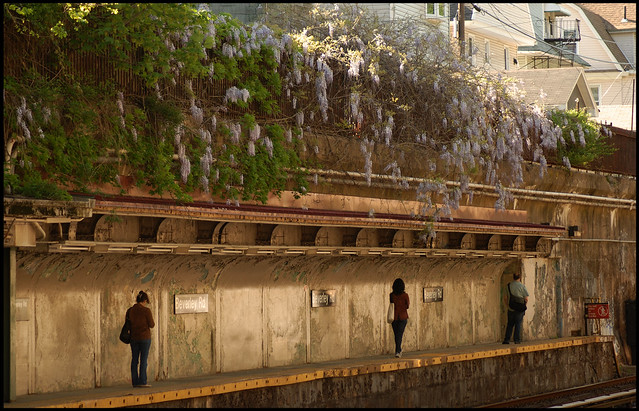
wisteria, subway station, ditmas park by flatbushnelson on Flickr
Just a short piece tonight because I was hit with an Internet outage just as I was about to start writing, and now I’d like to go to bed. I wanted though to share this photo posted late on Tuesday on Brownstoner. It is a truly gorgeous shot of the wisteria plants Beverly Rd. along the BMT Brighton Line, and it perfectly encapsulates waiting for the subway.
The photographer framed the shot in such a way that it highlights the intricacies of the trench along the Q and the B lines as well as the small platform spaces at many of the stations. The three people on the platform — all facing south to peer down the tracks for a looming train — have barely enough space in the sheltered station alcove to wait. The plants, meanwhile, are inching into the station as they begin to bloom, and for a few minutes, the station and subway trench, both in need of a good scrubbing and a fresh coat of paint, look absolutely timeless.
Despite our complaints and the shoddiness found in many stations, it’s still possible to find beauty in the architecture of the subway and a certain New York-ness to it all. It’s all right here for anyone to see.
When I travel from Brooklyn to the Washington Square Park/NYU area, I use the B train at 7th Ave., and despite its location along Flatbush Ave. in between Park Slope and Prospect Heights, that station is a mess. It hasn’t been renovated in decades, and it features a shuttered staircase that leads to a blocked off mezzanine. By itself, the staircase would be nothing more than an eyesore, but a homeless man has taken up residence in the station. It is not clean.
On top of the odor of human waste that often permeates the station, I’ve seen — shall we say? — physical evidence of a station inhabitant, and on more than one occasion, I’ve had to complain to the MTA about the presence of human waste on the platform. I’ve also witnessed MTA workers dragging leaking trash bags up and down the stairs. Generally, it’s a mess, and it’s indicative of the lack of care seen in stations around the system.
Now, I understand that maintaining aging infrastructure takes a lot of money the MTA, the city and the state simply do not have right now. I understand that if the MTA had its druthers, every station would get a fresh coat of paint, a thorough cleaning and dirt-resistant surfaces. I also understand that we all want to win the lottery tomorrow. That said, the system is a mess.
Last week, Greg Mocker, everyone’s favorite hyperactive muckracking TV news reporter, decided to explore the MTA’s crumbling stations, and he’s started a regular segment of his portion of the Channel 11 news. In it, he fields reader suggestions for the worst station, and of course, more than one have suggested Chambers St. While last night he stood only atop the J/Z platform and didn’t venture into the once-grand cavern, his video clip is notable for other reasons. Peep it below as Mocker tries to figure out exactly what is on the station walls at 18th Ave. in Brooklyn.
Of course, this being a TV news clip, we have tune in tonight to find out the resolution of the lab tests, but as Mocker and his environmental analyst speculated during the clip, it’s likely that the black and green gunk pulled off the wall will be mold. This can hardly come as a surprise to anyone who’s spent more than a few minutes in some of the system’s subway stations, but that thought isn’t exactly a comforting one.
As Mocker details, the MTA’s approaches to station maintenance have been varied. For decades, the authority tried a State of Good Repair program that targeted only six stations or so per year. Now, they’re trying a component-based program that targets parts of stations that are falling apart — staircases, ceilings, you name it. Of course, they still don’t have a plan to paint every station. They still don’t have the manpower or money to keep the station clean. It will remain a mess.
I’ll check back in with the results of the lab test tomorrow. I’m not sure we’re going to want to know though what various things are waiting with us in our train stations. Meanwhile, as the MTA works to convince us that things are getting better underground, the visual and physical environment underground isn’t. How do you balance the tension between technological upgrades and infrastructure decay when dollars are tight anyway?
Riding the subway on a daily basis can often seem mundane. We board the same trains; we see the same people; we wait in the same spot on the same platform at the same time every morning. By and large, the subways fail to surprise, and when they do, the surprises generally come in the form of unwelcome delays or trains cars that are more crowded than usual. That’s just the way of things in the world of underground commuting.
Now and then, though, intrepid — or foolhardy — New Yorkers try to shake us from our routine. We hear about guerrilla art projects in abandoned stations or spot the Rebel Alliance on the 6 train. Every year, thousands of people ride the subways with no pants on. Some people find the performance art stunts entertaining; others are annoyed by them. Still, they continue.
In fact, recently, a Rockaway-bound L train played host to a clandestine dining experience while a troupe of Shakespeare actors have taken to performing in the subway. Melena Ryzik of The Times found herself eating on the L this past Sunday. She reports of boarding an empty train at 8th Avenue and finding it taken over by hungry and in-the-know straphangers. She writes:
Within moments, a car of the waiting train was transformed into a traveling bistro, complete with tables, linens, fine silverware and a bow-tied maître d’hôtel. “Is this your first time dining on the second car of the L train?” he asked, as guests filed in.
They had been lured by the promise of a clandestine dining experience. (“Please go to the North East Corner of 8th Ave and 14th St,” read the instructions e-mailed early that morning. “There will be a tall slender woman there with jet black hair who is holding an umbrella. Please just go up and introduce yourself. Her name is Michele and she is quite lovely, but no matter how hard you press she won’t tell you about the adventure you are going on.”)
The event was the work of several supper clubs, and the menu they devised was luxurious: caviar, foie gras and filet mignon, and for dessert, a pyramid of chocolate panna cotta, dusted with gold leaf. All of it was accessible with a MetroCard swipe (Michele handed out single-ride passes) and orchestrated with clockwork precision. The six-course extravaganza took only a half-hour.
It wasn’t rush hour, so seating was easy. The tables (lap-width black planks, with holes cut to fit water glasses) were tied to the subway railings with twine. Tucking in behind them felt something like being buckled into a roller coaster. At 1:30 p.m., a few minutes ahead of schedule, the train lurched off.
As the train proceeded east, passengers found themselves thrust into a meal while chefs from various restaurants boarded the L to serve their course. One rider had thoughts echoed by many. “I had this fantastic lunch,” Paul Smith, a CUNY professor said to The Times, “very exquisite. And then I thought, am I going to get arrested?”
The MTA did not seem to find the event all that charming though. “A dinner party on the L train?” Spokesman Charles Seaton said. “No. Subway trains are for riding, not for holding parties.”
If dinner on the trains isn’t your thing — after all, not everyone believes the subways are for dining — how about some Shakespeare instead? Jo Piazza of The Wall Street Journal met with two actors from Brooklyn who reenact Shakespeare on the subway. Paul Marino, 29 years old, and Fred Jones, 26, spend 20 hours a week, primarily on the N, R, J, M or Z trains, acting out scenes from “Macbeth,” “Romeo and Juliet” and “Hamlet,” among others.
So far the two, who are featured in the video above, have found audiences receptive, but drunk riders will harass them. The pair, who make a few bucks per performance, have even managed to finagle some dates with the women in their crowds. Perhaps all the world is truly a stage after all.
A few weeks ago, I was traveling from Midtown to West 4th St. on a B train shortly after 1:30 in the afternoon when I happened upon this scene. By all appearances, the man who made the B his own personal sleeper car didn’t seem to be homeless; he was just tired. So he fell asleep.
Now, because of the seating configuration of the R68s, an industrious sleeper can stretch out and form a human barrier. As this photo that I snapped surreptitiously shows, this sleeper is effectively taking up five seats for the price of one just so he can grab a little shut-eye on the subway. It’s a good thing this was a mid-day ride down the relatively uncrowded 6th Ave. corridor and not a trip with a few more passengers at an hour approaching peak travel times.
So riddle me this, loyal readers: Is this behavior acceptable? According to the New York Transit Rules of Conduct, it is not. This snoozer is violating at least one provision in Rule 1050.7 and could be accused of breaking a few more. He is, contra to Rule 1050.7(10)(2), placing his feet on a seat and is also occupying more than one seat. When I boarded the B, it wasn’t crowded enough to claim this guy was “interfering with the comfort of other passengers.”
Our time aboard a subway car is always a fleeting one, and yet people treat the seats as their own personal foot rest all the time. I’ve seen passengers scramble to remove their shoes from a seat that I’m about to use, and I always wonder how they would feel if I stomped all over their living room couch or dining room chairs. One person, one seat, and keep your feet on the floor, I say.
Earlier this week to coincide with today’s Earth Day celebration, MTA Bridges and Tunnels replaced the last mercury vapor necklace lights on the Triborough Robert F. Kennedy Bridge with energy-efficient LED versions. It was but a small part of the MTA’s efforts to reduce their own carbon footprint.
Today, the authority has issued a report entitled “More MTA = Less CO2.” Available here as a PDF, the report touts the environmental impact the agency’s transportation network has on the region. Because the train network is so prevalent and popular, the MTA “reduced the carbon dioxide and other greenhouse gas emissions of the region by 16.6 million metric tons in 2009 through congestion relief, mode shift and land use effects.”
“The MTA’s transit system makes New York sustainable, with a carbon footprint one-quarter of the national average,” MTA Chairman Jay H. Walder said in a statement. “But our commitment to the environment goes even further, as we continue working to reduce our own emissions and improve the environmental performance of our entire operation.”
Meanwhile, the authority is working hard to become even more efficient. It has reduced its carbon output by 2.5 percent per passenger mile traveled. “It’s clear that the New York Metropolitan Transportation Authority has made lowering its emissions one of its top priorities,” Ryan Schauland, a technical specialist at LRQA Americas Sustainability, Inc., said. “The MTA’s proactive approach to voluntary verification of its greenhouse gas emissions under The Climate Registry gives the organization, and the millions of people who use its public transportation system, confidence in the MTA’s emissions reduction claims. We recognize their dedication and commitment to their carbon reduction strategies and congratulate them on another job well done.”
Even as the authority struggles under the pressures of economics and politics, today is as good a day as any to ponder how polluted and traffic-choked our city and region would be without its transit network.
By and large, most subway trips aren’t fraught with choices. If I want to get from, say, the northern end of Park Slope to the western edge of Washington Square Park, I take a 20-minute ride on the B train, and I don’t have to think about it. But what happens when two trains leave the same station bound for the same stop but take two different routes? How do we pick which one to take?
In the Internet age, apparently the answer is to ask Quora as one Brooklynite has done. The subway-related question is a simple one: “If an uptown F and A train depart Jay St./Borough Hall at the same time, which one will get to West 4th first?” Generally, the two trains seem to take the same amount of time to traverse the stops in between, and if anything, the F will arrive a minute or so sooner. But then other considerations take over. While neither train has seats, the A at West 4th St. is two flights closer to street level than the F.
Admittedly, these conflicts of timing are rare, but they always pose a dilemma. Is it faster to take the 4 from Brooklyn to Yankee Stadium or the D train? Should I take the F to Forest Hills or the E? And of course, if you leave from points in Midtown bound for JFK, neither the E nor the A is faster than the other. Choices, choices, choices.
A few weeks ago, Rolando Pujol of amNew York posted to twitter a photo of the MTA’s new garbage decals. I scoured the system looking for them but didn’t see them with my own two eyes until last night when I was waiting for a train at 96th St. Coincidentally, Michael Grynbaum wrote his Monday column on the new decal.
He talks of its design and origins:
The decal’s modern, stripped-down look is a stark departure from the agency’s previous approach to the school of informational trash can aesthetics. Close observers of the subway ecosystem will recall the last batch of garbage-related posters featured the rhyming instruction “Can It for a Greener Planet!” above a haiku-like poem: “Your City / Your Subway / Your Station / Your Litter.”
Now, poetry is out; clean, uncluttered design is in. The new poster takes advantage of the two-tiered structure of the average subway garbage can, or “trash receptacles,” as they are known in in-house M.T.A. parlance. The slogan, printed in large white-on-black letters on the top rim of the can, is easily spotted by straphangers; it is also the only three words on the entire poster, which depends on visuals rather than text.
To that end, the poster’s body has a simple pictogram of male and female stick figures depositing objects that look like coffee-cups into a trash bin. (The previous poster portrayed only a male stick figure.) The background is entirely black; the previous poster, with white and green colors, had a penchant for getting smudged and dirty.
The new stickers, designed in-house, first popped at Bowling Green and Whitehall, and 5000 garbage cans will sport the new look by the end of 2011. I do appreciate the design and how it mimics the overall look of the MTA’s rebranding campaign, but whether straphangers will make use of the garbage cans, new decal or not, remains to be seen.
I’m pretty beat from my Passover seder tonight at the end of a long Monday, and so posting will be light this evening. Enjoy instead this classic trip underground with the Muppets as they take to a subway system shown on Sesame Street in the 1970s. There’s a cameo from a Vignelli map and some timeless references to tokens. It’s still crowded underground, but at least the rolling stock looks cleaner. Odds are, too, you’ll be humming this catchy tune all day.
Whenever I find myself in a train station that isn’t on my regular route with some time to kill, I start looking closely at the station. On Saturday night, I had a few minutes to spare at 14th St. and later at 23rd St. along the West Side IRT, and at both stations, I found a few MTA signs that have long since stopped serving their purpose.
The first sign I found that raised an eyebrow was at 14th St. This one discussed a construction project the MTA had been engaged in that would improve service. I’ve seen similar signs throughout the system, but lately, I’ve noticed more and more of them are out of date. The ones along the 53rd St. tunnel talk of improving E and V service and have completion dates that the MTA simply missed.
Anyway, this one was, um, older:
As you can see, the MTA has not found a way to remove a sign announcing a project that was due to wrap up 15 years ago. In November 1996, the Yankees had just won their first World Series since 1978; America had just reelected Bill Clinton to his second term; and the Unlimited MetroCard wasn’t yet a thing. The fares, by the way, were a $1.50.
This sign isn’t in a particularly hard-to-miss location. If you enter the 14th St. station on 7th Ave. and walk toward the fare control area, it’s hanging on the left in front of the walkway between 6th and 7th Aves. It’s not in bad shape either; it’s just a sign of another era in New York City history.
That’s now, however, the only relic I saw on Saturday night. On my way back from dinner, I had to wait in the 23rd St. station for a five minutes, and while examining the neighborhood map next to the now-shuttered station booth on the southbound side, I saw that the 9 train lives. This photo below is an excerpt from the neighborhood map at 86th St., but it shows the same problem:
This neighborhood map must be from at least 2005 when the 9 train made its last trip. For the West Side IRT, the presence of the 9 doesn’t matter because it doesn’t materially impact service, but the 9 train isn’t the only relic. The map at 23rd St. still featured the V and W trains, and I’ve seen remnants of the Manhattan Bridge service changes at various places throughout the system. More recently, I’ve noticed how the Rockefeller Center entrances still think the V is going to stop there.
On their own, these various mistakes and mishaps aren’t too damaging to the MTA. The sign from 1996 might as well be a permanent part of the station at this point, and few people are going to be confused by the presence of a 9 train on a map whose purpose is to guide straphangers above ground. But on another level, these anachronisms show a certain level of neglect. The MTA does not have the capacity to keep its extensive signage up to date. It can’t afford to spend the money to do so, can’t find the manpower to make the changes or some combination of both. And so the end result are signs warning us of construction projects from 15 years ago or urging us to take trains that no longer run.
As I said just a few weeks ago, the MTA posts signs for the benefit of its customers. If the signs are wrong, people either get lost or lose faith in the trustworthiness of the post information. It’s these little things that make it tougher for the MTA to gain public support at a time when political backing is sorely lacking.
While this morning I spoke of the subway extension to nowhere, the city’s original subway to nowhere involved the 63rd St. tunnel. What began as an ambitious project to bring super-express service to Queens Boulevard eventually devolved into an expensive extension of subway service underneath the East River that terminated just one stop into Queens. The entire project, which began in 1969, would not wrap until 2001.
Today, the excellent NYC The Blog highlights a 15-minute video report from the early 1970s on the 63rd St. tunnel. Take a watch:
Today, the F train serves Queens Boulevard route via that 63rd St. route, but the bi-level tunnel has yet to realize its potential. The current station at 63rd St. currently plays host to an unused track and platform that will one day be a part of the Second Ave. Subway while the lower level will be integrated into the East Side Access project. Overall, then, is one never-ending forty-year project.