Category: Buses

  • Lappin: SBS good, over-enforcement bad

    A November report showed how popular the M15 Select Bus Service had become.

    City Council Member Jessica Lappin and her East Side constituents like what they see out of the Select Bus Service along First and Second Ave., but they all wish the MTA and NYPD weren’t so heavy handed with fine enforcement. In her second annual report card for the city’s latest efforts at speeding up buses, Lappin gave the service a solid B, up for a B- last year, but she urged the MTA to better fix its fare payment machines and ease up on enforcement in the meantime.

    “More East Siders are onboard with Select Bus Service, and want to see it expanded to other locations,” Lappin said. “But the MTA still needs to do a better job with fixing broken ticket machines and other inconveniences.”

    Lappin’s report card breaks down the service into four categories based on responses from her constituents. Overall, 98.3 percent of the 1155 respondents who took the survey said they have used the Select Bus Service. This number may be skewed a bit as a transportation survey will attract those who use transportation, but these are the folks who are most attuned to the good and bad of it all.

    By and large, Upper East Siders seemed content with the speed of service. Most wait times are between five and ten minutes, and nearly 70 percent of respondents said speeds were good or excellent. Lappin rated speed an A, and while fare payment was problematic, according to MTA studies, the time saved by eliminating the painfully slow MetroCard dip is the driving factor there.

    The biggest issue arose with ease of use of those fare payment machines though. While 55 percent of respondents rated the pre-board machines as good or excellent, nearly 45 thought them to be fair or poor. The Council Member offered up her take: “Council Member Lappin’s office frequently receives complaints about broken Select Bus Service ticket machines. When the machines are broken or out of paper, it is impossible to buy a ticket. Without a ticket, riders risk being issued a $100 summons. Constituents have also complained that ticket machines are dangerously close to the street.”

    Hand in hand with this concern are complaints over enforcement. Twenty respondents were ticketed when SBS payment machines failed to produce receipts, and riders complained that buses were stopped during fare inspections, thus defeating the purpose of a faster commute. One East Sider’s tale highlights these concerns. “Last September I received a $100 summons even though the SBS ticket machine wasn’t working,” an Upper East Side resident who declined to be named said. “When I called the MTA & Transit Adjudication Bureau to explain what happened, they made it impossible to get answers. It wasn’t just the ticket machine that was broken—the entire SBS fare collection system is broken and it needs to be fixed.”

    DNA Info offered up more tales of fare-payment woes and the subsequent summonses that so plague the new system. We’ve heard these complaints for years, but the stakeholders in the Select Bus Service system have yet to respond to them. Machines are repaired often enough, and enforcement is often overzealous. It’s what works though to keep the buses moving.

    So Lappin gives the buses a better grade in 2012 than she did in 2011. It’s an incremental step up, but as Select Bus Service becomes more pervasive, and the MTA and NYC DOT more adept at respond to complaints, those marks should only rise. If they don’t, something has gone wrong.

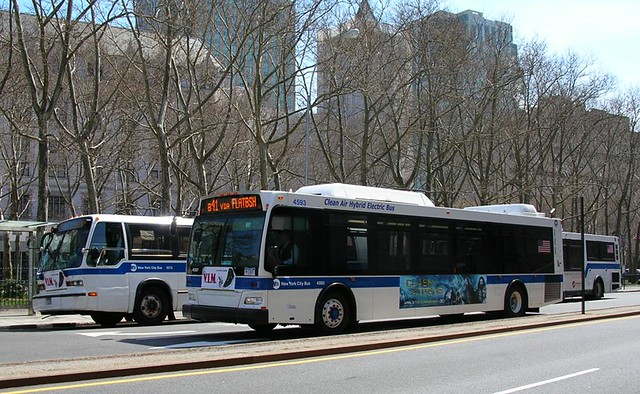
  • Former MTA bus head named DesignLine interim CEO

    So here’s a little bit of intriguing industry news: Joseph Smith, the former Senior Vice President of Buses with Transit, has been named interim CEO of the DesignLine company. Smith stepped down from his MTA post in late 2010 and had been consulting with Cyan Partners, the arranger of DesignLine’s recent debt and equity capital raises. Now, he’ll have the opportunity to right the DesignLine ship on an interim basis.

    To me, this is an intriguing bit because of DesignLine’s tortured history with its delivery of buses and its lack of recent success. DesignLine ran a 2007 pilot in New York City, and although customers gave high marks to the vehicles, Transit eventually determined that the vehicles were not robust enough for New York City. At around the same time, the city of Baltimore issued a similar announcement concerning DesignLine buses, and many in the transit production industry questioned the long-term viability of the company.

    So now Smith will take the reins. He served as the head of MTA Bus, the president of MTA Long Island Bus and most recently as the SVP with Transit overseeing buses. He was well-respected at the MTA and can take his insider perspective to a company that needs the help. A shift like Smith’s from buyer to vendor is not a rare one within the transit industry. It’s a tight-knit community that often can’t shake its “inside baseball” reputation. We’ll see now what future awaits these DesignLine buses.

  • In DUMBO, the way we share the streets

    Photos from DUMBO seem to suggest that buses aren't creating traffic problems. (Photo by flickr user katebriquelet)

    In his 1981 book The Highway and the City, Lewis Mumford wrote on the relationship between cars and urban life. “The right to have access to every building in the city by private motorcar in an age when everyone possesses such a vehicle is actually the right to destroy the city,” he said. Perhaps Mumford was overreaching a bit, but as we’ve seen over the last few years, New Yorkers go to crazy extremes to defend what they believe is their inalienable right to curbside access.

    The most famous example of curbside NIMBYism came along 34th St. as residents decried the way a dedicated bus lane would — GASP — require them to walk from the corner or cross a street to get to their apartment buildings. They could not unload their cars! They could not get direct door-to-door taxi service! It was an urban NIMBY nightmare.

    Recently, a similar situation long brewing in Brooklyn’s DUMBO neighborhood came to a head. Some local residents along Main St. have complained about the way the B25 ambles down Main St. as it turns around to head back toward Fulton St. on its way to East New York. Here’s how The Brooklyn Paper summed up the dispute:

    Residents on Main Street in DUMBO are demanding that the Metropolitan Transportation Authority re-route a bus that they claim causes traffic jams and road rage on their already cramped street — saying it’s only a matter of time before someone gets run over by the B25. “We’ve been petitioning the MTA for years,” said Ethan Goldman, a vocal opponent of the B25 bus route. “This is a huge problem that could easily be fixed, but they refuse to listen.”

    For decades, the B25 bus has run from Downtown to DUMBO via Cadman Plaza West before heading east on Front Street to Main Street.But that was before the neighborhood became a hotspot for families and art houses including Galapagos Art Space and powerHouse Arena.

    Now during the morning rush, DUMBO residents complain that one or more buses get stuck between illegally parked delivery trucks and cars — creating a din of perpetual honking and screeching tires in a neighborhood that is already among the noisiest in the city.

    Re-read that last paragraph and revel in its logic. The bus is a problem because it gets stuck behind illegally parked trucks and cars. It’s not the cars and trucks that are problematic; it’s the city bus. “If the enforcement is only way that this bus route is going to work, that’s a sign that this isn’t a good plan,” Rob Perris, district manager for Community Board 2, said.

    The comments from DUMBO residents, gathered at the bottom of a post on Brownstoner and torn apart by Brooklyn Spoke are just as illuminating. Here’ s a gem:

    Main Street is now a major destination in New York City, and on Saturday and Sunday there is asteady stream of limos coming down Main Street dropping off their parties on the street to takephotos in the park and to go to various restaurants in the neighborhood. The limos and the busesare engaged in a weekend-long battle for access to Main Street and wedding parties and guestsare regularly dodging the never-ending on-coming buses that always seem to travel in pairs.

    In the same group of letters, inconsistencies abound. Some residents claim delivery fleets and illegally parked cars are a problem while others say the street is simply too narrow and too congested with children — who somehow navigate the delivery trucks and parked cars? — to support buses. The valid concerns of speeding bus drivers who aren’t respectful or careful enough of pedestrians are lost in the din of a group of people who just don’t like buses. (Although how the buses could be speeding that dangerously with the streets clogged with illegally parked cars is another conundrum here.)

    DUMBO residents are seemingly alleging that buses are responsible for the traffic on their block, and their solution isn’t to enforce traffic laws or rethink the placement of loading areas. It is to ban buses. Let’s make it someone else’s problem so our idyllic little streets can be restored to their proper dignity, fit for cars and front-door deliveries. In any city, cars have a place; deliver vehicles have a place; limos and taxis have a place. But they do not have unfettered access to the streets at the expense of anything else. “Sharing” is a lesson we should have learned in kindergarten, but it is often lost on people battling over street space.

    I believe Doug Gordon at Brooklyn Spoke summarizes it best: “New York is in a strange place right now. We have visionary leadership transforming our streets every day. We are home to some of the most innovative thinkers, business people, artists, and techies. But when it comes to thinking our way out of the traffic hell that engulfs so many neighborhoods–and the climate change that will come to swallow low-lying neighborhoods like DUMBO–it’s all too easy for the narrow-minded and loud to win out over the nuanced and creative.”

  • Must love buses?

    Over the past few years, the MTA has witnessed a bus problem emerge. With slower traffic, unreliable schedules and slashed and reduced routes, the city’s local bus system has sometimes become an afterthought. Popular crosstown and through-borough routes can stick pack ’em in, but bus ridership has undergone a steady decline as subway use has skyrocketed.

    Meanwhile, the MTA’s and New York City’s investment in its bus network has been lukewarm at best. It seemingly takes nearly as long to get a Select Bus Service route up and running as it does to build out a subway extension as planning meetings bog down the process. The most radical street reconstructions, such as those envisioned for 34th Street, have fallen away in the face of NIMBY protests, and the city has struggled with basic bus improvements such as a faster ride to La Guardia Airport or Brooklyn/Queens connections that span popular neighborhoods.

    This attitude toward buses should change, though, one commentator has recently alleged. Will Doig, writing last week, at Slate penned a paean to buses. We might hate the bus and all it stands, but we should begin to love it. He writes:

    When it comes to improving mass transit, there’s a lot of low-hanging fruit on the humble city bus. The vital connective tissue of multi-modal transit systems, the bus could be an efficient — nay, elegant — solution to cities’ mobility woes if only we made it so.

    And yet we rarely do. Streetcars are replacing bus routes in cities across the country, and billions are thrown at light rail while the overlooked bus is left to scream “Marsha, Marsha, Marsha!” “If you decide that buses don’t merit investment, you’re going to miss a lot of opportunities to help people get where they’re going, and to expand their sense of freedom of movement, just because you don’t like the vehicle they’re riding,” says transit consultant Jarrett Walker.

    Making people like the bus when not liking the bus is practically an American pastime essentially means making the bus act and feel more like a train. Trains show up roughly when they’re supposed to. Buses take forever, then arrive two at a time. Trains boast better design, speed, shelters, schedules and easier-to-follow routes. When people say they don’t like the bus but they do like the train, what they really mean is they like those perks the train offers. But there’s no reason bus systems can’t simply incorporate most of them.

    Doig, who links to a recent post of mine on the MTA’s bus woes, urges American cities to adopt and adapt true bus rapid transit lanes for their cities. Forget Select Bus Service, a vision of what Limited bus service should be; embrace the dedicated, physically separated lane. Other changes, such as frequency mapping and more comfortable vehicles, could improve the bus commuting experience too, but faster service remains a paramount concern.

    Now, I’m of two minds when it comes to buses. I firmly believe the city should prioritize buses over, say, cars when it comes to planning transportation routes, but can a bus network in a city without space for the wide boulevards that have made TransMilenio be bus rapid transit? Can we expect buses to drive development and ferry the same number of people as a subway can? I don’t believe so.

    Buses should be a complementary part of a transit system. Because they do not run on fixed tracks, they can be routed to serve areas the subway doesn’t and can’t reach. They can bring people from one already-established neighborhood to another. They can serve that role as the “vital connective tissue,” as Doig writes. They can’t, though, replace subways now or into the future.

    So we don’t have to see buses as the future of everything, but if we tried to love them a little bit more, perhaps they could be more useful. It’s all about predictable service, faster speeds and better routing that gets people from where they are to where they want to be. Local buses have become second-class citizens in the transit world, and it’s time to reassess their place in our transportation ecosystem.

  • Link: Solving the problem of bus bunching

    These buses are bunched intentionally at their Brooklyn Heghts terminal. (Photo by flickr user Stephen Rees)

    Last week, when I left my apartment to head to work shortly after 8 a.m., I noticed a common occurrence in New York City: Despite scheduled times that allow for around 6-7 minute headways, the B67 and B69 were traveling north along 7th Ave. one on top of the other. It was a classic case of bus bunching, a problem that plagues many transit agencies and leads to complaints concerning reliability of service. Solving it has never been easy.

    This week, an Atlantic Cities post by Eric Jaffe has been making the rounds, and in it, he discusses a new approach to solving bus bunching. Two professors have a “self-equalizing” way of running buses on congested city streets. Jaffe writes:

    John Bartholdi III and Donald Eisenstein propose a method of bus coordination that abandons the concept of tightly-managed headways or schedules. Without the restriction of meeting pre-specified targets, drivers instead follow the flow of traffic, and natural headways emerge over time. The result is a “self-equalizing” system with less bunching and more reliability…

    The system outlined by Bartholdi and Eisenstein imposes simple adjustments at control points based on an equation whose goal is to both reduce the mean headway on a line and increase overall uniformity of headways. Because the calculation operates independent of a fixed schedule, adjustments can be made at any number of control points. When systems want more headway stability, say for longer routes, all they have to do is add more control points. “The result is that headways are constantly adjusted to become more nearly equal,” the authors write…

    For the study, Bartholdi and Eisenstein told drivers to abandon their schedule, ignore headways, and drive with the flow of traffic. When they reached a control point the “self-equalizing” equation computed their next departure time. Compared to average headways recorded on the same day for two weeks prior to the experiment, the new system reduced headway and increased stability

    So far, this system has been tested along one 18-mile route in Chicago and on the Georgia Tech campus bus system which sees around 5000 riders per day, and the two say its working. So could this be a piece of the bus problem facing New York City? Ridership is declining because of the unreliability of service. We don’t know when the next bus is coming, and routing needs some work. But solving the bunching problem or at least alleviating it could improve the rider experience, and right now, every little bit helps.

  • Seeking a solution for the MTA’s bus woes

    Bus ridership figures have declined dramatically over the past few years.

    As the MTA touts the fact that subway ridership is on the up-and-up, its ever-shrinking bus network is telling a different story. Authority board members want to do something, anything, to reverse the downward trends, but a simple fix lies right beneath the authority’s nose. Will it be enough to save the bus system or are more dramatic changes in order?

    First, the numbers. Subway ridership, we learned last night, is at levels not reached since 1947 before white flight, the true rise of the automobile and the general decline of New York City and its infrastructure. Bus figures though are going the wrong way. For 2011, bus ridership was 665.3 million — a hearty number, yes, but one that is 31.6 million trips fewer than the total from the year before. Bus ridership, in other words, declined 4.5 percent from 2010 to 2011.

    These declines were not isolated to any time of the week either. Weekday rides were down 4.3 percent while weekend ridership shrunk by 6.4 percent. 2011 marked the first full year after the June 2010 service cuts that decimated the bus network, and it seems as though those cuts have driven a stake through the heart of the bus network.

    Interestingly, the MTA doesn’t believe it’s losing transit riders, and the numbers bear them out. Average subway ridership increased by more than the number of bus rides lost between 2010 and 2011. Perhaps as the buses grow more inconvenient and less frequent, transit riders will opt for the subways instead. That’s the line Transit is pushing at least.

    Yet, we shouldn’t be so accepting of that argument. A healthy and vibrant bus network is a component to any transit system. Although buses aren’t nearly as environmentally friendly as a subway, they serve to localize trips and offer more flexibility than a subway track. Buses can carry people over shorter distances and could offer interborough trips that are more direct than the round-about subway routing that invariably carries nearly everyone into and out of Manhattan.

    So how to fix the buses and reverse this long-term trend? At the MTA Board committee meetings yesterday, some board members floated various ideas. “We have to start looking at the possibility of smaller buses in areas where there are not many people who need that service, and maybe a discounted fair for off peak hours, so as to encourage people back to using the buses,” Charles Moerdler said.

    MTA officials, who described the declining bus ridership totals as “dire,” did not seem to embrace Moerdler’s idea. “Reducing off-peak fares is not something that we are considering at this time,” an authority spokesman said in a statement. Transit officials, meanwhile, are hoping that they will one day have the money to restore buses lost to the cuts but do not know when that time may be.

    Even if we wait for money to materialize to restore these lost routes, the solution probably isn’t added service. Instead, it is to speed up the bus system. Buses in New York, as I’ve said many times before, are slow, plodding and unreliable. They’re at the whims of surface traffic and suffer through endless boarding delays. The secret of the faster and more popular Select Bus Service is the pre-board fare payment. That alone is responsible for the bulk of the service’s faster speeds. Enforced dedicated lanes and signal prioritization will help, but nothing gets buses moving faster in New York City than an end to the interminable wait for people to figure out how to dip their MetroCards.

    Of course, instituting pre-board fare payment in its current form at every local bus stop in the city would be costly and inefficient. Many bus routes do not attract enough people for such a measure, and those are the ones that would benefit from more service. Transit then should try a balancing act: A faster roll-out of SBS-like services along popular routes coupled with more reliable service along others could make buses more attractive. Only then will New Yorkers return to the city’s surface transit network.

  • NICE BUS, $7.3 million in the red, already threatening service cuts

    When Veolia took over operations of Long Island Bus from the MTA, the company never made explicit promises to maintain service levels or the fare structure. Now, just a few months into their tenure, the company has announced proposed service cuts totaling $7.2 million set for April. “A budget shortfall makes service changes necessary, although the changes are significantly less than those proposed by the MTA last year, involve no route cancellations, and are designed to impact the fewest possible passengers,” the company said in a statement.

    Clearly, Veolia is a bit touchy about these service cuts. In the statement, they claim that they have realized $35 million in operating efficiencies and that the cuts are only a portion of the $26 million in eliminations proposed by the MTA. Of course, that MTA proposal was designed as a ploy to call Nassau County Executive Ed Mangano’s bluff. The MTA simply wanted Nassau County to be upholding its end of the funding agreement.

    So how is Veolia planning on these “reductions and reconfigurations”? They offered up this take: “Our proposed system re-design is the result of a very careful analysis of how riders use the system. We rode every route and every stop, seven days a week, recording actual passenger usage and travel patterns. After a rigorous analysis, we focused on making the smartest changes that would impact the fewest passengers. Naturally, we focused on the routes that are least used by customers and are thus the most expensive to operate.”

    Essentially, then, Veolia is doing what the MTA threatened to do. Since Mangano cut county contributions to the bus system from $9 to $2.5 million, NICE BUS is essentially placing that funding cut on the backs of its riders. Perhaps the are operating at greater efficiencies than the MTA. Perhaps the MTA was bluffing about a $26 million cut to force Mangano’s hand. Either way, Long Islanders are no better off now as their county leadership continues to withdraw funding for transit.

  • Bronx tabbed as next BusTime borough

    As MTA Board members rail against the authority for neglecting the Bronx’s subway stations, the authority announced today that the city’s northernmost borough will be next in line for BusTime, the real-time bus tracking program currently in place on Staten Island. While the timeline for implementation remains a bit hazy, the authority pledged to have BusTime online in the Bronx and another yet-to-be-determined borough by the end of 2012 with the final two boroughs coming by the end of 2013.

    “I am happy to hear that the MTA is expanding this service to the Bronx. Now bus riders in our borough will not have to rely on guesswork and a look into the distance to see when their bus is going to arrive. This service is very convenient and will provide commuters in our borough with up to the minute information. That information will surely come in handy all year round, especially during the cold winter months,” Bronx Borough President Ruben Diaz Jr. said in a statement.

    To ready the Bronx fleet, the MTA and its contractors will outfit 1025 buses with GPS units and the other technological components needed to implement the service. In another 24 months, we’ll all get to enjoy a service that should markedly improve the New York City bus experience as smart phone-enabled bus tracking becomes the city norm. “Knowing how far away your next bus is means you can spend more time with your family or more time at a coffee shop instead of waiting at a bus stop in a state of uncertainty,” MTA Chairman Joseph Lhota said. “About 90% of our customers carry text-message enabled cell phones, so this is a big step forward to help make the lives of our customers a lot easier.”

  • Video: Introducing SI BusTime

    Real-time bus tracking made its Staten Island debut on Wednesday, and this week, the MTA released video exploring the technology. Give a watch to find out how the authority, working with students from Columbia and the folks from OpenPlans, have improved upon GPS-based technologies. I’ll have more in the coming weeks on how the agency plans to tackle the canyons of Manhattan and how you can track buses as they move through the Brooklyn Battery Tunnel.

  • Real-time bus tracking comes to Staten Island

    Staten Island express buses that venture into Manhattan remain on the BusTime tracking map.

    Updated (2:15 p.m.): After years of stops and starts, some false hopes and finally a successful pilot program along Brooklyn’s 5th Avenue, New York City Transit has debuted BusTime, its real-time bus tracking program, throughout Staten Island. Although the debut is technically 11 days late, the devil is in the details. It’s taken the MTA far too many years to get this right, but the widespread rollout of such a tracking application should change the way New Yorkers relate to the bus system.

    “Bus Time is going to transform the way that our 2.5 million bus riders use the bus system every day, and we’re thrilled to start here on Staten Island,” MTA Chairman Joseph J. Lhota said. “The MTA continues to bring new technology to our customers in ways that make our transit system better every day. With Bus Time you can get real-time information right on your cell phone or computer.”

    The Staten Island implementation, which is officially live at MTA’s BusTime Page, is similar to the one in place along Brooklyn. Users can search for a bus route or intersection to see where buses are along the line. Additionally, riders may text a bus stop code or intersection to 511123 to receive tracking information, and soon, bus poles and shelters on Staten Island will come equipped with QR codes as well.

    I’ve spent some time poking around with the Staten Island implementation, and I’m excited to see what this can do for bus ridership. It essentially takes the guesswork out of waiting as riders can now check to see where any bus is at any given time. Hopefully, mobile app developers will make good use of the plethora of data that will come out of BusTime as well. It should make it easier for potential riders to decide between a bus and a car ride.

    There is also an intriguing citywide element to SI’s BusTime as well. As Chris O’Leary pointed out to me, the tracking for X1, an express bus that services Manhattan, works throughout the route. In other words, the MTA has developed a GPS-based bus tracking system that works in Manhattan. That had long been one of the supposed sticking points that held up such a tracking system.

    The MTA hopes to roll out a city-wide system by the end of 2013. For more on the technology behind BusTime, check out my post on the topic from last February. “We’ve taken a new approach by using already existing off-the-shelf components and tailoring open standards and software,” Transit President Thomas Prendergast said. “The benefit of this in-house, open-design approach allows the MTA more freedom to purchase equipment from several different suppliers and adapt to new technology allowing us to roll out this important communications tool to our customers at a much lower cost.”