As The Daily News reported today, instead of a dedicated transitway along 34th Street, we’ll get the M34A SBS, a BRT-lite route that will improve travel for all of one bus route in the city. The M34A will replace the M16, and it will be equipped with the same SBS features found along 1st and 2nd Aves. and Fordham Road: pre-board fare payment with proof-of-purhase; surveillance cameras to enforce bus-only lanes; three-door, low-floor buses; and eventually, signal prioritization.
These measures can’t replicate bus rapid transit. Rather, they are simply a start, but it’s tough to say if these efforts to speed up bus travel will go anywhere. Even after the city dumped the plans for a Transitway, residents are still complaining about curbside access and want DOT to carve out an exception to the bus-only lanes from 10 a.m. to 4 p.m. every weekday.
DOT has rightly refused. “Although we appreciate the concerns of the residents of the 34th Street block between Ninth and Tenth Avenues, the current curb configuration on 34th Street provides significant benefits to bus riders,” a spokesman said to DNAInfo. This is a battle over transit speed and street space that won’t end soon.
Here’s an interesting question for you: Should public transit systems and the public authorities that run them be trying to turn a profit? In other words, at what point should authority heads such as Jay Walder cease running a transportation network as a public good and start running it as a business?
The answer to this question isn’t an easy one in an age of austerity. By and large, public transportation networks are inherently not operated as a business as the service level. In New York, for instance, the MTA runs mostly empty trains at 3 a.m. and allows buses to run routes with a cost-per-passenger high enough to make any private CFO cry. That’s how New York City exists as a huge economic hub and tourist destination today, and that’s how mass transit is operated as a public good.
On the other hand, though, are a few competing demands. First, the MTA must operate these services efficiently through a streamlined bureaucracy and a procurement process that isn’t beset with red tape. Second, it cannot become an organization beholden to pension costs and lifetime benefits. Third, it will require public subsidies from a government whose constituents depend on public transit for their daily lives, and politicians will have to recognize that the MTA or a similarly situated organization may not operate as efficiently as a corporation that answers to stock-holders. The demands are different, and the expected benefits are different.
Recently, a few good minds in the transit realm have been debating the way transit authorities operate. David Levinson has called for financially sustainable mass transit systems while Jarrett Walker has called upon those funding transit systems to better outline their goals. The competing demands of ridership vs. coverage are at odds with financially self-sustaining transit systems. I’ve simplified their arguments, and it’s worth reading their pieces at length because we’re seeing this debate play itself out in real life on Long Island.
The Long Island Bus saga has been a debacle. In its original agreement with Nassau County, the MTA agreed to operate the service as long as the county paid for it. Over the years, the county’s contributions had decreased while the MTA’s had increased, and the authority threatened to pull out of Nassau if County Executive Edward Mangano didn’t agree to upping the county’s contributions from $9 million to $26 million. Mangano called the MTA’s bluff and decided he could run the bus system for less by farming it out to a private company. He claimed no service cuts or fare hikes would follow.
From the start, the privatization process has been a mess. The county used a non-transparent process to pick Veolia, a company with close ties to Mangano’s campaign, and they failed to meet a July deadline for an agreement. The MTA will operate the buses until December 31, and at that point, Nassau County will reduce its contributions to just $2.5 million — $6 million less than the cost of fuel alone. Veolia will then be expected to cover the difference. Without subsidies, no one, including the company’s CEO, knows how.
Earlier this week, Michael Setzer spoke about how the company would save the millions it stands to lose from the MTA and state when it takes over the LI Bus network. “You can’t save $35 million by turning off the lights,” Setzer said. In other words, there’s virtually no way Veolia can operate the bus system with its current route structure and fare system while breaking even or turning a profit.
On their website, if you read closely enough, Veolia has said as much. They are threatening “adjustments” of bus timetables that will reduce frequency, and while they say there is no plan in place to raise fares next year, they also say that “it’s possible that modest service redesigns and fare increases will be recommended.” You can’t just save $35 million by turning off the lights.
Veolia is a private company long used to operate bus systems with large public subsidies. If they can’t turn a profit in Nassau County with a meager subsidy and the current route plan or fare structure, something will have to go. Relatively empty buses that provide a transit lifeline for people who can’t afford anything else will be cut, and fares will go up. A public good won’t be so public any longer.
As this grand experiment rushes toward a launch, we’ll watch Nassau County closely. It could be a model for how transit agencies can operate, but it sounds as though it’s going to be an example in government failure and the decline of a once-proud bus system. Perhaps Nassau County will come to its senses and recognize the purpose of its bus system before it’s too late, but I’m not counting on it.
As we’ve learned over the last few years, bus drivers are among the most vulnerable of MTA employees. There is no physical barrier between them and passengers, and irate riders often take out their frustrations on drivers. Over the years, the MTA has promised more cameras to enable them to catch perps who assault drivers, and they are slowly working on a bus partition pilot that will better protect drivers. The hits just keep on coming though.
CBS News’ Lou Young spoke with Maria Hogan, a driver in the Bronx who was assaulted this weekend. She had to deal with an irate passenger when she passed a stop closed for construction. The passengers yelled and then, on the way out, he punched her. As Young recounts, this happened in the middle of the day on Saturday afternoon “all of 300 yards from the passed stop.” It was the third such assault on this same bus line in three months.
Both the MTA and driver’s union reps said the right things. The MTA is committed to improving safety, and the union wants to work closely and quickly with the authority in doing so. Officials attribute a recent uptick in driver assaults to frustration over the economy, but whatever the cause, driver security has to be a priority. Protective measures should be implemented as soon as possible, and if the authority can’t speed up the pilot program, increasing police patrols on high-violence bus routes could be an answer.
A rendering of a proposed bike share station in front of the Atlantic Terminal in Brooklyn.
Whenever I leave my apartment for a stroll around my neighborhood, I walk past a former bus route. The B71 used to run, now and then when it felt like it, up and down Union St., and the CEMUSA shelter sits unused around the corner. Now, though, the city could find a use for these useless structures.
The bus shelters that are remaining on now-defunct bus lines are pretty much the pinnacle in useless infrastructure. Unless one believes the MTA is going to one day restore those bus lines — an unlikely proposition that would still be years off — the shelters serve only to satisfy an advertising agreement the city has signed with CEMUSA. They take up valuable sidewalk space, burn bright in the night sky and exist only to serve ads in high-traffic neighborhoods. What’s the point?
Today’s useless structures could have a purpose tomorrow for the city is starting a new initiative that could change the way we get around. The short of it is bike share. As Janette Sadik-Khan and city politicians announced yesterday, the city has signed an agreement with Alta Bicycle Share for an extensive bike share network. Included in this plan are 600 bike-share stations and 10,000 bikes. It would be, as Streetsblog noted, “a network of comparable size and density to bike-share systems in cities like London and Paris.”
The initial reaction from transportation advocates who have long fought for such a program focused on the integration of the bike network into the rest of the city’s public transit infrastructure. “Bike share will be the latest and greatest addition to New York’s menu of transportation choices,” Paul Steely White, Executive Director of Transportation Alternatives, said in a statement. “A subway or bus trip is rarely door-to-door and New Yorkers make hundreds of thousands of short trips a day that could benefit from the convenience of a public bicycle. This affordable and practical transit choice will empower New Yorkers with a new freedom of mobility and will harness the potential of bicycling to make our lives easier.”
Kate Slevin, from the Tri-State Transportation Campaign, issued a statement with a similar sentiment. “In cities like Washington, people use bike share to get to the train station, pick up the groceries, and visit that park or restaurant that was always a little too far of a walk,” she said. “Bike share will give New Yorkers another way to get around and improve everyone’s quality of life.”
The bike share, in other words, will complement the subways and buses, but how? To include the public as much as possible in the planning process, DOT has opened up a website asking for the public to request bike-share locations, and nearly every corner in Brooklyn and Manhattan seems to be claimed already. People clearly want access to bikes.
A clear answer came to me immediately, and I posted it to Twitter yesterday morning: “The obvious solution for bike share stations would be to use abandoned bus shelters along axed routes.” These shelters exist already, and many of them are along well-established routes. The city doesn’t have to use every bus shelter, but those, for instance, along Union St. would be ideal for cross-Brooklyn bicyclists. Reactivating wilting infrastructures whose only current purpose is to serve ads could do wonders for the streetscape.
Those responding to my plan questioned the location. It’s better to have bike share kiosks near major retail locations, of course, but the point of the bike share is to reach all neighborhoods. With 600 stations — that’s over 130 more than the number of subway stations in the city — DOT can blanket residential neighborhoods as well as key retail hubs, and the shelters, especially those at key intersections, provide them with a clear location.
As proponents have noted, the city will have to tred carefully over the next few months. The media is always skeptical of bike initiatives, and even though this bike share program will be paid for via private contributions and user fees, it’s going to arouse those who want to keep fighting the battle for city space between cars and everyone else. Once the fervor dies down, though, and the city begins to whittle down the list of bike share locations, they can look to former bus routes for guidance. The bikes can’t fill the holes left by the service cuts, but it’s a start.
4:00 p.m., Sunday – Limited bus service will resume in Manhattan and the Bronx beginning at 4:30 p.m. this afternoon, the MTA has announced. Queens and Brooklyn will see some service come back on line later while, as the authority said, “conditions in Staten Island continue to prevent restoration of service at this time.” The MTA will not be charging anyone for bus service today.
“Conditions vary greatly across our system, but we’re working hard to assess storm damage and will begin to restore service wherever we can do it safely, starting with limited bus service this afternoon,” MTA Chairman and CEO Jay Walder said in a statement. “The actions we took to protect the system have helped limit damage, but there were still storm impacts across our system and we will keep customers informed as we work to restore service across our 5,000 mile territory. I can’t say enough about the hard work of our employees first in evacuating New Yorkers and now in bringing service back.”
The MTA has not yet said which routes will be serviced. They are urging customers to check MTA.info for the latest. I’ll update as information becomes available.
As New York city and the MTA continue the painfully slow rollout of Select Bus Service offerings and pre-boarding fare payment systems, recurring problems are popping up. New York 1’s Tina Redwine yesterday produced a story on SBS riders getting summonses through no faults of their own. It’s a familiar tale: A rider holding a 30-day MetroCard finds that both SBS ticket machines are broken, boards the bus and receives a summons. “I am upset, because as a paying MTA customer, I should not be subjected to a $100 summons when I have proof I didn’t steal services that I’m being accused of stealing,” Aaron Goldberg, one of the riders highlighted, said.
The MTA isn’t too sympathetic to these plights. While authority officials said the summonses would likely be dropped and admitted that the machines were out of order, the folks who were ticketed on the Upper East Side still have to appear before the Transit Adjudication Board in Brooklyn. But that strikes me as an unfair result. The MTA’s proof-of-payment system is an antiquated one that relies on paper confirmation. If the authority isn’t going to stock the paper machines in a timely fashion so that people can board without risking a summons, something has to give. Goldberg and others are getting ticketing for being victims of the MTA’s own shortcomings.
A glimpse at the Queens bus map shows intricate lines in overlapping colors but little usable information.
An article in last week’s Queens Courier made me laugh. “Queens Buses Lack Helpful Maps,” the headline read. Of course, Queens buses aren’t the only surface vehicles suffering from a map deficit. Have you ever tried to use an MTA bus map?
The article itself covers some familiar territory. The maps are hard to read; drivers don’t announce enough stops or connecting services; and bus arrival times are a mystery. Take a read right here. The big news seems to be that the MTA is hoping to beef up the information offering on buses. Says The Courier:
Traveling on MTA buses in Queens is dizzying for even the most experienced commuters – let alone the every day New Yorker. On most Metropolitan Transportation Authority (MTA) buses, the only route indicator is a map located directly behind the driver’s seat.
The red, green and blue lines that wind and swerve across the borough’s bus map look like a board game gone terribly wrong. For most bus riders, the map is the only way to navigate neighborhoods unknown to them, and the over 100 lines that operate throughout Queens further complicate their commutes…In compliance with the Federal Transit Administration (FTA), the MTA requires bus drivers to announce bus stops at “transfer points, major intersections and terminal arrivals, as well as any stop requested by a customer,” said Charles Seaton, an MTA spokesperson.
In many cases, there are vandalized and torn maps or no map at all. Buses also lack route identification, providing riders with little to no assistance in planning their trips…According to Seaton, the authority has plans for audio and visual improvements, which will follow the MTA protocol for bus stop announcements. Riders can also use their phones to find directions from online services such as Google Maps and Hopstop.com.
The problem is one of familiarity. Those who know the Queens bus system, for instance, can use the map to supplement their own knowledge. A quick glance will reveal approximately where various routes intersect with each other and where they provide connections to nearby subways.
Problems arise, however, for those who aren’t regular users well versed in the ways of the map. The current MTA bus maps make planning a trip on the fly awfully difficult. Stops aren’t delineated, and frequencies are nowhere to be found. While the MTA has relied on apps to fill the information gap, those riders without the ability to check their phones will be left guessing or waiting if they don’t opt to drive instead.
Personally, I know these pains quite well. I’m very familiar with buses in Manhattan as my parents allowed me to take buses long before I could take the subway on my own, and I have a working familiarity with some Brooklyn bus routes. But if I’m going somewhere new and considering the bus, I’ll have to meticulously plan the route ahead of time or use my phone while out. The current maps, in their PDF or physical form, are a mess of contrasting colors, overlapping route lines and bare outlines
Better solutions are out there. Cap’n Transit has explored the idea of frequency maps for bus service, and others have taken a stab at streamlining the visual presentation. Yet when the MTA overhauls its maps, the subway diagram gets some cosmetic upgrades while the bus maps are left to their own confusing devices. As one rider — Matt Klopfer of Glendale — said to the Queens Courier, “It is very difficult to figure out where you’re going, when to get off and whether you’ve passed your stop or not once you’re on the bus. You need a magnifying glass and a college degree to both read and understand the map that is provided on the bus.”
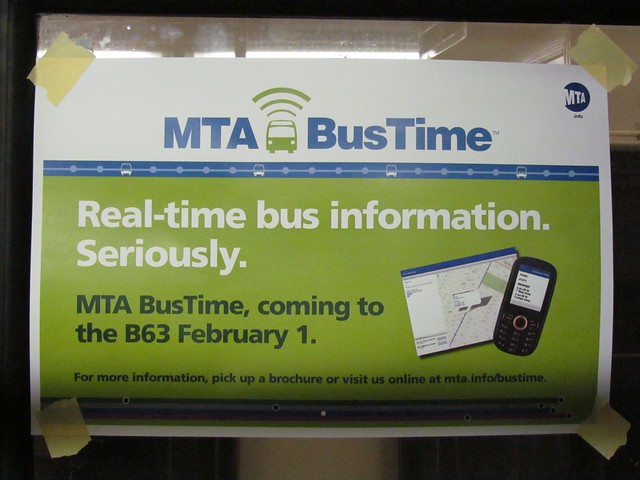
The real-time bus tracking system currently in place along the B63 will be live on Staten Island by the end of the year. (Photo by Benjamin Kabak)
Even as uncertainty reigns supreme at the MTA right now, the authority is moving ahead with projects that will welcome transit-oriented technologies to New York City. This week, in fact, the MTA Board approved a deal with Verifone that will help bring real-time bus tracking to Staten Island by the end of this year. The $6.9 million contract will be the first of a series of deals that will eventually total an additional $48.4 million the on-board components of a city-wide bus tracking system. Verifone’s deal includes only Staten Island, and the contracts for the remaining boroughs will be subject to future competitive bidding processes.
“Today, our transit system is quickly catching up with our 21st century expectation that real-time information is available on the go for all New Yorkers,” MTA CEO and Chairman Jay Walder said. “That means knowing if your bus is on time before you leave home, getting updates on delays while you’re out and about, and unlocking opportunities for better service across our entire network. MTA Bus Time is a big part of this new vision for bus service in New York.”
Verifone’s role on Staten Island will be that of a systems integrator. They will install the necessary hardware in every Staten Island-based bus that will allow for real-time tracking. The MTA will soon award a contract for the software that integrates location and, as the authority puts it, “other relevant information.” Those who worked on the B63 pilot in Brooklyn will lend their expertise to this project as well.
“I’m certain that bus customers will be thrilled with MTA Bus Time,” said NYC Transit President Thomas Prendergast. “Having next bus arrival times right in your hand available at any point in your trip is part of our ongoing effort to improve the customer experience.”
Both future deployment and potential next-generation fare technology provisions are included in the Verifone commercial. First, through a competitive bidding process and subsequent negotiations, Verifone will be paid an additional $48 million to bring the bus-tracking hardware to the other four boroughs over the next few years as well. They will also hold an option to purchase smart card readers as the MTA gears up to replace the MetroCard. It’s all a part of Walder’s technology push, and the contract award guarantees that New Yorkers will at least see the bus-tracking project expand.
Furthermore, the contract represents the MTA’s new way of doing business as well. Verifone’s original bid came in at $8.9 million, and the authority negotiated it down to $6.9 million, a figure over $300,000 lower than the next lowest bid.
I’ve long been a big proponent of the MTA’s BusTime system. I explored the technology and development process behind it earlier this year, and I believe it will only get better and more popular as it spreads throughout the city. Right now, it’s of limited use as it is in place only along 34th St. in Manhattan in one form and along 5th Ave. in Brooklyn in another. By blanketing a borough in a bus tracking system, the MTA will have the opportunity to see how much easier and convenient buses will become when real-time location data is at our collective fingertips. It can improve everything from waiting to transferring, and I look forward to seeing it spread throughout the entire city.
“With a variety of ways of accessing MTA Bus Time, Staten Island customers will find it extremely convenient and useful. It’s another way we’re committed to improving bus service,” Darryl Irick, VP for Department of Buses and President for MTA Bus, said.
According to a New York 1 report, 464 buses will receive the plexiglass partitions by year’s end. The program is still somewhat in the pilot phase, and Transit says they will install different partitions based on the type of bus. According to the NY1 story, the MTA will assess the two safety measures and “decide next year — with the union’s input — how to move forward.”
Bus drivers meanwhile seem mostly on board as safety has become a concern in the wake of some high-profile incidents. “A lot of operators don’t like them because they feel boxed in,” bus driver Lloyd Archer said. “I like them. They’ll protect me. I’d rather for someone to spit on that than spit on me, or punch that instead of punching me.”
Over the past few years, a few high-profile incidents involving unruly passengers and bus drivers have made the headlines. One driver was assaulted when she refused to allow a 17-year-old to bring her dog on board, and a 2008 murder has long led to calls for increased driver safety measures. The MTA, under union pressure, is now ready to act.
While a plan to install driver partitions is still in the pilot phase, the MTA announced that it will be installing security cameras on 341 buses around the city. Each bus will be equipped with six cameras — five on the outside, one on the inside — that will store but not transmit a video. The $10 million project expected to be completed within nine months will bring the total number of video surveillance-equipped buses to 426 — or around seven percent of the city’s fleet. The program will keep us safe,” Willie Rivera, a union official said to New York 1.
Once the 341 cameras are installed, the MTA will make a decision on whether or not to outfit another 1100 buses at a cost of $18,000 per bus. “Unfortunately, our streets can be kind of rough, but we’ve been testing this system for over a year now, and so far it’s stood up to the rigors of bus service,” Kenny said. Bus drivers certainly need more physical protection, and this is a step in the right direction.