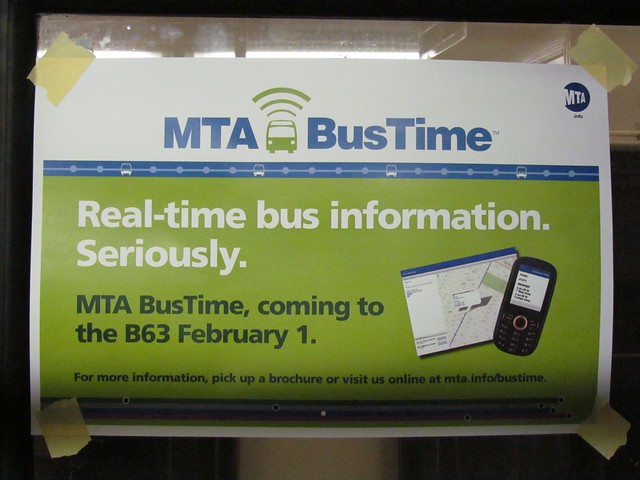
Even as uncertainty reigns supreme at the MTA right now, the authority is moving ahead with projects that will welcome transit-oriented technologies to New York City. This week, in fact, the MTA Board approved a deal with Verifone that will help bring real-time bus tracking to Staten Island by the end of this year. The $6.9 million contract will be the first of a series of deals that will eventually total an additional $48.4 million the on-board components of a city-wide bus tracking system. Verifone’s deal includes only Staten Island, and the contracts for the remaining boroughs will be subject to future competitive bidding processes.
“Today, our transit system is quickly catching up with our 21st century expectation that real-time information is available on the go for all New Yorkers,” MTA CEO and Chairman Jay Walder said. “That means knowing if your bus is on time before you leave home, getting updates on delays while you’re out and about, and unlocking opportunities for better service across our entire network. MTA Bus Time is a big part of this new vision for bus service in New York.”
Verifone’s role on Staten Island will be that of a systems integrator. They will install the necessary hardware in every Staten Island-based bus that will allow for real-time tracking. The MTA will soon award a contract for the software that integrates location and, as the authority puts it, “other relevant information.” Those who worked on the B63 pilot in Brooklyn will lend their expertise to this project as well.
“I’m certain that bus customers will be thrilled with MTA Bus Time,” said NYC Transit President Thomas Prendergast. “Having next bus arrival times right in your hand available at any point in your trip is part of our ongoing effort to improve the customer experience.”
Both future deployment and potential next-generation fare technology provisions are included in the Verifone commercial. First, through a competitive bidding process and subsequent negotiations, Verifone will be paid an additional $48 million to bring the bus-tracking hardware to the other four boroughs over the next few years as well. They will also hold an option to purchase smart card readers as the MTA gears up to replace the MetroCard. It’s all a part of Walder’s technology push, and the contract award guarantees that New Yorkers will at least see the bus-tracking project expand.
Furthermore, the contract represents the MTA’s new way of doing business as well. Verifone’s original bid came in at $8.9 million, and the authority negotiated it down to $6.9 million, a figure over $300,000 lower than the next lowest bid.
I’ve long been a big proponent of the MTA’s BusTime system. I explored the technology and development process behind it earlier this year, and I believe it will only get better and more popular as it spreads throughout the city. Right now, it’s of limited use as it is in place only along 34th St. in Manhattan in one form and along 5th Ave. in Brooklyn in another. By blanketing a borough in a bus tracking system, the MTA will have the opportunity to see how much easier and convenient buses will become when real-time location data is at our collective fingertips. It can improve everything from waiting to transferring, and I look forward to seeing it spread throughout the entire city.
“With a variety of ways of accessing MTA Bus Time, Staten Island customers will find it extremely convenient and useful. It’s another way we’re committed to improving bus service,” Darryl Irick, VP for Department of Buses and President for MTA Bus, said.
Leave a Reply