Category: PANYNJ

  • The Times tears down Santiago Calatrava

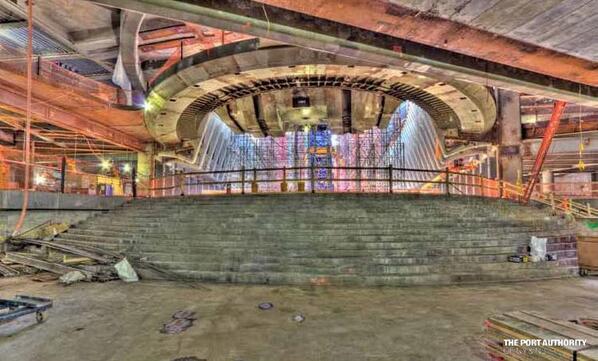
    A glimpse inside Calatrava’s costly subway station. (Photo via @WTCProgress)

    When The New York Times puts a target in its sights, the Grey Lady goes hard:

    In numerous interviews, other architects, academics and builders say that [Santiago] Calatrava is amassing an unusually long list of projects marred by cost overruns, delays and litigation. It is hard to find a Calatrava project that has not been significantly over budget. And complaints abound that he is indifferent to the needs of his clients…

    Mr. Calatrava is likely to come under renewed scrutiny in New York as building continues on one of his latest projects, the new PATH train station at ground zero. It is expected to open in 2015 but is six years behind schedule and will cost $4 billion, twice the original budget.

    Critics of the project, commissioned by the Port Authority of New York and New Jersey, find the final price tag hard to believe. (In January 2012 an independent audit of the Port Authority concluded that the agency was “a challenged and dysfunctional organization.”) But several executives who have been involved in construction at the World Trade Center site, who did not want to speak on the record because of their relationship with the project, said Mr. Calatrava’s designs were problematic, too, calling for hugely difficult construction, including a vast underground chamber. In addition, they said, he demanded that surrounding buildings house all the station’s mechanical elements, like ventilation, which complicated construction and called for time-consuming coordination.

    The Port Authority declined to discuss the cost overruns and issued a one-sentence statement: “Early estimates for the transportation hub were based on conceptual designs and were therefore unrealistic.”

    In Calatrava’s Spanish hometown, politicians aren’t as quick to lay the blame for cost overruns on the shoulders of so-called conceptual designs. Ignacio Blanco, a member of the Valencia parliament which has had its fair share of disputes with its native son, says that Calatrava’s designs — upon which cost estimates and funding requests are based — are devoid of necessary detail. “Other architects, they know exactly the door handles they want, and where to buy and at what cost,” he said. “But Calatrava is the opposite. His projects do not have this degree of precision. If you look at the files on the aquarium, which was built by someone else, they are fat. But there are just a couple of pages on the Calatrava projects.”

    I’ve been highly critical of the PATH WTC station for years now. It’s a glorified subway station that will cost taxpayers $4 billion. It’s a vanity project developed by a starchitect who has made it about him and his contributions to the New York scene rather than about a cost-controlled transit improvement. The mistakes of PATH and the mistakes of Calatrava should be a lesson to the various New York stakeholders at plans to expand or rebuild Penn Station move forward. This is a mess that didn’t have to be a mess.

  • Crain’s: $1 billion PATH airport extension on Christie’s radar

    PATH may soon extend from Newark Penn to Liberty International Airport.

    As New York City area airports go, Newark’s is relatively easy to get to. NJ Transit and Amtrak both provide regular and frequent service to the AirTrain station, and while the AirTrain is a bit sluggish, it works. Now, at the cost of $1 billion, it’s going to get even easier to get there as Governor Chris Christie will approve a PATH extension to the airport.

    Crain’s New York broke the story on Wednesday evening. Daniel Geiger notes that Gov. Christie was set to announce his support on Thursday but canceled his public appearance. Still, the money will be on the way. Geiger reports:

    Mr. Christie’s backing would almost certainly assure that the extension project, which has been mulled over by transit officials for more than a year, would be included in the Port Authority of New York and New Jersey’s roughly $30 billion capital plan, which is expected to be released to the public in the coming months.

    The extension would be of special benefit to lower Manhattan PATH riders, who would be able to take the line
    all the way to Newark Airport and transfer to the Air Train to travel to the airport’s terminals. Downtown PATH service currently ends at Newark Penn Station, and the most common approach for riders coming from Manhattan now is to take New Jersey Transit from Penn Station in Manhattan to the Air Train, a route that requires downtown riders to first head to midtown.

    Airport advocates hailed the decision. “A one-seat PATH ride from lower Manhattan directly to Newark Airport Airtrain is a major step forward,” said Joseph Sitt, a Manhattan landlord who earlier this year founded the Global Gateway Alliance to encourage airport improvements.

    This move comes after a year’s worth of study. The Port Authority first announced its plans to examine a PATH extension last September, and at the time, they estimated a $600 million project. That cost has, clearly, grown by two-thirds and will clock in at a lofty $1 billion. The details too are still unclear as we don’t yet know where the extension would terminate, but the right-of-way tracks the current NJ Transit/Amtrak routing.

    I’m still on the fence about this plan. As I said last year, extending PATH to the airport is a big help for Newark-bound riders from Brooklyn, Lower Manhattan, and Jersey City. But it’s a $1 billion investment in at-grade tracks through a preexisting right-of-way to serve an airport that isn’t lacking in transit connections. It’s $1 billion arguably better spent on La Guardia connectivity, a high-speed connection from Lower Manhattan to JFK or — dare I say it? — those projected cost overruns for the long lost ARC Tunnel. And why has the price tag jumped by 66 percent in 12 months?

    We’ll hear more about this plan in the “coming months” as the Port Authority gears up to unveil a $30 billion capital plan. It’s an embrace of transit from a governor who has been openly antagonist toward it, but is it a wise investment? I’m not convinced yet.

  • Why the PATH Hub isn’t a new Grand Central

    An occulus arises. (Photo via @WTCProgress)

    With great restraint, I haven’t written too much about the $4 billion World Trade Center PATH Hub over the past five weeks, but the Port Authority decided to take some reporters for a tour earlier this week. The resulting coverage has been particularly impressive for, on the one hand, its sweeping proclamations of success for a project two years away from opening and, on the other, for its sheer skepticism that this thing was worth building. Stuck in the middle was an entirely inapt comparison to Grand Central by none other than The New York Times.

    The story in The Times takes the Port Authority party line hook, line and sinker, at least for its first half. Carrying the headline “A Transit Hub in the Making May Prove to Be the Grandest,” David Dunlap’s piece foresees the PATH Hub as Grand Central South. With a lede that calls Grand Central an “enduring landmark” and “a portal to the city that has never lost its power to inspire awe,” Dunlap wonders if the PATH Hub can do the same:

    If the World Trade Center Transportation Hub is ever to emerge from under the shadow of its $3.94 billion price tag (double Grand Central’s, adjusted for inflation), it will have to do more than move PATH commuters efficiently. It will have to lift hearts. Perhaps it can.

    A visit to the monumental station on Wednesday left the impression that its main transit hall may be the most hopeful element at the trade center complex when it opens in 2015. Now full of light and air, it will one day be full of people, movement and life, as well. It could become a destination in its own right, even for those who are not among the 200,000 or so commuters traveling daily to and from New Jersey.

    The transportation hub and retail concourses will be “the only facilities on site that are completely accessible to the public,” said a report by the Port Authority of New York and New Jersey, which is building the hub. By contrast, visitors to the office towers, the National September 11 Memorial Museum and the 1 World Trade Center observatory will be subject to tight scrutiny.

    In the end, that may be the most astonishing feature of the hub; that a structure of such colossal proportions should be devoted to unobstructed public use. The main transit hall is 365 feet long — a block and a half — making it 90 feet longer than the main concourse of Grand Central Terminal. It is 115 feet wide, or just 5 feet narrower than the Grand Central concourse. It takes a half minute to walk from one side to the other.

    Now to be fair to Dunlap, he spends the second half of the article talking about the project’s ever-increasing cost which has essentially doubled since plans were first unveiled. He also accepts PATH’s estimate that 200,000 people will traipse through the hub daily without much of a second-guess. Currently, PATH’s total daily ridership is only around 260,000, and not all of those riders pass through the World Trade Center stop. A new hub — without added track or tunnel capacity — won’t deliver too many more riders.

    So is the PATH Hub positioned to be a new Grand Central? Not by a long shot. The current iteration of Grand Central was built by a private entity to uniform rail operations in New York, electrify the tracks and restore Park Avenue to the people of the city as opposed to its trains. It contains 123 tracks — 46 with platforms — and will soon see a marked increase when East Side Access, at a cost of just twice the PATH Hub, will bring in another eight tracks of LIRR service. The PATH Hub, as an underground mall, may rival Grand Central in its grandeur, but as a train station, it falls far short.

    Even still, some of those who saw the station in progress this week walked away far more skeptically than The Times did. Steve Cuozzo of The Post was one of those columnists casting stones on the half-completed transit hub. The structure is an architectural marvel, he says, but “is this pet project of the PA’s New Jersey side worth it?”

    The Hub’s so big, complicated and densely packed with everything all around, it made three skyscrapers and the Memorial much harder and costlier to build.

    And how many will use it? More than 250,000 daily, PA construction chief Steve Plate said yesterday. Skeptics say as few as 50,000, mostly Jersey commuters. The project adds no new track, only endless underground corridors for walking from here to there. Isn’t that what city streets are for?

    In an age with limited dollars available for transit and a glaring need to add capacity, have we spent wisely? Can’t we build great public spaces that inspire civic pride without flushing cash down the drain? At the former Ground Zero site, apparently not.

  • Midtown Bus Master Plan could usher in PABT replacement

    A new master plan could spell the end for the Port Authority Bus Terminal in its current form. (Photo by flickr user Andrew Mace)

    For all the talk about Penn Station and all the grief it gets, just a few blocks north sits a far worse transit hub. I had the distinct pleasure of arriving at the Port Authority Bus Terminal from Boston very early on a Sunday morning a few weeks ago, and it was not a sight to see. From the inside, the building seems to be falling apart, and from the outside, it isn’t much better. As city planners eye a Penn Station overhaul, midtown’s bus terminal may soon see a brighter future.

    With capacity the main concern — the PABT is at capacity during rush hour — the Port Authority announced on Thursday that it has commissioned a comprehensive study to assess how to accomodate future growth in bus commuting. The options could include things as mundane as terminal improvements and state-of-good-repair programs to possible terminal replacement. Ultimately, Port Authority wants to limit the number of buses idling on the streets of Manhattan and needs a better facility to serve as an entry point into the city.

    “The development of a Master Plan underscores the Port Authority’s commitment to make the Bus Terminal a world-class facility and bus transit the most reliable mode of access to midtown Manhattan,” said Port Authority Chairman David Samson. “While the Port Authority has already begun the work of revitalizing the Bus Terminal, including the recent acquisition of top-shelf tenants like Starbucks and Cake Boss Café and the installation of WIFI in the South Wing concourse, this comprehensive approach is the best way to ensure the Bus Terminal keeps pace with future passenger growth over the next fifty years.”

    Setting aside the hilarity of considering Starbucks and Cake Boss Cafe to be top-shelf tenants, the Port Authority should assess if its infrastructure can keep up with bus commuting over the next fifty months, let alone fifty years. With 65 million people passing through the Port Authority Bus Terminal each year, the structure, this monstrosity that breaks up the city grid, is nearing the end. What the future holds though is anyone’s guess.

    In announce the new Midtown Bus Master Plan, Port Authority identified a series of goals in addition to expanding, repairing or even replacing the terminal building. The study, to be conducted by Kohn Pedersen Fox and Parsons Brinckerhoff, will look to integrate the bus terminal into the development to the west. Right now, Port Authority is very focused on sending its customers east, but with the growth in Hell’s Kitchen and Hudson Yards, the west demands attention. “Modernizing the bus terminal will keep it apace with other public investments in the area and enable it to accommodate increases in customers and commerce,” the PA said.

    Unlike with Penn Station, doing something with the Port Authority Bus Terminal doesn’t involve upsetting entrenched interests and city institutions. Even a recent effort to improve the facade of the building has done little to lessen its hulking ugliness. As one traveler said to The Times when told of plans to remake the terminal, “They could start with the floors and the ceilings. The walls, I guess, are not very homey either.”

  • Photo: A glimpse inside a marble-lined subway station

    After fits, starts and budget overruns, Santiago Calatrava’s $4 billion monument to himself PATH station is finally starting to emerge from the below-ground depths of the World Trade Center site. The spikes of the stegosaurus are peeking up above the construction fence, and photos from the work are flying fast and furious. Nikolai Fedak over at New York Yimby posted some ground-level photos, but the one I want to focus on comes from the Port Authority itself.

    Via the @WTCProgress account, PATH has been posting photos of the work at the World Trade Center mostly so that New Yorkers can see something is actually happening there. Here’s what they published on May 31:

    A subway station encased in marble for some reason. (Via @WTCProgress)

    The accompanying text said, “Workers install marble floors at WTC Transportation Hub East West connector that will be lined with retail.” No wonder this thing’s cost has more than doubled from $1.9 billion. The Port Authority is building a marble-plated subway station and underground mall that’s going to put Moscow’s Metro to shame.

  • Inside the $3.7 billion PATH boondoggle

    A rendering of the world’s most expensive subway station.

    Early last week, a Port Authority twitter accounted trumped the installation of the first above-grade part of the Calatrava PATH Hub. For the Port Authority and Lower Manhattan, it was a big moment. In fits and starts, the Hub has taken shape, and even though it won’t open for a few years, it’s finally getting somewhere. It’s an occasion worth celebrating, but perhaps a tepid celebration is in order.

    Over the years, I’ve written skeptically about PATH’s new World Trade Center hub. It is a $3.7 billion monument to Santiago Calatrava that does little to advance transit access to Lower Manhattan. It doesn’t offer added capacity; it doesn’t expand PATH’s reach. It is, in essence, the world’s most expensive subway stop.

    It’s almost flippant to refer to the PATH hub as an overpriced subway terminal even if that’s what it is because the expense and construction time have had a very negative impact on Port Authority’s other transit-related projects. With so much money sunk into the PATH station, other efforts have taken second stage, but until recently, we haven’t had a good grasp on the extent of the situation. That changed this week when Stephen J. Smith published an in-depth look at the PATH hub. He is, as expected, very critical of the entire project, and I will excerpt liberally.

    We start with its cost and origins:

    When the grandiose ambitions and the emotions of 9/11 met with the famously flush Port Authority, disaster struck. Mission creep, an inattentive governor and extreme politicization sent costs skyward, eventually outstripping even the record-setting resources devoted to it. Its wings had to be stilled and its supports thickened, the bird in flight devolving into an immobilized stegosaurus. The world’s most expensive train station, it seems, was not expensive enough to contain all of New York’s dreams.

    For nearly $4 billion, most cities could build entire subway lines. Even the MTA, which frequently breaks cost records of its own, managed to build its Fulton Center hub, a renovation of five densely tangled lines, for $1.4 billion. Nobody’s subway tunnels cost more than the MTA’s, but even they could fund most of the second phase of the Second Avenue subway, from 96th Street to 125th, with that kind of cash.

    The World Trade Center PATH station is actually not a particularly busy one. “No one intelligently could say that the level of design and architecture associated with it was commensurate with the level of usage,” said one former commissioner. (Like nearly everyone we interviewed for this story, he would only speak on the condition of anonymity.)

    To make matters worse, the World Trade Center station doesn’t draw the traffic to warrant the expense. It is the city’s tenth busiest subway stop when stacked against the MTA’s own ridership, and no one is advocating for a $3 billion station at Lexington Ave. and 53rd St.

    Beyond that, Smith tells the story of its funding: When originally proposed by Calatrava, the $1.9 billion price tag was a red herring. Port Authority and the feds came to terms on the grant before anyone knew how much the full project would cost, and the various stakeholders took advantage of the uncertainty. Site foundation costs are baked into the PATH Hub costs, and a lot of common infrastructure costs eventually foisted onto Port Authority “might not have passed the FTA’s muster,” Smith explains.

    Port Authority had a chance to reign in costs. One of its heads, appointed by Eliot Spitzer, vowed to cap spending at $2.5 billion and had a plan that eliminated many superfluous elements to keep costs down. But, as with many transit expansion efforts in New York, this one too fell by the wayside when Spitzer resigned in the wake of his sex scandal. Chris Ward, Gov. David Paterson’s replacement, wanted to see accomplishments, never mind the costs. So Calatrava’s passageways and wings were retained, and the project marches ever onward as it becomes the world’s most expensive subway stop.

    Are there lessons we can take from this? Of course, there are, but it’s not really about Albany oversight or better control over Port Authority’s purse strings. Rather, it’s a lesson that should unfold a few miles north at the site of what is currently Madison Square Garden. Pending a City Council vote, various city stakeholders seem serious about the opportunity to do something about Penn Station and MSG, and, for better or worse, that something will involve a new station house.

    The mistakes of the World Trade Center Hub should not be repeated at Penn Station. If the city overhauls Penn Station, transit expansion should trump a fancy building designed by a big-name architect who wants to leave his mark on New York. We’ve spent far too much on buildings that do far too little to improve the region’s mobility problems, and that time should end. If we learn one thing from the PATH debacle, it should be that.

  • When an architectural symbol isn’t really an architectural symbol

    Over the weekend, seemingly in only an article in The New York Times and not anywhere else on the Internet, the New York State Department of Motor Vehicles announced a new look for the state’s driver licenses. Beginning in July, New Yorkers renewing their licenses or getting new ones will receive hard polycarbonate cards with two black-and-white photos. Ostensibly this is a move to combat counterfeiters and purveyors of fake IDs.

    The details surrounding the new licenses — including word of a lawsuit over the contract reward and bidding process — are laid out in Jesse McKinley’s article. For now, this move will have little impact on anyone’s life as we’re not being asked to fork over the dough to receive new licenses yet. I wanted to take a look at the sample though because something familiar grows in the background.

    license-articleLarge

    If you look closely you will see that the background is not a usual symbol of New York State. The seal of New York, the city skyline and Niagara Falls have all been banished from the license, and in their places are the Statue of Liberty and….Santiago Calatrava’s half-built World Trade Center PATH train transportation hub? Pardon my incredulity but since when do semi-realized architectural renderings for a project not due for completion until maybe 2015 or maybe 2016 qualify as a Great Symbol of New York State?

    To me, this reeks of an ex ante justification for the transportation hub — or perhaps even an ex post attempt at excusing the project. As of now, the hub is set to cost nearly $4 billion and won’t do a lick to increase rail capacity. It’s supposed to be an anchor in Lower Manhattan and a symbol of the area’s rebirth 15 years after the September 11th attacks, but it’s become a sign of New York’s inability to invest sensibly in infrastructure while keeping costs under control. We should have great public spaces, but we shouldn’t be bilked out of money by an architect more concerned with his vision than New York City’s needs.

    And so, we’ll be forever reminded of this multi-billion-dollar porcupine in Lower Manhattan that really serves as a gateway to and from New Jersey because it will be featured ever so prominently on state-issued ID cards. Today, it’s not a symbol of anything really because it doesn’t exist, and when it does exist, it shouldn’t be a symbol New York should embrace so readily.

  • Some forward-thinking as PATH resumes 24/7 pre-Sandy service

    Without much fanfare, the Port Authority has restored PATH train service to its pre-Sandy levels. Via a Tweet early Wednesday evening, the agency announced that weekend service to and from the World Trade Center and Exchange Place will commence this Friday. For Jersey City-bound travelers coming from points south in New York City, this announcement — unaccompanied by a press release — is a welcome one.

    PATH’s service restoration comes nearly four months to do the day after we witnessed stunning video footage of water flooding through PATH’s system. Although the PA wasn’t nearly as transparent with its post-Sandy images or plans, we heard that water completely flooded the tunnel between Lower Manhattan and Exchange Place, and a subsequent escalator malfunction at Exchange Place was seemingly the result of such flooding. Four months and countless dollars later, PATH service — an oft-underlooked but key element of the region’s transit system — has been restored.

    Yet, even with the good news, I am left wondering what now? The Port Authority hasn’t been too forthcoming with its plans, but now that service levels have been restored to pre-Sandy levels, the PA must placate concerns over future storms and future flooding. Will the agency invest in storm and flood mitigation efforts? Will the new $4 billion PATH hub in Lower Manhattan be protected from future storm surges? According to one report, Sandy cost PATH 18 months on that project, but subsequent denials cast doubt on that story. If those delays were due to hardening efforts, it would probably be a worthwhile one.

    We cannot as a region afford to look this gift horse in the mouth. Outside of the Rockaways, South Ferry and New Jersey Transit’s inane treatment of its rolling stock, transit services were restored to pre-Sandy levels very quickly. But that doesn’t mean doing nothing is an adequate response today or for the future. Be it PATH, New Jersey Transit or the MTA, our transit agencies should be preparing for the next storm now and not three days before it’s due to hit.

  • WTC PATH hub delayed another 18 months

    Santiago Calatrava’s monstrous testament to the power of no public oversight.

    The saga of Santiago Calatrava’s World Trade Center PATH hub is a familiar one to long-time readers. What once started out as a $2 billion project expected to take four years to build has stretched every onward and upward to become a $3.8 billion, six-year undertaking. It’s long been unclear exactly what is driving the costs and the timeline issues, but Hurricane Sandy, ostensibly, did not help.

    In an interview in The Times today, Cheryl McKissack Daniel, president of McKissack & McKissack, spoke about the PATH hub. Her words were not optimistic:

    Q. You’re also working on the World Trade Center transportation hub.

    A. There’s another long one!

    The World Trade Center started out being about 48 months and quickly grew to about six years. And now, after Sandy, that added another year and a half to the whole project. Everything was flooded — everything was new and flooded. And all of that had to be replaced because it’s all electrical work.

    We are part of a large team with Turner and Tishman to provide construction management services and it’s really more on the consulting side for the Port Authority.

    Vivian Marino, the Times interviewer here, was handed a gift horse and decided to turn it down. It’s a Very Big Deal that Sandy and the subsequent damage added another 18 months to this project, and logical follow-up concerns costs. The Port Authority has, so far, been mum on anything relating to this project and its projected spend.

    Meanwhile, I’ve heard from a few sources that Sandy isn’t the only factor behind this delay. These sources claim that Santiago Calatrava’s influence (and meddling) have led to some redesigns and cost increases. Additionally, others have questioned Downtown Design Partnership’s ability to manage public perception and the behind-the-scenes timeline.

    So what we’re left with here are more questions and concerns. It’s likely that this PATH terminal won’t wrap until after work on 1 World Trade Center is finished, and it’s guaranteed to cost $4 billion. To make matters worse, that $4 billion isn’t going toward any sort of increase in capacity or service levels. What a mess.

    * * *

    Update (4:00 p.m.): Via Twitter, the Port Authority issued a statement disputing Daniel’s statement: “Info provided by Ms. Daniel is wrong. The anticipated completion date of the WTC Transportation Hub remains 2015.” The fact, remains, however, that the project is set to open after 1 World Trade Center, cost nearly $4 billion and take eight years to construct. Is it worth it?

  • PATH set to restore HOB-WTC trains Wednesday morning

    PATH will run a full weekday schedule tomorrow for the first time since Hurricane Sandy, Governors Chris Christie and Andrew Cuomo announced today. Beginning at 6 a.m. Wednesday morning, trains will once again run from Hoboken to the World Trade Center, offering up that elusive one-seat ride that had been knocked out due to sever damage from flooding.

    “Restoring full PATH service to the region is possible because of the hard work of the men and women at PATH who labored 24/7 to bring this critical transit link back to life after the most devastating storm our region has ever suffered,” Gov. Christie said in a statement. “PATH riders’ patience, understanding and flexibility under such difficult circumstances are great examples of how the people of this region respond in the face of tragedy, and today is another major step toward returning our daily lives and routines to normal.”

    With this announcement, PATH’s weekday service is fully restored with trains running from Newark and Hoboken to the World Trade Center and from Journal Square and Hoboken to 33rd St. on pre-Sandy timetables. Overnight weekday service will run from Newark to 33rd St. via Hoboken and from Newark to the WTC station. For now, though, and throughout February, Exchange Place and World Trade Center will be closed during the weekend as crews continue to make necessary repairs. The Port Authority expects to restore all PATH service to pre-Sandy levels sometime in March.