Category: PANYNJ

  • PATH to restore Newark-WTC overnight connection tonight

    Weekday overnight PATH service between Newark and the World Trade Center stop will resume operations this evening, Port Authority announced today. With this resumption of overnight service, PATH’s weekday overnight service offerings have returned to pre-Sandy levels, three months after the storm swept through the region. Exchange Place and the WTC station will be closed throughout February from 10 p.m. Fridays through 5 a.m. Mondays as crews work to restore weekday service between Hoboken and the WTC and full weekend service.

    Meanwhile, last week, Ted Mann profiled the challenges facing PATH in an excellent article in The World Street Journal. PATH has leaned heavily on manual operations and jury-rigged signal systems as well as assistance from New Jersey Transit and the MTA to restore its infrastructure. As Mann notes, a large portion of the PATH system was within the Sandy flood zone. “If I had parts of system that were not affected, yeah, it’d be easier to bring those back, but virtually all of my system was damaged,” Acting PATH Director Stephen Kingsberry said.

    While reading Mann’s article and watching PATH and the MTA approach their respective rebuilding efforts, I’ve often wondered if it makes sense to have two distinct agencies responsible to entirely different oversight bodies. While PATH spans two states, it is an integral part of the New York Metropolitan area, and hundreds of thousands of New Jerseyians and New Yorkers rely on PATH to travel across the Hudson. As the region recovers from the storm, perhaps a second look at how PATH operates in relation to the rest of the region’s transit network should become a louder part of the discussion.
  • PATH restores some 24/7 services

    Nearly two and a half months after Superstorm Sandy swamped the PATH system, the Port Authority will be restoring some 24-hour service to its beleaguered interstate subway system, Governors Chris Christie and Andrew Cuomo announced today. Starting tonight, PATH service between the hours of 10 p.m. and 5 a.m., seven days a week, will commence between Newark and 33rd St. via Hoboken with stops including Harrison, Journal Square, Grove Street, and Newport in New Jersey and Christopher Street, 9th Street, 14th Street, and 23rd Street in Manhattan. This route will also run non-stop over the weekends starting at 10 p.m. on Friday and running through 5 a.m. on Monday.

    According to the press release, restoring PATH service “has been a top priority for the Port Authority.” Wise minds could debate what exactly that means for the same amount of time it took the PA to restore service. Still, I won’t look a gift horse in the mouth that closely. For lots of commuters and New Jersey residents, even this limited 24-hour service is a welcome relief to the transit desert that had enveloped the area.

    Meanwhile, the World Trade Center stop will not be a part of this service restoration. The infrastructure between the WTC and Exchange Place was seriously damaged during the flooding, and as this week’s escalator malfunction showed, there’s still a long way to go before everything is normal again. Still, this is a big step. Now who wants to go to Barcade in Jersey City?

  • The provincialism of the PATH train

    If the G train, is New York City’s forgotten stepchild of a subway, what does that make the PATH trains? Serving as a vital link between rapidly-growing waterfront communities in New Jersey and both Lower Manhattan and Midtown, PATH saw a record 76.6 million riders in 2011. But since Superstorm Sandy swamped the system, PATH riders have been left in the dark by a two-state agency seemingly responsible to no one.

    Earlier this week, the Port Authority finally restored a vital PATH link between Hoboken and Manhattan, at least partially. With service out to the flooded terminal, the city had been suffering tremendously with some residents even contemplating moving. The situation is still not ideal as service is operating only between 33rd St. and Hoboken and only between 5 a.m. and 10 p.m. The missing late-night and overnight service is a major concern.

    In announcing the restoration of service, Gov. Cuomo and Gov. Christie issued a joint press released that included no statement from either Governor. Even their press secretaries couldn’t be bothered to put words into their mouths for the occasion — which tells you how little they seem to understand the value PATH has to the city. The press release trumped the return of train service for “more than 29,000 commuters” but neglected to mention when 24-hour service would return. The release also noted that direct service from Hoboken to the World Trade Center terminal “remains several weeks.”

    Meanwhile, PATH’s reluctance to provide any further information has annoyed customers for nearly two months. Yes, Sandy created dire circumstances, but as the MTA’s willingness to share information has shown, customers appreciate updates. Furthermore, PATH’s own insularity can lead to absurd situations as well.

    Take, for instance, a message on Twitter issued by @PATHTweets yesterday. In an effort to assist customers navigate the system, PATH issued this statement on traveling from Hoboken to the World Trade Center:

    Yes, you’re reading that correctly. This is the official PATH account telling its followers to go into Manhattan to Christopher St., 1.5 miles away from the World Trade Center, travel back to New Jersey and then go back into Manhattan for this trip. Later, PATH clarified that the Hudson-Bergen Light Rail was still cross-honoring fares, but what of the subway? Why not take PATH to 9th St. and switch to a downtown A, C or E train?

    The problem of course is one of artificial agency turf wars. PATH later defended their instructions on the grounds of providing single-fare information, and therein lies the problem. Even though riders can use pay-per-ride MetroCards to swipe into the PATH system, there are no free transfers between the systems, and planners and politicians often act as though the two agencies are utterly foreign.

    In an ideal world, the PATH system would be integrated into the New York City subway with easier transfers and fare payment technologies. Other than state boundaries and controlling agencies, there’s no real reason, from a regional transportation perspective, to separate the various entities and their rail systems. But politicians are stubborn, and change is slow-moving. We’re left instead with a PATH system lacking in common sense and transparency when it could be so much more.

  • Sandy Update: WTC PATH service to resume Monday

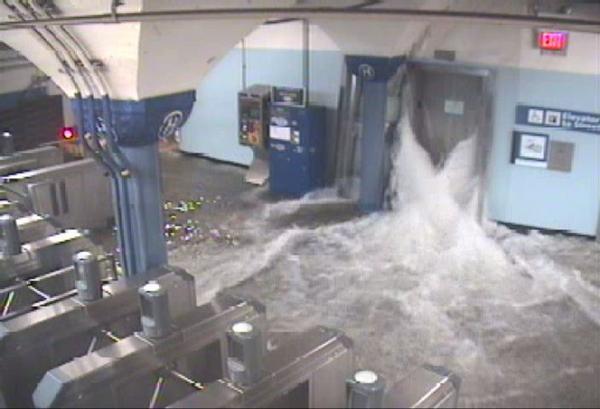
    The video atop this post is a 35-second glimpse at the power of floodwaters. During Hurricane Sandy, the storm surge, as we know, knocked out many of the MTA’s services, but New York City’s Transit Authority got most of the subway up and running within a week. In New Jersey, PATH suffered more severe damage and has been slower to come back, but starting Monday morning, the World Trade Center link will reopen.

    Over the weekend, Governors Andrew Cuomo and Chris Christie announced the resumption of limited service between the World Trade Center stop, Exchange Place in Jersey City and points west. The WTC PATH line will run from Monday through Friday from 5 a.m. to 10 p.m. with stops at Newark, Harrison, Journal Square, Grove Street and Exchange Place and in New York at the World Trade Center. Hoboken, though, remains shuttered due to extensive damage.

    The Port Authority, a two-state entity, has not been nearly as forthcoming with information about the damage its PATH system sustained or its efforts at repair as the MTA has been. We’ve seen limited images of the tunnels and little word of ongoing work. For thousands of riders who rely on the connection between Exchange Place and the World Trade Center, the restoration of even limited service is welcome news, and that workers put in the hours non-stop over the Thanksgiving weekend should not be overlooked.

    The release from the two governors’ offices contained more information on the efforts to restore service. Right now, there is no weekend service so workers can continue to make “the remaining necessary repair work.” Additionally, when the WTC line reenters service on Monday morning, the 33rd St. line will resume trips between Journal Square and 33rd St. with all station stops in Manhattan. On weekends, the 33rd St. line will stop at Harrison and Newark as well.

    As to Hoboken, the release sums it up: “Service at the Hoboken station, which saw unprecedented and widespread flooding remains suspended due to the fact vital switching equipment was destroyed and cannot be salvaged. Crews are working 24/7 to replace the signal equipment and restore communications in the tunnels, a process that is expected to take several weeks.”

    For now, ferry service and shuttle buses will continue to offer additional transit options for riders from Hoboken who are left without their PATH service, and as repairs continue, it’s imperative to begin discussing ways to avoid these problems in the future. Whether the answer lies in tunnel plugs, flood doors or an as-yet-undiscussed solution, the region needs to begin planning for the next storm now. It’s only a matter of time before we get another.

    Meanwhile, we should also remember not to take transit and its workers for granted. The storm hit four weeks ago, and only a few isolated trouble spots remain. Overall, the MTA and, to a similar extent, Port Authority have put in some diligent work restoring the system. We now know what these agencies can accomplish when faced with a crisis. Can they transport those experiences to day-to-day operations and long-term capital construction projects?

  • GWB Bus Terminal revamp set to start this month

    Lost amidst the clean-up efforts after Sandy was a bit of good news for Upper Manhattan. As The Daily News reported last week, the planned $180 million revamp of the Port Authority’s bus terminal at the George Washington Bridge is set to start this month. The renovation is set to overhaul the building’s ugly facade and bring approximately 100,000 square feet of retail space to the underused terminal.

    The former tenants of the space moved out over a year ago, and work on this project was set to launch last January. It was, however, delayed due to issues with funding and the various developers chosen for the project. Now, with a start date nearing, community leaders are pleased the project is moving forward. “We don’t see this just as getting the eyesore out of the community,” Maria Lizardo, an official with the Northern Manhattan Development Corp., said to The News. “We must make sure that it’s a hub for local employment.”

  • Limited PATH service set to restart Tuesday morning

    Although trains between Newark and the World Trade Center are still out of service, PATH trains will run from Midtown to Journal Square starting tomorrow morning at 5 a.m., the Port Authority announced this afternoon. PATH will run only a limited service with station stops at 33rd, 23rd and 14th Sts. in Manhattan and Newport, Grove St. and Journal Square in New Jersey, and trains will operate only from 5 a.m. to 10 p.m. Stations at 9th St. and Christopher St. in the West Village will not open due to concerns over capacity crowds.

    For the first time in a few days, the Port Authority also revealed some details on the extent of damage sustained by the system. Hoboken Station suffered extensive damage to the signaling and train control equipment while floodwaters damaged substation equipment at both Newark and Journal Square. PATH engineers are working to restore additional service, but there is no timeline for such work.

    Meanwhile, the WTC-Newark line seemed to bear the brunt of the floods as well. In a statement, PATH explained, “Exchange Place and World Trade Center stations both experienced an unprecedented amount of flooding, damaging multiple types of equipment, including those for signaling and train control. PATH engineers are repairing or replacing this equipment as quickly as safely possible. Hurricane Sandy caused more flooding in the tunnels than the terrorist attacks of 9/11.” It may still be a while yet for Exchange Place and Hoboken service to return to normal.

  • Christie: PATH may be out 7-10 days

    A surveillance camera at Hoboken showed water rushing into the PATH system. (Photo via @PANYNJ)

    PATH trains may be out for as much as 7-10 days, New Jersey Gov. Chris Christie announced at a press conference this morning. Noting that the system sustained “serious damage,” Christie explained that with salt water in the system, crews will have to drain, inspect and repair the PATH system.

    Additionally, Christie said, there is “major damage on each and every one of New Jersey’s rail lines” and “large section of track were washed out.”The New Jersey governor anticipates that New Jersey Transit trains will be offline for a few days as well as the system sustained a lot of damage but thinks those trains may be back sooner than PATH. As always, I’ll update as news develops.

    * * *
    Update (3:02 p.m.): As more news has emerged from New Jersey, the situation for New Jersey Transit sounds dire. As the agency tweeted earlier today, “Early inspections this morning reveal that Sandy has devastated NJTransit’s operation & infrastructure.” Service will not returning any time soon.

    Kate Hinds from Transportation Nation had more from NJ Transit officials. An agency spokesperson said the network had been “quite damaged, if not crippled.” “This is unprecedented damage,” Nancy Snyder said. Hoboken, Secaucus and Newark Penn Station were still underwater, and New Jersey Coast Line bridges had sustained serious damage as well. There is currently no timeline for the resumption of service.

    New Jersey Transit’s Hoboken Terminal was flooded earlier today. (Photo via @NJ_Transit)
  • Port Authority to study PATH extension to Newark Airport

    With dreams of providing a one-seat ride from Lower Manhattan to Newark Airport, the Port Authority announced last week that it would study the feasibility of extending PATH train from its current terminus at Newark’s Penn Station to the nearby Liberty International Airport. The study will lead to updated cost estimates, ridership figures and construction timeframes.

    “Mass transit options to our airports are essential to the future growth and economic vitality of our region,” Port Authority Chairman David Samson said in a statement. “We need another mass-transit link to Newark Liberty International Airport, which served nearly 34 million passengers last year, so this initiative is of utmost importance. We will move quickly to make it a reality.”

    Off-the-cuff, the Port Authority estimates that such a project would include “more than $600 million in design and construction activity over the project’s life, while adding permanent jobs for the link’s operation.” Meanwhile, airport-bound travelers from Lower Manhattan and Brooklyn as well as other parts of New Jersey could have streamlined routes to the airport. A PATH extension and the Newark airport parking lots could also serve as a park-and-ride option for New Jersey commuters heading into Manhattan.

    It’s unclear when such a study would be complete, how such an extension would be funded or when we can expect all of this. Still, it’s a worthwhile PATH extension that would have a major impact on the Newark Airport. I’ll follow along when and if this plan moves forward.

  • Tardy buses and an overtaxed Port Authority

    In today’s Wall Street Journal, Heather Haddon welcomes the unofficial end of summer with an article on everyone’s most infuriating transit topic: late buses. She delives into the New Jersey Transit data and finds that one out of nine buses departed Port Authority at least five minutes later than scheduled. It is an ongoing problem that has vexed transit planners but leads to one conclusion: New York City needs more space for buses.

    Overall, NJ Transit buses are getting tardier. More than one in 10 NJ Transit buses—12%—left the Port Authority Bus Terminal more than five minutes late in the first six months of 2012, according to NJ Transit records viewed by The Wall Street Journal.

    The numbers illustrate a continuing frustration for NJ Transit as bus ridership has grown: A system that brings nearly 100,000 commuters into New York City each day is running out of space in the world’s busiest bus terminal. “We’re bursting at the seams,” said Joyce Gallagher, NJ Transit’s vice president and general manager of bus operations. “We’re using every conceivable ounce of space that we can.”

    NJ Transit defines a late departure as leaving five minutes late or more, but commuters say they often have to wait up to an hour for a bus with a seat, as the vehicles fill to capacity quickly. They then must fight through Lincoln Tunnel traffic, which averages about 120,000 vehicles a day, including 10,000 buses.

    “The bus will come, but you are wrapped around in so many lines that you have to catch the third or fourth bus,” said Douglas Panchal, a 33-year-old Little Ferry, N.J., resident who works in the banking industry. He said he has waited nearly two hours for a bus.

    The problem doesn’t look to improve any time soon. New Jersey Transit competes with long-haul buses, airport shuttles and a variety of other vehicles or space at the Port Authority Bus Terminal, and PA officials anticipate a spike in demand by nearly one third over the next 25 years. New Jersey Transit is searching for solutions, but the obvious one requires some amount of political planning.

    Essentially, New York City and New Jersey need to rethink their trans-Hudson plans. Another rail tunnel would be ideal, but in the absence of that dream, the city needs to start pondering a new, larger bus terminal and lanes through the Lincoln Tunnel that are truly dedicated to buses. It isn’t sexy, and it doesn’t completely help wean us off fossil fuels. But as part of the transportation infrastructure, these improvements deserve a serious conversation before bus congestion and delays get much worse.

  • Amidst record ridership, some thoughts on PATH

    The 1909 plans from the Hudson & Manhattan Railroad Compay would have seen trains reach Grand Central. (Photo via Penn Station Maps Library)

    Every few weeks, I have to take a reverse commute on the PATH trains from the World Trade Center out to Jersey City. It’s a quick ride on a smooth and clean system, and I’m always floored by the rush of people leaving the station in Lower Manhattan. It can be tough to fight against the crowds flocking to work in the morning and for good reason too as PATH has announced record ridership for the first half of 2012.

    From January 1 through June 30, PATH ridership was up four percent over the record levels set in 2011. Ridership during that time exceed 39 million, and the interstate subway is on pace to see an increase of eight percent over 2009. That’s some rapid growth in the face of over $1 billion of investment in rolling stock, the signal system and station modernizations.

    “The PATH rail system is a critical component of the Port Authority’s interstate transportation network, and we have invested more than $1 billion to modernize PATH’s stations, trains and signal system to make sure it remains a preferred mode of travel between New Jersey and New York,” Port Authority Chairman David Samson said. “This continued record growth in ridership confirms our investment is working to attract millions of additional riders.”

    According to PATH, those stations with the largest percentages of growth were Harrison and Christopher Street, with each topping a 10 percent jump. Even as 56 percent of all riders entered in the system’s New Jersey stations, 23rd St., 9th St. and the World Trade Center all saw growths of over five percent. Grove Street too enjoyed a 5.7 percent jump in ridership. Overall, ridership in New York City rose by five percent while ridership in New Jersey went up by three percent.

    In the coming years, the Port Authority is working to accommodate 10-car trains on the WTC-to-Newark route and will improve the signal system to allow for more frequent service. And yet I want more. PATH has become an integral part of the commute from New Jersey to Manhattan, and it’s a system that should be better integrated into New York’s own interborough subway. Riders can use only pay-per-ride Metrocards on PATH, and transfers between the two systems are clunky.

    Once upon a time, the Hudson & Manhattan Railroad Company had plans to expand their tunnels east from 9th Street to Astor Place and north from 33rd St. to Grand Central. Those stations and that routing never saw the light of day, and PATH, on the New York City side, has remained stagnant for decades. For now, it can extend its tentacles further afield into New Jersey as an expensive new station arises at the World Trade Center site. Maybe we should dream bigger with PATH.