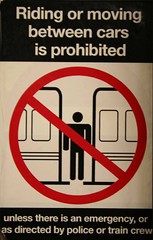
 I’ll let you decide if this one belongs in the “New York politicians will complain about anything” category, but listen: Even though it’s illegal to move between subway cars, one New York City Council member is calling upon the MTA to unlock the end doors on all subway cars. After fielding complaints from constituents supposedly trapped in subway cars as fights between teenagers broke out, Letitia James has put forth a resolution demanding the MTA unlock the doors on all 75-foot train cars. “They had nowhere to escape,” James said of her fearful constituents. “Riders need a place to run to safety, and right now there’s no way to do that.”
James’ legislation, numbered Res 0582-2010, has the support of five other council members and reads without much force behind it and seems to rely on circular logic. It reads, in part:
Whereas, The Metropolitan Transportation Authority (MTA) enacted a rule in 2005, which states that “No person may use the end doors of a subway car to pass from one subway car to another except in an emergency or when directed to do so by an Authority conductor or a New York City police officer;” and
Whereas, This rule was enacted in order to ensure the safety of subway riders, especially during a time when the threat of terrorism has significantly heightened; andWhereas, The MTA also claims that these doors are locked to prevent passenger injuries or fatalities as a result of falling between subway cars, however, passenger injuries or fatalities are extremely rare according to the New York Times; and
Whereas, The MTA New York City Transit website states that most subway accidents result from slips, trips, and falls on stairways when someone is in a rush; and
Whereas, Although the MTA made the decision to lock the end doors of a subway car for the purpose of protecting the public, locking these doors might serve as a detriment to public safety because passengers would not be able to escape in the event of an emergency or any other potentially dangerous situation in which one’s safety might be threatened, especially during non-rush hours; and
Whereas, Passengers, particularly women, fear being trapped in a locked car with a suspicious individual that may pose a threat to them; and
Whereas, When passengers believe that they are left with no option other than to ride a train and wait for it arrive at the next station stop before they can exit a car in which they feel vulnerable, the policy of locking the end doors of a subway car should be reconsidered.
Ultimately, the City Council, if it approves this bill, would “call upon” the MTA to unlock the doors because they find it “imperative” for the authority to do so in the name of safety.
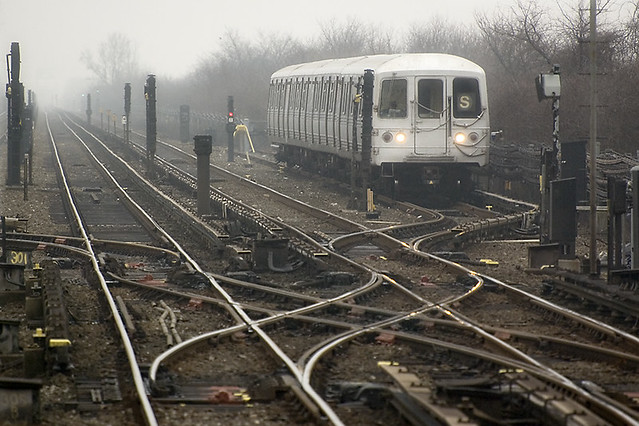
In a short statement to The Post, Transit spokesman Charles Seaton defended locking the doors. “When these trains negotiate curves or travel over switches, large gaps are created between the cars’ end, creating an extremely hazardous situation,” he said. It is, essentially, safety on one end vs. safety on the other, and it strikes me here that James is overreacting to one concern without heeding the other.


 (Rockaway Park Shuttle)