Archive for December, 2010

After months of public posturing and closed-door negotiations with Nassau County, the MTA Board voted this morning to cut all subsidies for the Long Island Bus. As the battle over funding has dragged on through the fall, the vote was not a surprise, and negotiations will continue into the spring. For now, Nassau County riders won’t be left without buses as the MTA must give 60 days’ notice before suspending service, but the urgency to find a solution to the funding woes is very much there.

Essentially, the debate is one of dollars. The bus system costs over $130 million to operate, and while the state picks up $45 million in costs, the county pays just $9 million. The MTA pays the rest even though Nassau County originally agreed in the 1970s to foot the bill. “I think Nassau County has an obligation to fund bus service in Nassau County, just as every other suburban county has an obligation,” MTA CEO and Chair Jay Walder said after the vote today.

Eventually, I expect the county and authority to reach a funding agreement that will gradually phase out MTA contributions while Nassau County increases theirs. Still, Nassau County is moving forward with a request for proposals should they need to privatize the system, and advocates are awaiting the resolution of this political drama with bated breath. “We’re disappointed,” TSTC’s Ryan Lynch said to Newsday. “They’re negotiating, so we have some hope.”

Categories : Asides, Buses
Comments (5)

The deep-cavern ARC terminal was one of many project flaws. (Click to enlarge)

Now that New Jersey Gov. Chris Christie has hired the high-powered Patton Boggs law firm (at a rate of $485 an hour, no less) to fight the federal government’s request for the return of the ARC money, the leaks are coming out about what the state knew and when it knew it. The Associated Press reported earlier this week that Christie was well aware he’d have to return the money if the project went forward. Essentially, it was written into the contract between the feds and the state.

As I mentioned in a comment a few weeks ago, the Early System Work Agreement requires a refund. It reads, “If an applicant does not carry out the project for reasons within the control of the applicant, the applicant shall repay all government payments made under the work agreement plus reasonable interest and penalty charges the Secretary establishes in the agreement.”

FTA officials have reiterated this stance in various statements to the press.”Gov. Christie’s decision to renege on that contract and abandon the project is what now requires us to insist on the return of federal funds expended under the ESWA,” FTA Administrator Peter Rogoff said. This is codified at law as 49 U.S.C. § 5309(g)(3)(B)(iv).

Christie, meanwhile, continues to dispute this claim and alleges that the federal government is only selectively enforcing the refund provision. “We don’t think we have to pay any of that money back because, in fact, the Obama administration and previous administrations have selectively enforced when they asked for the money back,” the governor said last week. “And I’m not going to allow them to say, ‘Hey, New Jersey has a Republican governor, so we’ll get the money back from them, so states where we have Democratic governors, we don’t ask for the money back.”

As the AP noted, though, the Rochester project which Christie has cited more than once relied on a different funding mechanism. New Jersey pushed for an Early System Work Agreement in January, and it’s going to have to live with that choice even if it means refunding the feds a few hundred million. That’s just contract law.

Meanwhile, New Jersey does have some flexibility with regards to its own ARC dollars. To that end, New Jersey Transit is seeking to reallocate $75 million in ARC money to go toward new rolling stock. The agency has asked the North Jersey Transportation Planning Authority for permission to purchase 100 additional bi-level cars as it engages in system-wide upgrades. That move should be met with far less resistance.

Categories : ARC Tunnel
Comments (19)

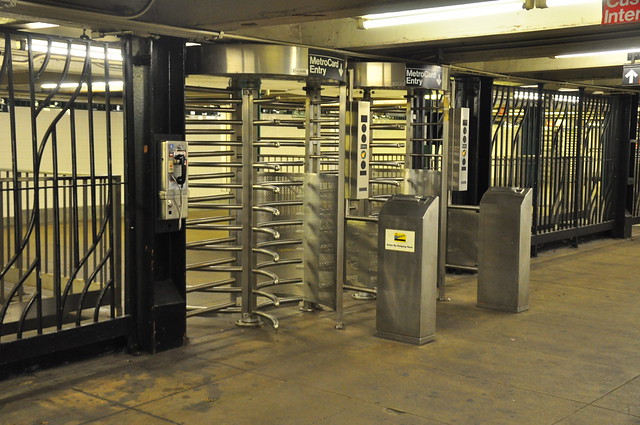
High Exit Entrance Turnstiles can prove daunting for the uninitiated. (Photo by flickr user Triborough)

As unstaffed station entrances proliferate across the subway system, the 21st century version of the MTA’s iron maiden turnstiles have become the norm around the city. These high entrance/exit turnstiles significantly slow down loading and unloading times at fare control areas, but they effectively combat turnstile jumpers in areas where station agents once roamed. They can, however, prove tricky.

It’s probably happens more often than anyone — not the MTA, not the so-called victims — want to admit, but the HEETs are designed such that it’s very very easy to get it wrong. Swipe a MetroCard, enter into the part at right that’s already begun is whirl around the turnstile. Those who swipe and push the gate that’s sticking out will find themselves stuck on the wrong side of the fare gate with less money — or an 18-minute freeze-out period — on their MetroCards. Consider it a New York subway initiation.

In his column in the Daily News on Monday, Pete Donohue tackles the prickly subject of the HEETs. This subway faux pas, he says, happens very frequently, and among transit workers, the HEETs have earned themselves the reputation of a fare thief. “These are the biggest robbers down here,” one worker said.

Donohue tracked down workers willing to talk, off the record, of the woes they see when it comes to the HEETs. “It happens all the time,” a turnstile repairman said to the News. “Most of the time it’s tourists, but sometimes it even happens to people who live here. Nobody knows. There’s no signs or information.”

Tourists from London where turnstiles rely on the tried-and-true tap-and-go system fall for it; natives from Westchester fall for it; even everyday businessmen in a hurry sometimes take a wrong first step. “If you don’t know what you’re doing,” one suburban visitor said, “you’re going to get screwed.”

For now, the HEETs will continue to pop up across the system. The MTA plans to pay $2.3 million to install 41 more of these turnstiles around the city, and as they can be reprogrammed to take a contactless card, they should survive the death of the MetroCard too.

But the HEETs are a problem. They’re clunky and slow. It takes a decent amount of force to push the door open and an equally strong effort to exit through it. Lines form at stations — the 7th Ave. exit at the 7th Ave. stop on the IND Culver line, for instance — as exiting passengers wait for the door to swing by. It might stop a few fare beaters, but it also stops harried and hurried New Yorkers.

The HEETs, though, aren’t going anywhere as long as station agents continue to disappear, and yet, the fix for them is so simple. If the MTA were to place floor decals with arrows leading into the HEET or a small sign at eye level on the MetroCard reader display, straphangers would find the iron maiden less daunting, and fares would cease to disappear. A small act of customer service can go a long way toward making the system more user-friendly for everyone.

Comments (19)

Back in May, at a talk with reporters, MTA CEO and Chairman Jay Walder talked, as he often does, about his experiences in London. To accomplish work efficiently, Transport for London often shuts down service across entire lines for much of a weekend, and the MTA has been debating doing that here. Walder mentioned it to me again during my interview with him, and at yesterday’s Transit Committee meeting, NYCT head Tom Prendergast broached the subject as well.

The MTA, it seems, may be revamping the way they approach weekend work. “Maybe for some of the more difficult tests, that take a long time to set up, pick one Saturday a month and do it at night, starting after five or six o’clock at night, look at things like that,” Prendergast said.

On the one hand, this will inconvenience thousands of subway riders, but on the other hand, weekend service changes already do that. If the MTA can minimize the frequency of the changes, blitzing a line could pay off in the long run. Meanwhile, in response to the findings that crews falsified signal inspections, Transit may need to increase the time and manpower required to conduct a thorough review of the system’s numerous signals. Weekend work and changes just make get worse before it gets better.

Comments (28)

The MTA can get plenty of satisfaction, according to internal polling. (Source)

Let’s try this one for size: The MTA yesterday released the results of its first-ever agency-wide standardized customer satisfaction survey, and while New Yorkers seem to make a sport out of hating the MTA, most riders seem to be satisfied with the state of their subway and mass transit survey. The results seem to belie reality on the ground, but when faced with a choice, New Yorkers may recognize the limitations of a vast system and their intractable demands.

The MTA didn’t share too much about methodology, but the authority says this survey represents the first time such statistics have been compiled “across the MTA family.” Customers were asked to rate the quality of service; MTA employees; on-board conditions such as lighting and comfort; information and communication; convenience, safety and security; home stations; and overall satisfaction. The commuter rail roads were deemed exemplary as as 93 percent of respondents say they are satisfied or very satisfied with Metro-North and 89 percent say the same of Long Island Rail Road. Overall, 18,000 people responded to the survey, and the results have margins of errors ranging from 1 to 4 percent.

Let’s drill down on the Transit results. The various presentations are all available right here. Initially, we see that the MTA used a 10-point sliding scale but grouped responses into four categories. Those who ranked services at 1 or 2 are considered very dissatisfied; 3-5 are simply dissatisfied; 6-8 means satisfied; and 9 or 10 lead to very satisfied customers. The presentation of the results, in other words, simplifies the scale.

Immediately, we see that 95 percent of riders are either satisfied or very satisfied with the countdown clocks. It’s hard to imagine anyone being dissatisfied with the efforts to bring real-time information underground, but I guess five percent of people prefer the time-tested method of peering wistfully into an empty tunnel.

On an overall basis, 71 percent of riders were satisfied with subway service, and 77 percent were satisfied with the line they use most often. That result seems to bolster the theory I set forth yesterday: Straphangers grow attached to their favorite train lines. In terms of service quality, 83 percent of people were satisfied with subway travel times while only 65 percent were satisfied with wait times. The MTA expects that real-time train arrival information will boost that figure, but I believe that until riders never have to wait for trains, they won’t be fully satisfied with service.

Next, we examine the information and communication totals. Clearly, riders enjoy having more info at their fingertips, but we start to see some sample size and selection bias concerns. Only 103 subscribers responded to the survey over email alerts, and these were, by and large, the satisfied customers. The placement of maps in the system, always a hot topic, drew some criticism.

The authority didn’t score too highly when it came to non-automated sources of information though. Only 69 percent of riders rated notices of service changes at least a six on the MTA’s scale, and only 56 said on-board announcements were clear. Only 62 percent found the availability of pocket maps satisfactory. While the MTA’s system is more complex than, say, London’s, the lack of a small pocket map is noticeable.

By and large, customers are happy with the rolling stock, and since so much of it is new, they ought to be. Where the authority is lagging though is in the cleanliness department. Only 68 percent were satisfied with car cleanliness, and just 64 percent say the stations are clean enough. That latter total seems far too high to me.

Interestingly, after nearly a year of debate over the role of station agents, straphangers didn’t say the subways seemed unsafe. Concerns were most pronounced after dark though as 80 percent say they feel personally secure before 8 p.m. but only 60 percent feel the same after 8 p.m. I’ll withhold judgment until we have another year’s worth of data to assess, but I can’t imagine those figures moving too far in either direction.

Even as we might cast a skeptical eye toward it, MTA officials were quick to promote the good news in this data dump. “This has obviously been an extremely tough year for our transit system and for our customers, but the survey results show that our customers appreciate the improvements we have been able to put into place, like countdown clocks,” MTA Chairman and CEO Jay Walder said. “This survey demonstrates the importance of improving service where we can in cost-effective ways.”

I found the most amusing part to be the customer suggestions though. Riders want more predictable travel times, cleaner stations and more real-time information. They also want shorter wait times, fewer delays, less crowding during rush hour and the Easter Bunny to arrive. What they don’t want to do is pay for it, and therein lies the great contradiction. Whether these numbers accurately reflect a generally acceptable level of satisfaction with the subways or whether the MTA is simply patting itself on the bank in a time of bad news matters little without the funds.

Categories : MTA
Comments (47)

Nearly two years ago, Edwin Thomas, a bus driver along the B46, was stabbed to death by a passenger who refused to pay his fare. It took over a year for the MTA to being a driver partition pilot program, and the unions have been pushing the MTA to improve bus driver safety in the interim. Today, we learn that the MTA will expand the number of bus equipped with surveillance cameras.

Beginning in the spring, Transit will begin to install cameras in 400 Manhattan buses, and by early 2012, the system should be up and running. According to the authority, “video surveillance is viewed as a vital element of [its] ongoing effort to maintain a safeand secure transit network for customers and employees.” They system, which will cost $9.75 million or $17,900 per bus, has been created by UTC to serve as a “visible crime deterrent.” It will assist law enforcement efforts and aid in the prosecution of criminal activity aboard buses.

The system carries a relatively high price tag because of its complexity. The system will include “multiple interior cameras and DVR functionality.” The images will be transmitted the the nine bus depots around the city where equipment can analyze the images and perform diagnostic checks. The authority tried to implement a similar system four years go but the contractor went out of business.

“Throughout the country video surveillance has clearly been shown to deter criminal activity on transit vehicles, and we also believe that it will be extremely valuable in investigating accident injury claims,” NYC Transit President Thomas F. Prendergast said. “This type of system will go along way towards ensuring the security of out customers and employees.”

Union leaders praised the move. “Our bus operators are assaulted three, four times a week across the city. I think cameras are a deterrent,” TWU head John Samuelsen said. He also requested that the city “beef up the police presence on buses.”

If this initial trial is successful, the MTA can exercise an option in the control for another 1150 cameras. Those would be installed in “high-crime routes” in the outer boroughs.

Categories : Buses
Comments (1)

Since 2008, the MTA had plans in the works to add tolls to the Tompkinsville stop along the Staten Island Rail Road. They move, they said, would generate $700,000 annually and cut into the SIR’s $3.4 million operating loss. That fare collection started in January, and it has so far been a guarded success.

In documents released this weekend, New York City Transit reported that ridership at Tompkinsville had totalled 204,000 paying customers between January 20 and the end of October with a low fare evasion rate of just 0.59 percent. Overall, SIR revenue is up only 6.1 percent over the same period last year, and the MTA attributes this lower-than-expected total to the weak economy and some higher labor expenses. The authority is still considering a plan to institute fares along the entire length of the SIR.

Categories : Asides, Staten Island
Comments (8)

As Phase 1 of the Second Ave. Subway inches toward the finish line, the date for revenue service remains, according to the latest MTA documents, December 2016. We’ll witness at least two more Presidential elections before the trains roll past 63rd St. and Lexington and up Second Ave. Yet, the one question I most often field from readers concerns the identity of the Second Ave. Subway. Now that the Q heads to Astoria and doesn’t terminate at 57th St., will the MTA reroute it to serve as the Second Ave. Subway or will they revive another letter — perhaps the W — to signify and celebrate the new service?

For now, my general answer is “don’t worry about it.” So much can happen in six years that it’s not worth pondering the potential fate of the Astoria-bound Q train. Maybe the MTA will revive the W. Maybe the MTA will reshuffle service into and out of Astoria to ensure that the Q runs from Second Ave. and East 96th St. to Coney Island. Maybe some other Broadway-based service pattern will emerge. Today, that’s the least of the authority’s concerns.

Yet, these questions make me think there’s something more to the train line than just a decal letter on a subway stop and a colored line on a map. As we ride, we form connections with train lines for better or worse. For my entire life, I’ve lived near the West Side IRT trains. Growing up, my local station was the 96th St. on the 1/2/3, and today, I’m just a stone’s throw away from Grand Army plaza — where a green interloper in the shape of a 4 takes up precious real estate on the station entrance sign.

At Grand Army Plaza, a Crown Heights-bound 3 train zooms away. (Photo by Benjamin Kabak)

I’ve always considered the 2 to be my favorite train. When I was growing up, the old redbirds that used to roll along the 2 captured my attention. As a kid waiting to go to Yankee Stadium from the Upper West Side, I would peer into the tunnel hoping to catch a glimpse of the headlights on the 2 — but not the bullet signs on the 3 — so we could be on our way north.

Today, the rolling stock for the 2 consists of the not-so-new R142s, and those are distinctive for the bright red beacon at the top. Generally, the cars are well lit and well air conditioned. They don’t have those too-narrow bucket seats that make you feel as though you’ve encroached far beyond the limits of your neighbor’s personal space, and that express ride up the West Side from Chambers to 96th is among the fatest in the system.

Growing up, I was always skeptical of those other trains. The lines along Central Park West were the far-off ones that we never rode, and the stations nearest us — 86th St., 96th St. — were empty local stops. Other trains — the mysterious F, the J/M/Z, the East Side’s 4/5/6 — were other people’s trains. They weren’t mine. What did I care what happened to them?

Well, 22 years ago this past weekend, something big happened to them for on December 11, 1988. I didn’t know it at the time but for millions of riders who weren’t me, the subways shifted. Trains that used to go over the Manhattan Bridge didn’t; trains that used to run to one part of Queens were re-routed to others. The K train disappeared completely, and a new Z train materialized.

The August 1994 subway map reveals service patterns lost to the sands of time.

Over the next 16 years, straphangers would find their favorite — or just their most convenient — routes changed. In fact, in 2004, Brooklynites long used to the Brighton Beach-bound D trains were in for a shock. The D — which had run down the Brighton Line for nearly 40 years — had become the B, and the B had become the D. Overnight, everything changed, and a Beastie Boys reference had become anachronistic with the stroke of a pen. That’s how fleeting subway routing can be.

New York City subway riders tend to view the map as immovable. It has always looked as it does today, and service patterns have always been what they are today. Does anyone remember the V train? Does anyone remember life before the 6th Ave. M? And where did that W train go anyway? The trains come and go. We form bonds; they become preferred and then favorites; and then we forget about them when they’re gone.

One day later this decade, if all goes according to plan, Astorians will see their service patterns shifted again. The Q will go up Second Ave., and it will become the favorite line of a young Upper East Sider. He or she will never know what life is like without the Second Ave. Subway because it will have always been there, a gleaming beacon of permanent change in a system that shifts whether we notice it or not.

Comments (26)

When the Nets new arena opens at the Atlantic Yards complex in a few years, it will bring with it traffic to a few of Brooklyn’s quieter residential neighborhoods. With Park Slope to the south, Prospect Heights to the east and Fort Greene to the north, the area doesn’t lend itself to the multitude of cars that will throng its streets on game days. Unfortunately, despite sitting atop one of the city’s busiest subway hubs and a Long Island Rail Road, the project will come with more parking than we’d like. To encourage mass transit use then, one advocate has proposed an idea for the masses: free beer.

At a Prospect Heights Neighborhood Development Council meeting held last week to attack the traffic problem, Ryan Lynch of the Tri-State Transportation Campaign called upon Forest City Ratner to subsidize a free beer for those who take the train to the game. “Give people a free beer. They’re not driving,” Lynch said. “There needs to be more incentives from the developer and events promoters to encourage event-goers to get on mass transit. You could show your Metrocard or LIRR ticket and get a discount at the concession stand.”

A spokesman for the developers issued a very spokesman-y statement. “We’re working on a fully integrated transportation plan that will look at a variety of ways of using mass transit instead of driving to the arena on game nights or event nights,” Joe DePlasco said. Ultimately, though, the Nets and Forest City Ratner should figure out a way to encourage transit use. Whether that includes supporting a residential parking permit program for the neighborhood’s streets or offering MetroCard- and LIRR-based discounts, driving to this arena should be discouraged. I’d drink to that.

Categories : Asides, Brooklyn
Comments (11)

These new signs will begin appearing in subway cars everywhere this weekend.

On my way to the Jay St.-MetroTech ribbon-cutting yesterday, I hopped on a Manhattan-bound 3 train at Grand Army Plaza and found myself in a car surrounded by unfamiliar placards. Instead of the regular SubTalk signs discussing various goings-on at the MTA, I was face-to-face with this sign. Identical to the example atop this post, it said “Improving, Non-Stop” and was clearly a redesign of the MTA’s house ads.

When I arrived at Jay St., I had a chance to quiz Jay Walder and Paul Fleuranges, the MTA’s Senior Director of Corporate and Internal Communications, on the changes. The new signs have been designed to explain a mix of messages to riders with a focus on highlighting, as Walder said, “things we’ve done this year and improvements we’ve made.”

Graphically, the signs are meant to be simpler than the old SubTalk signs. The top is calmer, with more white space, while the MTA bullet, minimized on the old version, has been restored to a primary spot at the top. The website address is added subtly below the bullet. For the ribbon across the bottom, the new signs borrow the strip map stylings that are prominent on the cover of the new subway map.

Fleuranges and I spoke about what will be on the signs. Some of them — such as the one above which you can click to enlarge — feature general messages about the need to improve the system. Another thanks the MTA’s employees for their hard work. Others focus on bus lanes, the changes made to Select Bus Service and the arrival of the countdown clocks throughout the subway system. Fleuranges said that Transit is unveiling nine or ten new signs this weekend with more to come over the next couple of months.

The long-running SubTalk ads debuted in 1993 and were often in the news. For years, the rotating ads included a popular series called Poetry in Motion, but that was canceled and replaced with the Train of Thought ads in mid-2008. According to Fleuranges, SubTalk hasn’t been officially canceled; for now it’s “on haitus.” The Train of Thought ads though are “on the way out.”

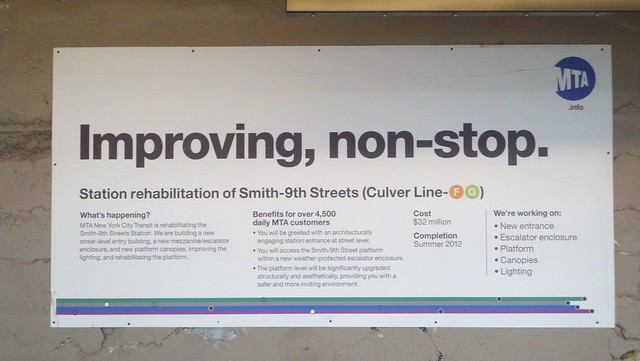
In addition to spots in subway cars, the “Improving Non-Stop” ads will pop up at construction sites as well. On the way back to Park Slope from Downtown Brooklyn, I spotted one at Smith-9th Sts. It looks a little something like this:

The Improving Non-Stop signs inform customers of big-ticket construction projects. (Photo by Benjamin Kabak. Click to enlarge)

The idea here is to present riders with the same look and same type of messaging as the in-car ads features. After nearly two decades, it was time for a rebranding.

Comments (13)
  • Extended Stay

    Featuring a wide range of sophisticated furnished apartments throughout the city and surrounding areas, ExecuStay can help you enjoy a New York extended stay that's both productive and relaxing.

  • Corporate Apartments

    As a resident of ExecuStay New York corporate apartments, you'll find that getting around is a snap, thanks to the many MTA subway lines, buses and yellow cabs.