Archive for February, 2011

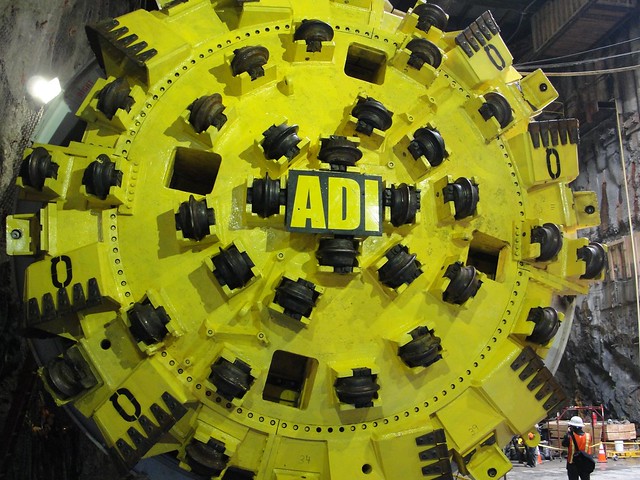
ADI, the tunnel-boring machine hard at work digging out the Second Ave. Subway, is just 82 feet away from completing the western tunnel, the MTA announced late on Friday. Once it reaches its end point, crews will disassemble the 485-ton, 450-foot long machine, pull it back to 92nd St. and begin its run through the eastern tunnel. The authority says that Phase 1 of the Second Ave. Subway remains on pace for a December 2016 opening date.

While this is but a small milestone on the path toward SAS completion, it’s a key one. The MTA now has one full-length tunnel from 96th St. to 63rd St. Barring an unforeseen happening, the city will finally, after what will be nearly 90 years, get part of a Second Ave. Subway later in the decade. For more, check out this brief release from the MTA.

Photo of the TBM awaiting launch by Benjamin Kabak.
Comments (41)

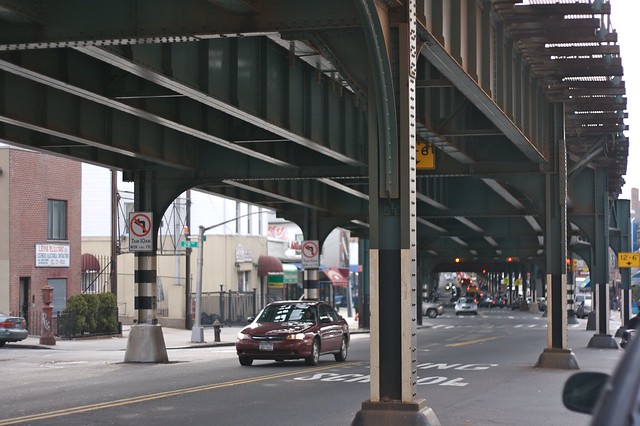
A glimpse underneath the elevated tracks in Astoria. Repair work will change service patterns along the N and Q. (Photo by flickr user Marcin Wichary)

For residents of Astoria, the MTA dropped a Friday surprise. For a series of weekends through 2011, rail replacement and structural work on the elevated tracks in Queens will force service changes on the N and Q. Here’s the announcement:

MTA NYC Transit announces two major projects slated for Astoria in 2011 that will affect several weekend and some weekday schedules during off-peak hours. The first project is track panel installation at 36th Avenue. This work is scheduled for the following weekends: February 12-13, 19-20, 26-27, March 5-6, 12-13, August 13-14, 20-21, 27-28, September 3-4, 10-11, 17-18 and 24-25. On these weekends, the Manhattan-bound N train will operate as an express from Astoria Boulevard to Queensboro Plaza bypassing 30th Avenue, Broadway, 36th Avenue and 39th Avenue from 4 a.m. Saturday to 10 p.m. Sunday. The work entails the replacement of thirty-nine-foot sections of elevated track including ties, running rails, third rail and walkways – all part of NYCT’s In-house Capital Construction Program.

Work will also go on during the week on Wednesdays, Thursdays and Fridays from 10 a.m. to 3 p.m. from February 2 to March 18. On those weekdays, Manhattan-bound N trains will run express from Astoria Boulevard to Queensboro Plaza and Q trains will terminate at 57th Street-7th Avenue. Manhattan-bound customers should plan for additional travel time as these service changes may add up to 15 minutes to their trip. Customers at the bypassed stations may backride to Astoria Boulevard for Manhattan-bound service or consider taking the R at Steinway or 36th Streets, the F at 21st Street-Queensbridge or walking to Queensboro Plaza.

The second project is structure painting from 40th Avenue to the 60th Street Tunnel portal west of 21st Street which is planned for some weekends in May, June, July and one weekend in October to be announced at a later date. The work will run through the entire weekend from 12:01 a.m. Saturday to 5 a.m. Monday.

Finally, during one minor project, on the weekend of March 19-21, there is no N service between Queensboro Plaza and Times Square. Customers must use the 7 line for service into and out of Manhattan. This is due to track maintenance work at 57th Street and in the 60th Street tube.

Of course, politicians are already bemoaning the changes. A few have claimed that recent snow efforts warrant shuttle service when these changes go into effect, and others seem to blame the high fares for the need to perform structural work on aging infrastructure. Such are the way of things.

Anyway, the regular service advisories are below. These come to me from New York City Transit and are subject to change without notice. Please check the signs at your local station and listen to on-board announcements. Subway Weekender has the map.


From 11 p.m. Friday, February 4 to 5 a.m. Monday, February 7, uptown 1 trains skip 50th Street, 59th Street-Columbus Circle and 66th Street due to switch renewal north of Times Square. Customers traveling to these stations may take the 1 or 2 train to 72nd Street and transfer to a downtown 1. Customers at these stations traveling uptown may take a downtown 1 or 2 train to Times Square-42nd Street and transfer to an uptown 1 or 2.


During the weekend overnight hours from 11 p.m. to 6:30 a.m. (5 a.m. on Monday), 2 trains skip 50th Street, 59th Street-Columbus Circle and 66th Street due to switch renewal north of Times Square. Customers traveling to these stations may take the 1 or 2 train to 72nd Street and transfer to a downtown 1. Customers at these stations traveling uptown may take a downtown 1 or 2 train to Times Square-42nd Street and transfer to an uptown 1 or 2.


From 12:01 a.m. Saturday, February 5 to 5 a.m. Monday, February 7, Manhattan-bound 2 trains skip Eastern Parkway, Grand Army Plaza and Bergen Street due to track work at Grand Army Plaza. Customers traveling to these stations may take a Manhattan-bound 2 to Atlantic Avenue and transfer to a Brooklyn-bound 2.


From 6:30 a.m. to midnight, Saturday, February 5 and Sunday, February 6, Manhattan-bound 3 trains skip Eastern Parkway, Grand Army Plaza and Bergen Street due to track work at Grand Army Plaza.


During the weekend overnight hours, (12:01 a.m. to 5 a.m.), uptown 4 trains skip Canal, Spring, Bleecker Streets and Astor Place due to work on the Broadway/Lafayette-to-Bleecker Street transfer connection.


During the weekend overnight hours (12:01 a.m. to 5 a.m.), Manhattan-bound 4 trains skip Eastern Parkway, Grand Army Plaza and Bergen Street due to track work at Grand Army Plaza.


From 5:30 a.m. to 11:30 p.m., Saturday, February 5 and from 7:30 a.m. to 11:30 p.m., Sunday, February 6, 5 trains run every 20 minutes between Dyre Avenue and Bowling Green due to work on the Broadway/Lafayette-to-Bleecker Street transfer connection.


From 12:01 a.m. Saturday. February 5 to 5 a.m. Monday, February 7, uptown 6 trains skip Canal , Spring, Bleecker Streets and Astor Place due to work on the Broadway/Lafayette-to-Bleecker Street transfer connection.


From 11 p.m. Friday, February 4 to 5 a.m. Monday, February 7, D trains run local on the R line between DeKalb Avenue and 59th Street in Brooklyn due to track work (concrete pour) south of DeKalb Avenue.


From 12:01 a.m. Saturday, February 5 to 5 a.m. Monday, February 7, E trains run on the F line between Roosevelt Avenue and West 4th Street due to work on the 5th Avenue Interlocking Signal System. The platforms at 5th Avenue-53rd Street, Lexington Avenue-53rd Street and 23rd Street-Ely Avenue are closed. Customers may take the R, G or shuttle bus. Free shuttle buses connect Court Square (G)/23rd Street-Ely Avenue (E), Queens Plaza (R) and the 21st Street-Queensbridge (F) stations.


From 11 p.m. Friday, February 4 to 5 a.m. Monday, February 7, N trains run local on the R line between DeKalb Avenue and 59th Street in Brooklyn due to track work (concrete pour) south of DeKalb Avenue.

Categories : Service Advisories
Comments (8)

An Ave. A entrance to the L's 1st Ave. stop would be a boon for Alphabet City.

As subway expansion plans and a city-subsidized ferry service have made headlines lately, the L train has come under consideration from some of my readers. I recently did some sleuthing on the potential for expansion within Manhattan and can now answer the question of why. Why doesn’t the L stop at Ave. C? Why is there no Ave. A entrance?

The 14th St. route into Williamsburg and beyond has seen tremendous growth over the last 15 years, but its limitations, especially in Manhattan, are obvious. It stops every two avenues until First Ave. and then not again until Bedford Ave., leaving the eastern part of the island without easy subway access. From a planning perspective, an entrance at Ave. A would alleviate pressure at First Ave. and bring the subway one very long avenue block closer to Alphabet City. At stop at Ave. C would be even better.

I had a chance to query Transit on these concerns this week and wanted to share the results. At Ave. C, as many expected, the engineering demands and issues with the city’s water table make a stop there too difficult to maintain. In an email, a Transit spokesman said he consulted with the operations planning team, and they explained the issues. “After the L train leaves 1st Ave., it begins to descend and the slope is too great to place a station (and reliably stop trains),” he said. “Excavating the station and smoothing out the tunnel would be extraordinarily challenging because the ground at that particular location is all filled in swamp. We would likely have to close the L completely for years during construction.”

The entrance at Ave. A however has suffered from another fate entirely. Transit tells me this is both a feasible and beneficial idea. In fact, it has been “conceptually sketched out” but it has “never made the capital program.” I don’t have any further explanation as to why it has been omitted from expansion plans, but I can guess that it’s not been a long-term priority. Up until quite recently, population growth in that area and L train ridership would not have warranted an entrance at Ave. A.

As they say, knowing is half the battle, and now we know. Of course, armed with this knowledge, community groups in the East Village, Alphabet City and Stuyvesant Town should began agitating for a concrete commitment to build out the entrance at Ave. A. It’s a project worth pitching for the five-year capital plan that starts in 2015, and it’s one that could be realized by the end of the decade.

Categories : Manhattan
Comments (19)

The Bloomberg Administration has asked Parsons Brinckerhoff to conduct an engineering and cost study as it pushes forward with a plan to explore extending the 7 line to Secaucus, the Daily News reported this morning. The engineering firm will conduct a study that explores how many people would use a subway to New Jersey and how much a potential extension might cost. Parsons Brinckerhoff earned the no-bid $250,000 contract due to its previous work on the ARC Tunnel, the current 7 extension and the Secaucus Junction train station, and its report is due in three months.

Still, even as the city pushes forward with this plan Bloomberg first floated in November, it is facing a certain level of skepticism from its potential partners. As a source said to the News, “City Hall really does want to explore it. “They have an incredibly reluctant MTA partner, and an incredibly wary New Jersey state government. Jay Walder doesn’t have enough money to finish what they’re already doing.”

The city hopes that PB will come back with a price tag in the $5 billion range. At that point, it will begin to pressure the MTA and New Jersey to sign on for this ambitious expansion of the subway system across the Hudson River and state borders. I’d rather see the money go toward furthering the Second Ave. Subway, but we can’t ignore the cross-Hudson congestion forever.

Categories : 7 Line Extension, Asides
Comments (38)

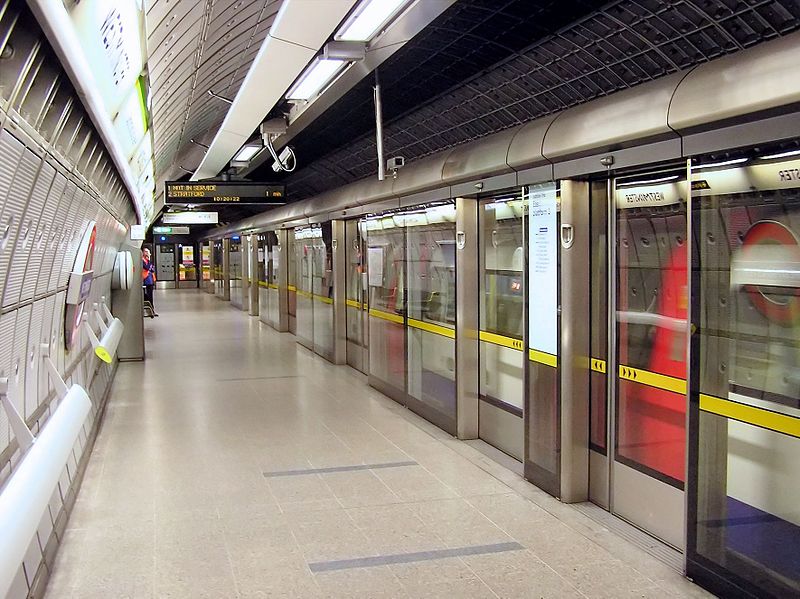
Platform screen doors aren't as crazy an idea as politicians and newspaper columnists think.

When the Daily News got wind of the MTA’s Request for Information concerning the possibility of installing glass doors on subway platforms, it seemed like a harmless news story. The authority wasn’t planning on committing resources to the project any time soon, and the RFI, generally the first stage in a long procurement process, made it clear that the MTA wanted any potential contractor to install the doors at as little cost as possible to the authority. The reaction though has been stupefyingly loud.

The first person to sound off on the idea was State Senator Diane Savino, and she was unamused. Noting that only .00005 percent of subway riders wind up on the tracks, she criticized the MTA for even thinking about it. Transportation Nation excerpted her statement:

“Much to my surprise the MTA found the notion intriguing. To even contemplate this nonsense is self-evidently a waste of time, effort, energy and yes – money; money the MTA does not have. The cost to install the barriers would be astronomical. The cost to maintain the doors in good operating condition would be even higher,” Savino said.

“Last year eight express bus and eight local bus routes where eliminated or reduced from my district along with the M train downtown extension into Bensonhurst and Dyker Heights, restoration of those routes should be the first discussion instead of spending additional monies on some harebrained notion like this,”

How dare the MTA try to solicit ideas for better service! It’s as though Savino isn’t trying. She clearly didn’t read the Request for Information because had she done so, she would have seen the authority’s intent to spend few dollars on this program.

Savino also doesn’t seem to understand the difference between the MTA’s operating budget and capital budget. The two are funded separately, and money from one cannot be easily shifted from the other. Still, she harps on last year’s operating cuts. “Life is precious and track fires are dangerous,” she said, “but the risks of both are far too minuscule to justify all the expense and effort — especially when most South Brooklynites and Islanders have had their modes of commuting eliminated under auspices of fiscal restraint.”

Of course, what Savino fails to mention is her own role in the cuts. She is leading a splinter group of Senate Democrats who support repealing the payroll tax, and she has consistently voted against congestion pricing measures. She did vote for the measure that robbed $143 million of allegedly dedicated funds from the MTA before saying that she never bothered to read the bill. She has also supported an unnecessary and costly no-layoffs bill. In other words, if the easy political points are there for the grabbing, she’s happy to take them.

But Savino isn’t the only one sounding off. The Daily News’ own editorial page yesterday featured two columns on it, and neither of them were written to sound as though the authors had read the paper’s own news coverage. First, we have an unsigned editorial calling the MTA “crazy” for even considering an “overblown plan” to build doors on the platform. I wonder how many times the Daily News has called someone crazy for asking for information or conducting a due diligence examination.

The editorial, clearly written at the urging of Savino, hits upon the same points she used in her letter to MTA Chair and CEO Jay Walder and even used most of the same language:

Some brainiacs have come up with the idea of erecting barriers along the edges of subway platforms to keep people from falling over. Said barriers would be equipped with sliding portals that would open and close in unison with subway doors,

Stop laughing. We’re not kidding. No, sir. We know this is no joke because the Metropolitan Transportation Authority found the notion intriguing enough to ask other brainiacs to submit even better proposals for adding a touch of Disney World to New York’s underground lair.

Merely to contemplate this nonsense is self-evidently a waste of time and money. The cost to install the barriers would be astronomical. The cost to maintain the doors in good operating condition would be even higher.

The Daily News editorial staff, experts in construction and maintenance costs of underground technological projects has deemed just thinking about it a “self-evident” waste of time and money. If they’re just going to serve as Diane Savino’s uncritical lapdogs, maybe we should appoint them to the MTA Board to see how they run things.

Finally, Joanna Molloy, who has an opinion about everything but seems to know little, sounds off on the project. While noting that CEMUSA paid $1.4 billion to install thousands of bus shelters throughout the city, she scoffs at the idea that the MTA could get the doors built for little or no cost seemingly without offering a reason why. But her crowning moment comes in the condemnation of the plan itself. She doesn’t want it because it’s not gritty enough for her. The logic is dumbfounding.

Sure, you can argue that the sleek, modern doors, which have worked so beautifully along the AirTrain, will save a few dozen lives – and spare the city from some pricey lawsuits. But we’re New Yorkers – we’re tough, and we like grunge and noise. It may be fine for San Francisco, where BART travelers politely form perpendicular lines at the exact spot at which they know the train door will stop. It’s just not us.

New Yorkers have true grit, and nothing gives grittier grit than the subway. We like to brag about the horrors we’ve seen down there. I once saw a 14-inch-long rat munch the last dregs of a hot dog on the tracks of Union Square station. Top that.

Got that? We don’t want clean subway systems that aren’t sweltering saunas in the subway because we’re New Yorkers and we like living and commuting in our own filth. Let’s not try to improve the system or enjoy pleasant commutes because then we wouldn’t be tough. We, like Jeff Bridges in the Coen Brothers’ latest, have true grit. On what planet does Joanna Molloy live anyway?

Now, I don’t know what the future will hold for the MTA’s idea to install doors on some or all of its platforms. In an early incarnation, the new Second Ave. Subway stops were to have these doors, but the authority won’t release SAS station specs for a little while yet. Maybe the MTA can find a contractor like CEMUSA willing to build the doors in exchange for the ad space, and maybe not. Maybe the Request for Information will lead to some results, and maybe the MTA will find that it’s not a feasible project for the New York City subway system.

No matter the outcome, the discourse around it is terrible. The MTA gets ridiculed for engaging in a no-cost effort to find out how to improve the system from politicians who clearly aren’t attuned to the mechanisms that fund the agency and from newspaper editorials that can’t see beyond the current filthy state of our system. This reaction creates a loop in which the MTA gains no public support or trust even as it’s trying to move the system forward, and now, we know why politicians get away with taking dedicated funds out of the MTA’s coffers.

Ultimately, this whole vicious cycle is why we don’t have nice things underground. A no-cost request for basic information to improve conditions underground just should not be met with such ignorant vehemence until dollar figures are attached to a specific proposal. Until the coverage improves and politicians understand what’s happening in transit globally and with the MTA locally, the loop will just keep circling back on itself forever.

Categories : MTA Absurdity
Comments (54)

Once upon a time, the glory days of late 2007, the MTA had high hopes for a battery-powered bus with a turbine engine from DesignLine. The authority ran a test bus throughout the fall and ordered a small series of five in 2009 for a pilot. At the time, these vehicles were in the running to be the bus of the future, and in late 2009, the public voiced its approval. Alas, it is not to be.

For the past few weeks, I’d heard rumblings that the DesignLine bus pilot had failed, and Transit today confirmed the news. They summed it up in a statement:

“Based on testing that was conducted on DesignLine buses from August 2009 through December 2010 it became clear that the 30KW turbine engine did not provide enough power to operate in regular passenger service in a multitude of conditions. A larger 65KW turbine was fitted on a test bus but after extensive testing in service operation, it proved to lack an acceptable level of reliability for NYCT passenger service. We will return the five buses that were in Evaluation Service and all monies that were given to DesignLine will be refunded to NYC Transit.”

So much for that.

Categories : Buses
Comments (20)

A swipeless, credit card-based fare payment system is in our subway-riding future.

Now that the MTA is well on its way toward building out an in-house real-time bus tracking system, the authority’s fare payment technology will be the next to see an upgrade. On and off for four years, the authority has run various contact-less fare payment pilot programs, and after the most recent one, Chair and CEO Jay Walder vowed to move forward with a replacement for the MetroCard.

“The history of some of the technology pieces is that we did a pilot to get to the next pilot and then we did the next pilot to get to the pilot after that,” he said to me in November. “The point of the pilot ending is that we are concentrating on moving out into the production phase of getting this done, and I think you will see contracts early-to-mid next year that will be moving this forward for the subway and bus system.”

That future is nigh. As Digital Transactions reported this week, the MTA will soon begin issuing the requisite documents to solicit proposals for the next-generation fare payment technology. The industry site has more:

MTA officials tell Digital Transactions News that they plan to publish a so-called Concept of Operations, a document outlining the agency’s broad plans that would help vendors develop formal proposals. That document is expected to be available for review soon, though the agency hasn’t given an exact date.

“Once we finish our industry-outreach activities, we will begin the process of turning that into technical requirements and move into high-level system design, and then detailed system design,” an MTA spokesperson tells Digital Transactions News by e-mail. “We expect to issue an RFP [request for proposals] this year to enable us to identify a systems integrator. One of their tasks will be to work with us to do the detailed design.”

The program will be centered on using general-purpose, contactless credit, debit, and prepaid cards and other media based on the ISO 1443 contactless technology standard. That would include contactless fobs that already come with some payment cards, and stickers that attach to cell phones.

Digitial Transactions notes that while the contours of the payment system is in place, the details remain unknown. The cost, for instance, should be steep, and as the MetroCard system cost $750 million to install in the mid-1990s, overhauling turnstiles and the like will require an outlay of capital.

Timing too is a concern. It took the MTA 12 years to move from a consulting project to actual implementation of the MetroCard when it first tried to replace tokens. The time-to-live for this project, though, should be considerably shorter as the MTA has already conducted the pilots for this project. Widespread implementation and scalability are the primary drivers here. The death clock for the MetroCard moves another second toward midnight.

Categories : MetroCard
Comments (20)

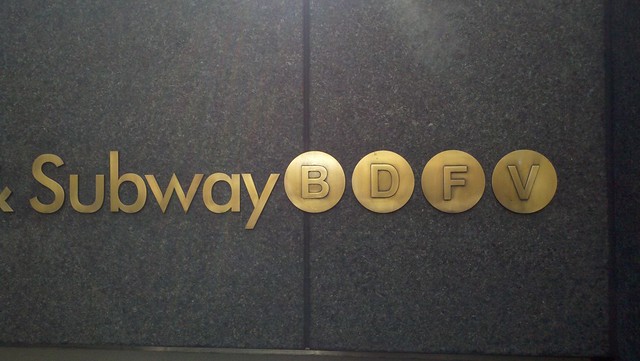
Where: Above the stairway leading to the Rockefeller Center station complex on the southwest corner of 50th St. and 6th Ave.
What: The V train bullet, a remnant of the June service cuts, still lives while at this entrance, the M doesn’t stop here.
When: Monday, January 31, 2011, seven months after the V’s last run.

I’ve been interning twice a week in Midtown this semester, and the nearest entrance into and out of the Rockefeller Center complex is the on on the west side of 50th St. As I bounded down the staircase Wednesday evening, I saw a ghost — the V train lives. This Monday, I snapped a better picture of this rather ornate station entrance with our dearly departed V train bullet in all of its glory.

In a sense, this photo is all about nostalgia over lost train lines. While the name has changed — the M now runs on the V — the service pattern is actually better for the city. The rapidly expanding populations in Middle Village and South Williamsburg now have a direct route to midtown, and the new M train service over the Chrystie St. Cut has been a resounding success even as it represents a service cut along Brooklyn’s 4th Ave. and West End lines.

On the other hand, though, this photography is about the tension between the MTA and those private companies with which it contracts. For many entrances within buildings, the landlord is in charge of maintenance and upkeep. Those duties include updating fanciful signage, keeping escalators running and clearing the staircases of snow and ice. Yet, oftentimes, landlords don’t do what they must do. Entrances — such as the one at 52nd and 8th. Ave. — remain closed, and escalators remain closed forever, a fact to which anyone who uses Union Square can attest.

At Rockefeller Center, the system’s 14th busiest station and a tourist destination, this sign still says a train that hasn’t operated since June still stops there. Anyone expecting the V will be waiting a long time indeed.

Comments (23)

A new report questions the MTA's current on-time performance metrics and suggests a passenger-based approach instead.

One of the biggest complaints New Yorkers have with the MTA and an oft-heard excuse early in the morning is one of the more mercurial aspects of transit operations. “Sorry I wasn’t on time,” we’ll often hear. “The B train was late this morning.” What exactly does that mean?

When I head from Brooklyn to Manhattan every day, I use the B train at 7th Ave., but I don’t really leave at the same time any day of the week. When I had two early classes last semester, I could time my trip to catch a B train at approximately the same time every morning, and when there was a problem, the train wouldn’t be there. To me, that’s the traditional definition of on time.

But there are other ways to measure on-time performance. One that the MTA uses internally is a wait assessment. Intuitively, this one makes some sense. If the B train is supposed to run every eight minutes, it matters less when the B trains arrives as it does when the next B train after that arrives. As long as the interval is eight minutes — or in the MTA’s case, eight minutes plus 25 percent — the trains are still on time, and people won’t be left with empty tracks when they expect a train.

Finally, we can judge a train based upon when it’s supposed to get to the end of the run. This is another metric Transit uses to judge on-time performance. If a train is at its terminal within five minutes of the scheduled time, it is still considered on time. Anything worse means delays or one sort of another along the route. But are these any good?

In a report released yesterday, the Permanent Citizens Advisory Committee to the MTA examined the authority’s wait assessment metrics and found them rigorous but lacking. The committee praised the MTA for being among the most transparent transit operators in the country in providing wait assessments but determined that the rankings did not help passengers evaluate on-time performance. The wait analyses, in other words, are geared toward internal evaluation and not improvements for the customers.

“A schedule is a promise,” PCAC Chair Ira Greenberg said. “A late train or bus breaks that promise and the impact is lost time for the riders. People depend on the MTA’s service for their livelihood. We want the MTA to think of the rider first, before trains and buses, and we look forward to working with them to achieve this.”

The report — which I’ve embedded below — presents an extensive evaluation of the MTA’s three rail divisions and a comparison with other U.S.-based transit providers. Passengers, it finds, are left in the dark, and ultimately, PCAC urges the MTA to develop a passenger on-time performance metric that can identify the number of passengers delayed and which ones are delayed most frequently.

Most vital is the report’s recommendation that the MTA start promoting capital expenditures as a way to improve on-time performance. PCAC highlights the countdown clocks as an example of a technology that can lead to more satisfied customers even if they don’t improve the wait times. “While countdown clocks do not create performance measurements,” the report says, “they serve to moderate the rider’s expectation of performance with real time knowledge.”

It takes a stronger stance on capital improvements viewed as disruptive by passengers. “The average rider doesn’t necessarily understand what new interlockings, switches and signals are, let alone appreciate how their improvement will enhance their commute. Historically, the use of performance metrics at the MTA began as an effort to secure needed capital funds. That linkage, as a tool to promote capital programs to the riding public and elected officials, has weakened over the years,” it says. “Specific information on how an item in the Capital Program will reduce the number of delayed and canceled trains, increase track speeds, and improve the ability to recover from a major service disruption is relevant to the riders.”

Now, that just makes sense. If the MTA can convince anyone that their work will make trains run on time, shouldn’t that be a prime selling point for a project? I would think so.

Keeping people moving and making sure they get somewhere on time should be a paramount goal for any transit provider. While wait measurements and delay assessments are more important for commuter rail riders who see transit only every 30 minutes at peak times instead of every five, subway riders like to know they’ll get to their jobs and appointments on time without egregiously long waits. By presenting that information to the public in an easy-to-understand fashion that directly addresses the wait, the MTA could improve the way customers impatiently wait for trains. Time might be on my side after all.

After the jump, read the PCAC’s full report. Read More→

Comments (25)

A Times graphic shows the proposed route for the city's new regular ferry service. (Via)

Pardon the hyperbole in the headline atop this post, and if anyone chuckled at the recycled idea of ferry service acting as the city’s transportation savior, I wouldn’t blame them. Politicians have been trying to bring regular, affordable ferry service to the city’s waterfront for decades, and now, the Mayor is at it again.

Michael Bloomberg will announce today that, beginning in June, BillyBey, a part of New York Waterway, will begin operating regular ferry service between Brooklyn, Queens and the East Side from 7 a.m. to 8 p.m. during the week and from 9 a.m. to 7 p.m. on weekdays. During peak hours, the ferries will operate every 20 minutes — a move the city hopes will help attract potential customers — and the boats will run every 30 minutes off-peak and once an hour during the winter. The ride, subsidized to the tune of $9 million a year by the Economic Development Corporation and with a three-year commitment, will cost $3 or $5.50 depending upon the departure point.

According to Michael Grynbaum’s coverage in The Times, the ferries will “travel along a seven-stop route that stretches from Long Island City, Queens, to the Fulton Ferry landing by the Brooklyn Bridge, and includes Manhattan terminals at Pier 11 in the financial district and East 34th Street.” New stops include India Street in Greenpoint and North Sixth Street in Williamsburg. On the Manhattan side, the operator will run a free bus down 34th St.

“If we want every part of Brooklyn, every part of Queens, to be as attractive to businesses and residents as Midtown Manhattan is,” City Council Speaker Christine C. Quinn said, “we have to make it as easy as possible to get to and from in an orderly, affordable fashion. That is what ferries can do.”

For the city, the key to this new service is the use of the word “regular.” In the past, efforts to bring ferry service to the East River have foundered due to, as Grynbaum puts it, “infrequent service, outsize operating costs and low ridership.” By enforcing a frequent schedule and subsidizing the route, the city hopes that residential growth along parts of the waterfront in northern Brooklyn will help make ferry service viable. “Consistent and dependable service will be a magnet for potential users,” Robert K. Steel, a deputy mayor, said. “Development has occurred along this corridor. You’ve got more people who would potentially find the service attractive.”

When the city first floated this idea back in June, I supported it, but the caveats about ferry service in the city remain. The biggest problem is one of access. New York’s waterfront — and Manhattan’s especially — is rather isolated from the city and not that close to the major job hubs. To make the ferries more dependable than, say, the subway, the trips will have to take less time, and it’s tough to see that happening especially when connecting bus rides are involved.

The other issue is one of demand. Does the demand exist to run ferries every 20 minutes? Do enough people live near the East River waterfront to fill up the boats? Pier 6 at the Brooklyn Bridge Park, for instance, is far from everywhere, and even though bikes will be allowed on board the boats, it’s probably faster just to ride over the bridges. Even in Williamsburg where waterfront development has been most pronounced, boats every 20 minutes seems aggressive.

Still, the city is trying, and that’s what counts. If the ferries lighten the load on the L train in the morning and take a few more cars off the road, perhaps they can work out after all.

Comments (26)
  • Extended Stay

    Featuring a wide range of sophisticated furnished apartments throughout the city and surrounding areas, ExecuStay can help you enjoy a New York extended stay that's both productive and relaxing.

  • Corporate Apartments

    As a resident of ExecuStay New York corporate apartments, you'll find that getting around is a snap, thanks to the many MTA subway lines, buses and yellow cabs.