Archive for April, 2011

Whenever I find myself in a train station that isn’t on my regular route with some time to kill, I start looking closely at the station. On Saturday night, I had a few minutes to spare at 14th St. and later at 23rd St. along the West Side IRT, and at both stations, I found a few MTA signs that have long since stopped serving their purpose.

The first sign I found that raised an eyebrow was at 14th St. This one discussed a construction project the MTA had been engaged in that would improve service. I’ve seen similar signs throughout the system, but lately, I’ve noticed more and more of them are out of date. The ones along the 53rd St. tunnel talk of improving E and V service and have completion dates that the MTA simply missed.

Anyway, this one was, um, older:

As you can see, the MTA has not found a way to remove a sign announcing a project that was due to wrap up 15 years ago. In November 1996, the Yankees had just won their first World Series since 1978; America had just reelected Bill Clinton to his second term; and the Unlimited MetroCard wasn’t yet a thing. The fares, by the way, were a $1.50.

This sign isn’t in a particularly hard-to-miss location. If you enter the 14th St. station on 7th Ave. and walk toward the fare control area, it’s hanging on the left in front of the walkway between 6th and 7th Aves. It’s not in bad shape either; it’s just a sign of another era in New York City history.

That’s now, however, the only relic I saw on Saturday night. On my way back from dinner, I had to wait in the 23rd St. station for a five minutes, and while examining the neighborhood map next to the now-shuttered station booth on the southbound side, I saw that the 9 train lives. This photo below is an excerpt from the neighborhood map at 86th St., but it shows the same problem:

This neighborhood map must be from at least 2005 when the 9 train made its last trip. For the West Side IRT, the presence of the 9 doesn’t matter because it doesn’t materially impact service, but the 9 train isn’t the only relic. The map at 23rd St. still featured the V and W trains, and I’ve seen remnants of the Manhattan Bridge service changes at various places throughout the system. More recently, I’ve noticed how the Rockefeller Center entrances still think the V is going to stop there.

On their own, these various mistakes and mishaps aren’t too damaging to the MTA. The sign from 1996 might as well be a permanent part of the station at this point, and few people are going to be confused by the presence of a 9 train on a map whose purpose is to guide straphangers above ground. But on another level, these anachronisms show a certain level of neglect. The MTA does not have the capacity to keep its extensive signage up to date. It can’t afford to spend the money to do so, can’t find the manpower to make the changes or some combination of both. And so the end result are signs warning us of construction projects from 15 years ago or urging us to take trains that no longer run.

As I said just a few weeks ago, the MTA posts signs for the benefit of its customers. If the signs are wrong, people either get lost or lose faith in the trustworthiness of the post information. It’s these little things that make it tougher for the MTA to gain public support at a time when political backing is sorely lacking.

Comments (12)

End of the week. You know what that means. As always, these come to me from New York City Transit and are subject to change without notice. Listen to on-board announcements and check signs at your local station for the latest. Subway Weekender has the map.


From 11:30 p.m. Friday, April 15 to 5 a.m. Monday, April 18, 1 service is suspended between 242nd Street and 168th Street due to Dyckman Street station and structural rehabilitation, canopy and platform edge work between 242nd Street and 181st Street. A trains, free shuttle buses and the M3 bus provide alternate service. Free shuttle buses run in two sections making 1 line stops:

  • On Broadway, between 242nd Street and the 207th Street A station and
  • On St. Nicholas Avenue, between 168th Street and 191st Street.


From 11:30 p.m. Friday, April 15 to 5 a.m. Monday, April 18, free shuttle buses replace 2 trains between 241st Street and East 180th Street due to track, signal and switch work north of East 180th Street.


From 12:01 a.m. to 6:30 a.m., Saturday, April 16 and Sunday, April 17 and from 12:01 a.m. to 5 a.m. Monday, April 18, Brooklyn-bound 4 trains skip 33rd, 28th, and 23rd Streets, Astor Place, Bleecker, Spring and Canal Streets due to work on the gap filler at 14th Street-Union Square and construction on the Broadway/Lafayette-to-Bleecker Street transfer connection.


From 6 a.m. to 11:30 p.m. Saturday, April 16 and from 8 a.m. to 11:30 p.m. Sunday, April 17, 5 trains run every 20 minutes between 149th Street-Grand Concourse and Bowling Green due to work on the gap filler at 14th Street-Union Square and construction on the Broadway/Lafayette-to-Bleecker Street transfer connection


From 12:01 a.m. Saturday, April 16 and 5 a.m. Monday, April 18, there is no 5 service between East 180th Street and 149th Street-Grand Concourse due to track, signal and switch work north of East 180th Street. Customers should take the 2 instead. Note: During this time shuttle trains run every 30 minutes between Dyre Avenue and East 180th Street.


From 12:01 a.m. Saturday, April 16 to 5 a.m. Monday, April 18, Bronx-bound 6 trains skip Whitlock Avenue and Morrison Avenue-Soundview due to station rehabilitation at Elder Avenue and St. Lawrence Avenue.


From 12:01 a.m. Saturday, April 16 to 5 a.m. Monday, April 18, downtown 6 trains skip 33rd, 28th and 23rd Streets, Astor Place, Bleecker, Spring and Canal Streets due to work on the gap filler at 14th Street-Union Square and construction on the Broadway/Lafayette-to-Bleecker Street transfer connection.


From 12:01 a.m. Saturday, April 16 to 5 a.m. Monday, April 18, downtown A trains skip 50th Street, 23rd Street and Spring Street due to track work north of Canal Street.


From 6:30 a.m. to midnight, Saturday, April 16 and Sunday, April 17, downtown C trains skip 50th, 23rd, and Spring Streets due to track work north of Canal Street.


From 12:01 a.m. Saturday, April 16 to 5 a.m. Monday, April 18, Manhattan-bound D trains run on the N Line from Coney Island-Stillwell Avenue to 36th Street due to structural repair and station rehabilitations between 71st Street and Bay 50th Street and ADA work at Bay Parkway. There are no Manhatttan-bound D trains at stations from Bay 50th Street to 9th Avenue.


From 12:01 a.m. Saturday, April 16 to 5 a.m. Monday, April 18, Brooklyn-bound D trains run local in Manhattan from 34th Street to West 4th Street due to platform edge work at 34th Street and substation rehabilitation.


From 12:01 a.m. Saturday, April 16 to 5 a.m. Monday, April 18, downtown E trains skip 23rd Street and Spring Street due to track work north of Canal Street.


From 12:01 a.m. Saturday, April 16 to 5 a.m. Monday, April 18, E trains run local between Queens Plaza and Roosevelt Avenue in both directions due to cable replacement.


From 11:30 p.m. Friday, April 15 to 5 a.m., Monday, April 18, Q service is suspended between 57th Street-7th Avenue and Prospect Park due to tunnel inspection, structural repair, track and switch north of Atlantic Avenue. For service between 57th Street-7th Avenue and Atlantic Ave-Pacific Street, customers may take the N or R instead. Free shuttle buses are available between Atlantic Avenue and Prospect Park.


From 5 a.m. to midnight, Saturday, April 16 and Sunday, April 17, R trains are rerouted to the F line between Queens and Manhattan. Trains will make R stops between Forest Hills-71st Avenue and 36th Street in Queens, then F stops between 21st Street-Queensbridge and Lexington Avenue/63rd Street, then resume on the R line at 57th Street-7th Avenue. For service to and from Queens Plaza, Lexington Avenue/59th Street and 5th Avenue/59th Street, customers may use the E, F, 4 or 6 instead.

Categories : Service Advisories
Comments (0)

The X27 and X28 express buses from, respectively, Bay Ridge and Bensonhurts to Midtown will be revived following a deal with the MTA struck by State Senator Marty Golden and Councilmember Vincent Gentile, the Brooklyn Eagle reported this week. The two buses had been eliminated due to low ridership last summer amidst the MTA’s service cuts, but Golden and Gentile, who helped file a lawsuit challenging the cuts, claimed that seniors and the handicapped needed this express routes. “The new routes were not working for the people of my district,” Golden said. “On a regular basis, I received emails and phone calls from people waiting at bus stops. The commute, based on the new routes and schedules, was almost double for many, and people were selling their homes, changing their hours at work, hiring second babysitters, and the list goes on.”

I’m happy for these neighborhoods that are getting their bus service back, and the politicians are too. “By restoring service on the X37,” Gentile said, “the MTA has acknowledged that south Brooklyn commuters have been shortchanged when it comes to transportation.” But while terms of the revival were not announced and cost figures are unclear, I have to wonder why these politicians wait until after the fact to act and why their actions are simply knee-jerk ones designed to restore a bus or two. Instead of seeking out institutional changes that will protect our transit services in advance, these politicians are simply pandering to their constituent demands. That’s no way run a public transportation agency, let alone an entire city or state.

Categories : Asides, Brooklyn
Comments (11)

Here’s an interesting tidbit from The Wall Street Journal today: With some federal seed money, New York City is going to invest in its own version of transit-oriented development in an effort to “revitalize areas around under-developed transit hubs.” According to the report, New York’s Department of City Planning will use the $3.5 million to explore ways to add housing stock and commercial development to areas along the city’s commuter rail lines. This should include spots in East New York and in the Bronx along Metro-North. The Journal says the city will search for ways to develop areas “around subway stops” as well.

What’s intriguing but also odd about this news is how New York City is one giant transit-oriented development. Outside of a few pockets of eastern Queens and southern Brooklyn, the entire city is close enough to a frequent bus route or subway stop to be well within acceptable walking distances. Rehabbing the area around the LIRR stop in East New York is more a matter of urban reclamation than transit-oriented development. The neighborhood is already well-served by multiple subway routes.

Ultimately, transit-oriented development through what are ostensibly low-income neighborhoods won’t work without a corresponding change in fare policy. It might be faster for a commuter to hop the LIRR in East New York to get to downtown Brooklyn or jump on the Metro-North stops through the Bronx to reach Grand Central. But the fares — $5 per ride off peak, $7.25 during peak hours — are far too high to convince riders to eschew the 3 train in Brooklyn or the 4, B and D in the Bronx. We’ll see how this goes.

Comments (24)

In the 1980s, subway cars were filthy, and stations were decrepit and unsafe. (Photo via NYCSubway.org)

The MTA’s current fiscal situation pales in comparison with the budget wranglings that have enveloped Albany and Washington, D.C., over the past few weeks, but for New York City’s economy and productivity, a relatively stable MTA is vital. Over the past 25 years, the authority has worked to upgrade its massive infrastructure, and while the system isn’t yet at a State of Good Repair, it has made great strides since its nadir thanks to the five-year capital budgets.

Today, though, there is a problem: The capital fund is nearly empty. The MTA has a $10 billion gap in its current five year plan — and that’s a gap that I’ve heard may be a few billion dollars higher — and after this five year plan, it can no longer bond out construction projects. It has reached the limits of debt it can take on and pay off in the future, but it must continue to invest in its system. That is, after all, the problem with running a modern subway system through a 110-year-old physical plant.

Last Friday, in this space, I examined how the MTA could close the gap in its capital budget through fare increases, and my conclusion wasn’t an optimistic one. The MTA would have to raise fares significantly to generate enough revenue to close that $10 billion gap, and the riding public has little appetite for fare hikes these days. So what happens if the fares don’t go up and the capital budget remains unfunded? That’s a topic Noah Kazis tackled on Streetsblog yesterday.

Evoking the “disrepair” of the 1970s, Kazis warns of a long, steep fall for the MTA. If you look closely, it’s sort of starting to happen now as the MTA simply cannot keep up with the demands of its aging infrastructure. He writes:

At the other end of the spectrum from fare-backed borrowing, the MTA could decide that it cannot take on any additional debt. In that scenario, the MTA would simply have to cancel or postpone every unfunded maintenance and expansion project — most of the next three years of the capital program. You can see those projects at the MTA’s capital dashboard, here. The result will be breakdowns, delays, and a slide back toward the decrepit and dangerous subway system of the late 1970s.

“You can expect to see the condition of the system decline pretty rapidly if you’re not doing this work,” said Felice Farber, the director of external affairs for the General Contractors Association of New York. “It’s not too hard to get back to the poor quality service of the past,” she said.

“You’ll have older buses, so they’ll be breaking down more often,” explained Pete Foley of TWU Local 100. “Subways will have to go slower,” as they pass over worn out tracks, he continued. “Eventually you’re going to have cracks. You’ll have derailments if you have a crack in the rail.”

Delays will be more common during rush hour as well, due to the lack of regular preventive maintenance. “You’ll be fixing things when they break,” said Foley. “They’ll wait until it’s an emergency.”

That is a grim picture made worse by the reality of the way the MTA spends capital dollars. For every dollar in capital spending, 23 cents go to expansion plans, 27 cents go “basic repairs,” 35 cents go toward rolling stock replacement and the remaining 13 cents are used to upgrade communications and technology infrastructure. The MTA can ill afford to let any of these projects stop, let alone all of them.

“In reality,” Kazis writes, “the MTA can choose to mix and match between fare-backed debt and deferred maintenance, putting off the features that might be nice to have and charging riders for the ones they need to have. The MTA could also potentially swap in service cuts or layoffs for fare hikes.”

That’s a bad reality. We’ve seen the MTA cut the Second Ave. Subway from three tracks to two; we won’t enjoy a station at 10th Ave. and 41st St. along the 7 line extension. What else will go before some action is taken to rescue the system from the slippery slope of the 1970s? Let’s hope we can avoid making the same mistakes of the past; that’s one history I’d rather not see repeated.

Categories : MTA Economics
Comments (45)

While this morning I spoke of the subway extension to nowhere, the city’s original subway to nowhere involved the 63rd St. tunnel. What began as an ambitious project to bring super-express service to Queens Boulevard eventually devolved into an expensive extension of subway service underneath the East River that terminated just one stop into Queens. The entire project, which began in 1969, would not wrap until 2001.

Today, the excellent NYC The Blog highlights a 15-minute video report from the early 1970s on the 63rd St. tunnel. Take a watch:

Today, the F train serves Queens Boulevard route via that 63rd St. route, but the bi-level tunnel has yet to realize its potential. The current station at 63rd St. currently plays host to an unused track and platform that will one day be a part of the Second Ave. Subway while the lower level will be integrated into the East Side Access project. Overall, then, is one never-ending forty-year project.

Comments (26)

When news surfaced yesterday that MTA crews had loaded up a passenger train with garbage bags, I figured heads would roll, and already, the authority is doling out the discipline. According to the Daily News, the worker responsible for supervising the work gang that collects trash from the tracks at 59th St. on the East Side will be disciplined. “We can’t state strongly enough that refuse is absolutely not to be stored or transported on passenger trains,” the agency said in a statement.

Per the News, the MTA determined that workers had collected the refuse from the tracks near the 59th St. station. Instead of carrying it above ground as they should have, the supervisor ordered trash loaded onto the next passenger train in order to take it to 42nd St. where a work train would pick it up. “This was not done with the knowledge or acquiescence of any senior manager,” MTA spokesman Charles Seaton said. “This is a complete no-no.”

Labor officials, meanwhile, hinted that this practice may be more widespread than anyone would prefer. “I have seen supervisors order cleaners to place garbage bags on passenger trains for transportation to a storage facility,” Marvin Holland, a TWU Local 100 member, said. “It’s a health and safety issue for passengers, and our members will not do it unless specifically ordered by supervision.”

Categories : Asides, MTA Absurdity
Comments (8)

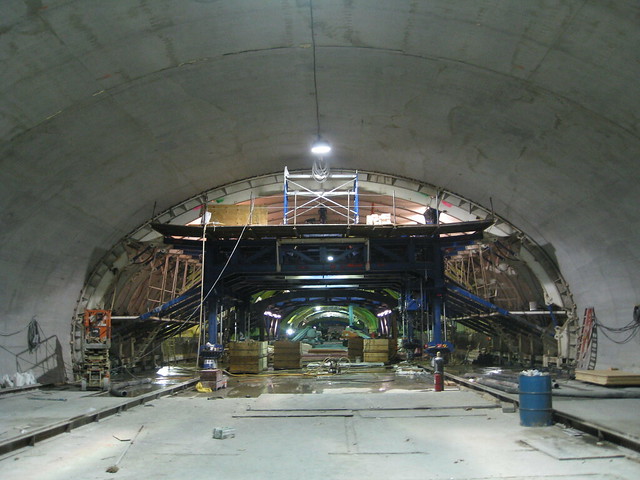
Work on the 7 line extension is moving quickly, but the same cannot be said of development at Hudson Yards. Photo by Photo by Clayton Price for the Metropolitan Transportation Authority.

Over the past four and a half years, I haven’t smiled upon the 7 line extension. A pet project of Mayor Michael Bloomberg’s that serves as a living relic of the city’s failed Olympics bid, the $2.1 billion extension has seen useful elements — such as a station at 41st St. and 10th Ave. — eliminated. While the new stop at 34th St. and 11th Ave. is one that will benefit an eventual neighborhood, at a time when subway expansion dollars are very limited, this Subway to Nowhere isn’t the best use of funds.

Yet, the project is, as we learned recently, moving forward. Just last week, the MTA unveiled photos from inside the station cavern, and the authority has maintained that the 7 will head to the Far West Side by December 2013, nearly 32 months from now.

Unfortunately, nothing will be there when the 7 train extension opens. Sure, the Javits Center will still host conventions and the few people who live and work in the undeveloped area will have quicker access to the rest of Manhattan. But Related Companies, the real estate developer who agreed to purchase the land above the rail yards from the MTA, doesn’t anticipate opening a building there until 2015 at the earliest. Things, though, may be moving forward on that front.

According to article in Monday’s Wall Street Journal, Related is attempting to convince Time Warner to anchor the Hudson Yards development. Apparently, Time Warner’s still-new corporate headquarters above Columbus Circle could now command such a high price that it would make more sense for the telecom giant to sell its space and move west. While talks, according to the Journal, “could fizzle,” Time Warner wants to move but “isn’t close to a decision.”

Eliot Brown and Lauren Schuker report:

If Time Warner makes the jump, it could finally open up a long-planned frontier in Manhattan development by the Javits Center. Related has been pushing a long-term plan to deliver a city-within-a-city to be built over the Long Island Rail Road storage yard. It’s slated to include 12.9 million square feet of new office, retail and residential development

The deal would be a major boost for Related Chairman Stephen Ross, who agreed in 2008 to a $1 billion long-term lease with the Metropolitan Transportation Authority to become the site’s developer. Related has said it needs a large tenant to begin construction and has pledged to make space available to the first tenants at the cost of development…

Time Inc. and HBO, both divisions of Time Warner, lease more than two million square feet of space in Manhattan that expires in 2017 and 2018, according to research firm CoStar Group Inc. It is unclear if those divisions would be part of a move to Hudson Yards. But the timing of the lease expirations would allow for it. Related has said it could deliver the first phase of the development by 2015.

The two reporters note that Related has yet to secure a tenant for its planned buildings but believes it will lease out around 3.5 million square feet this year. The company is targeting Coach as a potential anchor tenant as well.

Meanwhile, the subway moves forward. Optimistically, construction will be completed at least two years before the buildings start to grow above the rail yards that abut the Hudson River, but the Subway to Nowhere will go west nonetheless.

Categories : 7 Line Extension
Comments (38)

It’s become abundantly clear over the past few months that the MTA has a garbage problem. As budget cuts have led to fewer station cleaners, trash piles up in the subway, and along with the refuse come rats. Operationally, workers remove trash via the garbage train, but even this morning at 10 a.m., I saw MTA employees dragging bags of trash through the 7th Ave. station along the Brighton Line in Brooklyn. The leaking bags smelled terrible, and it was just a flat-out mess.

I found it fitting then when I spotted this story in the Daily News. According to a transit worker, some MTA crews have been using passenger trains to move garbage through the system. This action is, of course, against the rules, and no one is happy about it. Passengers are disgusted when trash bags start leaking, and the MTA spoke out against this practice. “It is not our practice to use in-service trains for trash removal,” the authority said.

So what’s going on here? TWU President John Samuelsen has an idea. Despite MTA denials, he claims workers are being instructed by supervisors to do so. “To bring those bags on passenger trains and expose riders to potential of rats jumping out of the bags is outrageous,” he said to the News. “When track workers walk past those bags, we give them a wide berth, knowing if you walk close to a bag, a rat could jump out right on top of you.” Heads should roll.

Categories : Asides, MTA Absurdity
Comments (19)

In certain respects, New York in the 1970s was a much different place than it is today. Long before the Disney-fication of Times Square and the gentrification of many neighborhoods throughout the five boroughs, the city was a dangerous place to live. Yet, its transit offerings were robust enough that even Sesame Street celebrated them. In the latest video making the rounds, the narrator acknowledges as much: “New York is one of the few places where you can get around without a car.”

This 90-second clip is a gem of a time capsule. It focuses on the various ways in which city denizens can get around town without a personal car, and the part on the subway is, obviously, my favorite. We complain a lot about the current state of the city’s public transit system, and while those complaints certainly are valid, it’s easy to lose sight of far we’ve gone.

As the woman taking about the subways says in the video, 35 years ago, the subways were crummy. “You get pushed; you get shoved,” she said. “Sometimes you get mugged in the subway during the daylight. I remember when public transit was the pride of New York. What happened?”

Of course, as some things change, the more they stay the same. “New York is almost broke,” one woman says. “You know why? Because too much money is going to the suburbs. They’re killing us.”

Categories : Subway History
Comments (5)
  • Extended Stay

    Featuring a wide range of sophisticated furnished apartments throughout the city and surrounding areas, ExecuStay can help you enjoy a New York extended stay that's both productive and relaxing.

  • Corporate Apartments

    As a resident of ExecuStay New York corporate apartments, you'll find that getting around is a snap, thanks to the many MTA subway lines, buses and yellow cabs.