
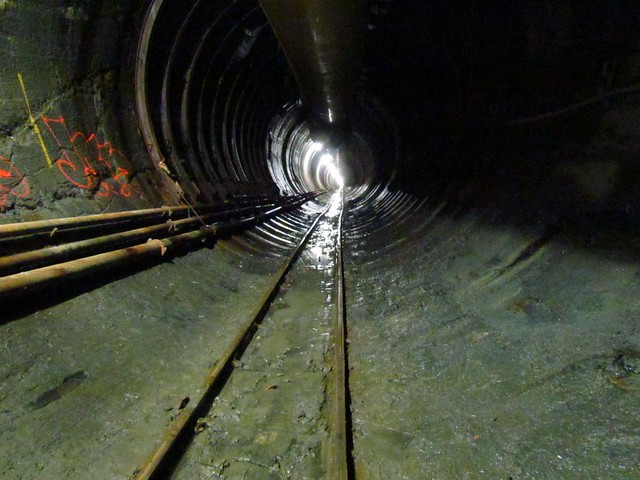
Toward 63rd Street (Photo by Benjamin Kabak)
Six hours ago, I found myself standing where few civilians have been. I am approximately 55 feet underneath Second Ave. between 91st and 92nd Streets, and I am standing inside a wet, dark, round tunnel. An industrial-sized air vent hangs above me while a set of rudimentary train tracks stretch southward as far as the eye can see. In five and a half years, the Q train, bound for Brooklyn via Second Ave. and Broadway, will rumble past that spot, but right now, it is the largest construction site in New York City.
Eleven months ago, the MTA readied the Second Ave. Subway launch box for a ceremonial start. The tunnel boring machine was set to launch, and the press and politicians gathered amidst as much pomp and circumstance as one can lend to the city’s largest ongoing public works project. I had the opportunity to attend that launch and posted the photos back in May.
Earlier today, in a far less ceremonial fashion, the MTA graciously brought a bunch of photographers and reporters down into the launch box to show the progress so far. Even as the MTA’s capital budget remains stretched to the max with a $10 billion hole, work underneath Second Ave. is proceeding at a rapid clip. The western tunnel is dug out all the way to 65th St., and the tunnel boring machine is a few hundred feet into the eastern tube. It might take another five years to finish, and the drama aboveground over station entrances and cleaner construction sites continue. There will, though, be a subway underneath a part of Second Ave. in the foreseeable future.
To get into the launch box requires a long walk down a staircase draped in scaffolding, and the first thing you notice is how truly deep the cavern is. The floor of the launch box, which will one day host the track bed and 96th St. station for the Second Ave. Subway, is around 60 feet down. While the station itself will be at around 50 feet deep, that’s more of a hike that most New York City subway riders are used to today. The next thing you notice is how wet it is. There’s water and mud everywhere, and one of the construction crews told me the wetness is natural. It’s all from the water table, and it’s all moisture that will have to be insulated so it doesn’t seep through station and tunnel walls.
Once inside, you can see just how much of a construction site it is. Heavy machinery that wouldn’t look out of place above ground sits dwarfed by the immensity of the launch box. While my photos — and these links all head to them on Flickr — look as though the launch box is well lit, it’s dark, foreboding and dirty. Sandhogs scurry about, and the subway is on its way.
I’ve embedded the slideshow at the bottom of this post, but I wanted to highlight a few photos I enjoyed: While we were underground, a crane lowered a portable toilet into the launch box. We spotted a microwave at the entrance to the western tunnel. Construction officials told us it takes around 70 minutes to walk from the launch box to the end of the tunnel at 65th St. due to the wetness and mud, and so the crews need their sustenance. The water, as you can see, is literally pouring out of the walls.
Dangling from the roof of the launch box are a series of wooden boxes. These boxes are holding the platforms that are underneath street-level manhole covers. This is infrastructure turned inside out. Above ground, federal safety regulations make sure everyone who enters the launch box is accounted for while inside the tunnel itself, it’s very dark.
After the jump, a full set of photos from the tour.
 Over the past year, as the MTA has struggled to maintain a balanced budget, “making every dollar count” has emerged as the authority’s mantra. Since finding itself on the wrong end of a budget crisis, the authority has identified over $500 million in annual savings and, amidst repeated cries for a forensic audit, has identified nearly $200 million more in savings with the potential to save on labor costs as well. But since the state comptroller can’t seem to figure out how to drill down on the MTA’s finances quickly, we have no way of knowing what the MTA should target and if their cuts are efficient.


 The MTA has frequently come under fire for its real estate holdings. Politicians and advocates believe that the authority doesn’t make proper use of the space it both rents and owns, and underground, commercial opportunities are decidedly low rent. It is a problem the MTA is trying to solve in order to generate more money.